4509
Unsupervised reconstruction of undersampled 3D whole-heart Cartesian MRimaging using neural fields1Millennium Institute for Intelligent Healthcare Engineering, iHEALTH, Santiago, Chile, 2Millennium Nucleus For Applied Control And Inverse Problems, Santiago, Chile, 3School of Engineering, Pontificia Universidad Católica de Chile, Santiago, Chile, 4School of Biomedical Engineering and Imaging Sciences, King's College London, London, United Kingdom
Synopsis
Keywords: AI/ML Image Reconstruction, Machine Learning/Artificial Intelligence, Neural Fields, Undersampling reconstruction
Motivation: 3D MRI is fundamental for the assessment of cardiovascular disease but suffers from long scan times. Undersampled reconstruction techniques have been proposed to accelerate the acquisition, but require long computational times for training.
Goal(s): To develop an unsupervised undersampled reconstruction approach based on implicit neural-field representations for 3D Cartesian MRI.
Approach: Dataset was acquired using image-based-navigator (iNAV). iNAV-based translational motion was corrected in k-space. Undersampled reconstruction was performed using a Neural-Fields. The method is evaluated on undersampled multi-coil data in comparison to a state-of-the-art.
Results: The feasible reconstruction results show similar image quality to the state-of-the-art reference, holding promise for future clinical evaluation.
Impact: The method proposed can be generalized to any context of reconstruction. The use in digital devices is feasible, ensuring its possible medical use. Furthermore, this work methodology could allow the use of the net architecture given for other research contexts.
Background
3D free-breathing whole-heart MRI is fundamental for the assessment of cardiovascular disease but suffers from long scan times. Several undersampled reconstruction techniques, including parallel imaging and compressed sensing have been proposed to accelerate the acquisition. These approaches achieved limited acceleration factors and they require careful setting of parameters. Recently several deep learning reconstruction approaches have been proposed to overcome these challenges, including end-to-end deep learning motion compensated reconstruction for free-breathing 3D CMRA1 . However, these approaches rely on large datasets for training. More recently, unsupervised reconstruction using Neural Fields Representation (NFR) have been proposed for 2D radial cardiac cine imaging2 . However, feasibility of this approach in 3D Cartesian whole-heart imaging has not been investigated. Here we develop a novel unsupervised undersampled reconstruction approach based on implicit neural field representations for 3D whole-heart Cartesian MRI. This approach considers the complexity of the 3D models and is compatible with a large increase in the dataset size. The proposed approach is evaluated on prospective undersampled multi-coil 3D whole-heart free-breathing CMRA data in comparison to a state-of-the-art reference.Methods
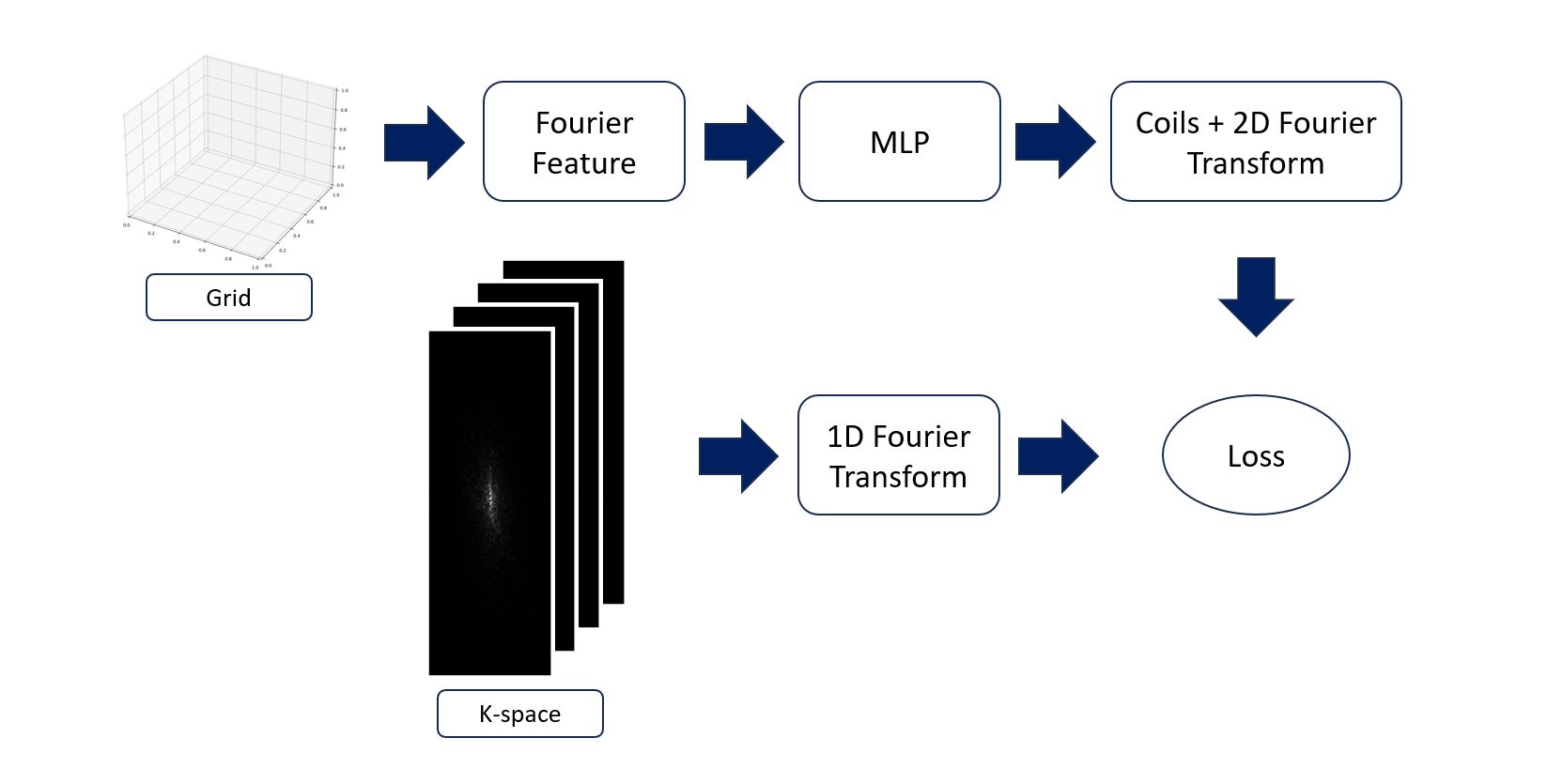
3D Neural Field Representation Network: Neural Fields is a neural representation of a vector field where the MRI inverse problem’s solution is translated to the training of the network3. Neural fields representations are a fully connected multilayer perceptron (MLP) that takes the spatial coordinate as input and aims to predict the pixel intensity value. Neural fields representations suffer of a well-known spectral bias which can be solved using Fourier Features4, a preprocessing step applied to the coordinates before passing them through the MLP.Reconstruction based on Neural fields representations consists of an initial application of Fourier Features, and a spatial encoder to featurize input coordinates4. In the proposed approach (Figure 1), the Fourier feature encoding consists of a linear encoder followed by another, but radial, encoder. The first linear encoder uses a finite number of centered Gaussian vectors independent, to generate hyperplanes for each coordinate. The second encoder consists of composing each linear encoding using two sinusoidal and orthogonal functions, doubling the size of the encoding. The encoded coordinate grid is the input of the fully connected multilayer perceptron (MLP) that takes the spatial coordinate as input and aims to predict the pixel intensity MLP network. For each dense layer, a rectified linear unit (ReLU) activation function is applied, except for the last one. The output of the last layer is the complex value for the image reconstructed at the initial coordinate input.
Training: To simplify the 3D processing, before reconstruction, a one-dimensional Fourier transform is applied in the readout direction to obtain a mixed data set between image space and k-space, allowing to train by batches in the readout dimension. To train the network, at each iteration the image estimated by the network is 2D Fourier Transformed (in the plane orthogonal to the readout direction), weighted by the coil sensitivities and undersampled. The loss function consists in the quadratic mean error between the “hybrid k-space” generated and the obtained from the dataset, in the batch selected, divided by the percent of undersampling. The last rescaling of the loss function value allows us to interpret the value as the real mean error of reconstructing each voxel.
Data: The proposed approach was evaluated on a 3D whole-heart Cartesian MRI dataset. Acquisition was performed at 1.5T (Aera, Siemens Healthineers). Acquisition was performed using image-based (iNAV) navigator5 with a 4-fold variable density Cartesian undersampling (VD-CASPR)6. iNAV-based foot-head and right-left translational motion was corrected in k-space. Reconstruction was performed with iterative SENSE for comparison purposes.
Results
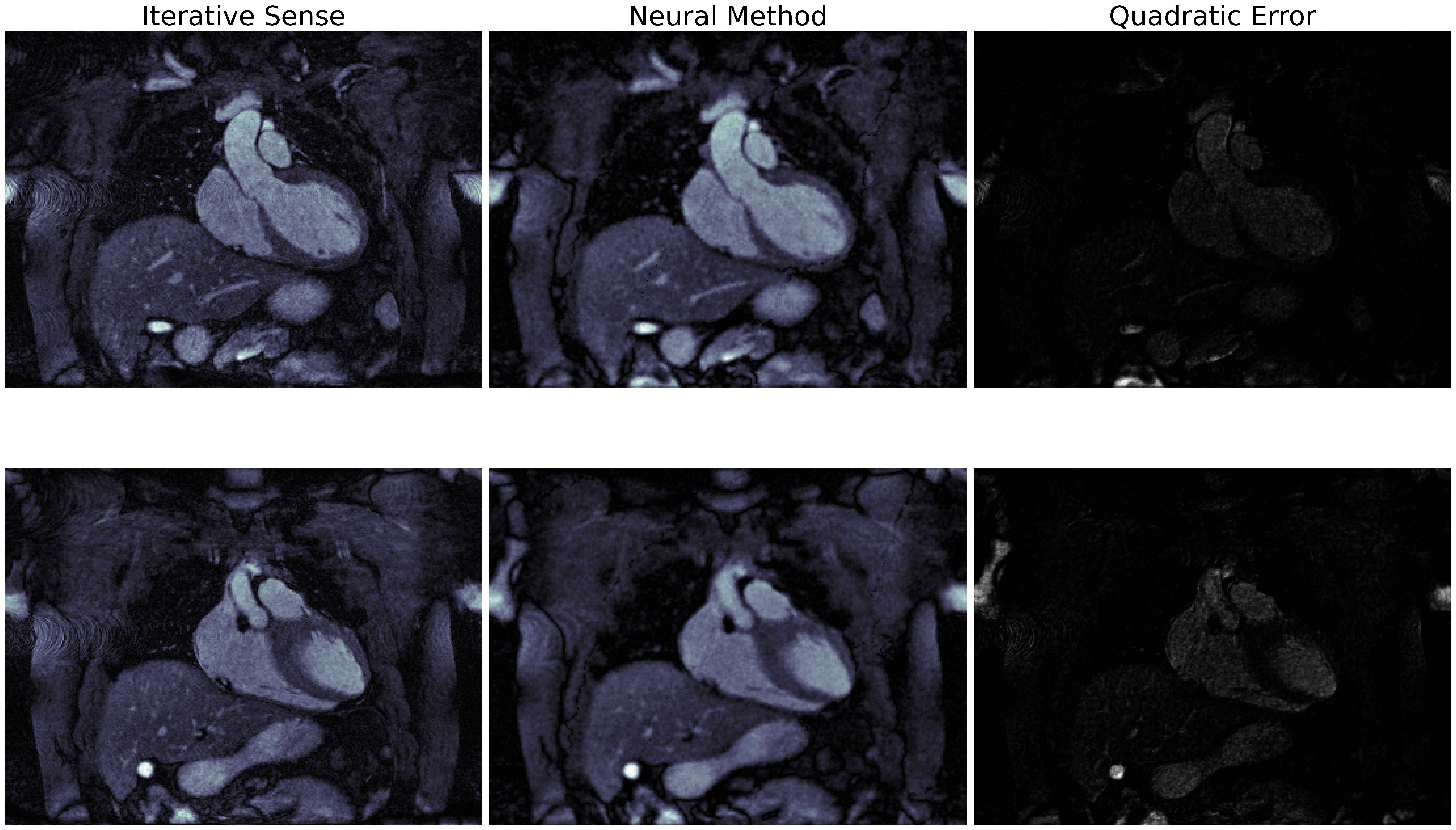
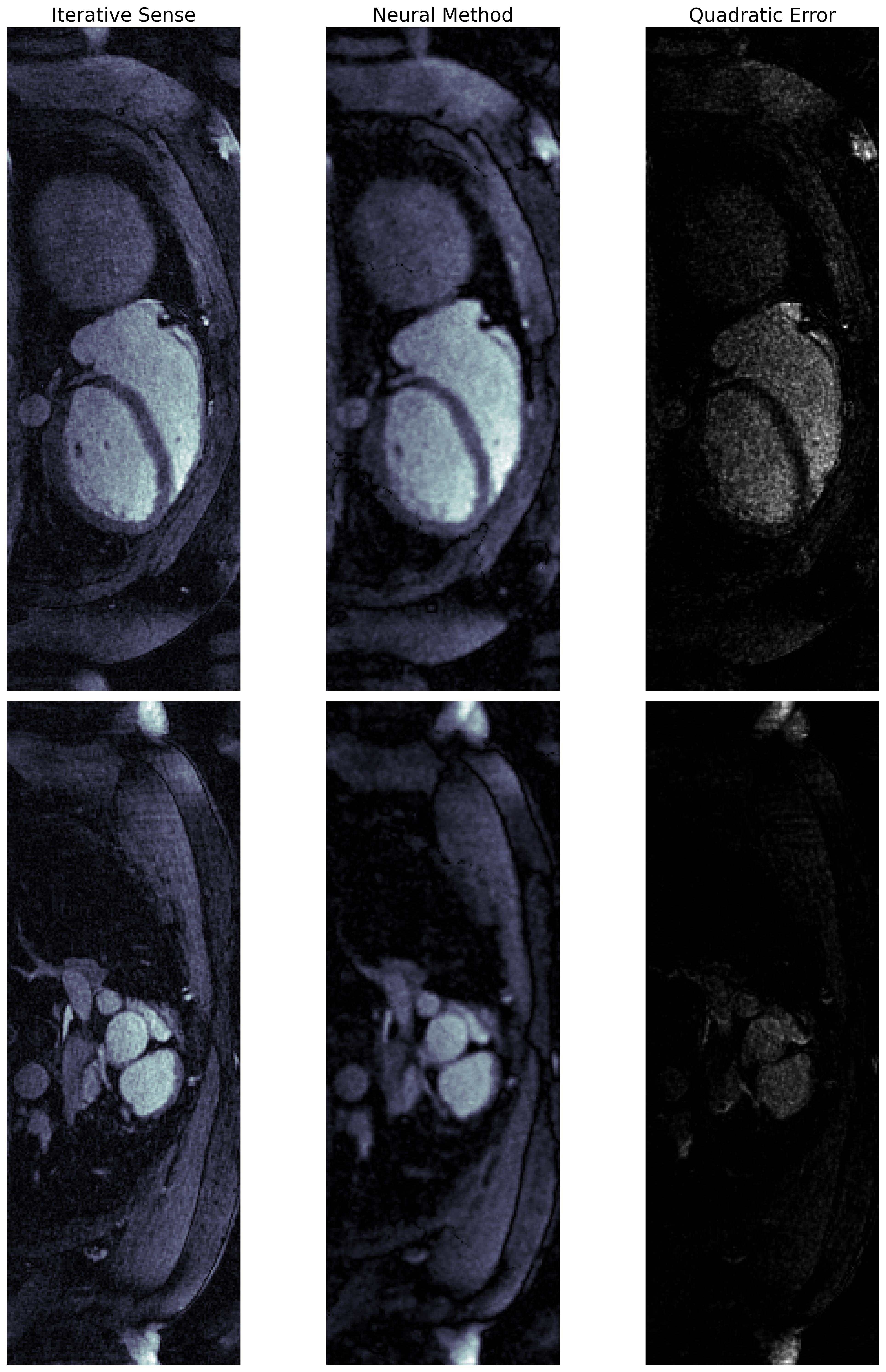
Reconstructions results for the proposed approach in comparison to iterative SENSE are shown in Figure 2 and Figure 3 for two coronal and transversal slices, respectively. Reconstructions results show similar image quality to the iterative SENSE reference, although with some remaining blurring.Discussion
3D whole-heart Cartesian MRI undersampled reconstruction with unsupervised neural fields enables 4-fold accelerated acquisition, showing similar image quality to the state-of-the-art reference, holding promise for future clinical evaluation. Future work will focus on parameter optimization to reduce remaining blurring and evaluation in a larger cohort of healthy subjects.Acknowledgements
- BHF RG/20/1/34802
- EPSRC EP/V044087/1
- ANID Millennium Institute iHEALTH, ICN2021_004; Fondecyt 1210637 and 1210638; Basal Funding, IMPACT, FB210024
- The Technical University of Munich – Institute for Advanced Study.
References
- Qi H, Hajhosseiny R, Cruz G, Kuestner T, Kunze K, Neji R, Botnar R, Prieto C. End-to-end deep learning nonrigid motion-corrected reconstruction for highly accelerated free-breathing coronary MRA. Magn Reson Med. 2021 Oct;86(4):1983-1996. doi: 10.1002/mrm.28851. Epub 2021 Jun 6. PMID: 34096095.
- Tabita Catalán et al. Unsupervised reconstruction of accelerated cardiac cine MRI using Neural Fields. 2023. arXiv: 2307.14363 [eess.IV]
- Yiheng Xie et al. Neural Fields in Visual Computing and Beyond. 2022. arXiv: 2111.11426[cs.CV].
- Matthew Tancik et al. Fourier Features Let Networks Learn High Frequency Functions inLow Dimensional Domains. 2020. arXiv: 2006.10739 [cs.CV].
- Henningsson M, Koken P, Stehning C, Razavi R, Prieto C, Botnar RM. Whole-heart coronary MR angiography with 2D self-navigated image reconstruction. Magn Reson Med. 2012 Feb;67(2):437-45. doi: 10.1002/mrm.23027. Epub 2011 Jun 7. PMID: 21656563.
- Prieto, C., Doneva, M., Usman, M., Henningsson, M., Greil, G., Schaeffter, T. and Botnar, R.M. (2015), Highly efficient respiratory motion compensated free-breathing coronary mra using golden-step Cartesian acquisition. J. Magn. Reson. Imaging, 41: 738-746. https://doi.org/10.1002/jmri.24602
Figures