4508
Accelerating MRI with Spiral Trajectory Optimization and Reconstruction using Diffusion Models1Bioengineering, University of Pennsylvania, Philadelphia, PA, United States, 2University of Pennsylvania, Philadelphia, PA, United States, 3Radiology, University of Pennsylvania, Philadelphia, PA, United States
Synopsis
Keywords: AI/ML Image Reconstruction, Machine Learning/Artificial Intelligence
Motivation: Deep learning methods for accelerated MRI achieve state-of-the-art results but largely ignore additional speedups possible with noncartesian sampling trajectories.
Goal(s): To create a generative diffusion model-based reconstruction algorithm for multi-coil undersampled spiral MRI.
Approach: We train a conditional diffusion model and use frequency-based guidance to ensure consistency between images and measurements.
Results: Evaluated on retrospective data, we show high quality (SSIM > 0.87) in reconstructed images with ultrafast scan times (0.02 seconds for a 2D image). We use this algorithm to identify a set of optimal variable-density spiral trajectories and show large improvements in image quality compared to conventional nufft reconstruction.
Impact: We apply diffusion models to the task of non-cartesian reconstruction. Combining efficient spiral sampling trajectories, multicoil imaging, and deep learning reconstruction enables drastically accelerated imaging. Potential applications of this technology include real-time 3D imaging.
Introduction
MRI acceleration is achieved through a combination of scanning efficiently and reducing acquired k-space data. Successful techniques for faster scanning include radial and spiral imaging methods, which exploit the unequal distribution of image signal across k-space by densely sampling lower frequencies1,2. Undersampling k-space–sampling below the Nyquist limit–saves time but introduces ambiguities during reconstruction, manifesting as artifacts. To resolve these ambiguities, algorithms rely on inherent data redundancy and learned or assumed image priors3-5.In recent years, deep learning methods have pushed acceleration factors past what was previously achievable with parallel imaging and compressed sensing5,6. Within this category, diffusion models produce state-of-the-art results for tasks including undersampled reconstruction, motion correction, and noise reduction7-9. Despite this, the vast majority of deep learning approaches focus on Cartesian-sampled MRI, potentially missing out on acceleration gains achieved by using non-Cartesian trajectories. To address this gap, we introduce a diffusion model-based method for trajectory-agnostic reconstruction of undersampled multicoil spiral MRI.
Methods
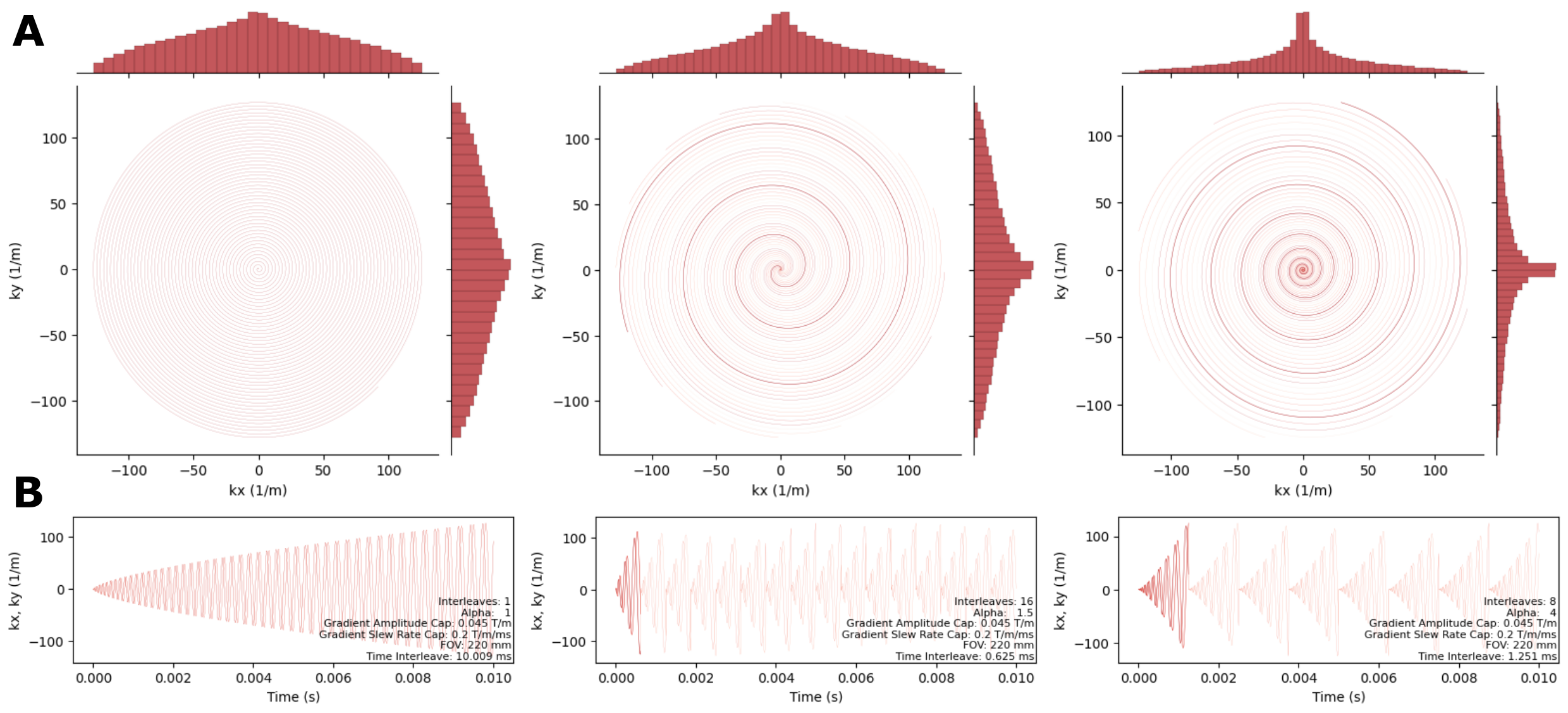
For training and testing, we use raw k-space data from the NYU FastMRI dataset10. This consists of 6970 fully sampled brain scans on hardware ranging from 4 to 24 coils acquired using a turbo spin echo sequence. We estimate effective scantime for one image slice at 2562 matrix size to take 3.7 seconds. As this data is initially acquired using Cartesian sequences, we retrospectively interpolate in k-space to simulate spiral acquisition.Following Kim et al.11, we consider spiral trajectories of the form $$$k(\tau) = \int_{0}^{\tau} \frac{1}{\rho(\phi)} d\phi e^{j\omega \tau}\;\;\approx\;\; \lambda \tau^\alpha e^{j \omega \tau}$$$ (figure 1). During training, the model sees randomly generated trajectories with varying numbers of interleaves and alpha, a parameter controlling sampling bias towards low vs high frequencies. Training follows a typical conditional score matching with langevin dynamics process12,13.
Reconstruction is an ill-posed inverse problem of recovering an image signal $$$x$$$ from a set of incomplete k-space measurements $$$y$$$. As $$$x$$$ and $$$y$$$ exist in different domains, $$$x$$$ is hidden behind a sampling operator $$$A$$$: $$$y \approx Ax$$$. In the case of non-Cartesian MRI, $$$A$$$ is the non-uniform fourier transform.
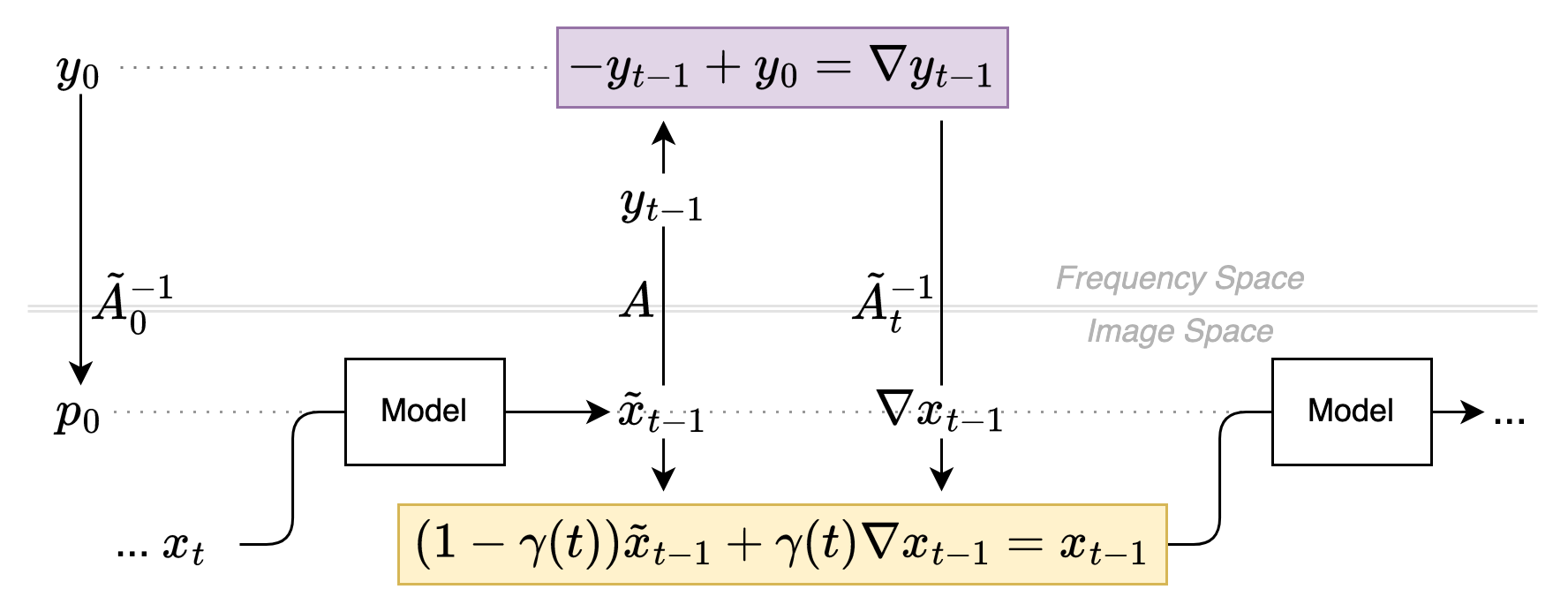
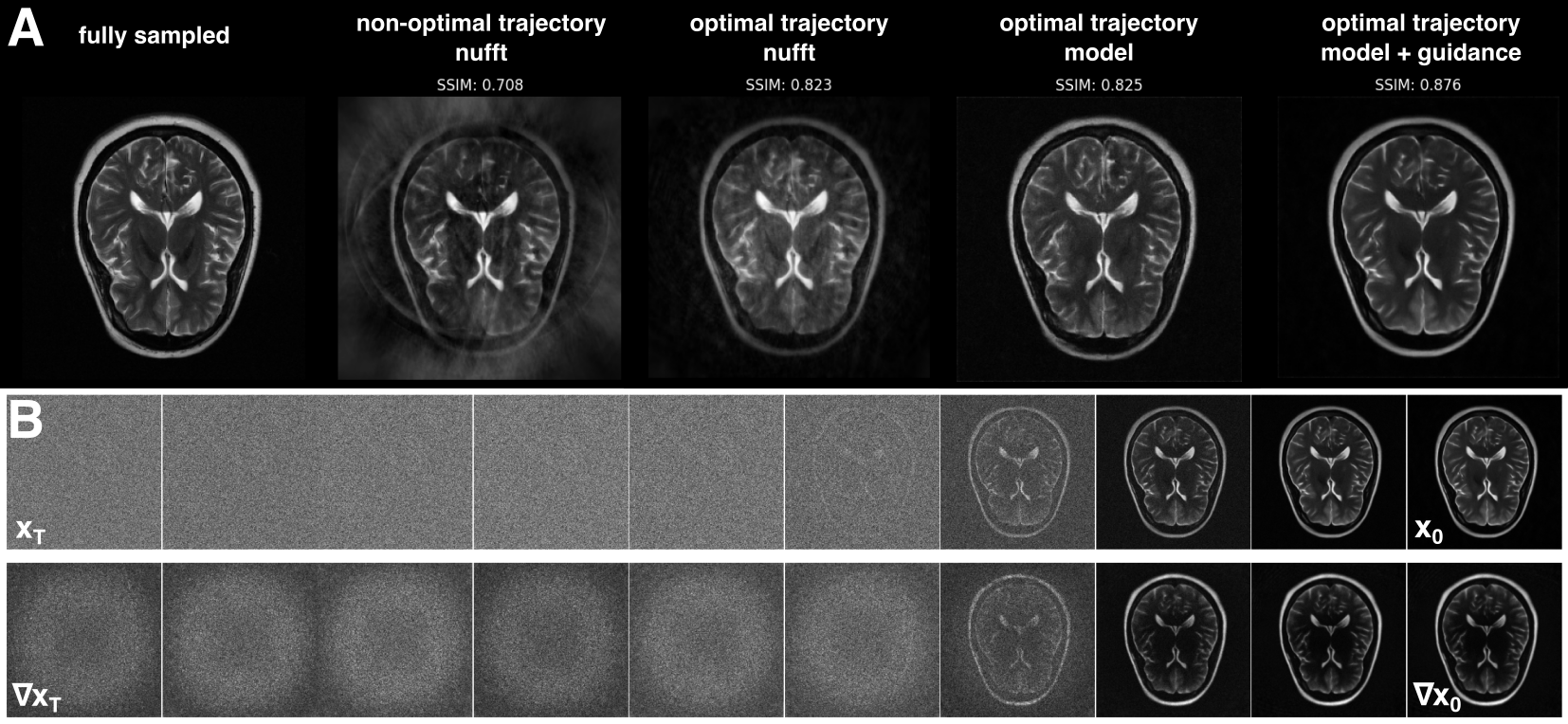
To solve this problem, we assume an underlying distribution of images and seek to generate samples from this distribution consistent with $$$y_0$$$. Conditioning is supplied in two forms: first, by learning a conditional score function $$$\nabla_x \log p_t(x_t|\tilde{A}^{-1} y_0)$$$, where $$$y_0$$$ is the measurement in frequency space and $$$\tilde{A}^{-1}$$$ is the approximate inverse non-uniform fast Fourier transform (nufft) solved iteratively using conjugate gradients. Second, by using frequency space gradients to weakly guide the sampling process (figure 2). Because the nufft is not invertible, imperfections in the inverse nufft bleed into the final image reconstruction, reducing quality. To avoid this, we anneal the guidance signal following $$$\gamma(t) = \beta(1-t)$$$, ensuring strong guidance at the beginning and minimal artifacts at the end of sampling.
Results
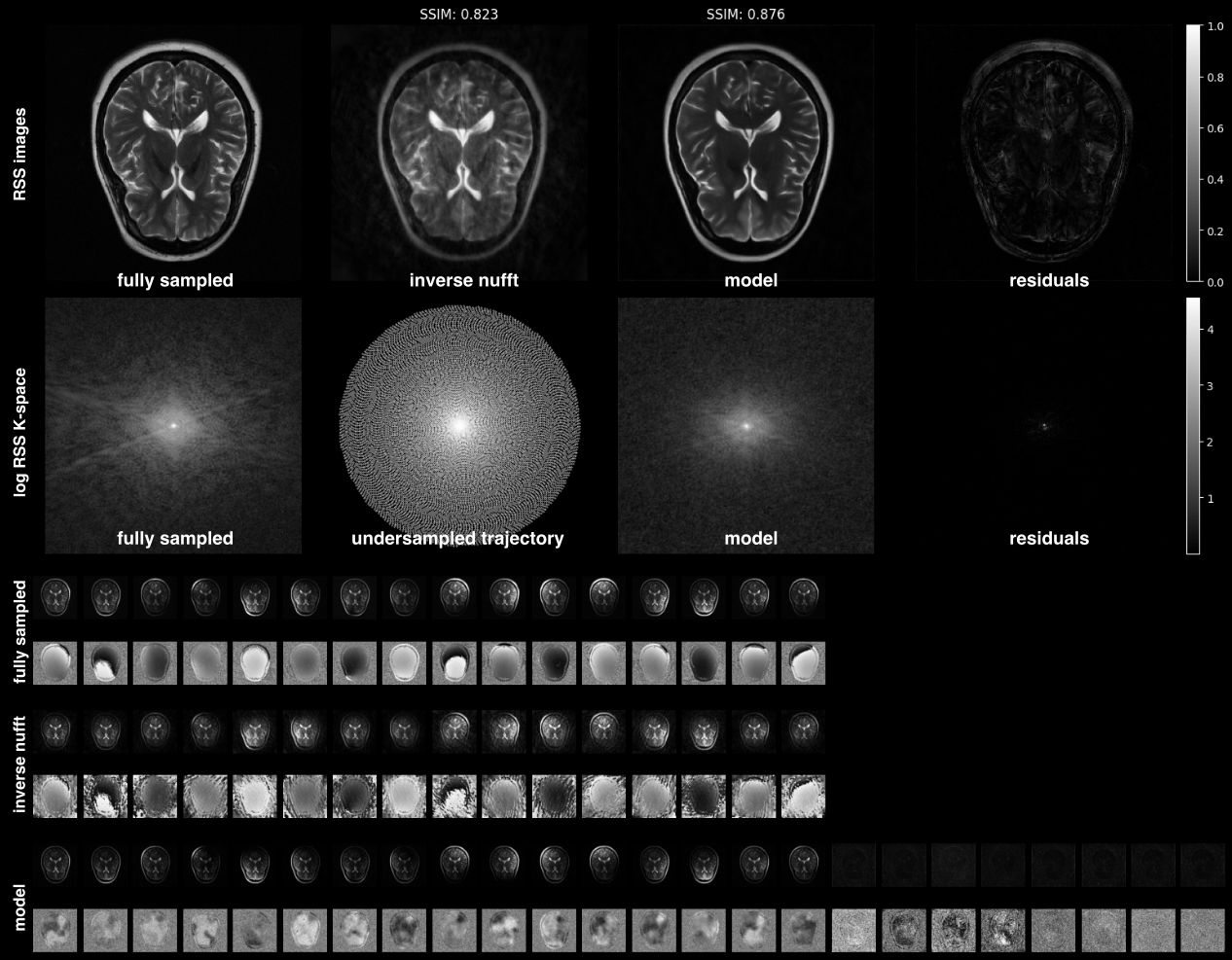
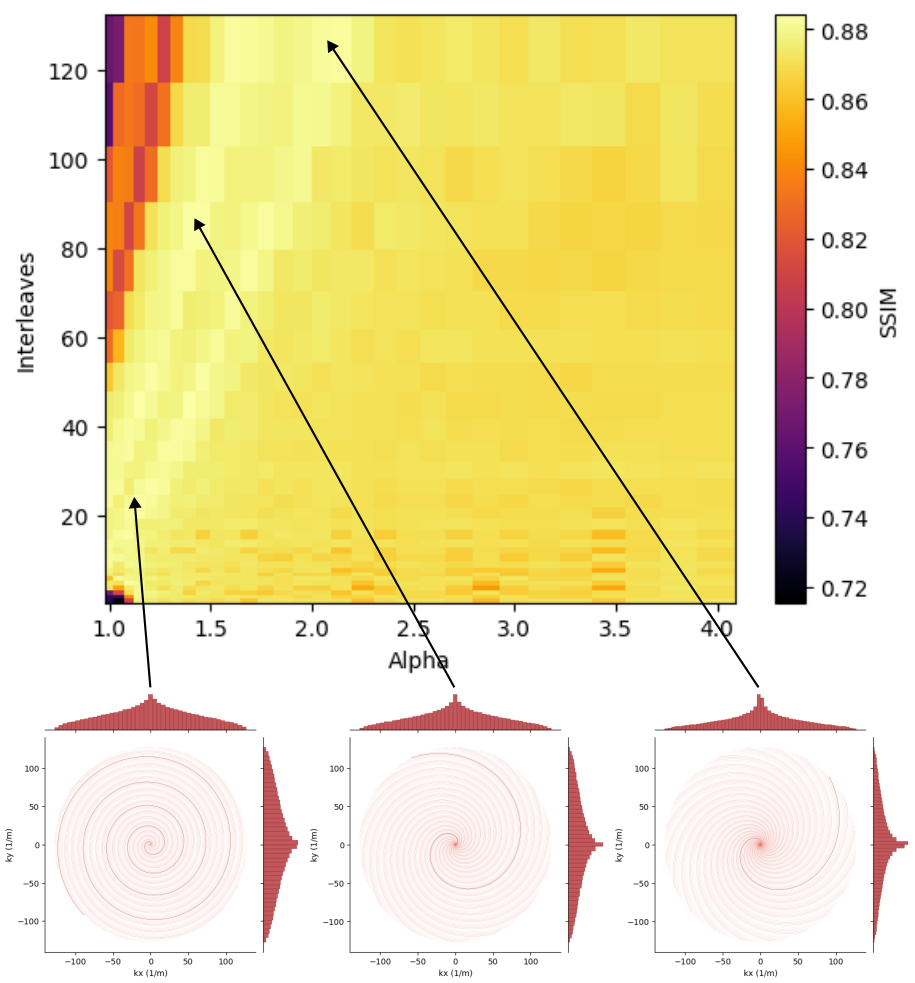
Performance was evaluated on a held-out test dataset. Test trajectories have a fixed readout duration of 0.02 seconds, long enough to reconstruct a 256x256 pixel, 22x22 cm2 2D image. Images were scored using structural similarity (SSIM) (figure 3).As a further experiment, we performed a grid search of the parameter space of fixed-duration spiral trajectories in order to find optimal trajectories (figure 4).
Finally, we compared results for reconstructing data acquired using optimal and non-optimal trajectories, with model but no frequency guidance, and with both model and guidance. We found that the combination of optimized trajectory, model conditioning, and annealed frequency guidance results in significant improvements in SSIM up to and exceeding +0.15 (figure 5).
Discussion
While initial results are promising, the main limitation of this project is the reliance on retrospective, Cartesian-sampled data. Prospective experiments will likely require tweaking spiral sequences to match contrast and signal, which will constrain the space of realizable trajectories. Until a dataset of raw non-Cartesian MRI data becomes available, this will be an obstacle. For a similar reason, it is difficult to make head-to-head comparisons between the original sequence and the proposed sequences without prospective validation. A more direct comparison is between the proposed sequences and their Nyquist-sampled counterparts, which run roughly 3x longer.Conclusion
We introduce a new method and show preliminary results for reconstructing spiral MRI using a diffusion model. Combining multicoil imaging, spiral scanning, and undersampling enables dramatically faster imaging speeds. Potential applications of this work are widespread, but a focus is on real-time 3D imaging.Acknowledgements
No acknowledgement found.References
- Blum, Mark J., Michael Braun, and Dov Rosenfeld. "Fast magnetic resonance imaging using spiral trajectories." Medical Imaging. Vol. 767. SPIE, 1987.
- Winkelmann, Stefanie, et al. "An optimal radial profile order based on the Golden Ratio for time-resolved MRI." IEEE transactions on medical imaging 26.1 (2006): 68-76.
- Sodickson, Daniel K., and Warren J. Manning. "Simultaneous acquisition of spatial harmonics (SMASH): fast imaging with radiofrequency coil arrays." Magnetic resonance in medicine 38.4 (1997): 591-603.
- Lustig, Michael, David Donoho, and John M. Pauly. "Sparse MRI: The application of compressed sensing for rapid MR imaging." Magnetic Resonance in Medicine: An Official Journal of the International Society for Magnetic Resonance in Medicine 58.6 (2007): 1182-1195.
- Oscanoa, Julio A., et al. "Deep learning-based reconstruction for cardiac MRI: A Review." Bioengineering 10.3 (2023): 334.
- Johnson, Patricia M., Michael P. Recht, and Florian Knoll. "Improving the speed of MRI with artificial intelligence." Seminars in musculoskeletal radiology. Vol. 24. No. 01. Thieme Medical Publishers, 2020.
- Song, Yang, et al. "Solving inverse problems in medical imaging with score-based generative models." arXiv preprint arXiv:2111.08005 (2021).
- Aali, Asad, et al. "Solving Inverse Problems with Score-Based Generative Priors learned from Noisy Data." arXiv preprint arXiv:2305.01166 (2023).
- Cui, Zhuo-Xu, et al. "Spirit-diffusion: Self-consistency driven diffusion model for accelerated mri." arXiv preprint arXiv:2304.05060 (2023).
- Knoll, Florian, et al. "fastMRI: A publicly available raw k-space and DICOM dataset of knee images for accelerated MR image reconstruction using machine learning." Radiology: Artificial Intelligence 2.1 (2020): e190007.
- Kim, Dong‐hyun, Elfar Adalsteinsson, and Daniel M. Spielman. "Simple analytic variable density spiral design." Magnetic Resonance in Medicine: An Official Journal of the International Society for Magnetic Resonance in Medicine 50.1 (2003): 214-219.
- Song, Yang, et al. "Score-based generative modeling through stochastic differential equations." arXiv preprint arXiv:2011.13456 (2020).Karras, Tero, et al. "Elucidating the design space of diffusion-based generative models." Advances in Neural Information Processing Systems 35 (2022): 26565-26577.
- Karras, Tero, et al. "Elucidating the design space of diffusion-based generative models." Advances in Neural Information Processing Systems 35 (2022): 26565-26577.
Figures