4507
Deep-learning-based optimization of k-space undersampling in self-supervised MRI reconstruction1School of Biomedical Engineering, ShanghaiTech University, Shanghai, China, 2Shanghai Clinical Research and Trial Center, Shanghai, China
Synopsis
Keywords: AI/ML Image Reconstruction, Image Reconstruction
Motivation: Self-supervised deep learning has shown good performance in reconstructing undersampled k-space. While recent developments focus on improving reconstruction performance for a given undersampling pattern, there is limited research aiming to learn and optimize k-space sampling strategies to offer a performance gain in self-supervised reconstruction.
Goal(s): To design a deep learning framework to optimize the sampling pattern in self-supervised MRI reconstruction.
Approach: An Auto Mask Module was optimized simultaneously with the self-supervised reconstruction module in an end-to-end framework.
Results: The proposed method can achieve better reconstruction results than self-supervised methods based on fixed masks.
Impact: The proposed method can produce better self-supervised reconstruction results by optimizing the k-space undersampling pattern.
Introduction
To reduce the scan time of MRI, k-space data can be undersampled by sampling data below the Nyquist rate, which however, causes aliasing artifacts. Deep learning (DL) reconstruction methods have achieved great success in eliminate undersampling artifacts [9]. While most DL reconstruction methods requires fully-sampled data for supervised training, self-supervised learning approaches such SSDU [1], have been proposed to train the reconstruction network with only undersampled k-space [1, 2]. Nevertheless, recent developments of self-supervised DL reconstruction work on some predefined handcrafted under-sampling patterns, such as Random Uniform [3], Variable Density[4], and equi-spaced Cartesian[5] with skipped lines. Although learning-based optimization of the undersampling pattern has been developed to improve the reconstruction performance of supervised DL reconstruction [10], there is limited research aiming to learn and optimize k-space sampling strategies to offer a performance gain in self-supervised reconstruction. In this study, we present a DL framework that optimizes the undersampling patterns for self-supervised DL reconstruction methods.Methods
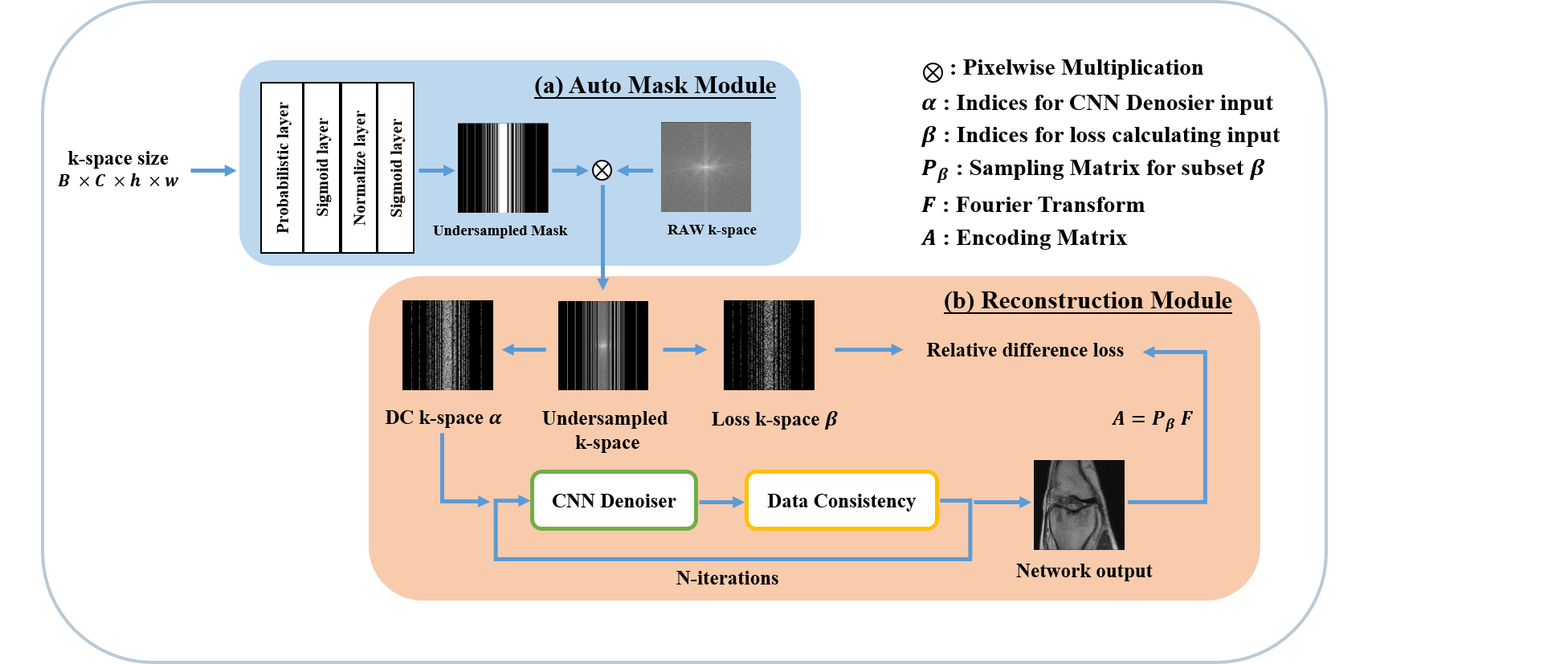
The proposed deep learning framework is illustrated in Figure 1. This framework consists of two modules: The Auto Mask Module (Figure 1(a)) and the Reconstruction Module (Figure 1(b)). The Auto Mask Module optimizes 1D under-sampling masks, and the Reconstruction Module removes aliasing and noise from the undersampled data by self-supervised learning. So, the model can implement in an end-to-end learning framework for optimizing the under-sampling pattern in self-supervised MRI reconstruction.Auto Mask Module: The architecture of Auto Mask Module is shown in Figure 1(a). This module consisted of three parts: the probabilistic layer, the normalization layer, and the sigmoid layer. The probabilistic layer takes k-space size as input and outputs an independent Bernoulli random variable at each k-space point. The normalize layer ensures that the sampling ratio is consistent with the target sampling ratio; the Sigmoid layer makes the values of the learnable masks close to binarization.
Reconstruction Module: We adopted the SSDU [1] approach for the reconstruction module. As shown in Figure 1(b), the k-space undersampled by the Auto Mask Module is randomly divided into two disjoint sets, DC K-space ($$$\alpha$$$) and Loss k-space ($$$\beta$$$). The ratio $$$\varphi = \beta /(\alpha + \beta )$$$ is 0.4. Loss k-space is used to calculate loss, and the DC k-space is used to enforce Data Consistency which is done as in [6] . The convolutional neural network (CNN) denoiser is implemented based on a ResNet structure, which is combined with DC and unrolled for ten iterations. The reconstructed images are Fourier transformed to k-space and then undersampled by $$$P_\beta $$$ to calculate the loss. The relative difference loss [7] is adopted to combat the influence of unbalanced magnitude distribution of k-space data.
Data and pre-processing: RAW single-coil k-space measurements for knee were obtained from the NYU fastMRI open dataset [8]. The training set consisted of 852 slices of coronal proton density (PD) knee images from 71 subjects, and the testing set consisted of 252 slices of coronal PD images from 21 subjects. The outer k-space regions filled with zero in the original dataset were discarded to prevent the Auto Mask Module from overfitting to those regions. To save on computation, we crop the images to size of 256×256.
Network training: Two reconstruction models were trained and compared: self-supervised reconstruction with Auto Mask Module and self-supervised reconstruction with the fixed variable-density random undersampling mask. The acceleration rate was set to 4. All reconstruction models were trained for 500 epochs with a learning rate of 1e-4.
Results & Discussion
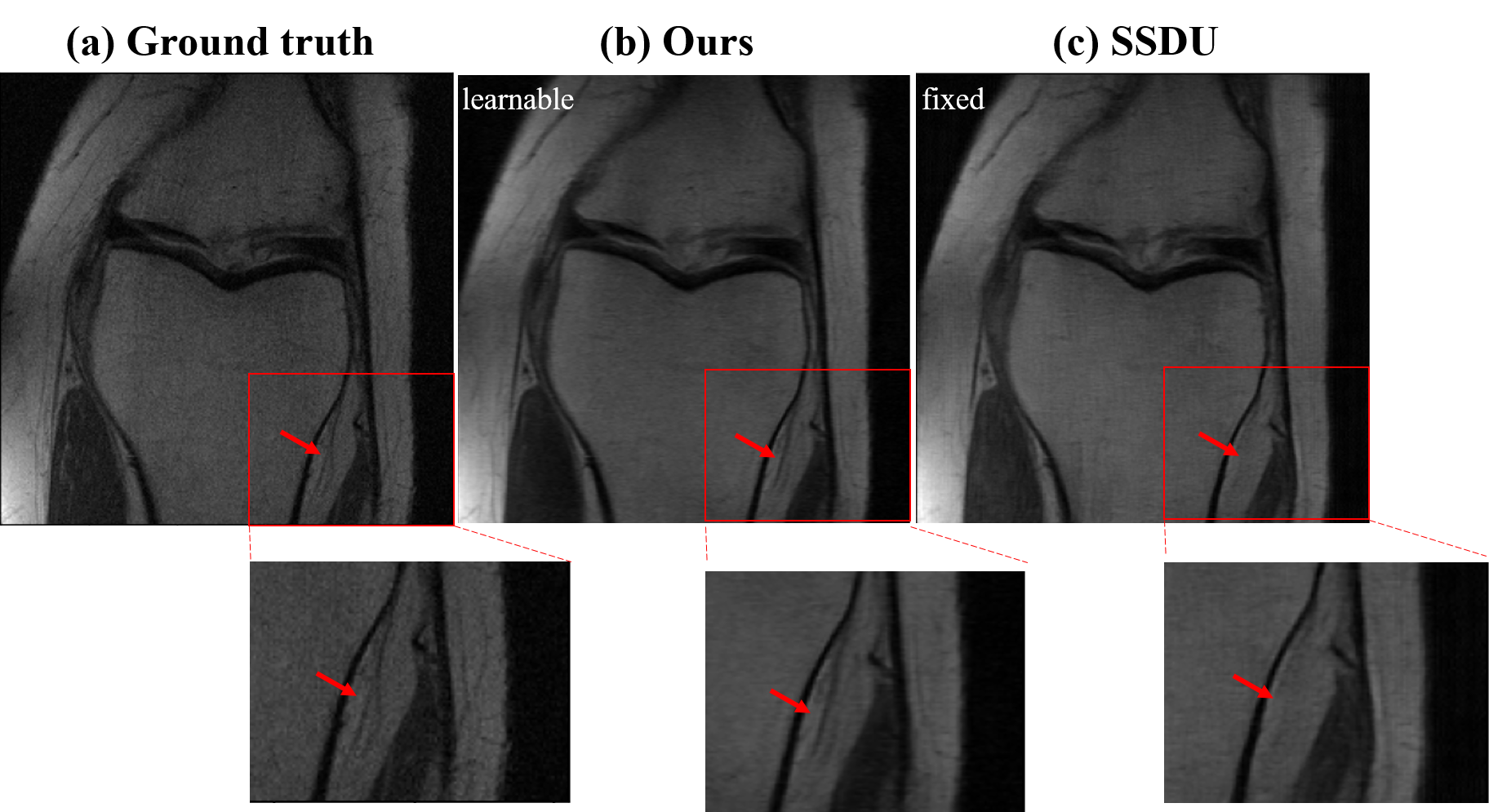
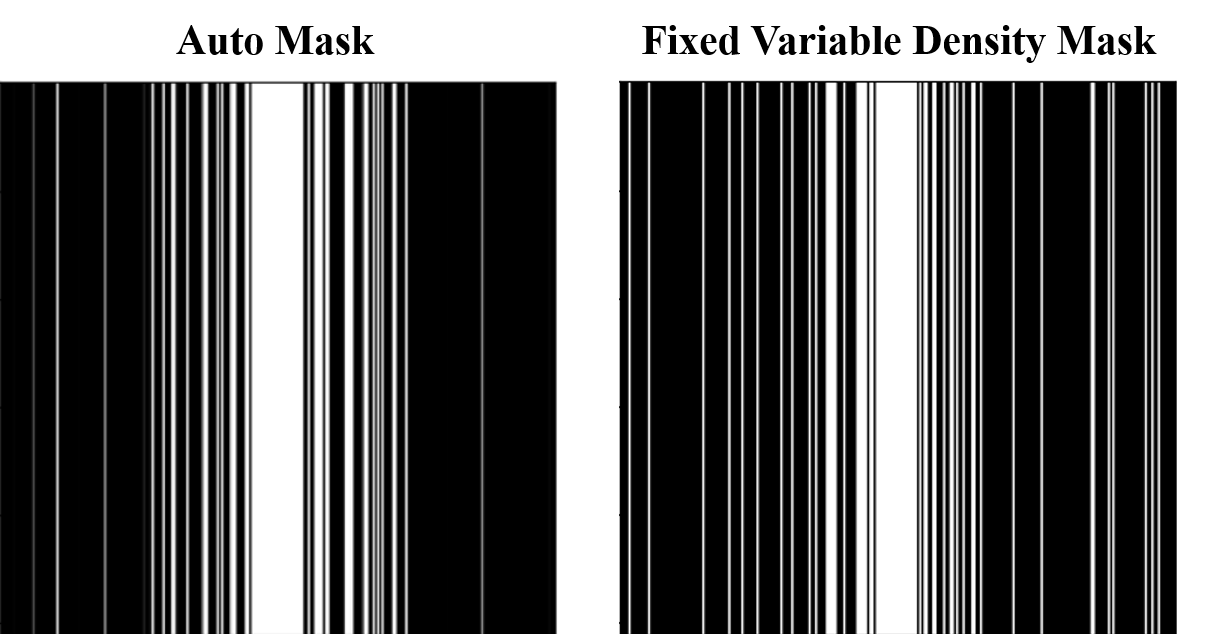
Figure 2 shows that all reconstruction methods were able to remove the undersampling artifacts, while the proposed method showed sharper images and higher consistency with the fully-sampled image compared to SSDU with fixed undersampling pattern. Table 1 summarized the quantitative comparison between the proposed method and SSDU. Self-supervised reconstruction with learned undersampling pattern show significantly better reconstruction quality than original SSDU in terms of PSNR and SSIM metrics. The learned k-space trajectories (Auto Mask) and the fixed k-space trajectories (Fixed Variable Density Mask) were demonstrated in Figure 3. Compared to the empirically designed mask, the learned trajectories tend to more densely sample the central k-space region which dominates the reconstructed image contrast.Conclusion
The proposed approach is a practical way of optimizing the undersampling pattern for self-supervised reconstruction, which can achieve better reconstruction quality compared to the self-supervised methods based on empirically designed undersampling masks.Acknowledgements
No acknowledgement found.References
1. Yaman, B., et al., Self‐supervised learning of physics‐guided reconstruction neural networks without fully sampled reference data. Magnetic resonance in medicine, 2020. 84(6): p. 3172-3191.
2. Hu, C., et al. Self-supervised learning for mri reconstruction with a parallel network training framework. in Medical Image Computing and Computer Assisted Intervention–MICCAI 2021: 24th International Conference, Strasbourg, France, September 27–October 1, 2021, Proceedings, Part VI 24. 2021. Springer.
3. Gamper, U., P. Boesiger, and S. Kozerke, Compressed sensing in dynamic MRI. Magnetic Resonance in Medicine: An Official Journal of the International Society for Magnetic Resonance in Medicine, 2008. 59(2): p. 365-373.
4. Wang, Z. and G.R. Arce, Variable density compressed image sampling. IEEE Transactions on image processing, 2009. 19(1): p. 264-270.
5. Haldar, J.P., D. Hernando, and Z.-P. Liang, Compressed-sensing MRI with random encoding. IEEE transactions on Medical Imaging, 2010. 30(4): p. 893-903.
6. Schlemper, J., et al., A deep cascade of convolutional neural networks for dynamic MR image reconstruction. IEEE transactions on Medical Imaging, 2017. 37(2): p. 491-503.
7. Feng, J., et al., Spatiotemporal implicit neural representation for unsupervised dynamic MRI reconstruction. arXiv preprint arXiv:2301.00127, 2022.
8. Knoll, F., et al., fastMRI: A publicly available raw k-space and DICOM dataset of knee images for accelerated MR image reconstruction using machine learning. Radiology: Artificial Intelligence, 2020. 2(1): p. e190007.
9. Zeng G, Guo Y, Zhan J, Wang Z, Lai Z, Du X, Qu X, Guo D. A review on deep learning MRI reconstruction without fully sampled k-space. BMC Med Imaging. 2021 Dec 24;21(1):195.
10. Bahadir, C. D., Wang, A. Q., Dalca, A. V. & Sabuncu, M. R. Deep-learning-based optimization of the under-sampling pattern in MRI. IEEE Trans. Comput. Imaging 6, 1139–1152 (2020).
Figures