4503
Low-rank regularized implicit neural representation for k-space completion in fast MRI reconstruction1School of Biomedical Engineering, Shanghai Jiao Tong University, Shanghai, China, 2School of Infomation Science and Technology, ShanghaiTech University, Shanghai, China, 3The National Engineering Research Center of Advanced Magnetic Resonance Technologies for Diagnosis and Therapy (NERC-AMRT), Shanghai Jiao Tong University, Shanghai, China
Synopsis
Keywords: AI/ML Image Reconstruction, Machine Learning/Artificial Intelligence
Motivation: The highly reduced k-space measurements would induce noises and artifacts in the reconstructed image in parallel imaging.
Goal(s): To effectively complete the undersampled k-space points for MRI acceleration and provide high-quality images.
Approach: We developed a novel k-space completion framework based on implicit neural representation. The inherent low-rankness of k-space is incorporated into the model to capture the continuous representation in k-space. The proposed method was evaluated on the public dataset and compared with the image and k-space domain reconstruction methods.
Results: The results show that our method can effectively complete the undersampled k-space points without any priors in the image domain.
Impact: The proposed method leverages implicit neural representation in the k-space reconstruction, demonstrating the ability to complete the undersampled k-space points at high acceleration factor. This result implies our method can further reduce the measured k-space points and accelerate MRI acquisition.
Introduction
Parallel imaging utilizes the information redundancy of multiple receiver coils to undersample the k-space for MRI acceleration. The conventional k-space domain reconstruction methods estimate the missing k-space points by exploiting the correlations between multiple receiver coils in the local k-space data1,2. Compared with the reconstruction in the image domain, it does not require the explicit estimation of coil sensitivities, avoiding error amplifications in the images3. Recently, various deep learning methods utilized convolutional neural network (CNN) for the k-space interpolation4,5. However, CNN relies on the local operators and limits its spatial connectivity and correlation in k-space, restricting the reconstruction performance at high acceleration factors. In this work, we proposed a novel k-space completion framework based on implicit neural representation (INR)6,7. The proposed method enhances the ability to capture the continuity of k-space signals, facilitating the completion of the missing k-space points. Additionally, to harness the multi-coil correlations, the low-rankness and SPIRiT kernel are also incorporated as the regularization for INR learning.Methods
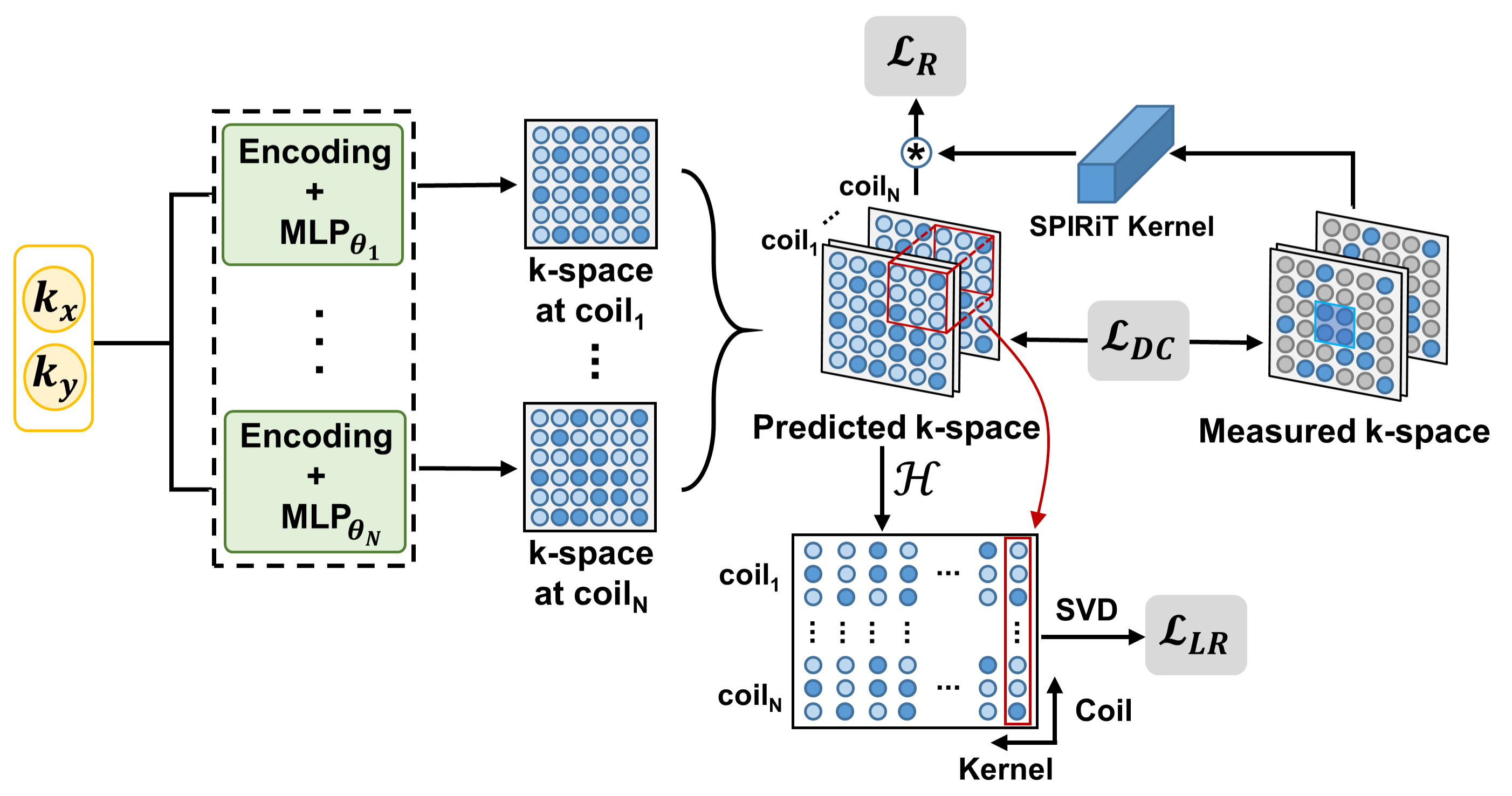
K-space completion:Fig. 1 displays the overview of the proposed k-space completion framework. The k-space coordinates are fed into the encoding module and multi-layer perceptron (MLP) to estimate the k-space signal of each coil. Then the k-space is stacked along the coil dimension to obtain the multi-coil predicted k-space $$$\hat{k}$$$. To enforce the linear relationship between the neighboring k-space points across all coils, the predicted k-space is refined by a linear convolutional kernel, namely SPIRiT kernel $$$d$$$, which is estimated from the auto-calibration signal (ACS)2 of the measured k-space. Therefore, the k-space reconstruction can be performed by solving the following optimization problem:
$$\underset{\theta_{j}}{argmin}{\sum\limits_{j=1}^{n_{c}}{\left\|{k_{j}-\mathbf{M}\hat{k_{j}}}\right\|_{1}+\lambda_{R}\left\|{\mathcal{d}\mathcal{*}\hat{k}-\hat{k}} \right\|_{1}}}\tag{1}$$
where $$$n_c$$$ denotes the number of coils, $$$k_j$$$ is the measured k-space at the $$$j$$$th coil, $$$\theta_j$$$ represents the parameters to be optimized in the $$$j$$$th MLP, $$$\mathbf{M}$$$ is the sampling mask, $$$*$$$ is the convolution operator and $$$\lambda_R$$$ is the weighting for the refinement regularization. To further utilize the linear dependency of multi-coil k-space data, the predicted k-space is formulated into the low-rank Hankel matrix8 by the operator $$$\mathcal{H}$$$. This structured matrix is formed by vectorizing the local block into each matrix column followed by sliding the block across the whole k-space. Given the structured Hankel matrix, singular value decomposition (SVD) is applied to the matrix to enforce low-rank regularization. With the refinement and low-rank regularization, the k-space reconstruction problem can be described as:
$${\underset{\theta_{j}}{argmin}{\sum\limits_{j=1}^{n_{c}}{\left\|{k_{j}-\mathbf{M}\hat{k_{j}}}\right\|_{1}+\lambda_{R}\left\| {\mathcal{d}\mathcal{*}\hat{k}-\hat{k}}\right\|_{1}}}}+\lambda_{LR}\left\|{\mathcal{H}\left(\hat{k} \right)}\right\|_{*}\tag{2}$$
where $$$\lambda_{LR}$$$ is the weighting for low-rank regularization and $$$\left\|\cdot \right\|_{*}$$$ denotes the nuclear norm. The parameters of the model are optimized by minimizing the total loss, comprising of data-consistency loss $$$\mathcal{L}_{DC}$$$, refinement loss $$$\mathcal{L}_{R}$$$ and low-rank loss $$$\mathcal{L}_{LR}$$$. After the k-space reconstruction, we can directly obtain the MR image using inverse Fourier Transform followed by Root-Sum-Squares.
Experiment:
The MLP contains 5 layers with 128 neurons in the hidden layer and the hash encoding9 is adopted in this work. A 15-coil knee dataset and a 16-coil brain dataset from the public fastMRI dataset10 were retrospectively undersampled using a 2D variable density sampling pattern to evaluate the proposed method. The image reconstruction method L1-ESPIRiT11 and the k-space reconstruction method AC-LORAKS12 and SAKE8 were compared in the experiment.
Results
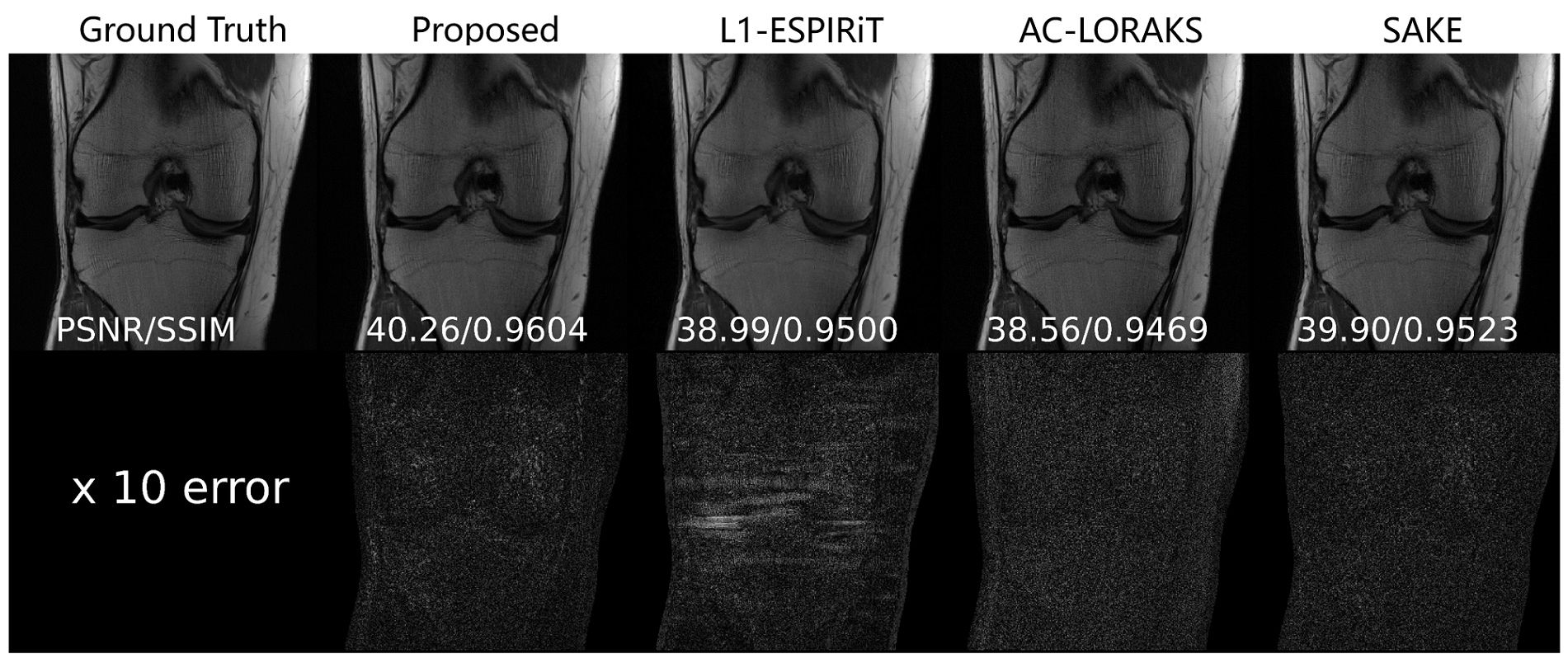
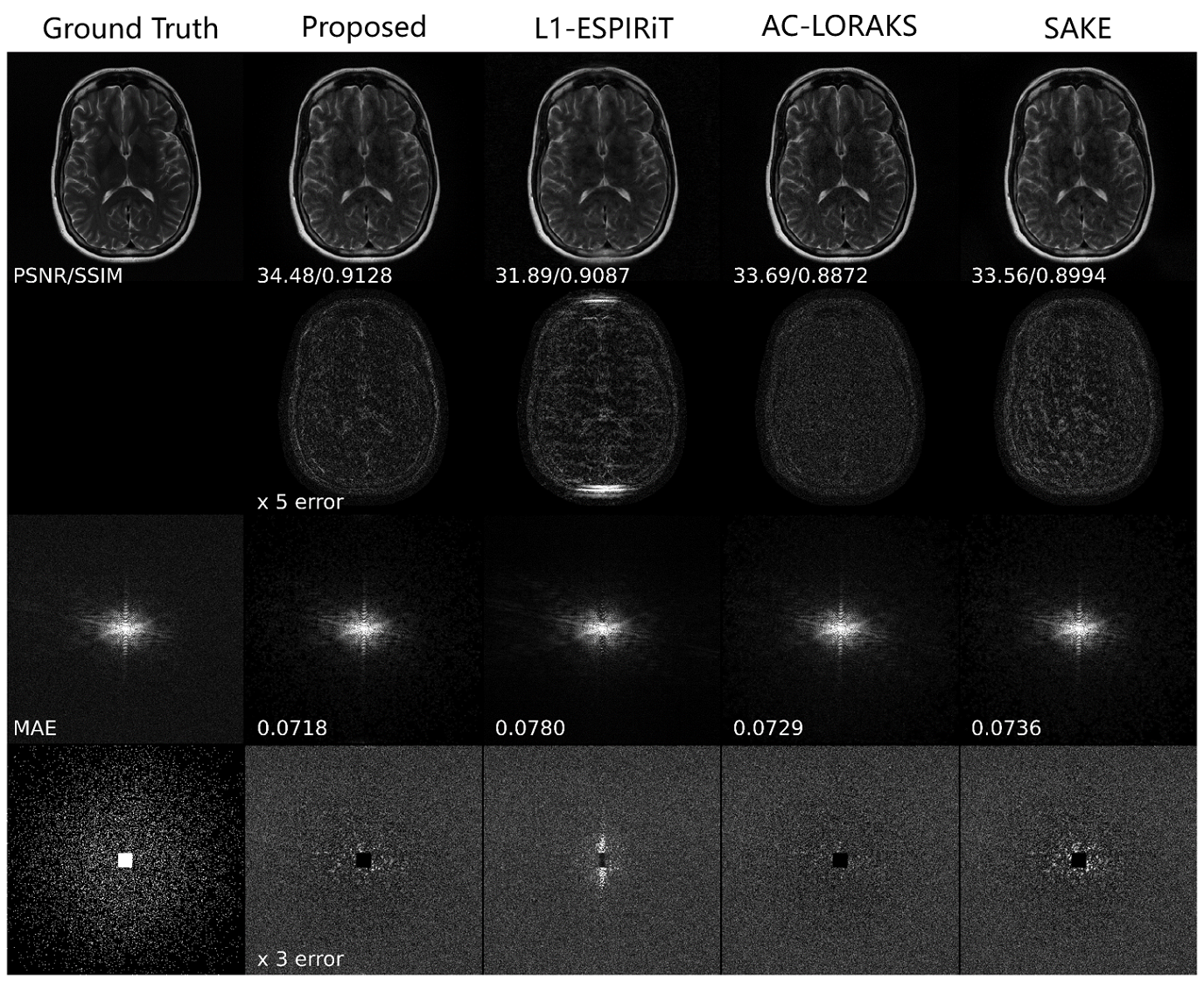
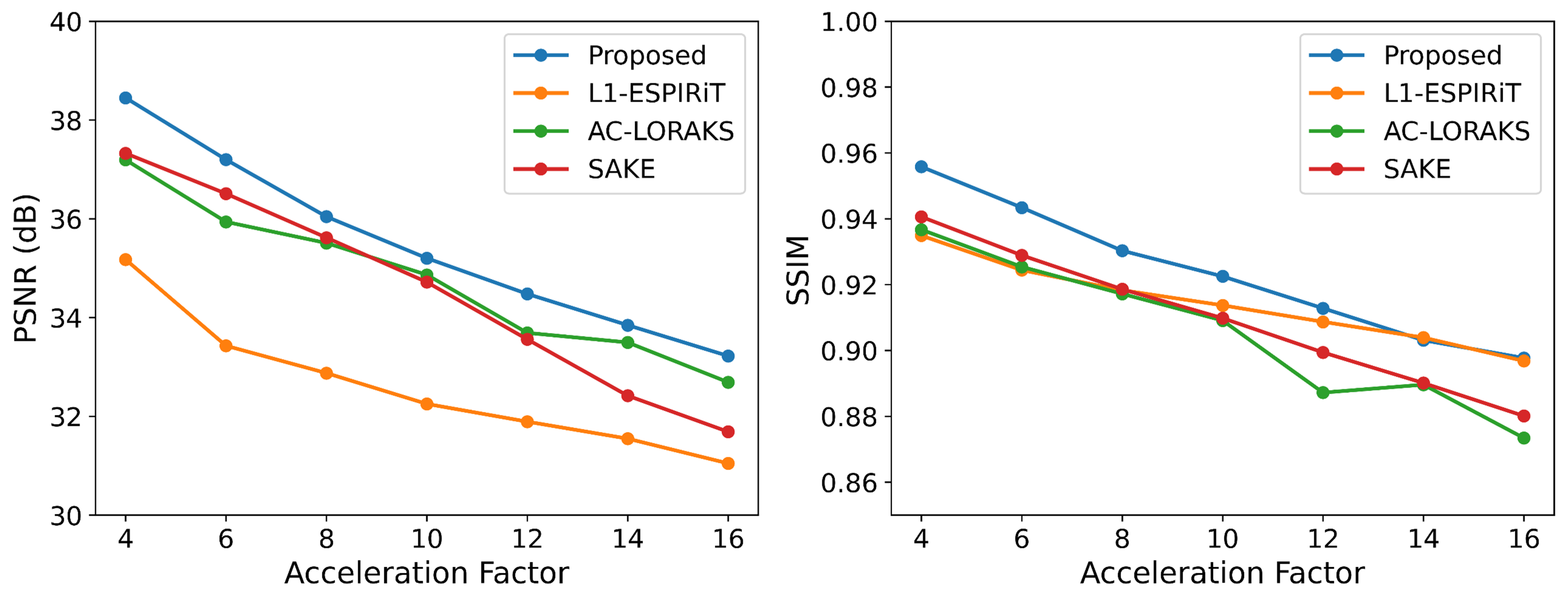
Fig. 2 compares the proposed method, L1-ESPIRiT, AC-LORAKS and SAKE on the 15-channel knee dataset at AF=6 and ACS=24. Quantitatively, the proposed method achieves the highest evaluation metrics with PSNR=40.26dB and SSIM=0.9604. Fig. 3 presents the results on the 16-channel brain dataset at AF=12 and ACS=24. The proposed method achieves the highest PSNR/SSIM and the lowest MAE in k-space. Fig. 4 plots the reconstruction performance variation of the proposed method, L1-ESPIRiT, AC-LORAKS and SAKE at AF=4-16. The proposed method maintains the highest PSNR across AF and comparable SSIM with L1-ESPIRiT at extremely high AF.Discussion
The comparison with the typical image domain and k-space domain reconstruction methods demonstrates that our method can effectively recover the multi-coil k-space and reconstruct high-quality images. This advantage can be attributed to the successful k-space point completion using INR with the regularization of the intrinsic low-rankness in k-space. Specifically, a continuous implicit representation of k-space is captured to generate the missing k-space points on the given coordinates. In addition, L1-ESPIRiT achieves comparable SSIM with the proposed methods at AF=14-16, which may result from the sparsity regularization in the transform domain. However, overemphasizing the sparsity priors would bring additional artifacts into the image.Conclusion
In this work, we proposed a novel k-space completion framework incorporating the inherent low-rank regularization. Our method shows the ability to further reduce the measured k-space point and accelerate MRI acquisition.Acknowledgements
No acknowledgement found.References
1. M. A. Griswold et al., "Generalized autocalibrating partially parallel acquisitions (GRAPPA)," Magn Reson Med, vol. 47, no. 6, pp. 1202-1210, 2002, doi: 10.1002/mrm.10171.
2. M. Lustig and J. M. Pauly, "SPIRiT: Iterative self‐consistent parallel imaging reconstruction from arbitrary k‐space," Magn Reson Med, vol. 64, no. 2, pp. 457-471, 2010, doi: 10.1002/mrm.22428.
3. M. Blaimer, F. Breuer, M. Mueller, R. M. Heidemann, M. A. Griswold, and P. M. Jakob, "SMASH, SENSE, PILS, GRAPPA: how to choose the optimal method," Top Magn Reson Imaging, vol. 15, no. 4, pp. 223-236, 2004.
4. M. Akçakaya, S. Moeller, S. Weingärtner, and K. Uğurbil, "Scan‐specific robust artificial‐neural‐networks for k‐space interpolation (RAKI) reconstruction: Database‐free deep learning for fast imaging," Magn Reson Med, vol. 81, no. 1, pp. 439-453, 2018, doi: 10.1002/mrm.27420.
5. Y. Han, L. Sunwoo, and J. C. Ye, "k -Space Deep Learning for Accelerated MRI," IEEE Trans Med Imaging, vol. 39, no. 2, pp. 377-386, Feb 2020, doi: 10.1109/TMI.2019.2927101.
6. B. Mildenhall, P. P. Srinivasan, M. Tancik, J. T. Barron, R. Ramamoorthi, and R. Ng, "NeRF," Communications of the ACM, vol. 65, no. 1, pp. 99-106, 2021, doi: 10.1145/3503250.
7. R. Feng, Q. Wu, Y. Zhang, and H. Wei, "A scan-specific unsupervised method for parallel MRI reconstruction via implicit neural representation," in 2023 IEEE 20th International Symposium on Biomedical Imaging (ISBI), pp. 1-5, 2023.
8. P. J. Shin et al., "Calibrationless parallel imaging reconstruction based on structured low-rank matrix completion," Magn Reson Med, vol. 72, no. 4, pp. 959-70, Oct 2014, doi: 10.1002/mrm.24997.
9. T. Müller, A. Evans, C. Schied, and A. Keller, "Instant neural graphics primitives with a multiresolution hash encoding," ACM Transactions on Graphics, vol. 41, no. 4, pp. 1-15, 2022, doi: 10.1145/3528223.3530127.
10. F. Knoll et al., "fastMRI: A Publicly Available Raw k-Space and DICOM Dataset of Knee Images for Accelerated MR Image Reconstruction Using Machine Learning," Radiology: Artificial Intelligence, vol. 2, no. 1, 2020, doi: 10.1148/ryai.2020190007.
11. M. Uecker et al., "ESPIRiT--an eigenvalue approach to autocalibrating parallel MRI: where SENSE meets GRAPPA," Magn Reson Med, vol. 71, no. 3, pp. 990-1001, Mar 2014, doi: 10.1002/mrm.24751.
12. J. P. Haldar, "Autocalibrated LORAKS for fast constrained MRI reconstruction," in 2015 IEEE 12th International Symposium on Biomedical Imaging (ISBI), pp. 910-913, 2015.
Figures