4470
Brain Temperature Mapping Based on Chemical Exchange Saturation Transfer of Creatine at 5.0T1Shenzhen Institute of Advanced Technology, Chinese Academy of Sciences, Shenzhen, China, 2University of Chinese Academy of Science, Beijing, China
Synopsis
Keywords: CEST / APT / NOE, Thermometry
Motivation: High-resolution brain thermometry remains challenging.
Goal(s): To estimate the feasibility of creatine chemical exchange saturation transfer (CrCEST) imaging for brain thermometry.
Approach: The CrCEST imaging of creatine phantom and swine brain was conducted at various temperatures on a 5.0T MR scanner (UIH Jupiter). The relationship between the apparent offset of CrCEST and the temperature was estimated with regression analysis, based on which the temperature maps were generated.
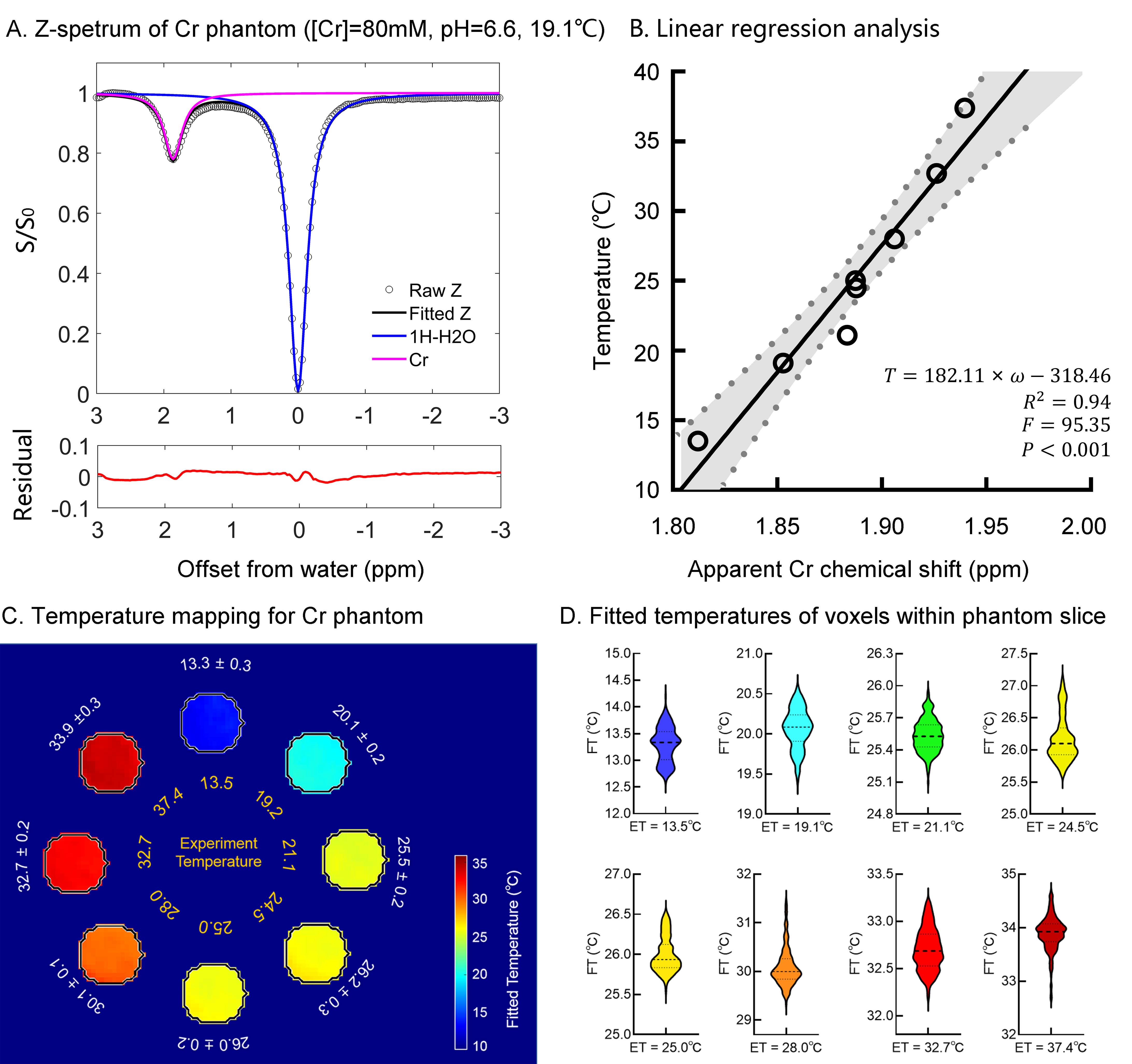
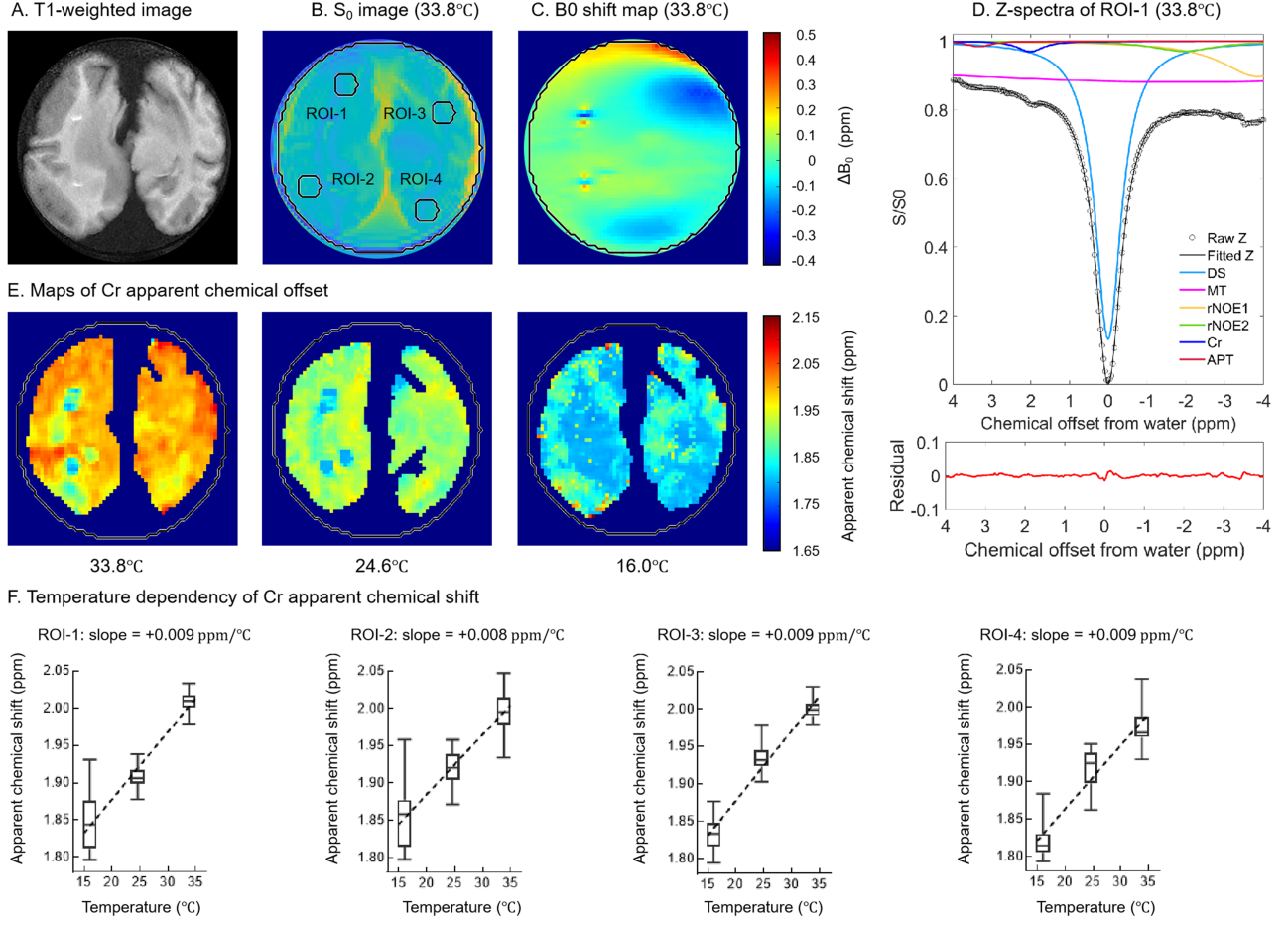
Results: Strong linear relationships between temperature and the apparent CrCEST offset were identified for both the creatine phantom (0.005ppm/oC) and the ex vivo swine brain (0.008ppm/oC) experiments.
Impact: The linear relationship between the apparent CrCEST offset and temperature confirmed the feasibility of CrCEST for high-resolution brain thermometry.
Introduction
Temperature is an important parameter inferring brain physiology and pathology. However, it remains challenging to image brain temperature with high spatial resolution. In this study, we aim to investigate the feasibility of the chemical exchange saturation transfer of endogenous creatine (CrCEST) for brain temperature mapping.Materials and Methods
Creatine phantom (concentration of 80mM, pH of 6.6) was prepared and immobilized in a cylindrical container connecting to a water circulation system (Thermo Fisher Scientific, ARCTIC PC200-A25) for temperature maintenance. An MR-compatible fluorescent optic-fiber thermometer was used for real-time temperature monitoring during the experiment (FOTS-DINA-1000, INDIGO, Suzhou, China). The CrCEST imaging was performed at eight different temperatures (ranging from 13.5℃ to 37.4℃) on a 5.0T scanner (United Imaging Healthcare, Shanghai, China) with a 48-channel phased-array head coil. The CEST sequence consists of a 4-second hard irradiation pulse (saturation power of 0.6 μT) and a single-shot fast spin echo sequence for readout (TR/TE 5000/7.12 ms, FA 110°, voxel size 1.40 mm × 1.40 mm, slice thickness 8 mm). The offset frequency was from -3 to +3 ppm with an interval of 0.03 ppm. The B0 shift was corrected using the water saturation shift referencing (WASSR) method 1. The full-range Z-spectra of voxels were fitted using a two-pool Lorentzian model to estimate the apparent offset of CrCEST peak. The relationship between temperature and the apparent CrCEST offset was estimated with regression analysis (SPSS 19.0), which was subsequently used to conduct the voxel-wise temperature mapping of the phantom. Swine brains were collected at a local slaughterhouse immediately after death and preserved in saline solution at pH of 7.0. CrCEST imaging of the swine brain was conducted at 16.0℃, 24.6℃, and 33.8℃, respectively, using the same protocol of temperature maintenance as Cr phantom. The power of the continuous-wave saturation was 0.4 μT, frequency offsets were from -4 to +4 ppm with an interval of 0.04 ppm. The maps of CrCEST apparent offset were generated by fitting Z-spectra for each voxel using a six-pool Lorentzian model including the direct saturation (DS) at 0 ppm, relayed nuclear Overhauser effects (rNOEs) at -3.5 ppm and -1.6 ppm, magnetization transfer (MT) at -2.0 ppm, amine proton transfer of creatine at +2 ppm, and amide proton transfer (APT) at +3.5 ppm.Results
The representative Z spectrum and temperature mapping of phantom and swine brain were shown in Figure. 1 and Figure. 2, respectively. Linear relationships of the experiment temperature and the apparent CrCEST offset were identified for both the Cr phantom (+ 0.005 ppm/℃, R2 = 0.94, P < 0.001, Fig. 1A and 1B) and the swine brain (+ 0.008 to 0.009 ppm/℃, P < 0.001, Fig. 2). Calculated temperatures agreed well with the experiment temperatures for Cr phantom based on region of interest analysis (r = 0.96, P < 0.001).Discussion
A strong linear temperature-dependency of the apparent CrCEST offset was identified in this study, which confirmed the feasibility of CrCEST for high-resolution brain thermometry. The thermal response coefficients of the phantom and the ex vivo swine brain were smaller than that of water (-0.01 ppm/℃) 2, suggesting the existence of additional contributions besides of the thermal dependency of the MR frequency of water. We speculated that the MR frequency of guanidinium protons of creatine may decrease with increasing temperature, potentially due to the temperature response of hydrogen bonding equilibrium and water organization around creatine molecules 3,4. In addition, the difference in the temperature-dependency coefficients of phantom and swine brains may be attributed to multiple overlapped CEST effects and the chemical exchange rates of creatine in the microenvironment of biological tissue 5,6.Conclusions
The apparent chemical offset of creatine was linearly regressed with temperature, based on which the temperature maps of phantom and brain tissue were successfully generated, laying foundations for CrCEST-based in vivo brain thermometry.Acknowledgements
This work was supported in part by NSFC (92159101), Scientific Instrument Innovation Team of the Chinese Academy of sciences (GJJSTD20180002), Shenzhen Municipal Scientific Program (JCYJ20220818101213029 and JCYJ20200109110612375), and the Key Laboratory for Magnetic Resonance and Multimodality Imaging of Guangdong Province (2023B1212060052).References
1. Kim M, Gillen J, Landman BA, Zhou J, Van Zijl PCM. Water saturation shift referencing (WASSR) for chemical exchange saturation transfer (CEST) experiments. MRM. 2009;61:1441-1450.
2. Kuroda K, Suzuki Y, Ishihara Y, Okamoto K, Suzuki Y. Temperature mapping using water proton chemical shift obtained with 3D-MRSI: Feasibility in vivo. MRM. 1996;35(1):20-29.
3. Panić J, Vraneš M, Tot A, Ostojić S, Gadžurić S. The organisation of water around creatine and creatinine molecules. The Journal of Chemical Thermodynamics. 2019;128:103-109.
4. Gangopadhyay D, Sharma P, Singh RK. Temperature dependent Raman and DFT study of creatine. Spectrochimica Acta Part A: Molecular and Biomolecular Spectroscopy. 2015;150:9-14.
5. Zhang X-Y, Xie J, Wang F, et al. Assignment of the molecular origins of CEST signals at 2 ppm in rat brain. MRM. 2017;78(3):881-887.
6. Zhang Z, Wang K, Park S, et al. The exchange rate of creatine CEST in mouse brain. MRM. 2023;90(2):373-384.
Figures