4462
Periodically Rotated Spiral Sampling (PRSS) and Multi-offset Transformer Reconstruction (MoTR) for CEST MRI1Department of Biomedical Engineering, City University of Hong Kong, Hong Kong, China, 2Hong Kong Centre for Cerebro-Cardiovascular Health Engineering (COCHE), Hong Kong, China, 3School of Biomedical Engineering & State Key Laboratory of Advanced Medical Materials and Devices, ShanghaiTech University, Shanghai, China, 4Department of Diagnostic Radiology, University of Hong Kong, Hong Kong, China, 5Shanghai United Imaging Intelligence Co., Ltd., Shanghai, China, 6Shanghai Clinical Research and Trial Center, Shanghai, China, 7Russell H Morgan Department of Radiology and Radiological Science, Johns Hopkins Medicine, Baltimore, MD, United States
Synopsis
Keywords: Image Reconstruction, CEST & MT, Spiral Sampling
Motivation: CEST MRI is often limited in its application due to its time-consuming nature. Also, multiple saturation frequency offsets are required to accurately measure CEST effects.
Goal(s): Accelerate CEST imaging by undersampling k-space of each frequency offset below Nyquist rate.
Approach: Periodically rotated spiral sampling (PRSS) is proposed to make adjacent offsets capture different k-space subregions. Besides, a multi-offset transformer reconstruction (MoTR) network is further presented to fuse complementary information from multiple offsets.
Results: Compared to fully-sampled images, reconstructed images using our method can achieve an average SSIM/MAE of 0.9899/0.0032, resulting a coefficient R value of 0.93/0.95 in terms of CEST signals at -3.5ppm/+3.5ppm.
Impact: Our method can realize 4× acceleration of CEST imaging without sacrificing down-stream CEST analysis performance. Besides, our method has the potential to work on MRI scanner for CEST acceleration, which can further expand the application of CEST MRI.
Introduction
CEST MRI enables noninvasive measurement of endogenous low-concentration molecules containing exchangeable protons1. To facilitate wider application, there is a desire for fast CEST imaging2. Existing methods such as keyhole3, compressed sensing4, and deep neural network5,6 have demonstrated feasibility of accelerating CEST MRI by undersampling k-space and reconstructing missing information in undersampled images. However, the quality of reconstructed images differs from case to case, which affects the down-stream CEST analysis. This work addresses the challenge by explicitly combining complementary information in different frequency offsets, allowing 4× acceleration using the proposed PRSS sampling strategy and MoTR reconstruction algorithm. Spiral trajectory is adopted because it is time-efficient and deployable on MRI hardware7.Method
CEST data of 20 wild type mice were acquired using a 3T Bruker MRI scanner. CEST sequence was a 2D continuous-wave saturation module followed by rapid acquisition with relaxation enhancement acquisition module. For each mouse, 81 CEST images including 4 M0 images were acquired. All mice data were randomly divided into a training set and a testing set with a ratio of 8:2. Sequential images of adjacent frequency offsets were retrospectively undersampled using PRSS and processed using NUFFT8 to get undersampled images as input of the MoTR network. The diagram of proposed method is shown in Figure. 1.The main concept behind PRSS is to ensure neighboring frequency offsets to cover distinct subregions of k-space. This enables reconstruction algorithm to leverage complementary information provided by multiple offsets. Specifically, the spiral trajectory is rotated counterclockwise by an increment angle of φ for moving onto next offset. In this study, the acquired image has a resolution of 64×64, and each trajectory has 8 equally spaced interleaves (composed of 128 non-uniformed distribution points), leading to 4× acceleration of acquisition time. The increment angle φ was set to 5.625°, resulting in 8 sequential offsets covering most k-space. The proposed MoTR network takes 8 sequential undersampled images as input, and generates 8 corresponding reconstructed images, as shown in Figure. 1. Following feature embedding, an offset-wise self-attention is computed. This allows each frequency offset to incorporate features from all other offsets, effectively compensating for any missing information. The network was trained using l1 loss function. The batch size, learning rate, and epochs were set to 8, 0.05, and 120, respectively. Source code and pretrained model are publicly available at https://github.com/hb-liu/CEST-PRSS-MoTR.
Results and Discussion
To quantitatively evaluate effectiveness of the accelerated acquisition, structural similarity index (SSIM) and mean absolute error (MAE) metrics were utilized. These metrics were calculated by comparing reconstructed images with fully-sampled images. In addition, CEST data was denoised using MLSVD9 followed by Lorentzian difference (LD) analysis10 to generate CEST maps at ±3.5ppm. Apart from the proposed method, a compressed sensing method based on wavelet sparsity (CS-Wavelet) was also implemented for comparison4,11.In testing set, the proposed MoTR network achieved an average SSIM/MAE of 0.9899/ 0.0032, while CS-Wavelet achieved an average SSIM/MAE of 0.9453/0.0114. A Wilcoxon signed-rank test was conducted to compare the performance of MoTR and CS-Wavelet. The resulting p-value was 1.119×10⁻¹², indicating that MoTR network significantly outperforms traditional compressed sensing. Figure. 2 shows reconstructed images, difference maps, together with the corresponding fully-sampled images at selected frequency offsets. MoTR shows small reconstruction errors, and the performance is stable irrespective of frequency offset. However, CS-Wavelet tends to produce over-smoothed images, and cannot recover missing structures from undersampled images. Figure. 3 compares Z-spectra, LD spectra, and CEST maps produced by fully-sampled images, MoTR and CS-Wavelet reconstructed images, respectively. The results indicate that CS-Wavelet reconstructed images deviate significantly from fully-sampled images, while images reconstructed using MoTR are more accurate, particularly in terms of Lorentzian difference. Figure. 4 calculates pixel-by-pixel correlation of CEST signals between fully-sampled images and MoTR/CS-Wavelet reconstructed images for all testing data. The Pearson correlation coefficient (R) values of MoTR are superior to those of CS-Wavelet (0.93 vs 0.65 and 0.95 vs 0.63 for -3.5ppm and +3.5ppm, respectively), suggesting that MoTR maintains high accuracy in CEST analysis.
Conclusion
CEST MRI requires acquisition of images at different saturation frequency offsets, which inherently leads to redundancy in data. This study proposes PRSS to make adjacent frequency offsets capture different k-space subregions. An MoTR network is then proposed to utilize transformer-based deep learning to effectively fuse complementary information from multiple frequency offsets. Experimental results demonstrate that joint effect of the proposed sampling strategy and reconstruction network leads to a high acceleration rate without sacrificing image quality and down-stream CEST analysis performance. Our method also has the potential to be implemented on MRI scanners for accelerating CEST MRI, thereby facilitating its future clinical applications.Acknowledgements
Authors would like to acknowledge the funding supports from Research Grants Council (11102218, 11200422, RFS2223-1S02, C1134-20G); City University of Hong Kong (7005433, 7005626, 9609307, 9610560 and 9610616), National Natural Science Foundation of China (81871409), Tung Biomedical Sciences Centre, and Hong Kong Centre for Cerebro-cardiovascular Health Engineering.
References
1. Huang J et al. Deep neural network based CEST and AREX processing: Application in imaging a model of Alzheimer’s disease at 3 T. Magnetic resonance in medicine. 2022; 87(3): 1529-1545.
2. Chen et al. In vivo imaging of phosphocreatine with artificial neural networks. Nature communications. 2020; 11(1): 1072.
3. Varma et al. Keyhole chemical exchange saturation transfer. Magnetic resonance in medicine. 2012; 68(4): 1228-1233.
4. Heo et al. Accelerating chemical exchange saturation transfer (CEST) MRI by combining compressed sensing and sensitivity encoding techniques. Magnetic resonance in medicine. 2017; 77(2): 779-786.
5. Guo et al. Fast chemical exchange saturation transfer imaging based on PROPELLER acquisition and deep neural network reconstruction. Magnetic resonance in medicine. 2020; 84(6): 3192-3205.
6. Xu, Jianping, et al. Accelerating CEST imaging using a model‐based deep neural network with synthetic training data. Magnetic Resonance in Medicine. 2023.
7. Lustig, Michael et al. Faster imaging with randomly perturbed, under-sampled spirals and l1 reconstruction. Proceedings of the 13th annual meeting of ISMRM, Miami Beach. 2005.
8. Fessler, Jeffrey A et al. Nonuniform fast Fourier transforms using min-max interpolation. IEEE transactions on signal processing. 2003; 51(2): 560-574.
9. Chen, Lin, et al. High‐sensitivity CEST mapping using a spatiotemporal correlation‐enhanced method. Magnetic resonance in medicine. 2020; 84(6): 3342-3350.
10. Jones, Craig K., et al. In vivo three‐dimensional whole‐brain pulsed steady‐state chemical exchange saturation transfer at 7 T. Magnetic resonance in medicine. 2012; 67(6): 1579-1589.
11. Lustig, Michael et al. Sparse MRI: The application of compressed sensing for rapid MR imaging. Magnetic Resonance in Medicine. 2007; 58(6): 1182-1195.
Figures
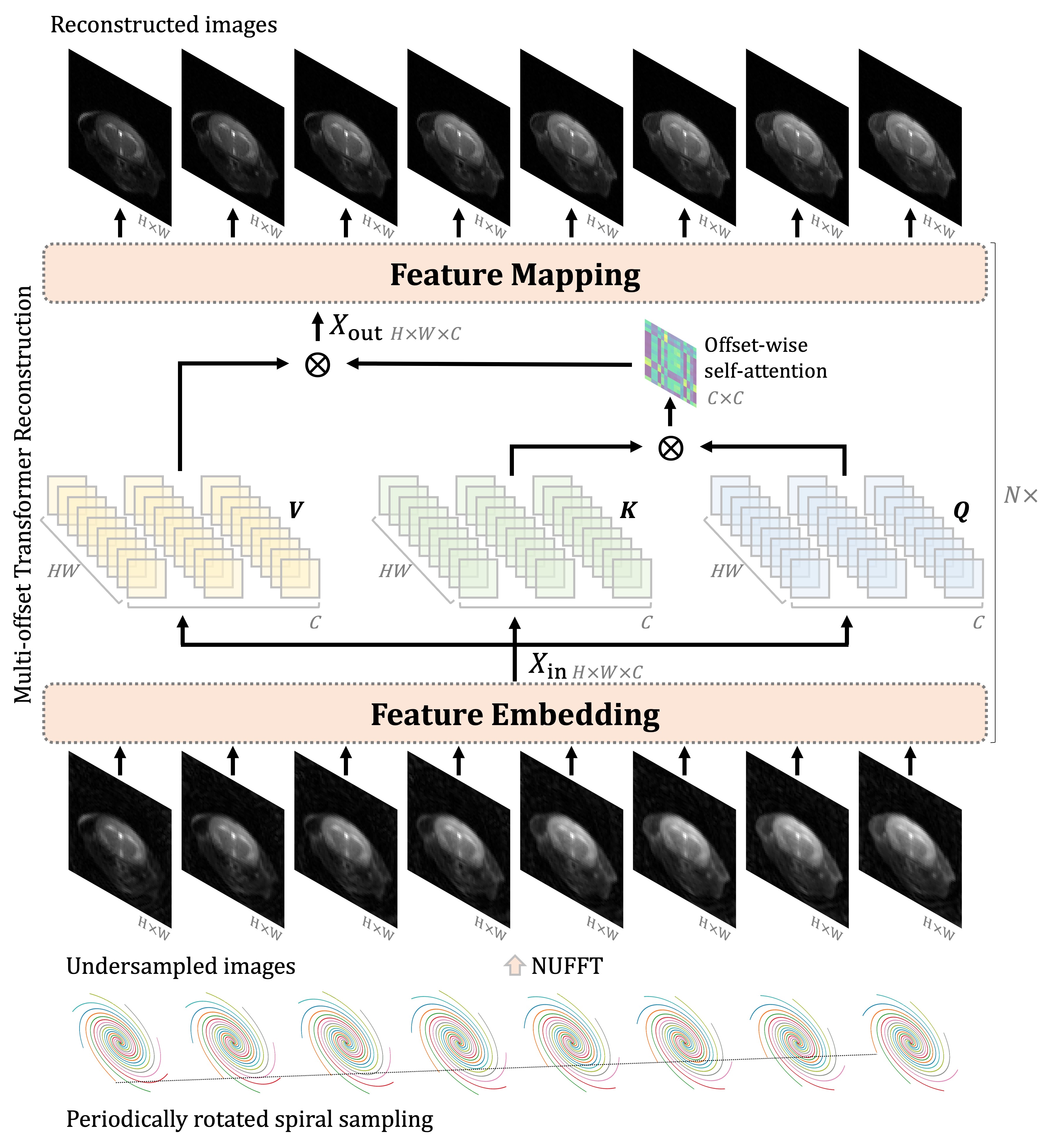
Figure. 1. Diagram of the proposed periodically rotated spiral sampling (PRSS) and multi-offset transformer reconstruction (MoTR) network.
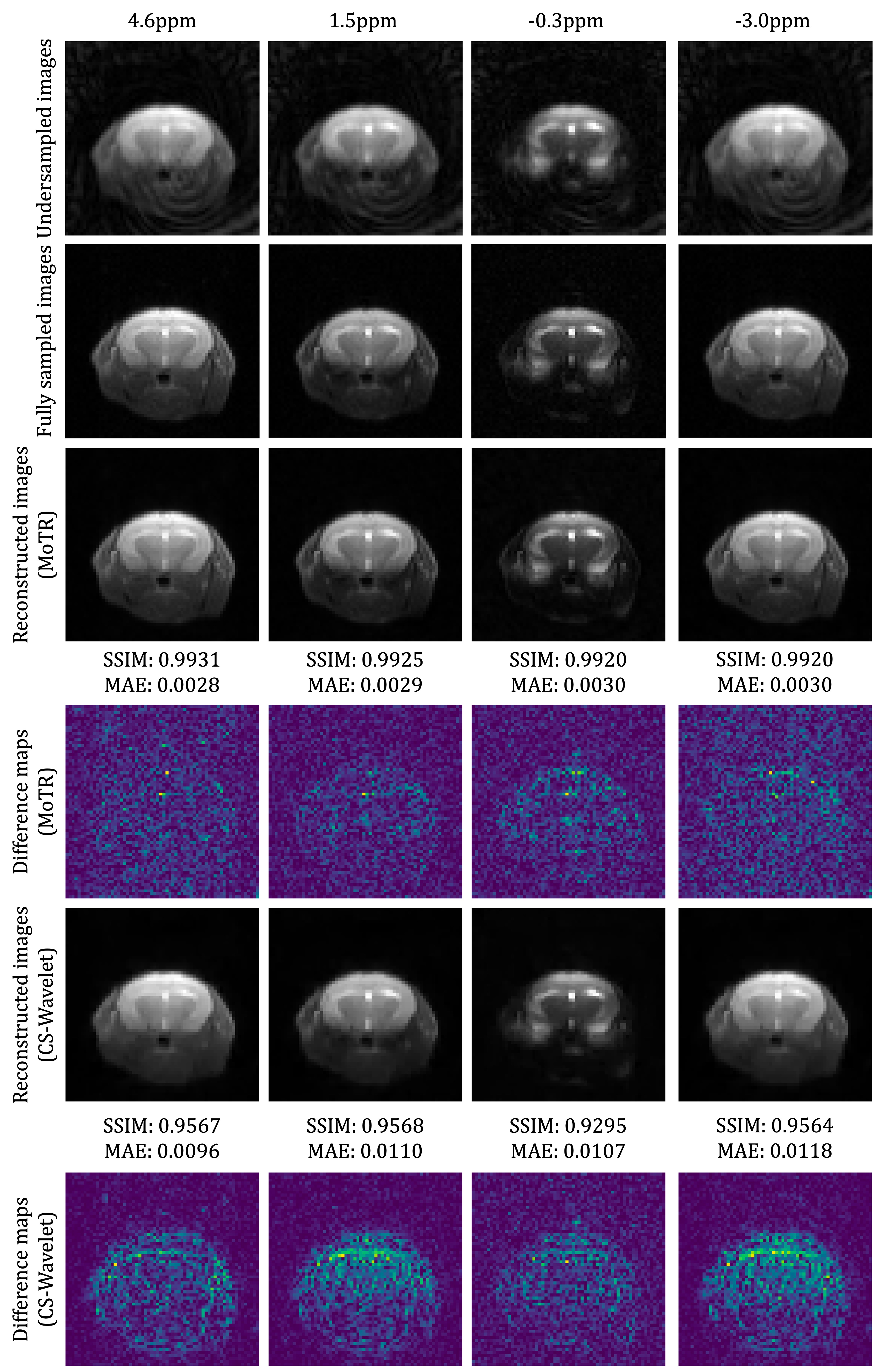
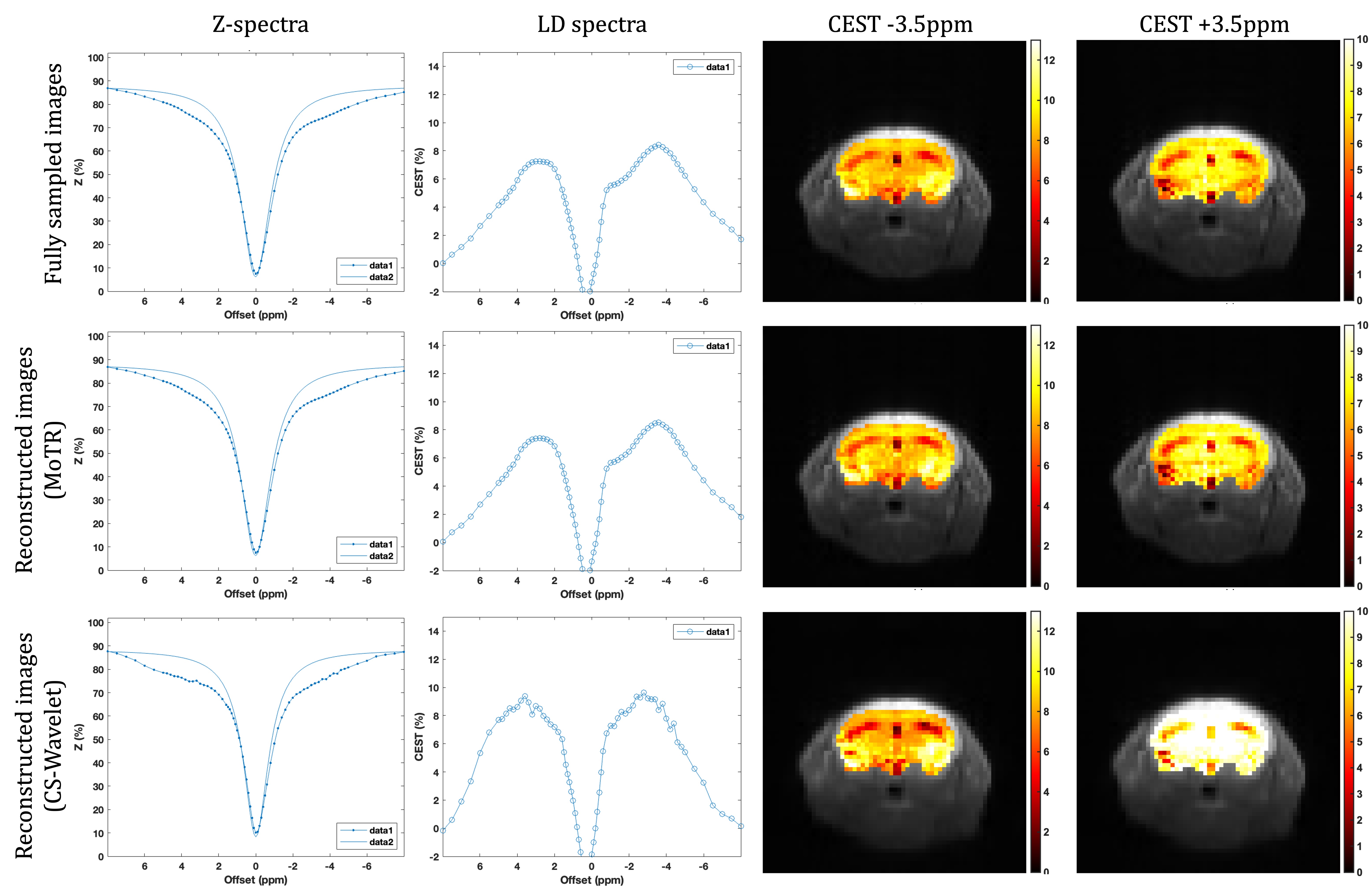
Figure. 3. Z-spectra, LD spectra, and CEST maps produced by fully-sampled images, MoTR reconstructed images, and CS-Wavelet reconstructed images.
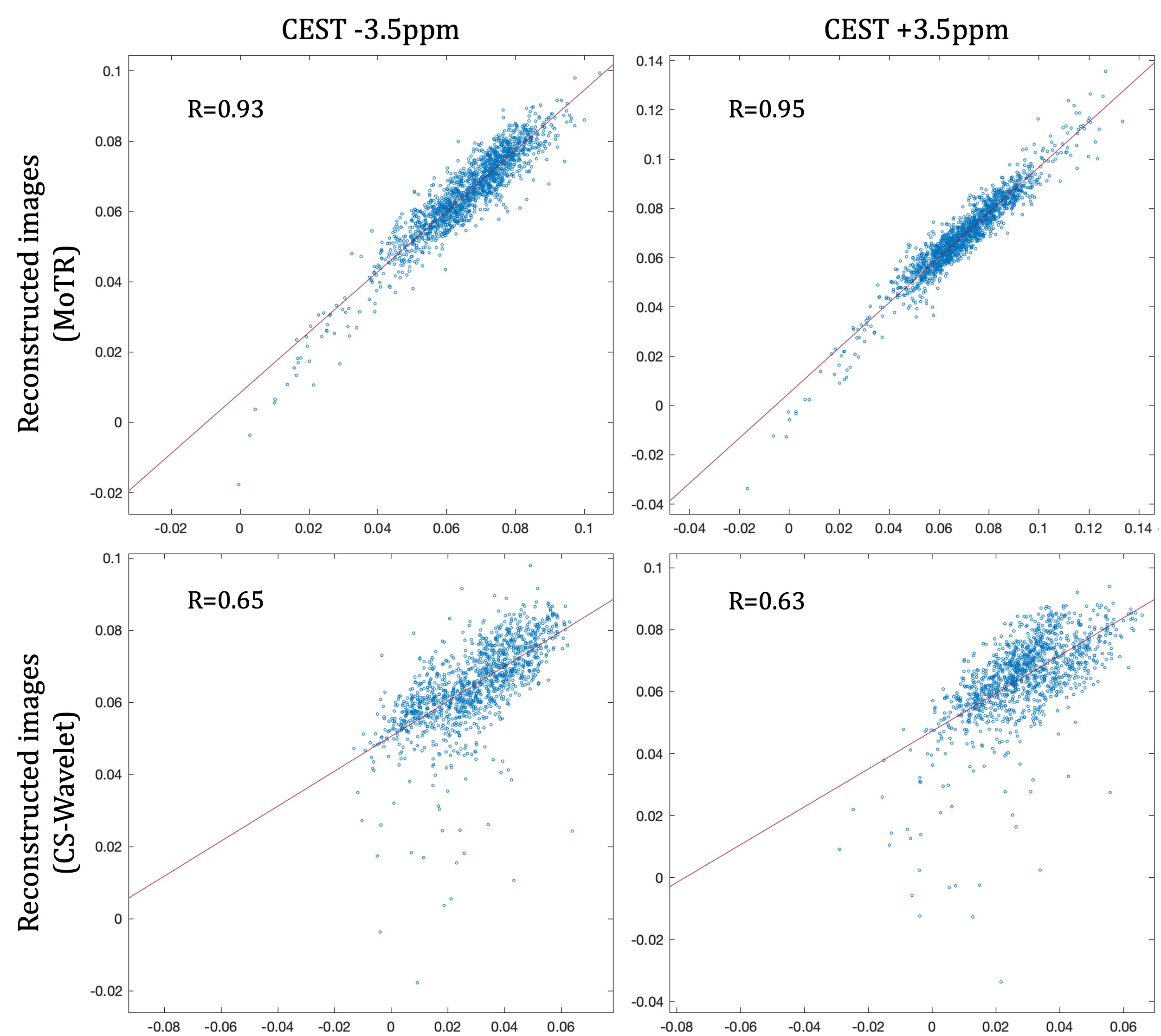
Figure. 4. Correlation of CEST signals between fully-sampled images and MoTR/CS-Wavelet reconstructed images for all testing data.