4422
Advanced Quadratic RF Phase Selective Encoding through Nutation and Fingerprinting (qRF-SENF) for Gradient-Free Quantitative Imaging1Biomedical Engineering, Vanderbilt University, Nashville, TN, United States, 2Vanderbilt University Institute of Imaging Science, Vanderbilt University, Nashville, TN, United States, 3Physics, Case Western Reserve University, Cleveland, OH, United States, 4Radiology, Case Western Reserve University, Cleveland, OH, United States, 5Biomedical Engineering, Case Western Reserve University, Cleveland, OH, United States
Synopsis
Keywords: Quantitative Imaging, Quantitative Imaging
Motivation: Eliminate the need for B0 gradients and improve the efficiency of quantitative imaging.
Goal(s): To develop an advanced approach for gradient-free quantitative imaging called Quadratic RF Phase Selective Encoding through Nutation and Fingerprinting (qRF-SENF).
Approach: Design an improved sequence for qRF-SENF that increases sensitivities to off-resonance and relaxation parameters. Validate the advanced approach with a 1D experiment. Evaluate the SNR efficiency of the approach in simulation.
Results: Successfully validated an improved sequence for qRF-SENF with a 1D experiment that differentiates between two materials. Simulations of SNR efficiency show the advanced approach has sufficient SNR for current and future experiments.
Impact: Selective Encoding through Nutation and Fingerprinting (SENF) is a gradient-free quantitative imaging technique that simultaneously encodes spatial and quantitative information with the potential to be implemented on low-cost MRI scanners with flexible magnet design and acquisition strategies.
Introduction
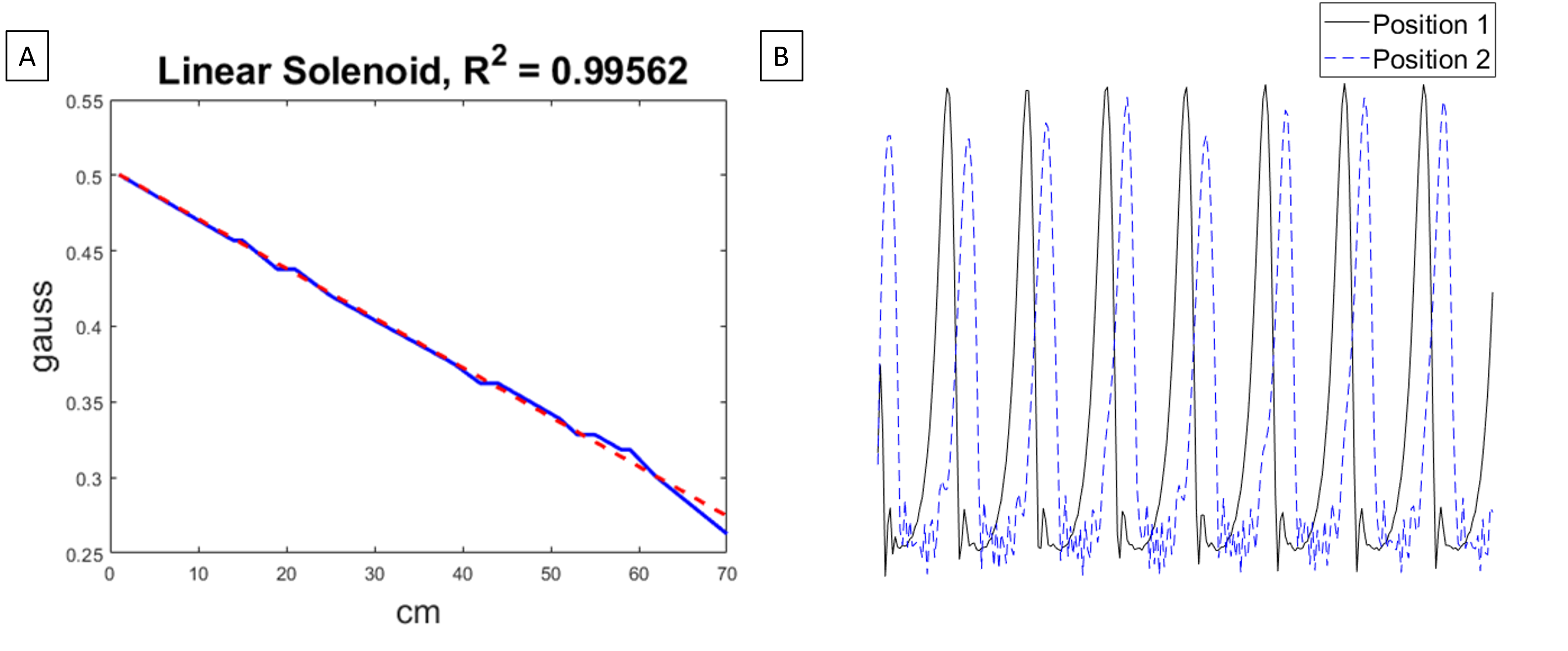
Conventional MRI uses B0 gradients for spatial encoding, which are expensive, bulky, noisy, prone to breakage, and induce PNS. Several spatial encoding methods have been proposed that use RF gradients1-4 instead of B0 gradients, but none enable quantitative imaging of tissue parameters such as T1&T2 relaxation times. Selective Encoding through Nutation and Fingerprinting (SENF)5-7, can accomplish RF spatial encoding and quantitative imaging simultaneously using MR Fingerprinting7-like sequences that encode space as an additional dimension. One SENF embodiment uses quadratic RF phase modulation paired with Bloch-Siegert-shift-based mapping of space to frequency (Figure 1B) via an RF gradient coil (qRF-SENF; Figure 1A)9,10. However, its original implementation suffered low sensitivity and limited power to simultaneously encode space, T1&T2 relaxation and off-resonance. In this work we demonstrate an advanced qRF-SENF acquisition and reconstruction which alleviates these limitations via flip angle modulation and the use of multiple Bloch-Siegert pulse polarities. We further report an evaluation of the method’s SNR efficiency.Methods
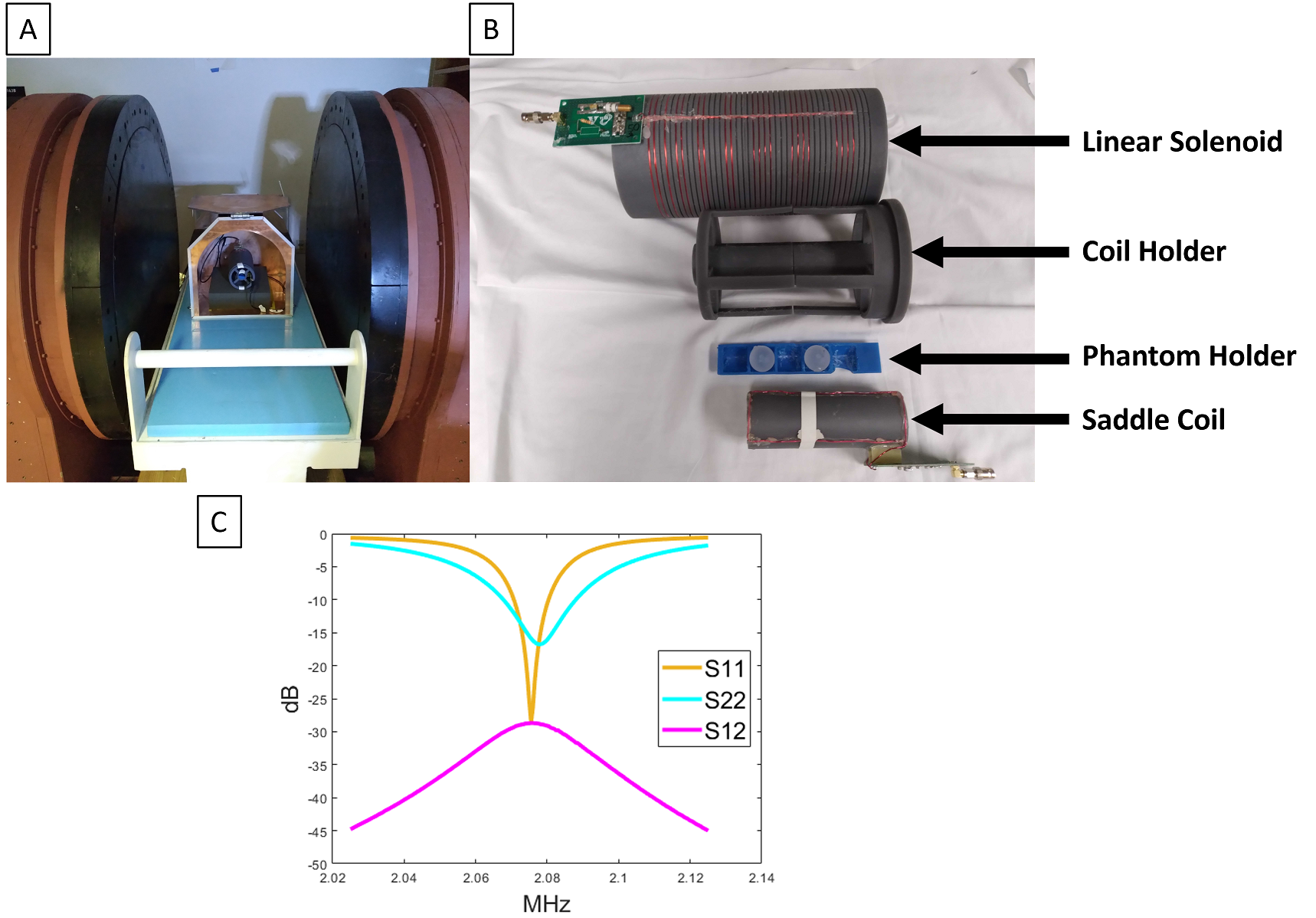
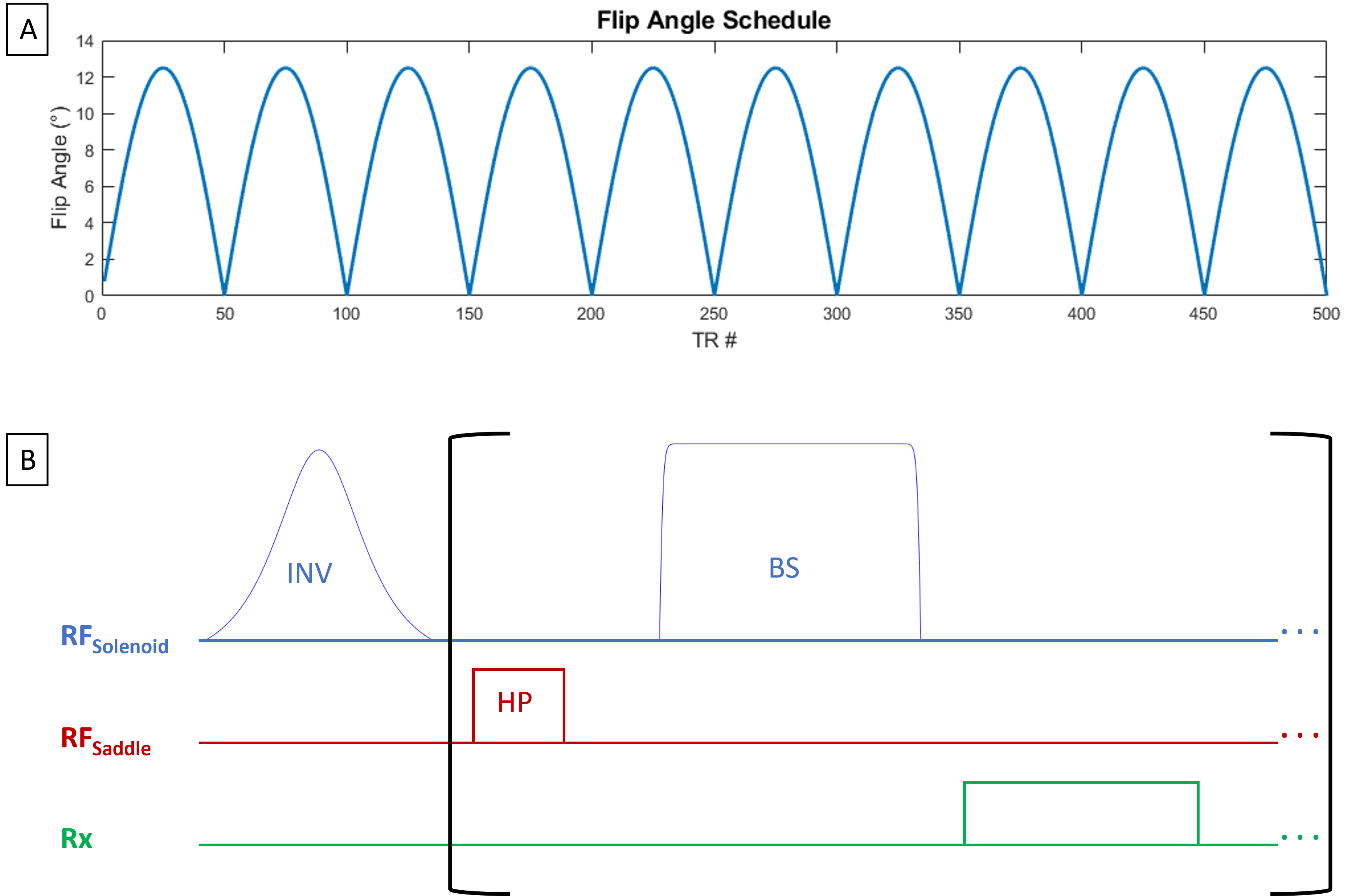
A linear-pitch solenoid RF gradient coil (r=6cm and L=20cm) was constructed with a uniform saddle coil (r=1.75cm and L=12cm) on a coil holder positioning it in the center of the solenoid (Figure 2). The coils were geometrically decoupled by 30dB and another 40dB with a Reed relay TR switch. The phantom holder was used for positioning a 2.5cm ball phantom of mineral oil (T1=104ms, T2=96ms). The setup was placed in a shielded box to minimize EMI. The experiments were performed on a 47.5mT low-field scanner.The sequence (Figure 3B) consists of an inversion pulse followed by a series of hard pulse excitations with a sine-modulated flip angle schedule shown in Figure 3A with quadratically incremented phase each TR at a rate of 5.6TR2. The flip angle schedule was optimized by minimizing off-diagonal correlations within the dictionary to improve spatial and T1&T2 sensitivity. The phase modulated hard pulses were transmitted through the saddle coil and a 10kHz off-resonance 9ms Bloch-Siegert pulse was transmitted through the linear solenoid and scaled to produce a π phase ramp across the FOV. The Bloch-Siegert pulse polarity was negated for the second half of the sequence to produce a -π phase ramp. The accrued phase from off-resonance has a constant sign for the duration of the sequence, while the accrued phase from the Bloch-Siegert shift negates between Bloch-Siegert pulse polarities providing sensitivity to off-resonance while minimizing its effect on spatial encoding. The sequence consisted of N=500 TRs 16ms each in length and a 1 second delay between the 16 averages taken for a total scan time of 144 seconds.
For the experiment a mineral oil ball phantom was placed in the phantom holder centered at 4.6cm in an 8cm FOV.
A Bloch simulation generated signal time courses across B1 amplitudes for an 8cm FOV for mineral oil (T1=104ms, T2=96ms) and doped water (T1=330ms, T2=220ms) at a spatial resolution of 1mm, using a measured B0 map and a B1 map for the RF gradient coil (Figure 1A). The simulated signals were collected in a dictionary and the collected data were reconstructed with a regularized pseudoinverse of the dictionary.
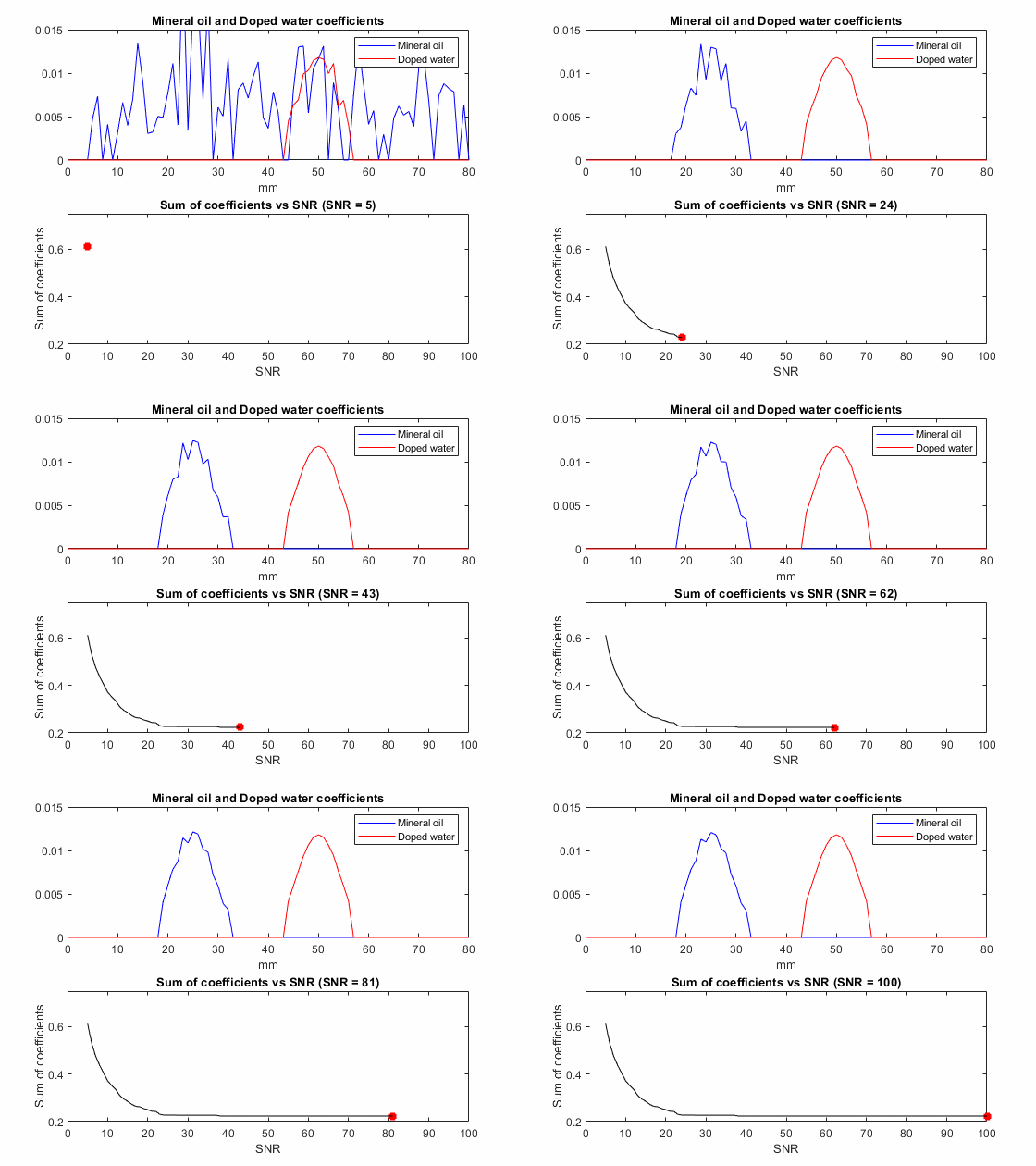
To assess noise sensitivity, the same dictionary was used to synthesize data for a mineral oil and a doped water ball phantom centered at 2.6cm and 5.1cm, respectively. Signals were synthesized by taking a weighted sum across dictionary entries using the expected phantom positions and Gaussian noise was added (SNR=5-100). The data were then reconstructed with a regularized pseudo inverse of the dictionary. The sum of the reconstruction coefficients was evaluated vs SNR to determine the minimum acceptable SNR level.
Results
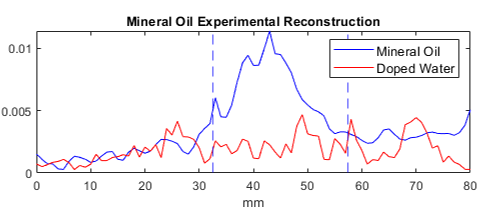
The 1mm resolution reconstruction for the mineral oil experiment matches the expected position (Figure 4), demonstrating that SENF can resolve objects spatially and with a confounding material present in the dictionary. The simulated mineral oil and doped water reconstructions (Figure 5) show that a minimum SNR=24 is required to reconstruct the phantoms without artifacts which can be achieved with our current experiment and sequence if the number of averages is increased from 16 to 23.Discussion
Experimental results showed improved encoding of T1&T2 relaxation times by reconstructing mineral oil accurately with a dictionary that included doped water as a confounding material. The simulation of a two material experiment at various SNR levels shows an SNR=24, achievable with our current sequence with a small increase in averages, is sufficient for a future two-material experiment. Future experiments will further integrate low cost on-board RF power amplifiers11,12 and a parallel transmit array to perform these experiments in 2D. Finally, we will extend this method with B1+-Selective excitations13,14.Acknowledgements
This work is supported by NIH grant R01 EB 032709.References
[1] D. I. Hoult. Rotating frame zeugmatography. J Magn Reson, 33(1):183–197, 1979.
[2] D. Canet. Radiofrequency field gradient experiments. Prog Nuc Magn Reson Spect, 30:101–135, 1997.
[3] J. C. Sharp and S. B. King. MRI using radiofrequency magnetic field phase gradients. Magn Reson Med, 63(1):151–161, 2010.
[4] U. Katscher, J. Lisinski, and P. Boernert. RF encoding using a multielement parallel transmit system. Magn Reson Med, 63(6):1463–1470, 2010.
[5] C. E. Vaughn, M. A. Griswold, W. A. Grissom. MR Barcoding: Gradient-Free MRI Using B1-Selective Parallel Transmission. ISMRM, 2020
[6] Christopher E Vaughn, N Reid Bolding, Mark A Griswold, and William A Grissom, ISMRM 2022, Selective Encoding through Nutation and Fingerprinting (SENF): 1D Experimental Validation on a 47.5 mT Low-Field Scanner
[7] Christopher E Vaughn, N Reid Bolding, Mark A Griswold, and William A Grissom, ISMRM 2023, Selective Encoding through Nutation and Fingerprinting (SENF) using Quadratic RF Phase Modulation and the Bloch-Siegert Shift
[8] D. Ma, V. Gulani, N. Seiberlich, K. Liu, J. L. Sunshine, J. L. Duerk, and M. A. Griswold. Magnetic resonance fingerprinting. Nature, 495:187–192, 2013.
[9] Wang, CY, Coppo, S, Mehta, BB, Seiberlich, N, Yu, X, Griswold, MA. Magnetic resonance fingerprinting with quadratic RF phase for measurement of T2* simultaneously with δf, T1, and T2. Magn. Reson. Med. 2019; 81: 1849– 1862. https://doi.org/10.1002/mrm.27543
[10] Boyacioglu R, Wang C, Ma D, McGivney DF, Yu X, Griswold MA. 3D magnetic resonance fingerprinting with quadratic RF phase. Magn Reson Med. 2021 Apr;85(4):2084-2094. doi: 10.1002/mrm.28581. Epub 2020 Nov 12. PMID: 33179822.
[11] R. Bolding, C E Vaughn, C Blades-Thomas, W A Grissom, and M A Griswold. Low-cost Modular RFPA Platform for Gradient-Free Quantitative Imaging. Submitted to ISMRM 2022, London.
[12] N. Gudino, J. A. Heilman, M. J. Riffe, O. Heid, M. Vester, and M. A. Griswold. On-coil multiple channel transmit system based on class-D amplification and pre-amplification with current amplitude feedback. Magn Reson Med, 70(1):276—289, 2013.
[13] C. H. Cunningham and M. L. Wood. Method for improved multiband excitation profiles using the Shinnar-Le Roux transform. Magn Reson Med, 42(3):577–584, Sep 1999.
[14] W. A. Grissom, Z. Cao, and M. D. Does. B1+-selective excitation pulse design using the Shinnar-Le Roux algorithm. J Magn Reson, 242:189–196, 2014.
Figures