4365
Changed excitation-inhibition balance and dynamic functional connectivity provide evidence for sensory deprivation theory in presbycusis1Shandong Provincial Hospital Affiliated to Shandong First Medical University, Jinan, China, 2Russell H. Morgan Department of Radiology and Radiological Science, The Johns Hopkins University School of Medicine, Baltimore, MD, United States, 3Philips Healthcare, Shanghai, China
Synopsis
Keywords: Other Neurodegeneration, Spectroscopy, Presbycusis, dynamic functional connectivity, cognitive impairment
Motivation: To learn more about neurophysiological changes in the cognitive-ear link in presbycusis.
Goal(s): To explore the role of excitation-inhibition (EI) balance and dynamic functional connectivity (dFC) in mediating the associations between hearing loss and cognitive impairment in presbycusis patients.
Approach: MRS in the auditory cortex and resting-state fMRI of whole brain in 98 presbycusis patients and 60 healthy controls were assessed.
Results: EI balance and dFC indices were statistically different between presbycusis patients and healthy controls. Hearing loss can affect cognition via a bottom-up route from ear to cognitive in a neurochemical and dFC way in presbycusis.
Impact: Shifted EI balance and dFC abnormalities play important roles in cognitive-ear link reorganization and provide evidence for sensory deprivation theory, and they can serve as a potential neuroimaging marker for predicting cognitive impairment in presbycusis patients.
Introduction
Sensory deprivation theory is an important hypothesis in the potential pathways between presbycusis and cognitive impairment, which emphasizes that prolonged sensory deprivation in presbycusis patients causes long-lasting changes and reorganization in brain structure and function, such as neural deafferentation, cortical reallocation, and atrophy. However, neurophysiological changes in the cognitive-ear link still remain to be explored.Methods
Magnetic resonance spectroscopy (MRS), RS functional MRI and 3D T1-weighted MRI data were acquired from 98 PC patients and 60 healthy controls (HCs) using an eight-channel phased-array head coil within a 3.0 T Philips Achieva TX scanner. MRS data was processed for calculating E/I ratio, i.e. EI balance. Resting-state fMRI data underwent sliding-window correlations, to identify recurring dFNC states and between-group dFNC differences in brain functional networks. Statistical analyses were conducted using SPSS 12. Student’s t-test, Pearson’s chi-square test, and Pearson's correlation analyses were used for different variables. The PROCESS Macro in SPSS was applied for further mediation study.Results
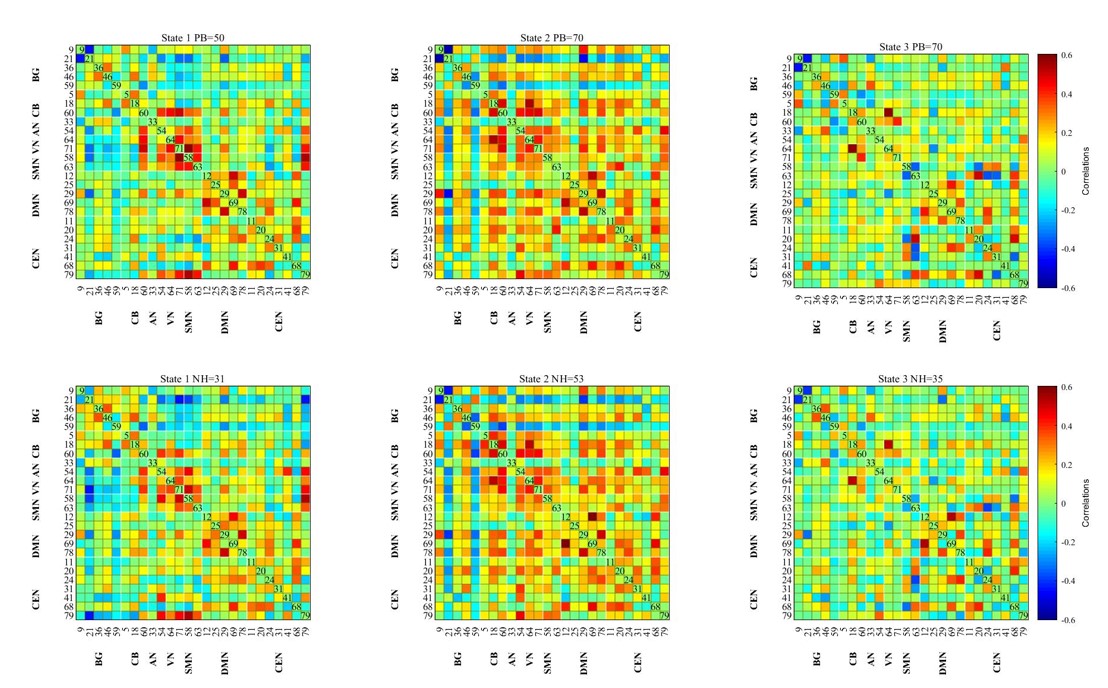
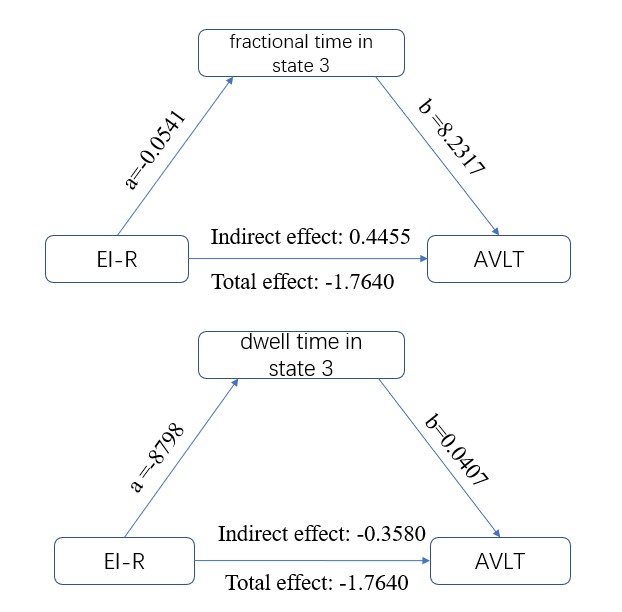
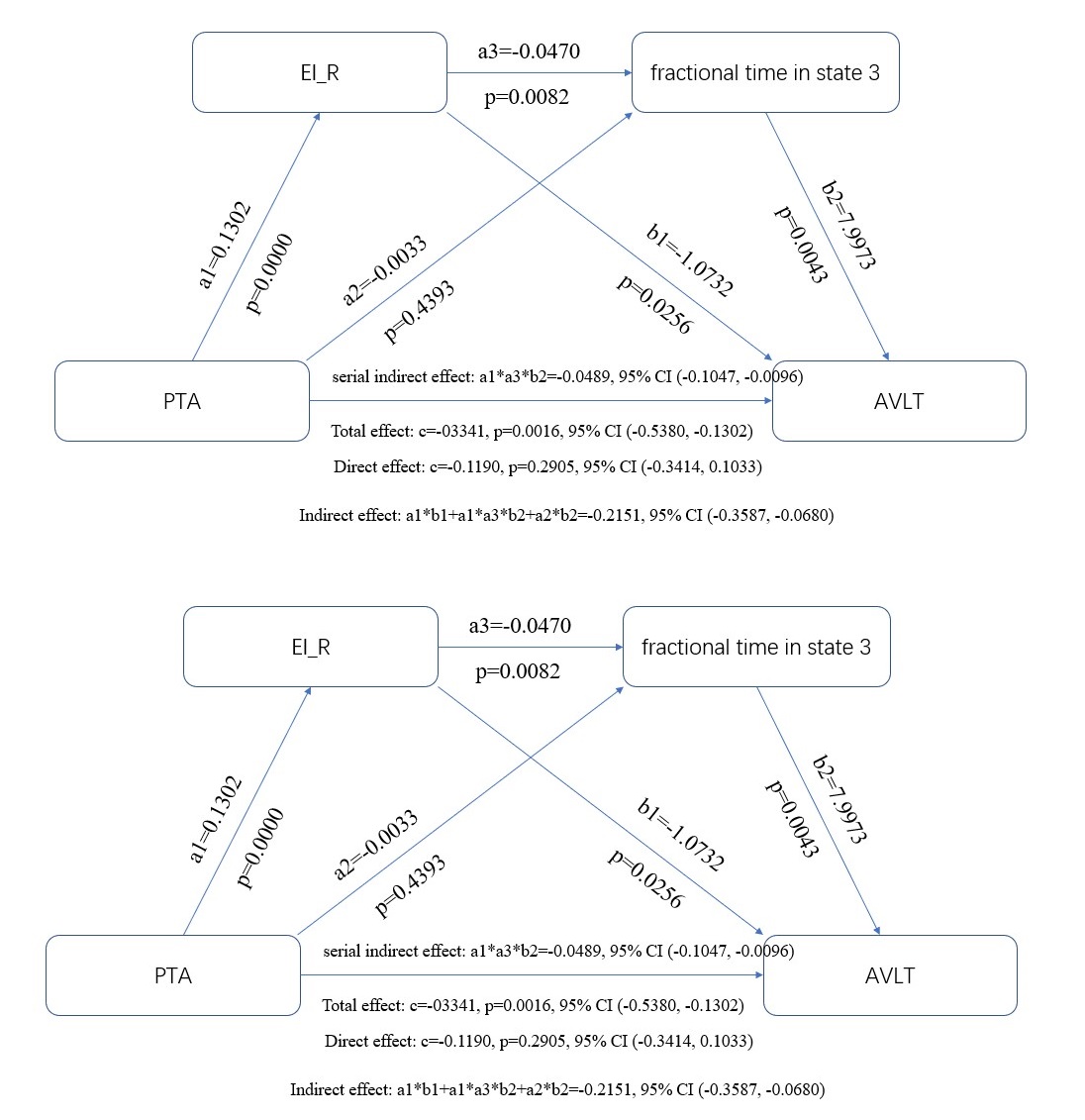
Pure tune average (PTA) and auditory verbal learning test (AVLT) scores were statistically significant between patients with presbycusis and healthy controls. E/I balance in the right auditory cortex shifts toward excitation in PC patients compared to HCs. DFNC identified three recurring connectivity states: State 1 (frequency of appearance during fMRI acquisition=25.40%, middle-high dFC strength with negative functional connectivity), State 2 (frequency=39.10%, high dFC strength) and State 3 (frequency=35.50%, low dFC strength). Compared to HC, PC patients exhibited higher fractional windows and dwell time in State 3 dFC (p<0.001, corrected), and lower dwell time in States 2. In the simple mediation model, both fractional windows and dwell time in state 3 were negatively correlated with EI balance in right auditory regions but positively correlated with AVLT scores. In mediation analysis, EI balance in right auditory regions was positively correlated with PTA but negatively correlated with both fractional windows and dwell time in state 3, and both fractional windows and dwell time in state 3 were positively correlated with AVLT scores. Meanwhile, the E/I balance in right auditory cortex and the fractional windows, as well as dwell time in state 3, mediated the relationship between PTA and AVLT scores in presbycusis.Discussion
It was found in previous study that EI balance plays a pivotal role in the processing of acoustic information within the human nervous system, and EI balance emerges as a pivotal determinant in the stability of the network. This study unveiled a noticeable shift in the EI balance and marked changes in the temporal characteristics of dFC, which have been found to be closely intertwined with both auditory and cognitive impairment, thereby substantiating the evidence for sensory deprivation's impact in cognitive-ear link. EI ratio, along with the reduced fractional windows and dwell time in sparse dFC mediate the relationship between hearing loss and the ability of episodic verbal learning and recall in presbycusis patients, suggesting that neurochemical metabolites and dFC play important roles in potential pathway from hearing to cognition. Importantly, the EI balance, affected by hearing loss, regulating brain network connectivity and associated with cognitive impairment directly, plays an essential role in the reorganization of cognitive-ear link.Conclusion
Above all, these findings greatly facilitate our comprehension of the relationship between neural mechanisms and cognitive impairment in individuals with presbycusis. Hearing loss can affect cognition via a bottom-up route from ear to cognitive in a neurochemical and dFC way, which support the reorganization under partial hearing deprivation of the cognitive-ear link in patients with presbycusis. The EI balance and dFC hold promise as potential biomarkers for investigating and predicting cognitive impairment.Acknowledgements
Over the course of my researching and writing this paper, I would like to express my thanks to all those who have helped me. A special acknowledgement should be shown to Doctor Fei Gao, who gave me kind encouragement and useful instruction all through my writing. Sincere gratitude should also go to all my partners, friends and family who have greatly helped me in my study as well as in my life.
This work was supported by the National Natural Science Foundation of China (Nos. 61701342, 81601479); Taishan Scholars Project of Shandong Province (No. tsqn201812147); Tianjin Natural Science Foundation (No. 19JCQNJC13100); Shandong Provincial Natural Science Foundation of China (grant nos. ZR2021MH030, ZR2021MH355), Jinan Science and Technology Development Program of China (No. 202019098), and the Academic Promotion Programme of Shandong First Medical University (grant no. 2019QL023).
References
1. Powell, D.S., et al., Hearing loss and cognition: what we know and where we need to go. Frontiers in aging neuroscience, 2022. 13: p. 769405.
2. Li, N., et al., Neurochemical and functional reorganization of the cognitive-ear link underlies cognitive impairment in presbycusis. NeuroImage, 2023. 268: p. 119861.
3. Xing, C., et al., Abnormal static and dynamic functional network connectivity in patients with presbycusis. Frontiers in Aging Neuroscience, 2021. 13.
4. Kim, J., et al., Abnormal intrinsic brain functional network dynamics in Parkinson's disease. Brain, 2017(11): p. 11.
5. Fiorenzato, E., et al., Dynamic functional connectivity changes associated with dementia in Parkinson's disease. Brain, 2019. 142(9).
Figures