4269
Acceleration of multi-echo high resolution brain imaging using variable-density sampling and patch-based regularization framework1Biomedical Engineering Department, School of Biomedical Engineering and Imaging Sciences, King's College London, London, United Kingdom, 2London Collaborative Ultra high field System (LoCUS), London, United Kingdom, 3School of Engineering, Pontificia Universidad Católica de Chile, Santiago, Chile, 4Institute for Biological and Medical Engineering, Pontificia Universidad Católica de Chile, Santiago, Chile
Synopsis
Keywords: Image Reconstruction, High-Field MRI
Motivation: Long acquisition times facilitate the acquisition of high resolution multiparametric maps at 7T, however long scan times can lead to motion artefacts even with accelerated k-space sampling.
Goal(s): Our goal is to reduce acquisition time and reduce motion artefacts using variable-density sampling.
Approach: We use the variable-density-cartesian-trajectory (VD-CASPR) to retrospectively undersample the k-space of fully-sampled multi-echo GRE data in spiral-like interleaves for acceleration factors 6, 8 and 10. HDPROST regularisation framework is used to reduce motion artefacts taking advantage of the multiple echoes by patch-based denoising.
Results: HDPROST enables greater acceleration potential taking avantage of the information redundancy and incoherent aliasing across echoes.
Impact: This work demonstrates a reconstruction technique that may allow for faster high-resolution quantitative mapping which may be beneficial for a range of neurological applications, especially in the identification and characterization of small scale brain architecture and its alteration in pathology.
Introduction
High resolution quantitative mapping is beneficial for a range of neuro applications[1] but scan times can be long. For multi-echo gradient echo (MEGRE) sequences we previously showed that longer repetition times (TRs) facilitate the acquisition of high-resolution multi-parametric maps at 7T[2] but these can be clinically infeasible. Parallel Imaging reconstruction from multiple coils is the most common approach to reconstruct images with uniform undersampling of k-space data to accelerate scan[3]. However this may lead to remaining aliasing and artefacts at large acceleration factors. In this study, we investigate the use of variable density undersampling and patch-based low-rank reconstruction to further accelerate multi-echo sequences at 7T. We use a variable-density Cartesian trajectory (VD CASPR)[4] to retrospectively undersample the k-space of a fully-sampled MEGRE acquisition in spiral-like interleaves on a Cartesian grid. Acceleration factors of 6, 8 and 10 are used to generate the undersampled data using two types of scenarios: (a) same VD-CASPR pattern for all echoes, and (b) rotating the undersampling pattern across echoes to introduce aliasing and motion incoherence. Reconstructions for the undersampled data were performed using a patch-based low-rank regularization (HD-PROST) framework[5]. Image quality is quantified using gradient entropy and normalized gradient-square metric[6].Methods
Data acquisition: Data acquisition was performed at 7T (Siemens, MAGNETOM) for two healthy volunteers(HV). For HV1, a 10-echo GRE at 1mm3 resolution dataset was acquired with echo times TE1/TE2/..TE10 = 2.0/4.6/…25.3ms and TR=30ms. Additional sequence parameters were FOV=203x195x160mm3, flip angle/BW = 36°/420Hz/px. The total time of acquisition was Tacq =12:26[min:s].For HV2, a 7-echo GRE at 0.7mm3 resolution dataset was acquired with TE1/TE2/..TE7=2.7/6.1/...23.5ms and TR=27ms. Additional sequence parameters were FOV=256x278x157 mm3 and flip angle/BW=39°/310 Hz/px. The total time of acquisition was Tacq=24:50[min:s].The data was fully sampled with an elliptical shutter.
Reconstruction CG-SENSE: For the ground truth reconstruction, CG-SENSE was used to reconstruct all the fully sampled echoes for tolerance residual=10-10, maximum iterations=15. For the cases where data was undersampled, CG-SENSE was also performed for comparison purposes. Coil compression[7] to 16 channels was performed prior reconstruction. Sensitivity maps for each echo were calculated from the k-space centre using the ESPIRiT[8].
Undersampling with VD-CASPR: The VD-CASPR defines a spatial encoding trajectory that samples the phase-encoding plane following spiral-like interleaves on the Cartesian grid[9] allowing for denser sampling of k-space centre. Undersampling was done keeping golden angular step between two consecutive spirals. Undersampling was simulated computationally for acceleration factors 6,8 and 10. Two sampling scenarios were considered (a)using identical sampling trajectories for all echo volumes, and (b)sampling the echo volumes such that the spiral interleaves between subsequent volumes were rotated (shifted) by golden angle to introduce incoherence in aliasing.
HD-PROST reconstruction: HD-PROST is a regularization framework that performs an iterative low-rank high-order singular value decomposition (HOSVD) of tensors obtained from multiple contrasts (with structural and contrast similarity) which in our case were the multiple echo volumes with different T2* weighting. The thresholding parameter σ=0.0051 and regularisation parameter 𝜆=0.1 were used.
Analysis: Comparisons were performed between the undersampling scenarios (a) and (b) for acceleration factor 6,8 and 10 using visual assessment and gradient entropy analysis on the segmented whole brain volume. Analysis was done to quantify the difference for the whole brain segmented volume for the different scenarios.
Results
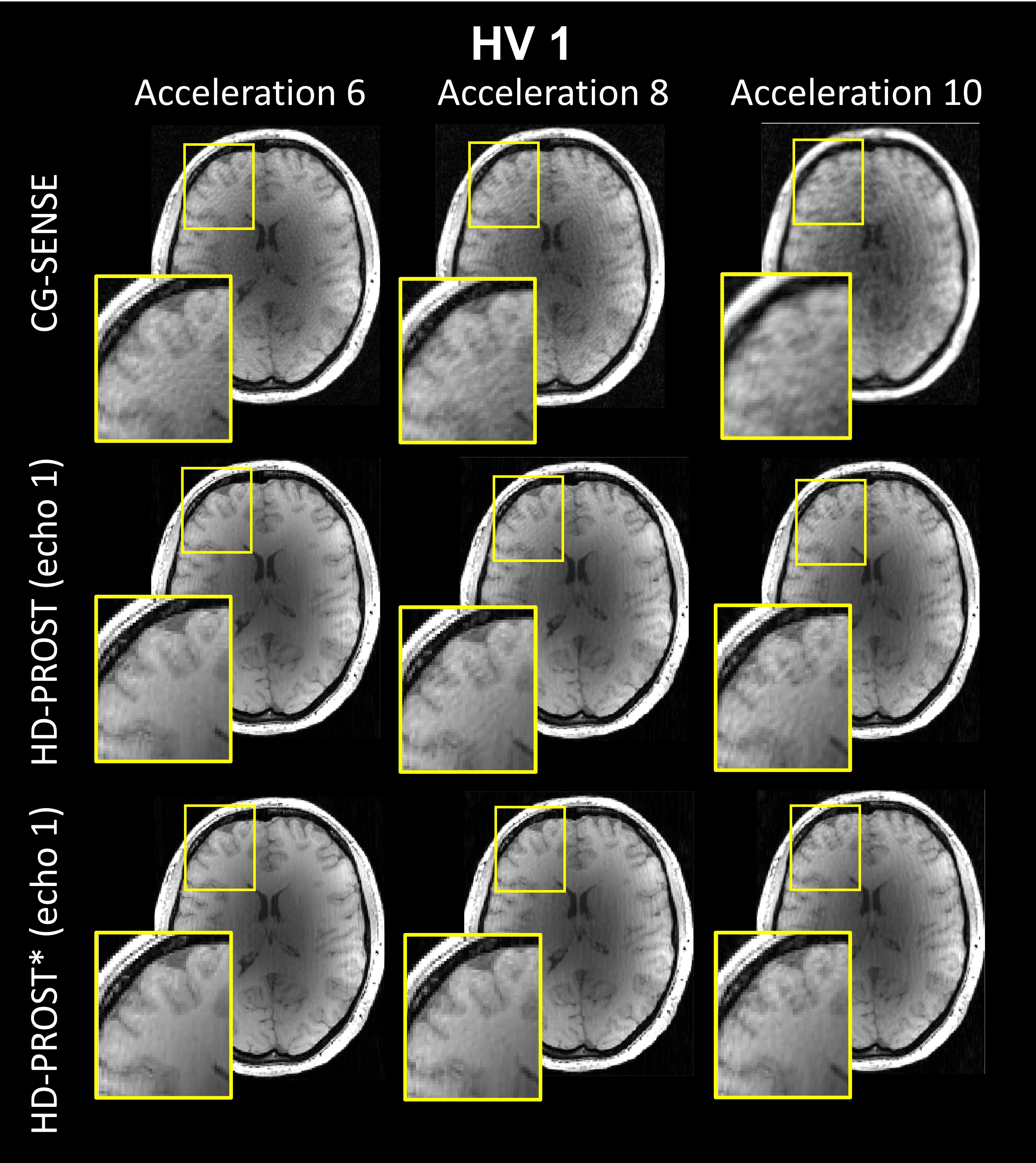
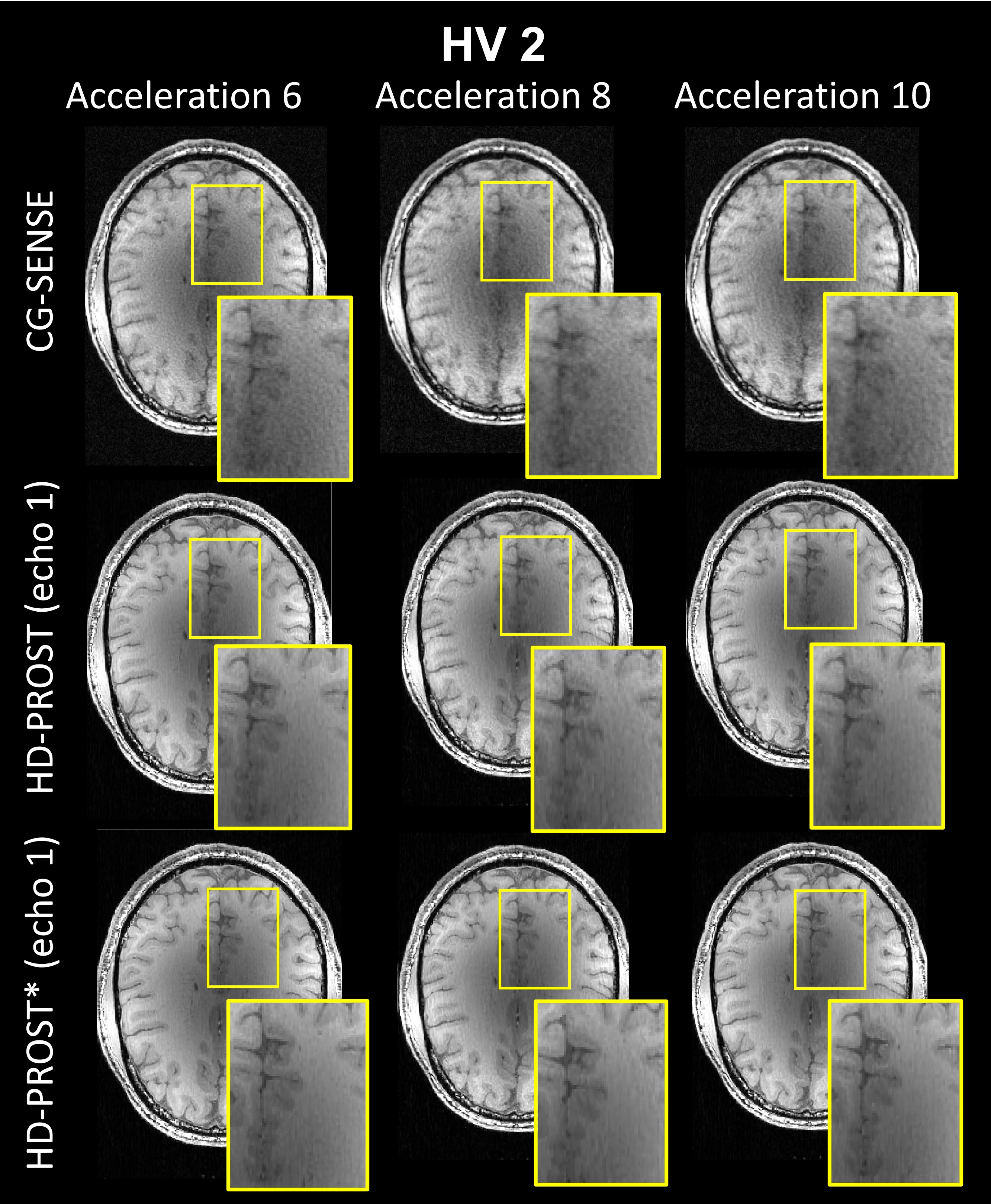
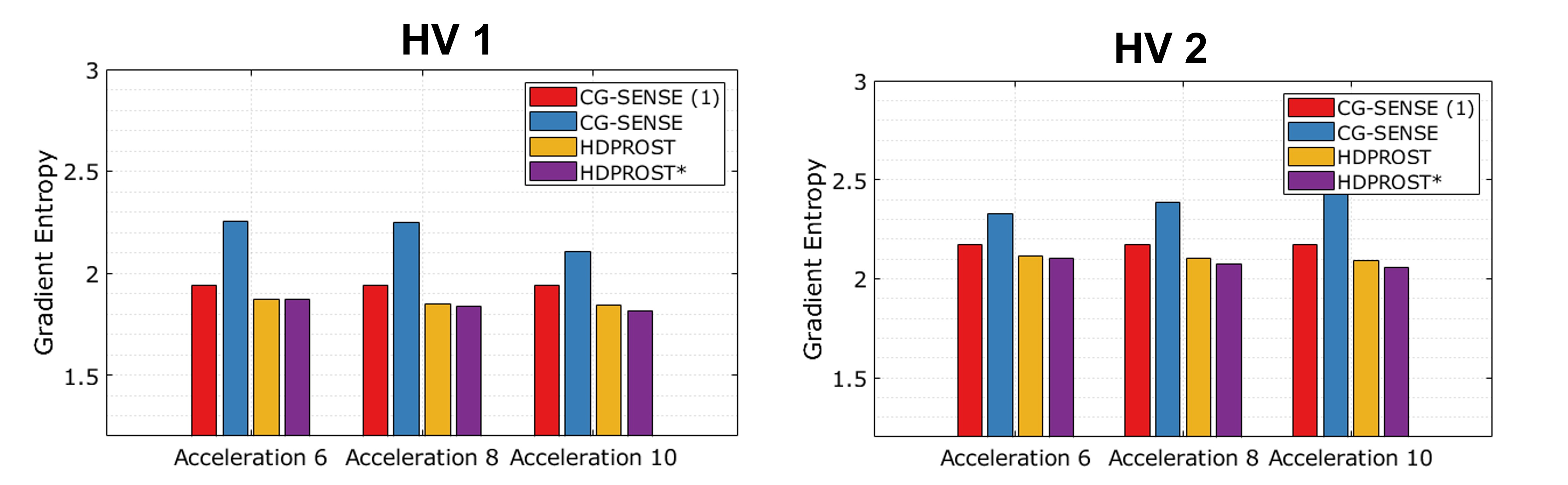
Fig 1 shows the results of the reconstructions for HV1 and HV2 for acceleration factors 6,8 and 10. The top row corresponds to the CG-SENSE reconstruction for the first echo for each dataset. The second and third row correspond to the HD-PROST reconstruction for sampling scenarios (a) and (b) respectively. The inset shows the representative ROI corresponding to the gradient entropy values in the bar plots as shown in Fig. 2. Fig. 2 shows the gradient entropy of the ROIs from the different reconstruction strategies for both HVs. HD-PROST reduces the gradient entropy of the image compared to CG-SENSE for all acceleration factors. HD-PROST* (shifted,scenario b) reconstruction results in lower or equal gradient entropy as compared to the non-shifted (scenario a) HD-PROST for all cases.Discussion
We have used redundancy within ME-GRE, the multi-echo images are inherently coregistered and display similar contrast making them uitable for this reconstruction approach. Comparison of performance with compressed sensing[10] is yet to be explored but previous work [6] showed HD-PROST was superior.Conclusion
HD-PROST enables significantly greater acceleration potential than standard parallel imaging approaches owing to the exploitation of information redundancy consistent with previous work. There is a clear advantage to altering the phase-encoding between echoes to decrease artifact coherence across the echo-train.Acknowledgements
This work was supported by EPSRC CDT PhD studentship (JM). This work was supported also by the Wellcome/EPSRC Centre for Medical Engineering [WT203148/Z/16/Z] and by the National Institute for Health Research (NIHR) Biomedical Research Centre based at Guy’s and St Thomas’ NHS Foundation Trust and King’s College London and/or the NIHR Clinical Research Facility. The views expressed are those of the author(s) and not necessarily those of the NHS, the NIHR or the Department of Health and Social Care. This research was also supported by GOSHCC Sparks Grant V4419 (DC)References
- Carey, D., Caprini, F., Allen, M., Lutti, A., Weiskopf, N., Rees, G., Callaghan, M. F., & Dick, F. (2018). Quantitative MRI provides markers of intra-, inter-regional, and age-related differences in young adult cortical microstructure. Neuroimage, 182, 429.
- Mangal J., Carmichael D., et al, (2023), Proc. ISMRM
- Kelton, J., Magin, R. M., & Wright, S. M. (1989). An algorithm for rapid acquisition using multiple receiver coils. Proc of the 8th Annual SMRM, Amsterdam, 1172.
- Prieto C, Doneva M, Usman M, et al. (2015) Highly efficient respiratory motion compensated free-breathing coronary MRA using golden-step Cartesian acquisition. J Magn Reson Imaging ;41:738–46.
- Bustin A, Lima da Cruz G, Jaubert O, Lopez K, Botnar RM, Prieto C. (2019) High-dimensionality undersampled patch-based reconstruction (HD-PROST) for accelerated multi-contrast MRI. Magn Reson Med. Jun;81(6):3705-3719.
- McGee, K.P., Manduca, A., Felmlee, J.P., Riederer, S.J. and Ehman, R.L. (2000), Image metric-based correction (Autocorrection) of motion effects: Analysis of image metrics. J. Magn. Reson. Imaging, 11: 174-181
- Zhang, T., Pauly, J.M., Vasanawala, S.S. and Lustig, M. (2013), Coil compression for accelerated imaging with Cartesian sampling. Magn Reson Med, 69: 571-582
- Uecker M, Lai P, Murphy MJ, Virtue P, Elad M, Pauly JM, Vasanawala SS, Lustig M. ESPIRiT--an eigenvalue approach to autocalibrating parallel MRI: where SENSE meets GRAPPA. Magn Reson Med. 2014 Mar;71(3):990-1001.
- Bustin A, Ginami G, Cruz G, et al. Five-minute whole-heart coronary MRA with sub-millimeter isotropic resolution, 100% respiratory scan efficiency, and 3D-PROST reconstruction. Magn Reson Med. 2019;81:102–15
- Ronja C. Berg, Tobias L, Nikolaus W, Christine P,Multi‐parameter quantitative mapping of R1, R2*, PD, and MTsat is reproducible when accelerated with Compressed SENSE,(2022) NeuroImage, Vol 253,119092, ISSN 1053-8119
Figures