4267
Linear Image Reconstruction Technique for MRI with Nonlinear Encoding Fields (Part II) – O-Space Imaging (LIRT-OSI)1Yale School of Medicine, New Haven, CT, United States
Synopsis
Keywords: Image Reconstruction, Image Reconstruction, Non-linear Encoding Field, ART, Kaczmarz, ART, SART, O-space Imaging, OSI
Motivation: The extremely time-consuming iterative algebraic reconstruction techniques(ART), e.g., Kaczmarz, have been used for image reconstruction in MRI with nonlinear encoding fields, e.g., O-space imaging (OSI).
Goal(s): We evaluate the effectiveness and performance of the linear image reconstruction technique (LIRT) for MRI with nonlinear encoding fields with an application of image reconstruction for O-space imaging (OSI).
Approach: The rotation theorem and linearity of 2D Fourier Transform lay the theoretical basis for LIRT image reconstruction for OSI.
Results: We compared the computation time of LIRT with SART for OSI image reconstruction. The final reconstructed images show no visually perceived non-linear distortion for OSI.
Impact: LIRT-OSI further demonstrate how LIRT can be accommodated to a wide range of nonlinear MRI field systems for quick image reconstruction and assessment, which is the first time such a technique has been proposed to the best of our knowledge.
Introduction
We lay the theoretical basis for LIRT in Part I and now we will demonstrate how to extend LIRT to reconstructing images for O-space imaging1 (OSI). The LIRT image reconstruction for OSI (LIRT-OSI) bases itself on the rotation theorem and the linearity of 2D Fourier Transform. We'll do comparisons between LIRT-OSI and SART for OSI image reconstruction.Theoretical Basis
We use the following 2D properties of Fourier transform. Suppose $$$\mathcal{F}\left(u,v\right)=\mathcal{FT}\{f\left(x,y\right)\}$$$ and $$$\mathcal{G}\left(u,v\right)=\mathcal{FT}\{g(x,y)\}$$$, where $$$\mathcal{FT}\{\}$$$ is the Fourier transform operator, and $$$\mathcal{R}$$$ is the 2D rotation operator about the origin, the following 2D properties hold true:\begin{align}\tag{1}\mathcal{FT}\left\{f\left(x,y\right)+g\left(x,y\right)\right\}&=\mathcal{F}\left(u,v\right)+\mathcal{G}\left(u,v\right) \\\tag{2}\mathcal{FT}\left\{\mathcal{R}f\left(x,y\right)\right\}&=\mathcal{RF}\left(u,v\right) \end{align}In OSI1, each radial projection is associated with one O-placement. Any radial projection in the K-space is first rotated so that the projection is aligned with the x-axis (vertical in Fig. 1), the 2D image of that projection is reconstructed using the proposed LIRT-NEF (Part I), the image of that projection is then rotated back to the original angle at which the K-space data were acquired, and the reconstructed 2D images of all radial projections will be summated to generate the final image. The reconstruction steps are summarized in Fig. 1.Methods
In OSI1, the nonlinear encoding gradient has the following quadratic form:\begin{equation}\tag{3}\mu (x,y,t)=xG_{x}(t)+yG_{y}(t)+(x^{2}+y^{2})G_{o}(t)\end{equation}During the imaging of the phantoms1,2, $$$(G_{x}(t), G_{y}(t))$$$ varied so that the K-space data were acquired along radial projections. The vertex of the parabola associated with each projection, or the O-placement, was located at $$$\left(r_{0},0\right)$$$, where $$$r_{0}=-\sqrt{\left(\frac{G_{x}}{2G_{o}}\right)^{2}+\left(\frac{G_{y}}{2G_{o}}\right)^{2}}$$$, along the projection in the presence of the quadratic gradient term $$$G_{o}(t)$$$. The magnitude of the nonlinear component $$$G_{o}=0.002G_{x}=0.002G_{y}$$$. Total 256 radial projections, each of 512 points, were acquired. The center of the 2D image plane, or the origin of the 2D coordinate $$$(0,0)$$$, was chosen as $$$(x_{0},y_{0})$$$, refer to Part I, eq. (5).Results
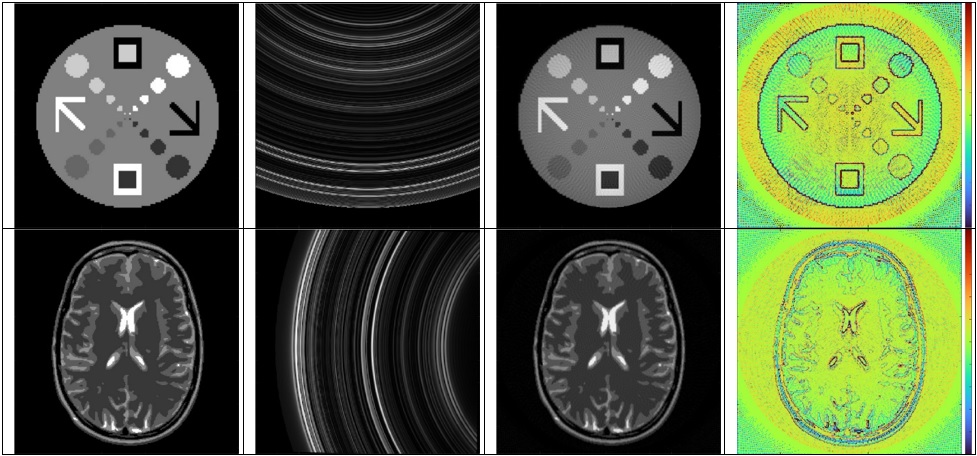
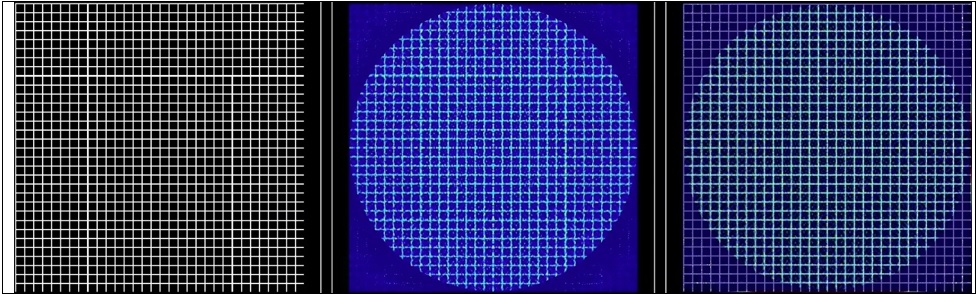
We present the reconstruction results in Fig. 2. A simple grid phantom was also used to evaluate the geometric distortion that might exist in the reconstructed image, results shown in Fig. 3. To evaluate the time efficiency, we compared the computation time of LIRT-OSI with SART3, which is implemented in AIR Tools II, for OSI image reconstruction, and the comparison details are listed in Fig. 4.Discussion
We define the following relative error image to evaluate the LIRT-OSI performance with comparison with SART3:\begin{equation}\tag{4} \Delta I_{rel}\left(i,j\right)=\frac{I_{\textit{recon}}\left(i,j\right)-I_{ref}(i,j)}{mean(all\textit{nonzero}\textit{pixel}\textit{values}inI_{ref})}\end{equation}Where $$$I_{ref}$$$ is the analytical reference, $$$I_{\textit{recon}}$$$ is the reconstructed image, and $$$(i,j)$$$ are the pixel indexes. We have the following observations based on the relative error images (Fig. 2, 4th column): 1) Relative errors up to 10% or more occur along the edges of sharp tissue contrast; 2) In areas lacking of contrast or in the zero background the relative errors are primarily less than 2%; 3) By taking absolute values of all the relative errors and averaging them over all the pixels of a relative error image, we get an overall mean relative error (MRE), which for the analytical phantom and brain, is %3 and 4%, respectively. A summary of comparison in time/MRE with SART is in Fig. 4. Given the time it takes compared to SART, it is fair to say that the LIRT-OSI performance is reasonable and satisfactory. The general pattern of relative error maps indicates the low-pass filtering ``windowing'' effect, or loss of high-frequency components in the K-space, consistent with the common observations in images during radial reconstruction. Oversampling was used to increase the FOV as the nonlinear encoding stretched the linearly DFTed 2D radial images (Part 1, Method, Step 1). With oversampling, the stretched image $$$m(x,y)$$$ of each projection was kept within the FOV before mapping to $$$\hat{m}\left(\hat{x},\hat{y}\right)$$$ (Part I, Method). To calculate the pixel intensity correctly for OSI, an additional factor, in addition to the local gradient factor $$$\frac{\partial \mu }{\partial x}\frac{\partial \mu }{\partial y}$$$ at $$$\left(\hat{x},\hat{y}\right)$$$, was considered because the size of a pixel on a radial projection depends on its position.The error images, together with the overlay of the image on the grid phantom (Fig. 3), seem to show that the linear approximation of the nonlinear encoding gradients has minimal effect on geometric distortion in reconstructed images. For OSI, we set $$$G_{o}=0.002G_{xmax}$$$ in our evaluation. Given that the magnitude of the nonlinear encoding component $$$(x^{2}+y^{2})G_{0}$$$ is a quadratic term of $$$(x,y)$$$, the magnitude is not unreasonably small as it looks.Conclusion
A linear reconstruction method LIRT has been developed for OSI. Compared with the original analytical phantoms, the reconstructed images show good image contrast. Our preliminary results show both the efficiency in the reconstruction time and the effectiveness for the removal of the nonlinear spatial distortion in images.Acknowledgements
No acknowledgement found.References
1. Stockmann, J.P., et al., O-space imaging: Highly efficient parallel imaging using second-order nonlinear fields as encoding gradients with no phase encoding. Magn Reson Med, 2010. 64(2): p. 447-56.
2. Guerquin-Kern, M., et al., Realistic analytical phantoms for parallel magnetic resonance imaging. IEEE Trans Med Imaging, 2012. 31(3): p. 626-36.
3. Andersen, A.H. and A.C. Kak, Simultaneous Algebraic Reconstruction Technique (Sart)
Figures