4263
3D Dual-Polarity GRAPPA for Ghost Correction of Volumetric Echo-Planar Imaging Data1SigProc Expert Solutions, Westwood, MA, United States, 2Siemens Medical Solutions USA Inc, Malvern, PA, United States, 3Athinoula A. Martinos Center for Biomedical Imaging, Massachusetts General Hospital, Charlestown, MA, United States, 4Maastricht University., Maastricht, Netherlands, 5Radiology, Harvard Medical School, Boston, MA, United States, 6Harvard-MIT Division of Health Sciences and Technology, Massachusetts Institute of Technology, Cambridge, MA, United States
Synopsis
Keywords: Artifacts, Artifacts, Nyquist Ghost Correction
Motivation: 3D-EPI suffers from inherent sampling errors, similar to conventional 2D-EPI, which result in Nyquist ghosting and shading artifacts that arise from non-linear phase errors in the sampled data.
Goal(s): To demonstrate that the Dual-Polarity GRAPPA (DPG) reconstruction method can be extended and applied effectively to 3D-EPI data.
Approach: We modified the DPG kernel to extend to all three sampling directions, to better accomodate 3D-EPI data.
Results: Phantom and in-vivo data demonstrate that DPG provides reconstructed images with lower levels of ghost artifacts and reduced artifacts from non-linear phase errors. This extension to DPG will enable high-fidelity reconstructions in future 3D-EPI applications.
Impact: Our extension of Dual-Polarity GRAPPA to a 3D reconstruction kernel can improve image quality for 3D-EPI applications, providing higher fidelity and fewer artifacts than current conventional methods for improved imaging performance in emerging high-resolution fMRI and ultra-high-field imaging applications.
Introduction
Echo-Planar Imaging (EPI) is a workhorse data acquisition method that is widely used in applications where rapid imaging is required. Recent methodology developments have included extending EPI to 3D encoding, where the slice-selective RF pulse is replaced with a slab-selective hard pulse and a second phase-encoding or “partition-encoding” along kz is performed, typically with one shot per partition to encode a full volume of k-space. However, sampling imperfections inherent to 2D-EPI that cause Nyquist ghosting and related artifacts are also present in 3D-EPI. Dual-Polarity GRAPPA (DPG) [1] has been widely demonstrated to be an effective approach to correct 2D-EPI sampling imperfections—particularly in the presence of local field inhomogeniety, where non-linear phase errors may be present. In this work, we extend DPG along the kz encoding dimension to create a 3D DPG kernel, and demonstrate improvements over the standard Nyquist ghost correction approach [2], including higher fidelity volumetric reconstructions.Methods
Nyquist ghost artifacts in EPI arise from a mismatch between data sampled on positive readout gradients (RO+) versus negative readout gradients (RO−). DPG corrects EPI ghosting artifacts by embedding the ghost correction into a set of GRAPPA reconstruction kernels. This increases the flexibility of the the ghost correction model, which provides a means to correct non-linear phase errors. It achieves this by splitting each GRAPPA kernel into two parts, with one-half of the kernel sourcing from RO+ data,while the other half sources from the RO− data. Previous implementations of this approach employed 2D kernels to correct 2D-EPI data. Here we simply extend the DPG kernels extent along kz, while retaining its dual-polarity nature.Results
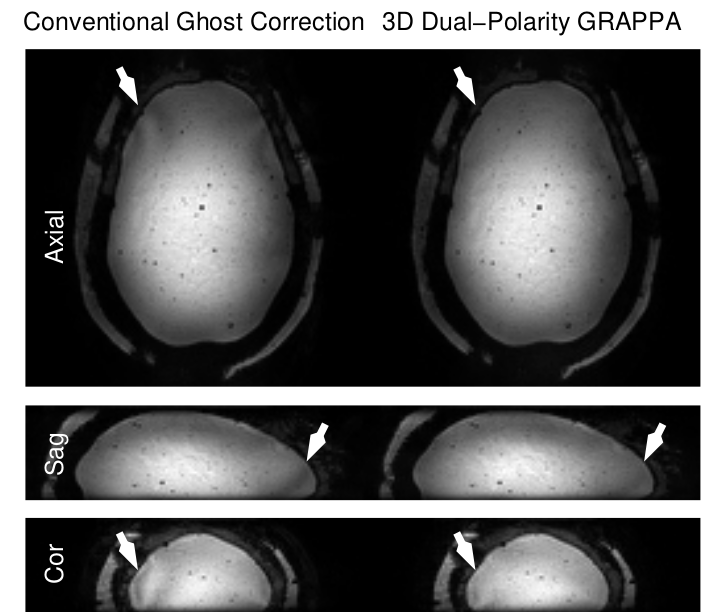
In this work we employed a 2ky-by-5kx-by-3kz DPG kernel to reconstruct multi-shot 3D-EPI data. Anthropomorhic phantom data were acquired on a high-field 7T Terra (Siemens Healthineers, Erlangen, Germany) with acquisition parameters: volume TR=6sec; TE=19msec; 64 receiver channels;matrix size=128x128; 36 partitions; phase-encoding acceleration=3x, partition-encoding acceleration=1x. In-vivo data in three volunteers (provided written informed consent prior to scanning, following all policies of our institution’s Human Subjects Research Committee) were acquired on the same system. A basic 3D-EPI sequence was developed by extending the product 2D-EPI. Standard dual-polarity calibration data were acquired, and processed via GRAPPA-Wash [1 (Fig.10)] to improve SNR and reduce phase error bias.Fig. 1 shows an example reconstruction from the phantom data. Notably, there are image intensity variations consistent with non-linear phase error in the image reconstructed with standard ghost correction. These artifacts are noticeably reduced in the DPG reconstructed image.
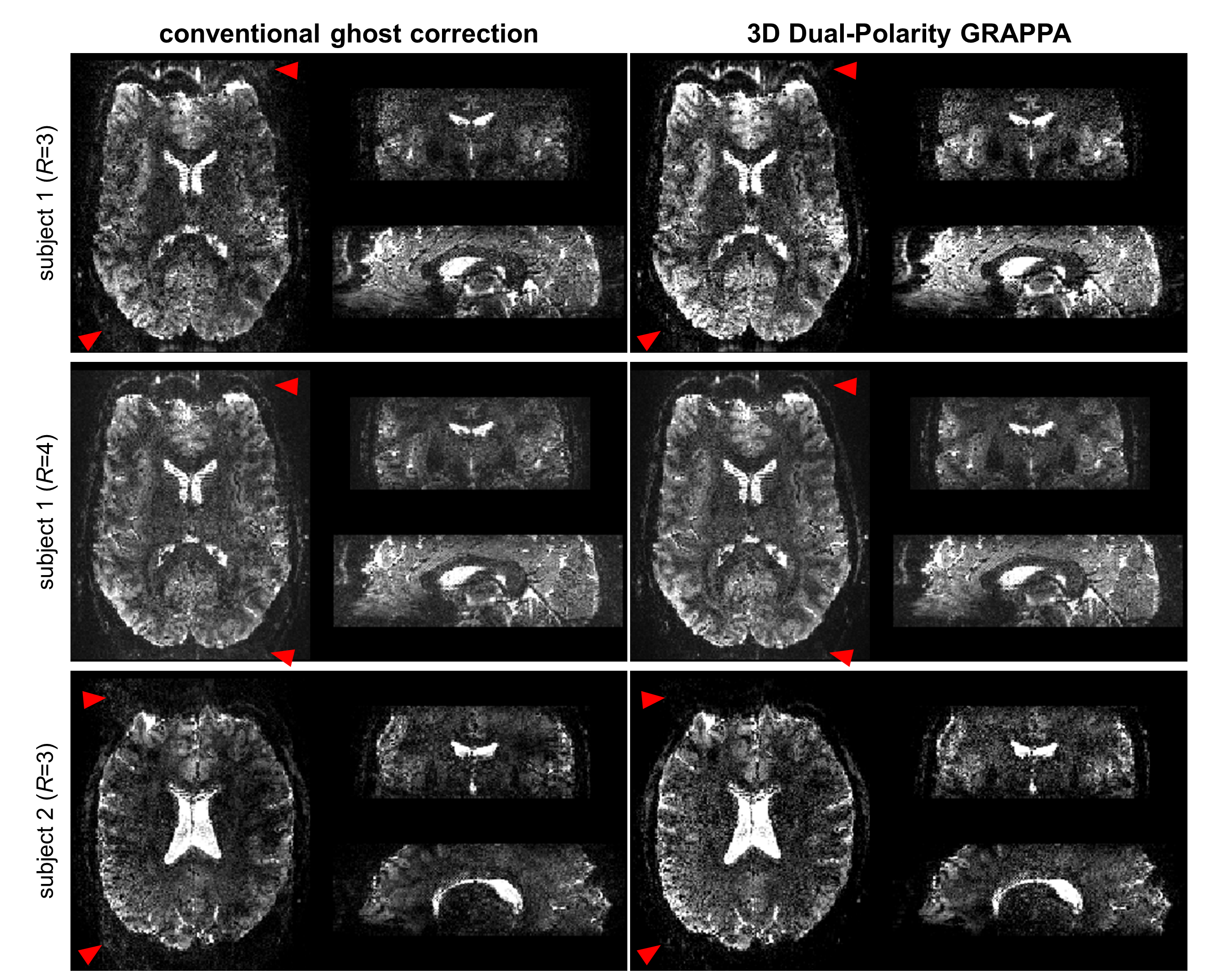
Fig. 2 shows a similar comparison for three in-vivo data sets. Notably, the images formed using conventional Nyquist ghost correction show significant ghosting in the signal-void region at both 3x and 4x acceleration rates, highlighted by the red darts. The ghost artifacts are notably absent in the images formed using 3D-DPG.
Discussion
Here we have demonstrated that DPG reconstruction, originally developed for 2D-EPI, can improve image quality for 3D-EPI as well. Combined with our demonstrations[3] of DPG for Simultaneous Multi-Slice (SMS) EPI [4, 5], this shows that the core advantage of DPG, namely its use of GRAPPA for EPI ghost correction, can be generalized to multiple EPI variants. Because 3D-EPI is gaining in popularity, especially for high-resolution functional MRI and ultra-high-field imaging [6], our 3D-DPG method can help boost imaging performance in these emerging applications. While other subtle imaging artifacts due to other scanner imperfections may still be present[7], further extensions of DPG may be capable of addressing these as well.Acknowledgements
We thank Kyle Droppa for his help with subject recruitment and MRI scanning support, Azma Mareyam for 7T hardware support. This work was supported in part by the NIH NIBIB (grants P41-EB030006 and R01-EB019437), by the BRAIN Initiative (NIH NIMH grant R01-MH111419 and NIH NINDS grant U19-NS123717), and by the MGH/HST Athinoula A. Martinos Center for Biomedical Imaging; and was madepossible by the resources provided by NIH Shared Instrumentation Grant S10-OD023637.References
[1] Hoge WS, Polimeni JR. "Dual-Polarity GRAPPA for simultaneous reconstruction and ghost correction of EPI data." Magn Reson in Med 2016;76(1):32–44.
[2] Feiweier T. "Magnetic resonance method and apparatus to determine phase correction parameters, 2013." US Patent 8,497,681.
[3] Hoge WS, Setsompop K, Polimeni JR. "Dual-polarity slice-GRAPPA for concurrent ghost correction and slice separation in simultaneous multi-slice EPI." Magn Reson in Med 2018;80(4):1364–1375.
[4] Setsompop K, Cohen-Adad J, Gagoski BA, Raij T, Yendiki A, Keil B, Wedeen VJ, Wald LL. "Improving diffusion MRI using simultaneous multi-slice echo planar imaging." NeuroImage 2012;63(1):569 – 580.
[5] Moeller S, Yacoub E, Olman CA, Auerbach E, Strupp J, Harel N, Ugurbil K. "Multiband multislice GE-EPI at 7 tesla, with 16-fold acceleration using partial parallel imaging with application to high spatial and temporal whole-brain fMRI." Magn Reson in Med 2010;63(5):1144–1153.
[6] Huber L, Ivanov D, Handwerker DA, Marrett S, Guidi M, Uludağ K, Bandettini PA, Poser BA. "Techniques for blood volume fMRI with VASO: From low-resolution mapping towards sub-millimeter layer-dependent applications." NeuroImage 2018;164:131–143.
[7] Huber L, et al. "Low spatial-frequency ripple artifacts in layer-fMRI EPI: Identification, cause, andmitigation strategies with dual-polarity readout." in Proc of the 31st Annual Meeting of ISMRM. Toronto, Ontario Canada, 2023; 1149.
Figures