4258
Harnessing sparsity: Feasibility of undersampled fixed evolution time ²³Na TQTPPI FID reconstruction for optimal ²³Na TQ/SQ-signal estimation1Computer Assisted Clinical Medicine, Heidelberg University, Mannheim, Germany, 2Mannheim Institute for Intelligent Systems in Medicine, Medical Faculty Mannheim, Heidelberg University, Mannheim, Germany, 3Cooperative Core Facility Animal Scanner ZI, Medical Faculty Mannheim, Heidelberg University, Mannheim, Germany
Synopsis
Keywords: Sparse & Low-Rank Models, Spectroscopy, Sodium
Motivation: The 23Na TQ-signal is a potential biomarker for cell viability but the required phase-cycling leads to long scan times with redundant information.
Goal(s): To investigate the feasibility of undersampling the fixed TQTPPI FID in the second dimension and reconstructing it by either an undersampled fit or two iterative thresholding algorithms.
Approach: Investigation of the feasibility of undersampling the fixed TQTPPI FID in the second dimension and reconstructing it by either an undersampled fit or two iterative thresholding algorithms.
Results: Undersampled fit successfully reconstructed data up to a 14 undersampling factor, while accuracy of the CS algorithms declined post-Nyquist-limit in both measurement and simulation.
Impact: While undersampled fit was as accurate as CS algorithms in simulations and below the Nyquist-limit it showed more reliable results and outperformed the latter two on measurement data and post-Nyquist limit, suggesting that physics informed reconstruction is advantageous.
Introduction
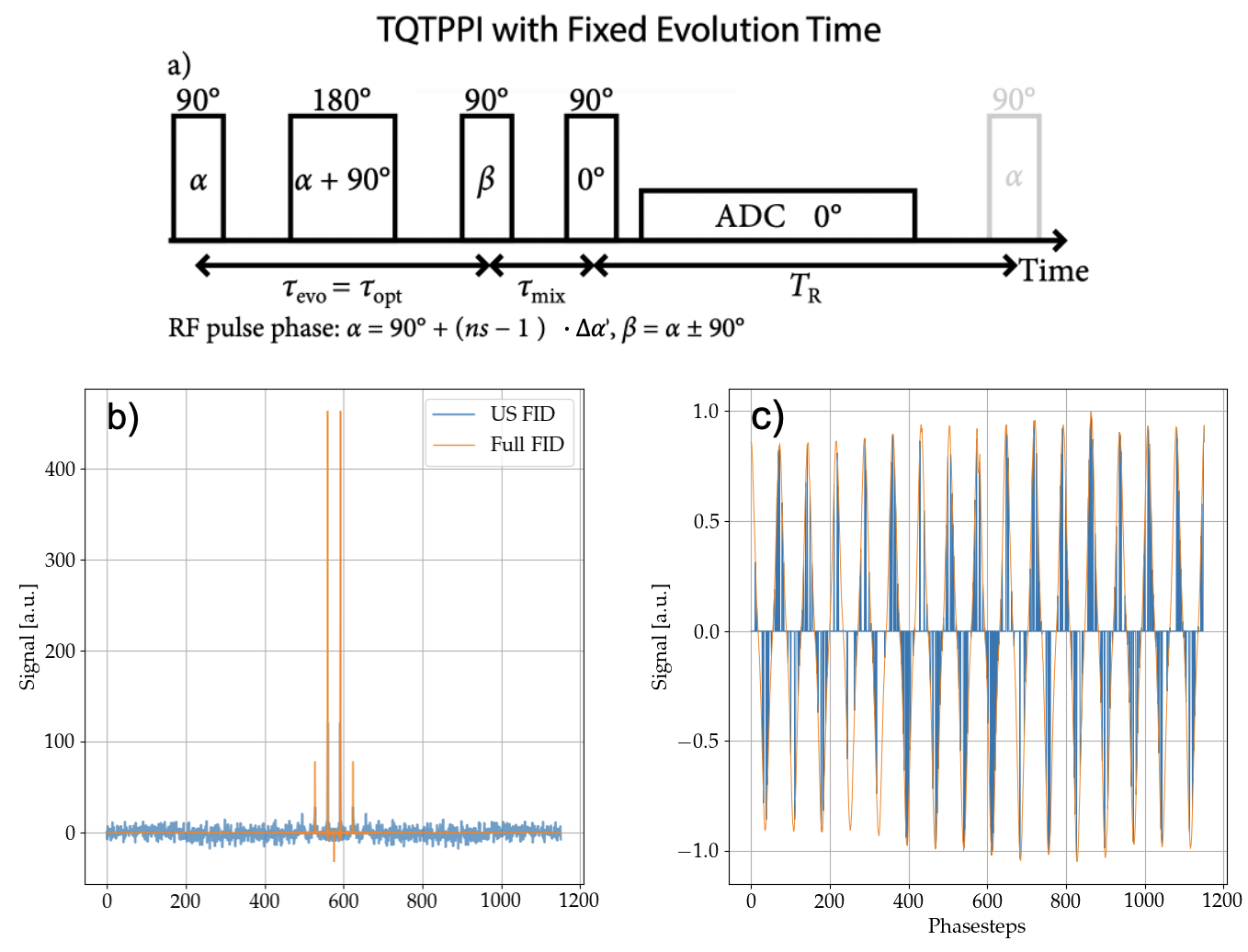
In the presence of macromolecules the quadrupole moment of the sodium nucleus can create multiple quantum coherences (MQCs). The triple quantum (TQ) signal in particular holds promises for novel information due to its intracellular sensitivity1,2. To take advantage of this a thorough understanding of the TQ-signal using model phantoms and cell experiments is required. To this end, the TQ time proportional phase incrementation (TQTPPI) pulse sequence has proven to be an elegant way to sample the SQ and TQ signals using simultaneous evolution time and phase increments, allowing the simultaneous detection of SQ- and TQ-signals3. In contrast, the TQTPPI pulse sequence with fixed evolution time, when set to the optimal evolution time, allows the extraction of the maximum TQ-signal, while the standard TQTPPI sequence only gives a lower mean TQ-signal. Still, both sequences rely on RF phase-cycling increasing the measurement time drastically which is not suitable for fast dynamic measurements. Fortunately, the fixed TQTPPI spectrum is sparse, which can be efficiently exploited using compressed sensing (CS).In this study, we investigated the feasibility of undersampled fixed TQTPPI reconstruction employing undersampled fit and two versions of an iterative soft thresholding (IST) algorithm to accelerate measurements.
Material and Methods
Measurement data was acquired at a 9.4T preclinical MRI (Bruker Biospec 94/20) equipped with a linear Bruker 1H/23Na volume coil and with a phase increment of 5° and 16 phase cycles. The agarose sample consisted of a 2% w/v agarose phantom with 154 mmol NaCl. The protein sample consisted of 30% w/v bovine serum albumin (BSA) and 154mmol NaCl. To quantify the SQ- and TQ-signal amplitudes, the fixed TQTPPI FID was non-linearly fitted using:$$Y(\alpha) = A_{SQ}sin(\omega\alpha+\phi_1)+A_{TQ}sin(3\omega\alpha+\phi_2)+DC, (1)$$
where $$$Y(\alpha)$$$ is the fixed TQTPPI FID amplitude, $$$\alpha$$$ the phase step and ATQ/ASQ are the SQ- and TQ-amplitudes respectively. Phase-cycling undersampling was performed retrospectively with factors ranging from 2 to 14 in phase direction. Sampling points were drawn from a uniform distribution. The first dimension FIDs corresponding to the given phase steps were removed entirely and the undersampled FID created by taking the mean along the phase increment direction. Simulations were performed using equations (1) with addition of Gaussian white noise. To account for different ion interaction strengths, the TQ-amplitude was varied by ATQ/ASQ=5-25% and the SNR from 40 to 200 2,4 . Each parameter was varied individually while the others remained at standard values SNR=60, ATQ/ASQ=12.85% and 1152 phase steps. Undersampling was performed in the same way as above.
The two versions of the CS-algorithm IST (IST-D/IST-S) were implemented and adapted to the fixed TQTPPI pulse sequence using python5. The relative threshold was set to 0.6 for both algorithms. The reconstructed FID was fitted using the same using equation (1). Additionally, the undersampled FID was fitted directly (US fit).The ground truth for the measurement data represents the fit result of the fully sampled FID (FS fit).
Results/Discussion
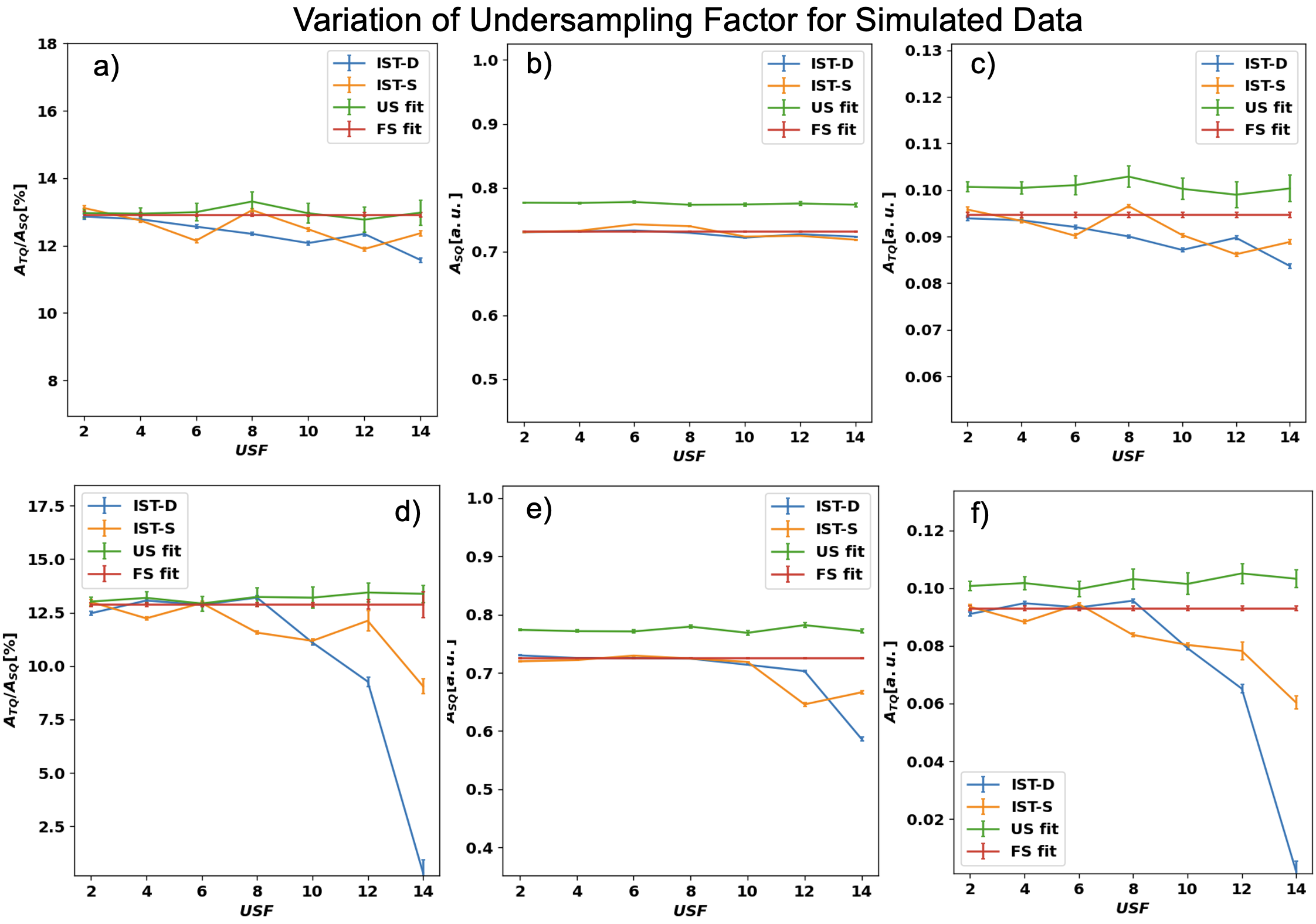
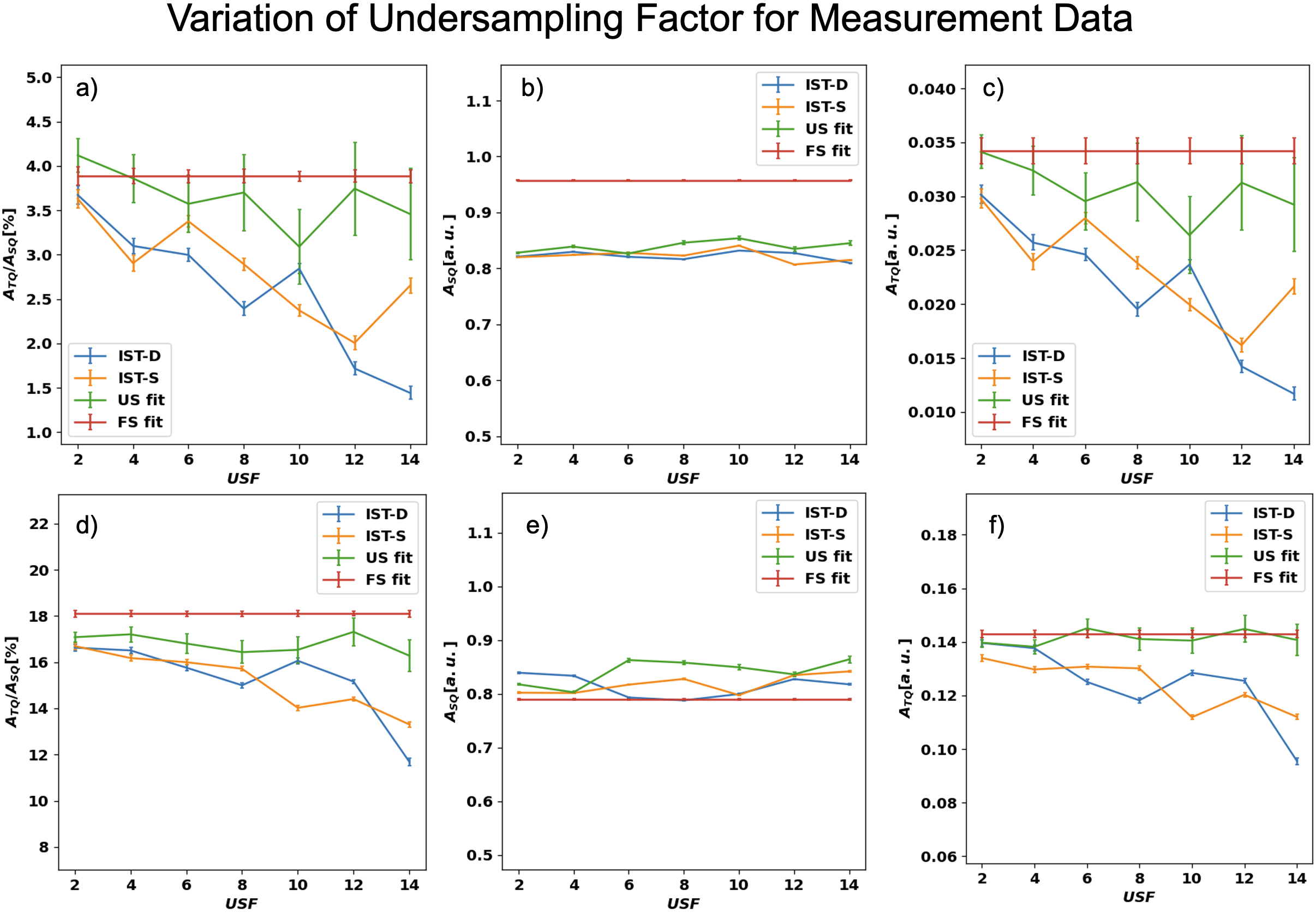
Fig.2 shows the accuracy of the ATQ/ASQ, SQ and TQ signal for different undersampling factors and phase steps of 1152 in the upper row and 576 in the lower row corresponding to 5° and 10° phase increment respectively. The undersampled fit performed as good as the FS fit over the whole range of undersampling factors for ATQ/ASQ, while for SQ and TQ it was even closer to the true values than the fully sampled fit. The CS-Algorithms show equal optimal performance up to the corresponding Nyquist limit of the TQ signal, which is at an undersampling factor of 12 and 6 respectively for the two phase-step numbers. Overall the undersampled fit shows more reliable results than both CS-algorithms even beyond the corresponding Nyquist limit where CS usually has its strength. Fig. 3 confirms these findings on measurement data. For both phantoms ATQ/ASQ and TQ signal of the undersampled fit is within the confidence interval of the fully sampled fit while the CS-algorithms accuracy decreases with increasing undersampling. All three methods performed similarly on the SQ signal showing constant deviation from for the BSA sample.Conclusion
Undersampled fit performed equally good as both CS algorithms up to the Nyquist-limit and better post-Nyquist-limit, with deviations less than 10% for ATQ/ASQ and TQ signal on both simulated and measurement data. A potential measurement time reduction of up to 80% can be achieved. This could be beneficial for TQTPPI applications which require a high temporal resolution such as dynamic studies of perfused organs or bioreactor systems. Future work might benefit from a model based CS approach, combining both methods.Acknowledgements
No acknowledgement found.References
1. Hoesl MAU, Kleimaier D, Hu R, et al. 23 Na Triple-quantum signal of in vitro human liver cells, liposomes, and nanoparticles: Cell viability assessment vs. separation of intra- and extracellular signal. J Magn Reson Imaging. 2019;50(2):435-444. doi:10.1002/JMRI.26666
2. Kleimaier D, Schepkin V, Nies C, Gottwald E, Schad LR. Intracellular Sodium Changes in Cancer Cells Using a Microcavity Array-Based Bioreactor System and Sodium Triple-Quantum MR Signal. Processes 2020, Vol 8, Page 1267. 2020;8(10):1267. doi:10.3390/PR8101267
3. Schepkin VD, Neubauer A, Nagel AM, Budinger TF. Comparison of potassium and sodium binding in vivo and in agarose samples using TQTPPI pulse sequence. Journal of Magnetic Resonance. 2017;277:162-168. doi:10.1016/J.JMR.2017.03.003
4. Madelin G, Lee JS, Regatte RR, Jerschow A. Sodium MRI: Methods and applications. Prog Nucl Magn Reson Spectrosc. 2014;79:14. doi:10.1016/J.PNMRS.2014.02.001
5. Shchukina A, Kasprzak P, Dass R, Nowakowski M, Kazimierczuk K. Pitfalls in compressed sensing reconstruction and how to avoid them. J Biomol NMR. 2017;68(2):79-98. doi:10.1007/S10858-016-0068-3/FIGURES/14
Figures