4248
Reconstruction Tools for Hyperpolarized 13C MRI with the RTHawk Research Platform1University of California, San Francisco, San Francisco, CA, United States, 2Vista.ai, Palo Akto, CA, United States
Synopsis
Keywords: Data Acquisition, Data Acquisition, images reconsturction
Motivation: The motivation behind this project was to address critical gaps in our Hyperpolarized (HP) 13C MRI.
Goal(s): The primary goal of this study was to develop and implement a set of tools and methods to support HP 13C MRI. These tools aimed to facilitate real-time data processing, improve image quality, and enable precise quantification of metabolic processes.
Approach: We created the HP 13C RTHawk reconstruction toolbox. These tools included functions for data reading, gridding, coil combination, DICOM writing, B1+ and B0 calibration.
Results: The RTHAWK toolbox significantly enhanced the capabilities of HP 13C MRI, empowering researchers to obtain higher-quality images.
Impact: The study have far-reaching implications for scientists. By enhancing the capabilities of HP 13C MRI, the toolbox enables more precise studies. This not only broadens our understanding of but also paves the way for improved diagnostic procedures and treatment strategies.
Introduction
Hyperpolarized (HP) 13C MRI has shown promise as a valuable modality particularly for in vivo measurements of metabolism1 and is currently in human trials at 12 research sites worldwide with over 65 human research publications. It is based on intravenous injection of a hyperpolarized contrast agent that has been enriched with 13C. As HP 13C continues to grow, we need tools to assist with our data and getting quality images. We have used the RTHawk Research platform (Vista.ai, formerly HeartVista) to develop advanced acquisitions for HP 13C MRI. This platform was built around fundamentally providing real-time images and ability to perform real-time feedback based on data acquired. The ability to provide real-time feedback has been useful for HP 13C, allowing us to create an autonomous scanning approach that performs bolus tracking and real-time B0 and B1 calibrations2. The bolus tracking is important to reproducibly capture the rapid perfusion and metabolism kinetics. The real-time calibrations are important because there is very low 13C natural abundance for which to perform calibration. We have also used the ability to rapidly switch between pulse sequences in HP 13C metabolite-specific bSSFP pulse sequences, providing more than 2-fold SNR increases for lower concentration compounds such as lactate, urea, and bicarbonate3-5.To support these methods, we have created a HP 13C RTHawk reconstruction toolbox
Methods
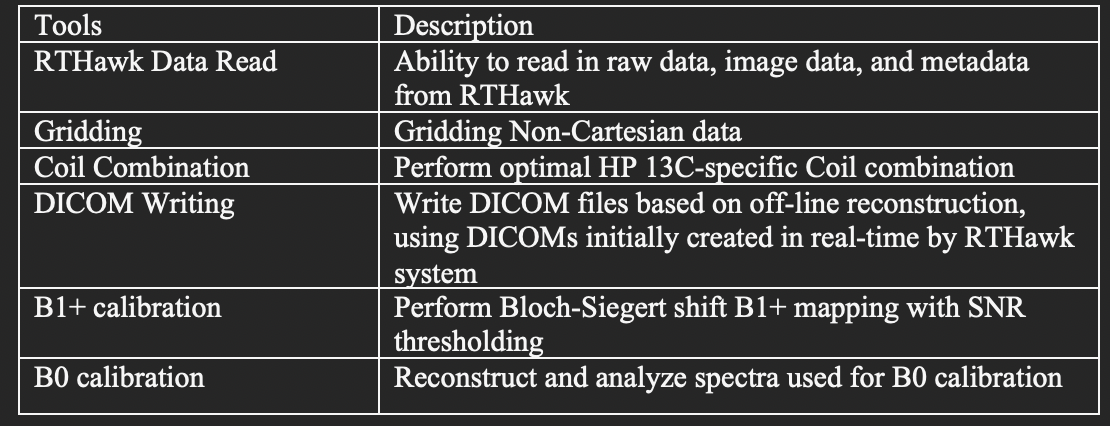
In figure 1, we list the tools in the HP 13C RTHawk reconstruction toolbox that have helped in multiple research papers to get the best results in 13C studies.RTHawk Read Functions
We have created multiple MATLAB functions that are able to read raw data, image data,and other metadata from RTHawk. This includes MATLAB functions, "load_rth_dicom," and "load_rth_images," that are designed for loading and processing data acquired using the RTHawk system."load_rth_dicom" allows for loading DICOM files, from a single or multiple folders. "load_rth_images" loads general RTHawk image data, but supports optional parameters for coil, slice, and time point counts.
Gridding
The "gridkb_batch" is a versatile MATLAB function designed for gridding non-Cartesian k-space data and generating images. The "gridkb_batch" function begins by accepting essential inputs, such as k-space data (d), k-space trajectory (k), k-space weighting (w), image size (n), oversampling factor (osf), and kernel width in oversampled grid samples (wg). It then proceeds with the gridding process, computing the gridding kernel using a Kaiser-Bessel window. The algorithm accounts for the nearest neighbor interpolation and effectively grids the data by accumulating values in the k-space to the image space, it implements deapodization6 to mitigate the effects of the gridding process.
Coil Combination
Estimating coil sensitivity profiles is important for coil combination of low SNR data, such as HP 13C MRI. Performing HP 13C optimal coil combination7 a key feature of this toolbox, it’s imported from the hyperpolarized-mri-toolbox8.
DICOM Writing
DICOM writing is important for integrating into clinical workflows. This function takes as input the paths to the HP images generated online by the RTHawk system, the DICOM images folder, and a selection mode for either dynamic images or AUC images. It processes and organizes data from the original HP DICOM files, ensuring proper naming and replaces the images with the off-line reconstructed data. The function can be used in the medical imaging field to facilitate the conversion and storage of RTHawk MRI reconstruction data in DICOM format for further analysis or clinical use.
B1+ Calibration
The toolbox includes functions for reconstructing Bloch-Siegert shift B1+ mapping data. This is used for real-time calibrations as well off-line compensation of flip angle variations to improve HP 13C quantifications. “load_rth_bsb1_phase_images” is specialized for B1 phase image data and can accept optional parameters for the number of coils, slices and time points.
B0 Calibration
Our RTHawk sequences also include a broad-band calibration, consisting of a slab-selective spectrum acquisition. The toolbox can reconstruct these spectra from the raw data, including spectral apodization, coil combination, and peak finding.
Results
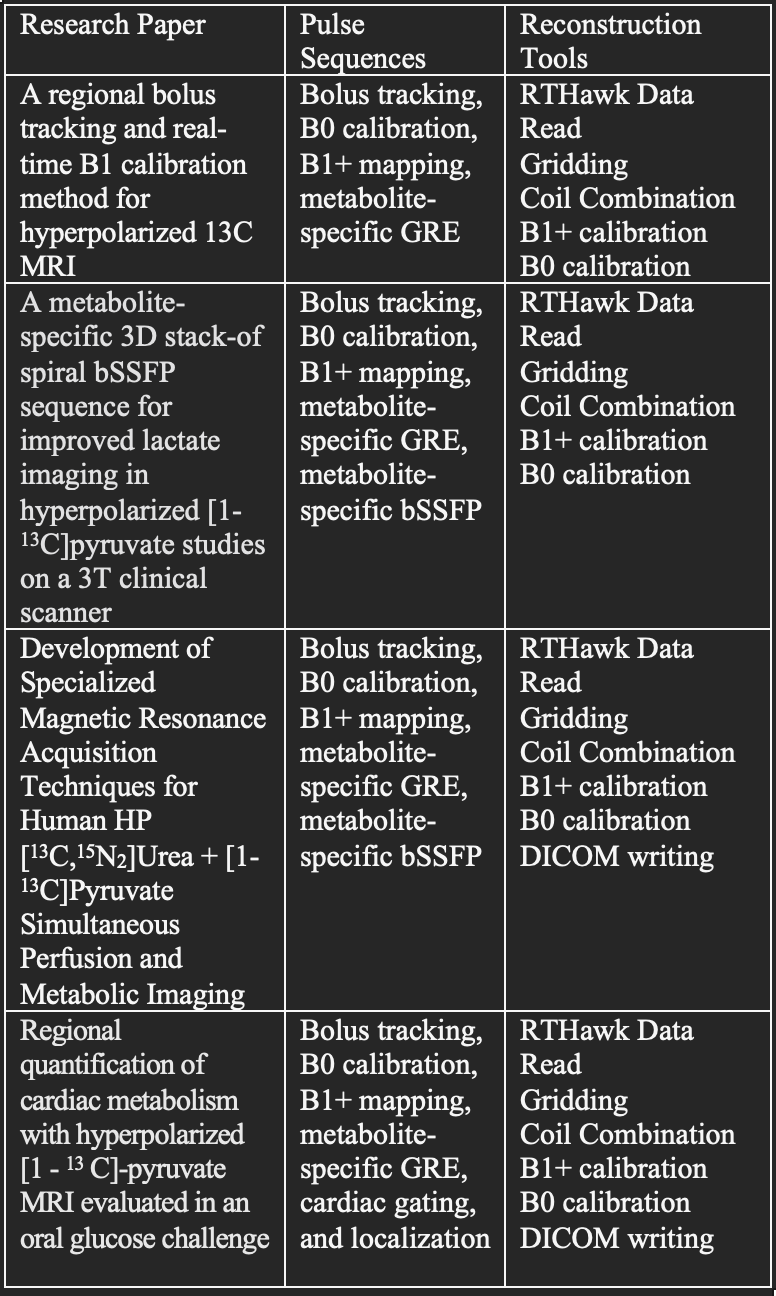
The RTHawk reconstruction toolbox have made substantial impact to the field of imaging. Our versatile tools have been able to deliver great contribution to numerous research publications. With the results of these tools, we have been able to make great contribution to advancing HP 13C studies. Figure 2 shows example publications that have been supported by the RTHawk Research reconstruction toolboxDiscussion/Conclusion
With the impact of RTHawk reconstruction toolbox to research publications, we're looking to forward to keep on updating and advancing the tools. This includes the move from MATLAB to Python, enhances accessibility and adaptability, ensuring the toolbox's continued relevance in medical imaging and scientific research.Acknowledgements
No acknowledgement found.References
[1] Hyperpolarized 13C MRI: State of the Art and Future Directions. Radiology. 2019 05; 291(2):273-284. Wang ZJ, Ohliger MA, Larson PEZ, Gordon JW, Bok RA, Slater J, Villanueva-Meyer JE, Hess CP, Kurhanewicz J, Vigneron DB. PMID: 30835184; PMCID: PMC6490043.
[2] Regional quantification of cardiac metabolism with hyperpolarized [1 - 13 C]-pyruvate MRI evaluated in an oral glucose. Peder E. Z. Larson, Shuyu Tang, Xiaoxi Liu, Avantika Sinha, Nicholas Dwork, Sanjay Sivalokanathan, Jing Liu, Robert Bok, Karen G. Ordovas, James Slater, Jeremy W. Gordon, M. Roselle Abraham. medRxiv 2023.10.16.23297052; doi: https://doi.org/10.1101/2023.10.16.23297052
[3] Tang, S, Bok, R, Qin, H, et al. A metabolite-specific 3D stack-of-spiral bSSFP sequence for improved lactate imaging in hyperpolarized [1-13C]pyruvate studies on a 3T clinical scanner. Magn Reson Med. 2020; 84: 1113–1125. https://doi.org/10.1002/mrm.28204
[4] Liu X, Tang S, Mu C, Qin H, Cui D, Lai YC, Riselli AM, Delos Santos R, Carvajal L, Gebrezgiabhier D, Bok RA, Chen HY, Flavell RR, Gordon JW, Vigneron DB, Kurhanewicz J, Larson PEZ. Development of specialized magnetic resonance acquisition techniques for human hyperpolarized [13 C,15 N2 ]urea + [1-13 C]pyruvate simultaneous perfusion and metabolic imaging. Magn Reson Med. 2022 Sep;88(3):1039-1054. doi: 10.1002/mrm.29266. Epub 2022 May 8. PMID: 35526263; PMCID: PMC9810116.
[5] Regional quantification of cardiac metabolism with hyperpolarized [1 - 13 C]-pyruvate MRI evaluated in an oral glucose challenge.Peder E. Z. Larson, Shuyu Tang, Xiaoxi Liu, Avantika Sinha, Nicholas Dwork, Sanjay Sivalokanathan, Jing Liu, Robert Bok, Karen G. Ordovas, James Slater, Jeremy W. Gordon, M. Roselle Abraham.medRxiv 2023.10.16.23297052; doi: https://doi.org/10.1101/2023.10.16.23297052
[6] P. J. Beatty, D. G. Nishimura, and J. M. Pauly. “Rapid Gridding Reconstruction with a Minimal Oversampling Ratio.” IEEE Trans\ Med\ Imaging 24, no. 6 (June 2005): 799–808.
[7] Z. Zhu, X. Zhu, M.A. Ohliger, et al. Coil combination methods for multi-channel hyperpolarized 13 C imaging data from human studies J. Magn. Reson., 301 (2019), pp. 73-79, 10.1016/j.jmr.2019.01.015
[8] Hyperpolarized-MRI-Toolbox,” https://github.com/LarsonLab/hyperpolarized-mri-toolbox https://doi.org/10.5281/zenodo.1198915
Figures