4182
A Generalized Inverse Fourier Transformation (GIFT) Approach for Direct Image Reconstruction from Arbitrary K-space Trajectories1Yale School of Medicine, New Haven, CT, United States
Synopsis
Keywords: Image Reconstruction, Image Reconstruction, FFT, NUFFT, GFFT, GIFT, Re-gridding, Arbitrary K-space Sampling, Arbitrary K-space trajectory
Motivation: K-space re-gridding or sampling density compensation is required for image reconstruction with arbitrary K-space trajectory, e.g., in FFT, NUFFT, GFFT, etc.
Goal(s): We propose a generalized inverse Fourier transform (GIFT) approach to direct image reconstruction. The reconstruction is continuous in image space.
Approach: We generalize continuous Fourier transform to any coordinate systems, arbitrary K-space sampling/trajectory, and arbitrary K-point size and shape.
Results: Images were calculated from a spiral k-space trajectory in the 2D Cartesian coordinate system, which we use as examples to demonstrate GIFT's reconstruction flexibility for different resolutions, also within any small, focused region of interest (ROI).
Impact: The generalized image reconstruction algorithm apply to both Cartesian and Polar, can be readily used for non-uniform K-space with arbitrary trajectory. Images can be reconstructed with arbitrary resolution also within any small ROIs.
Introduction
Image reconstruction from any type of arbitrary K-space trajectory, such as spiral, radial, random, etc, usually requires K-space re-gridding or sampling density compensation. We propose a generalized inverse Fourier transform (GIFT) approach that reflects a direct approximation of the continuous Fourier transform regardless of the coordinate systems, 2D or 3D, Cartesian or Polar, in which the data are presented. The reconstruction is linear and flexible in choosing reconstruction resolution and any focused region of interest.Theory
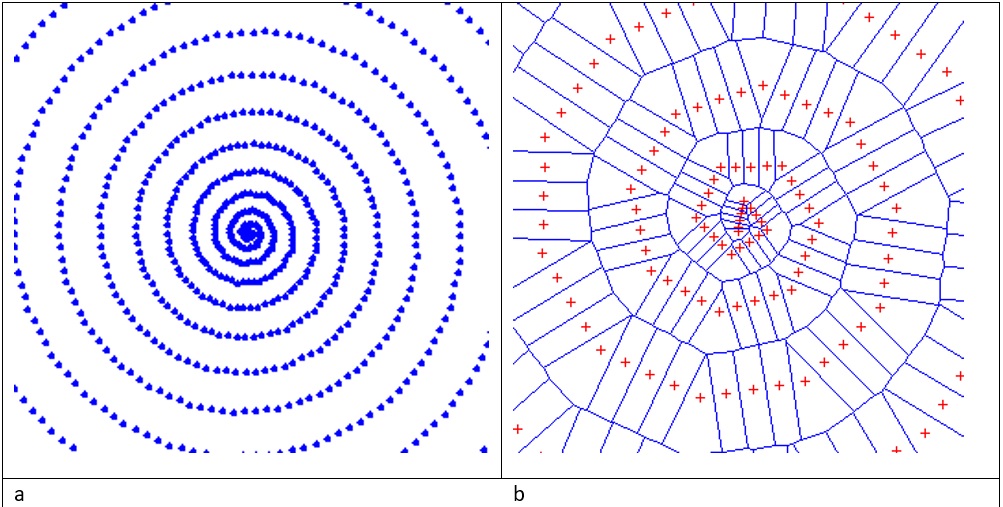
The MRI signal can be expressed as continuous Fourier transformation: \begin{equation}\tag{1}s(k)=\int m(r)e^{j2\pi k\cdot r}dr\end{equation}and its inverse Fourier transform as:\begin{equation}\tag{2}m(r)=\int s(k)e^{-j2\pi r\cdot k}dk\end{equation}where infinite image and K-space are assumed, and $$$m(r)=m(x,y)$$$ is the image intensity at position $$$(x,y)$$$ and $$$s(k)=s(k_{x},k_{y})$$$ is the K-space data at $$$(k_{x},k_{y})$$$. The discrete form of (2) for Cartesian K-space:\begin{equation}\tag{3}m(x,y)=\sum _{{k_{x}}}\sum _{{k_{y}}}s(k_{x},k_{y})e^{-j2\pi (x{k_{x}}+y{k_{y}})}\Delta k_{x}\Delta k_{y}\end{equation}can be generalized for arbitrary K-space trajectories follows:\begin{equation}\tag{4}m(x,y)=\sum _{({k_{x}},{k_{y}})\in K}s(k_{x},k_{y})e^{-j2\pi (x{k_{x}}+y{k_{y}})}\Delta A_{{k_{x}}{k_{y}}},\,s.t.\,\sum _{({k_{x}},{k_{y}})\in K}\Delta A_{{k_{x}}{k_{y}}}=Area(K)\end{equation}in which $$$\Delta A_{{k_{x}}{k_{y}}}$$$is the neighborhood area of a given K-space point$$$(k_{x},k_{y})$$$. For arbitrary or randomly distributed K-space points, the neighborhood of each point needs to be defined and its area calculated. There are many ways to calculate $$$\Delta A_{{k_{x}}{k_{y}}}$$$, such as, analytic formulation, region-growing, the Voronoi graph, etc. In our implementation, we employed the Voronoi graph to calculate the shape and area of the neighborhood for every point on the spiral trajectory. Please note that in eq. 4 $$$m(x,y)$$$ is a continuous function of $$$(x,y)$$$ despite that the K-space is discretely sampled, which technically allows any image resolution to be achieved and any $$$(x,y)$$$ location chosen in reconstruction.Methods
K-space data were collected on a Siemens scanner (TIM Trio 3T) with a single channel TxRx head coil, using a spiral-out EPI sequence: FOV=200mm, TE=2.78ms, TR=2s, slice thickness=5mm, the trajectory intersects with the x- or y-axis 128 times, and the total number K-space points=16384.Results
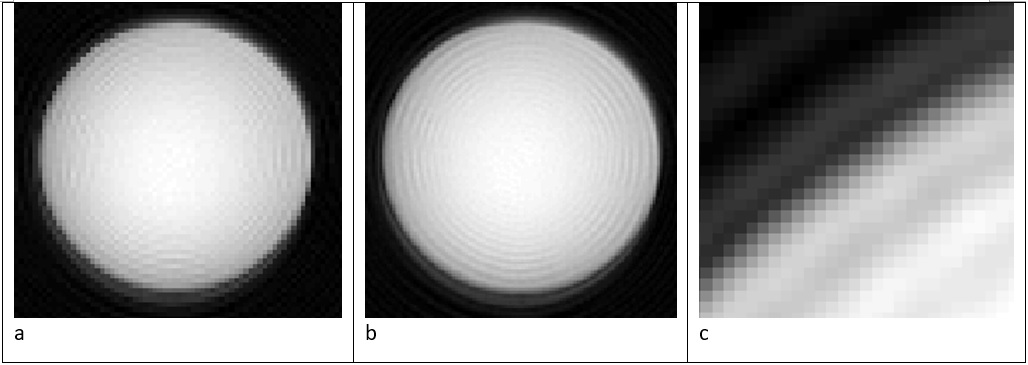
Since $$$m(x,y)$$$ is a continuous function in the image plane, $$$(x,y)$$$ can be anywhere in the plane with infinitely small resolution, which is not technically limited and the improvement of reconstruction quality may be only limited in theory to the sampling density of points and the extent of the K-space. Images reconstructed using eq. (4) are shown in Fig 1: the image reconstructed with 2 mm resolution(a), with 1-mm resolution(b), and a directly calculated ROI with 0.5-mm resolution(c). Fig 2 shows the spiral trajectory (a) and a zoom-in view of the Voronoi graph around the K-space center(b).Discussion
While the iterative image reconstruction methods based on the discrete matrix form of the image-to-FID transformation, e.g., ART, Kaczmarz, can be used for reconstruction, for the direct linear methods dealing with the non-uniform K-space, the closest approach to GIFT would be the weighted correlation (WC) method1, in which the spin density at an image point is estimated by calculating the ``weighted correlation'' of the FID signal and the phase modulation function with the assumptions: (A1) the algorithm is linear, and (A2) the PSF is shift-invariant. The weights are chosen to improve the PSF. WC and GIFT are derived based on completely different concepts but end up with similar equations. Equation 4 is more general in that only (A1) need be assumed. By re-gridding or interpolating the non-uniform K-space points into uniform points, the WC method can be accelerated by FFT, NUFFT, GFFT, etc. Direct acceleration of the WC exploits the fact that all the image points rendering the same phase can be grouped and calculated together (EPL, LUT, LSQT, etc.). GIFT might lead to larger errors from larger neighborhoods compared to the re-gridding methods when the prior knowledge can be utilized for interpolation, but for the proposed method the prior knowledge and other information can also integrated in the definition of the neighborhoods to optimize the PSF.Conclusion
We have proposed the GIFT approach to image calculation that was derived by a direct generalization of from the continuous IFT. Compared with the more traditional FFT, NUFFT, GFFT, no re-gridding is necessary, arbitrary image resolution can be achieved with no limits, and the reconstruction can be quickly done for only a small region of interest.Acknowledgements
No acknowledgement found.References
1. Maeda A et al, IEEE Trans Med Imaging. 1988;7(1):26-31.Figures