4178
Zero-FRESCO: Zero-Shot Fast REconstruction for Multi-Shot Sensitivity EnCOded Diffusion MRI1Electrical and Electronics Engineering, Bogazici University, Istanbul, Turkey, 2Athinoula A. Martinos Center for Biomedical Imaging, Massachusetts General Hospital, Charlestown, MA, United States, 3Department of Radiology, Harvard Medical School, Boston, MA, United States
Synopsis
Keywords: Image Reconstruction, Image Reconstruction
Motivation: Self-supervised neural network reconstruction improves multi-shot diffusion MRI (dMRI), yet suffers from prohibitively long computation times.
Goal(s): To develop a zero-shot self-supervised learning method for fast multi-shot dMRI reconstruction.
Approach: We propose a physics-guided neural network that operates in both k- and image-spaces to combine information from different EPI shots. We show that reconstruction quality can be improved with a novel sampling mask strategy, and that faster training is possible with a new training strategy. Finally, we extend our results to SMS acquisitions.
Results: Our results show that the proposed method provides improved and fast reconstructions compared to 2-shot LORAKS and 2-shot ZS-SSL.
Impact: The proposed physics-guided self-supervised learning method provides fast and high-quality reconstruction of multi-shot diffusion MRI volumes, while also eliminating the need for external training datasets.
Introduction
Diffusion MRI (dMRI) is a powerful tool that can provide information about tissue microstructure. Since dMRI requires repeated acquisitions with different diffusion directions, echo planar imaging (EPI) is commonly employed for faster scans. Multi-shot EPI (ms-EPI), which acquires different EPI shots at high acceleration, is commonly used to reduce artifacts resulting from B0 inhomogeneity and relaxation-related blurring. However, combining multi-shot images is challenging due to shot-to-shot phase variations. ms-EPI is commonly used with low rank reconstruction1 and parallel imaging to mitigate these challenges.Deep learning methods can serve as an alternative to traditional ms-EPI reconstruction. However, they usually require fully-sampled reference datasets, which is challenging to acquire in dMRI. Recently introduced Zero-Shot Self-Supervised Learning2 (ZS-SSL) overcomes this problem by creating training tasks directly from undersampled measurements. In this work, we propose Zero-Fresco, a fast ZS-SSL method to reconstruct ms-EPI images of a single subject for all diffusion directions and slices. Zero-Fresco demonstrates high-quality reconstructions compared to 2-shot LORAKS and 2-shot ZS-SSL.
Methods and Experiments
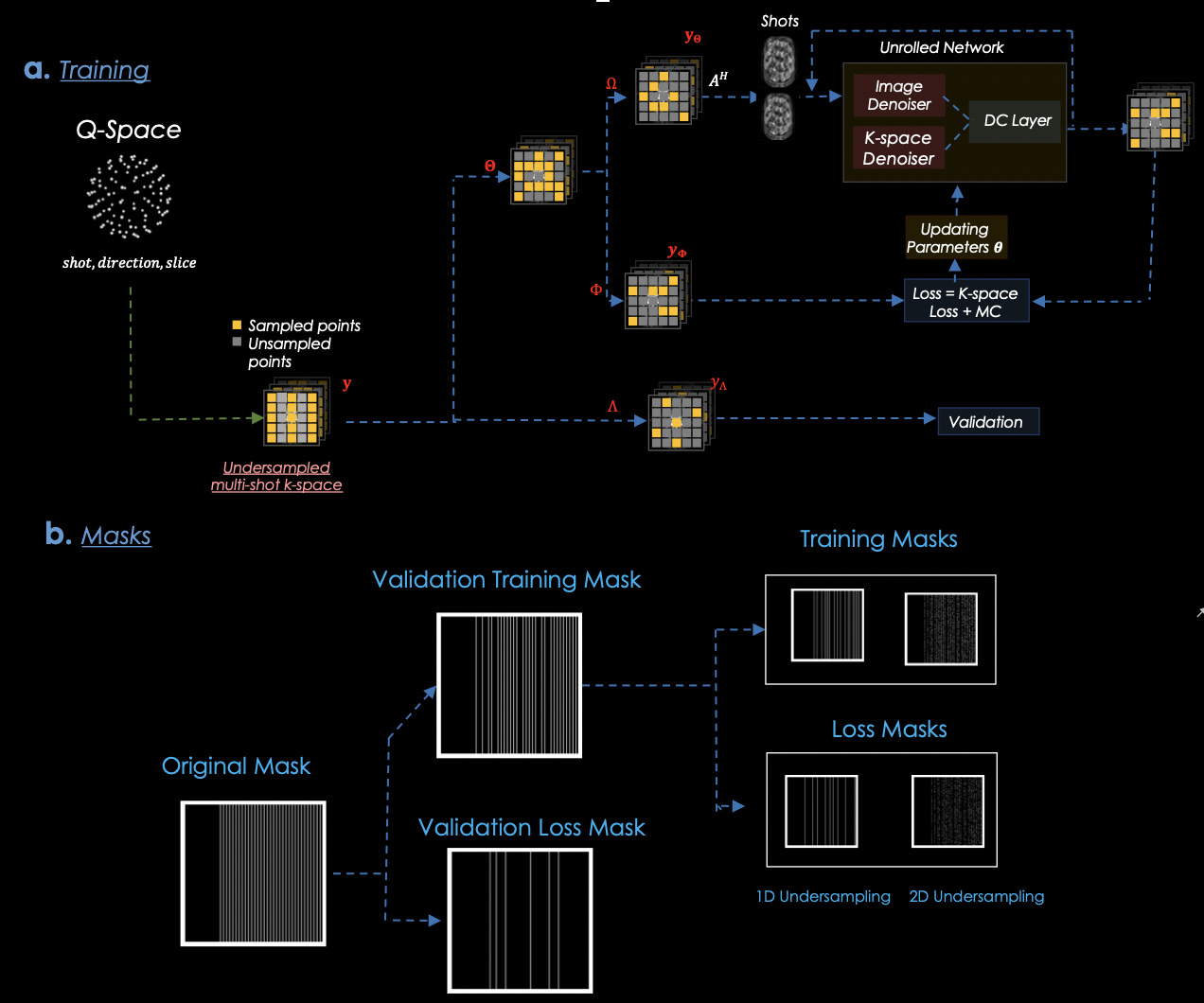
Data Acquisition: We acquired in vivo data using a 3T Prisma scanner with a multi-shot EPI sequence3 that allowed for “fully-sampling” the data using 32chan reception at 1 mm in-plane and 4 mm slice thickness at b=1000 s/mm2 R=5-fold acceleration was performed and 5 shots were collected to fully encode the k-space. Performing S-LORAKS on these multi-shot data permitted the reconstruction of a fully-sampled reference, which was used for computing error metrics.Proposed Approach: The schematic of Zero-Fresco is shown in Figure 1.a. Our network has a model-based architecture4 alternating between convolutional and conjugate-gradient based data-consistency(DC) steps. Different from the original ZS-SSL approach, we also utilize a k-space network to better exploit shot-to-shot relations. We train the model with the following loss function:
$$\frac{\parallel u-v\parallel _{2}}{\parallel v\parallel _{2}} + \frac{\parallel u-v\parallel _{1}}{\parallel v\parallel _{1}} + \lambda(\parallel mag(I_{1}) - mag(I_{2}))\parallel _{2})$$
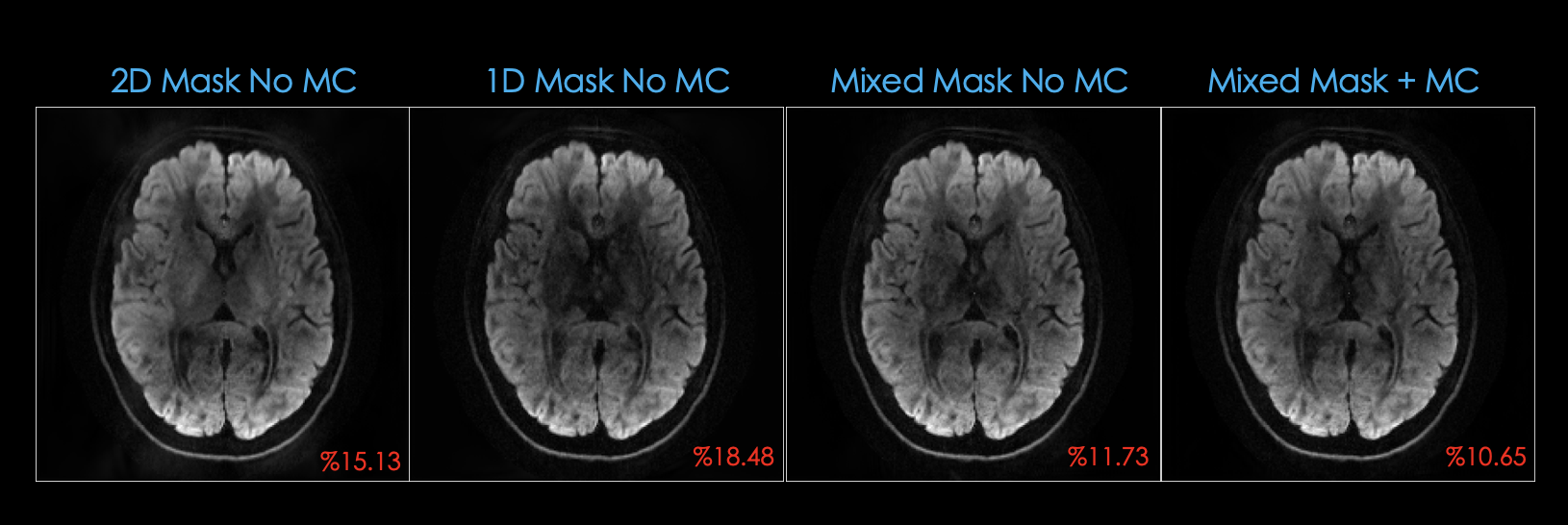
Here the first 2 terms are l1 and l2 losses in k-space, and the last term is the magnitude constraint(MC). MC regularizes the model by ensuring that reconstructions from 2 shots have similar magnitude. As previously5 pointed out, ZS-SSL performs better when the original sampling mask and training masks have the same distribution. Hence, we experimented with column-wise(1D) undersampling masks when partitioning the k-space, since the original sampling mask is 1D. We observed that using only 1D masks results in signal underestimation in the reconstructions, and we solved this problem by using mixed masks. %90 of our masks are 1D, but we also include 2D masks. Figure 1.b shows example masks.
Due to the large number of directions and slices, directly training with all the available data would be impractical. To solve this, we exploit the high degree of similarity between different directions. Instead of using all available data during an epoch, we use random directions for each mini-batch. The large number of slices and masks ensure that Q-space is covered during training, despite using randomly sampled directions. For further acceleration, we use Geometric Coil Compression6 (GCC), reducing the number of coils from 32 to 12. GCC accelerates training by speeding up the DC steps, and also by allowing us to use higher batch sizes due to reduced memory requirements.
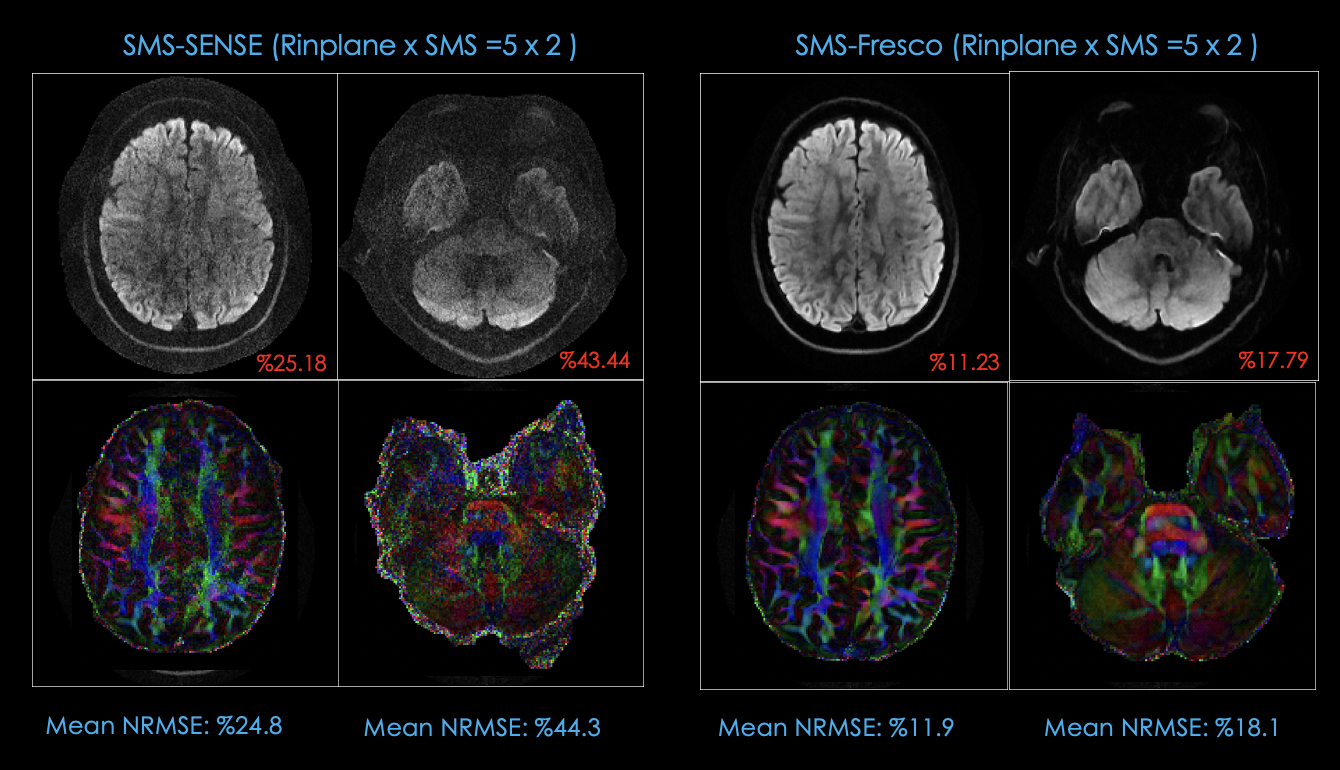
Finally, we propose SMS-Fresco for simultaneous multi-slice (SMS) acquisitions. We modify the DC units based on the SMS forward operator. We also modify the network architecture by including two different sub-networks, each consisting of k- and image-space networks, to process data from two slices.
Results
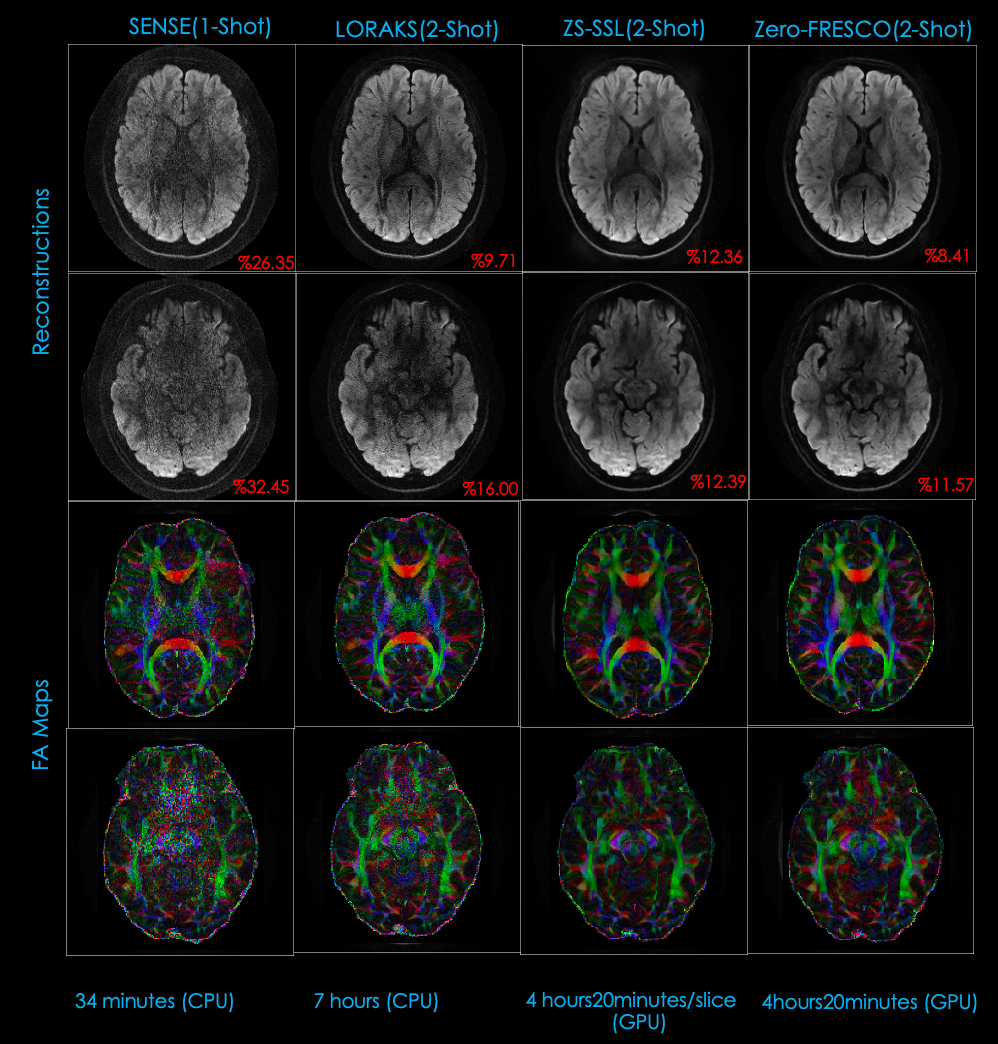
Figure2: Zero-Fresco outperforms SENSE, 2-shot LORAKS and standard 2-ZS-SSL. It was able to reconstruct data with 32 directions and 32 slices in ~4.5 hours. In terms of color FA maps, Zero-Fresco significantly outperforms SENSE and LORAKS, while also having higher SNR in the central regions compared to 2-ZS-SSL.Figur3: Ablation study shows the effect of different sampling masks and magnitude constraint. Mixed masks solve blurring and underestimation problems, MC improves overall performance.
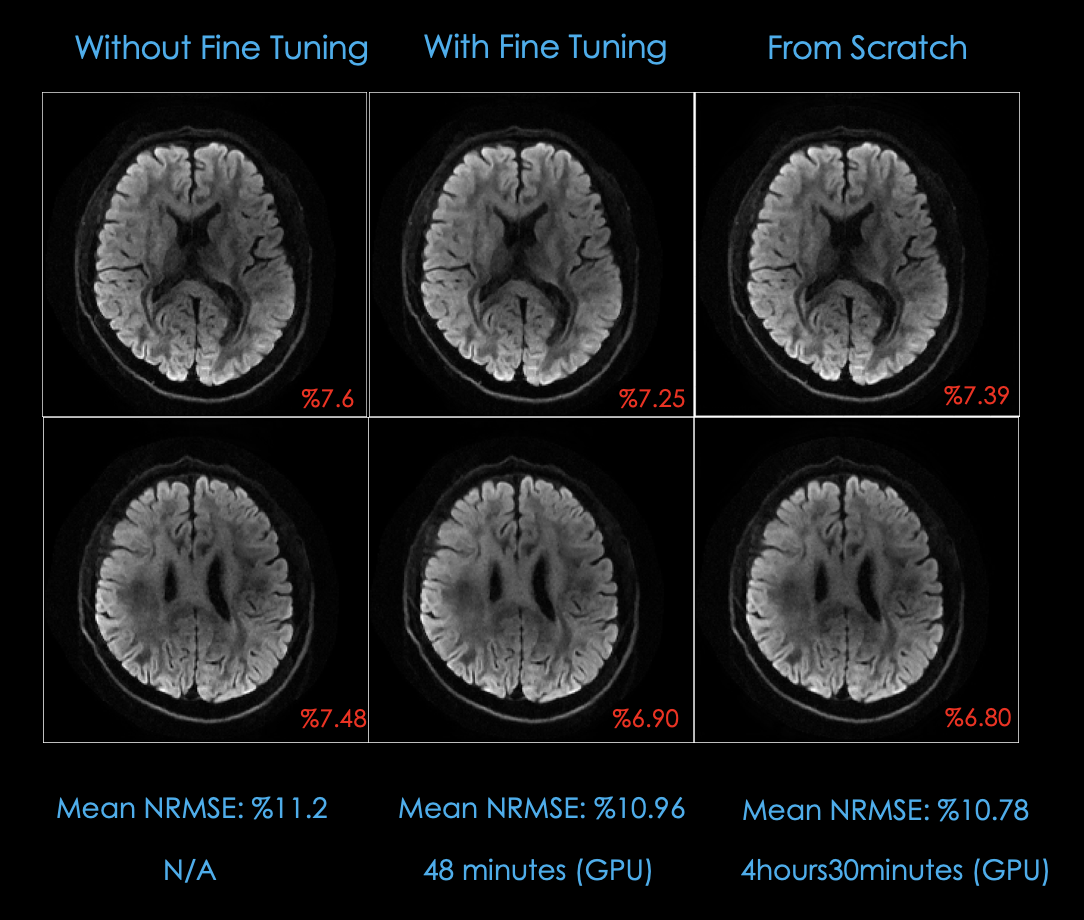
Figure4: Transfer learning can be used to fine-tune a pretrained model. This way, one can reconstruct another subject’s data significantly faster. With transfer learning, reconstruction takes 48 minutes, compared to 4 hours for training from scratch.
Figure5: SMS-Fresco yields significant improvements over SMS-SENSE in terms of reconstruction quality and color FA maps.
Discussion and Conclusion
We have proposed Zero-Fresco to reconstruct msEPI dMRI data of a subject for all slices and directions. Zero-Fresco surpasses both traditional methods and standard 2-ZS-SSL in terms of reconstruction quality. We also show Zero-Fresco, when combined with transfer learning, can yield high-quality reconstructions for new subjects with significant reduction in training time. Finally, we proposed SMS-Fresco, and showed superior performance over SMS-SENSE.Acknowledgements
This work was supported by research grants NIH R01 EB028797, U01 EB025162, P41 EB030006, U01 EB026996, R03 EB031175, R01 EB032378, UG3 EB034875, NVidia Corporation for computing support.References
1. J. P. Haldar, "Low-Rank Modeling of Local k-Space Neighborhoods (LORAKS) for Constrained MRI," in IEEE Transactions on Medical Imaging, vol. 33, no. 3, pp. 668-681, March 2014, doi: 10.1109/TMI.2013.2293974.
2. B. Yaman, S. A. H. Hosseini, M. Akcakaya, “Zero-Shot Self-Supervised Learning for MRI Reconstruction”, International Conference on Learning Representations, 2021
3. C. Liao, B. Bilgic, Q. Tian, J. P. Stockmann, X. Cao, Q. Fan, S. S. Iyer, F. Wang, C. Ngamsombat, M. K. Manhard, S. Y. Huang, L. L. Wald, K Setsompop, “Distortion-free, high-isotropic-resolution diffusion MRI with gSlider BUDA-EPI and multicoil dynamic B0 shimming”, Magnetic Reson Med, vol. 86, no. 2, pp. 791-803, 2021
4. H. K. Aggarwal, M. P. Mani and M. Jacob, "MoDL: Model-Based Deep Learning Architecture for Inverse Problems," in IEEE Transactions on Medical Imaging, vol. 38, no. 2, pp. 394-405, Feb. 2019, doi: 10.1109/TMI.2018.2865356.
5. Millard C, Chiew M. A Theoretical Framework for Self-Supervised MR Image Reconstruction Using Sub-Sampling via Variable Density Noisier2Noise. IEEE Trans Comput Imaging. 2023 Jul 26;9:707-720.
6. Zhang T, Pauly JM, Vasanawala SS, Lustig M. Coil compression for accelerated imaging with Cartesian sampling. Magn Reson Med. 2013 Feb;69(2):571-82.
Figures