4102
Probe-based co-simulation method for irregular wireless RF coils1Vanderbilt University Institute of Imaging Science, Vanderbilt University Medical Center, Nashville, TN, United States, 2Department of Radiology and Radiological Sciences, Vanderbilt University Medical Center, Nashville, TN, United States, 3Department of Electrical and Computer Engineering, Vanderbilt University, Nashville, TN, United States, 4SINO Canada Health Institute Inc., Winnipeg, MB, Canada
Synopsis
Keywords: RF Pulse Design & Fields, RF Arrays & Systems
Motivation: There is a lack of tools for predicting the component values for such irregular wireless volume coils.
Goal(s): The goal is to propose a novel co-simulation method that accurately predicts the capacitance distribution of irregular volume coils.
Approach: We validated this method using various shapes of irregular volume coils, including bottle-shaped, dome-shaped, and elliptical coils, at both 1.5 T and 3 T.
Results: The consistency between the simulated and practical capacitance further confirms the accuracy and reliability of the proposed probe-based co-simulation methods.
Impact: This co-simulation method can guide fabricating wireless irregular volume coils and can be extended to other types of wireless coils.
INTRODUCTION
Wireless coils are increasingly used in MRI as they do not require costly components, such as preamplifier models, baluns, coil plugs, and coil ID circuits [1-3]. To maximize the sensitivity of wireless coils, they are favorable to conform to the anatomy of the region of interest. Consequently, the optimal shape for these wireless coils may extend beyond the confines of a cylindrical surface. For instance, a dome-shaped coil offers a higher SNR in head imaging as it captures the MR signal from both the top and sides of the head. In hand and wrist imaging, a bottle-shaped coil provides a higher SNR because it better matches their geometry. However, there is a lack of tools for predicting the component values for such irregular wireless volume coils. Existing theories and tools primarily focus on cylindrical volume coils. Building a high-quality irregular wireless volume coil can be laborious or impractical without knowing the approximate capacitance values.In this study, we propose a novel co-simulation method that accurately predicts the capacitance distribution of irregular volume coils. It is based on multiple H-field probes and reduces the number of time-consuming full-wave electromagnetic (EM) simulation attempts. We validated this method using various shapes of irregular volume coils, including bottle-shaped, dome-shaped, and elliptical coils, at both 1.5 T and 3 T.
METHODS
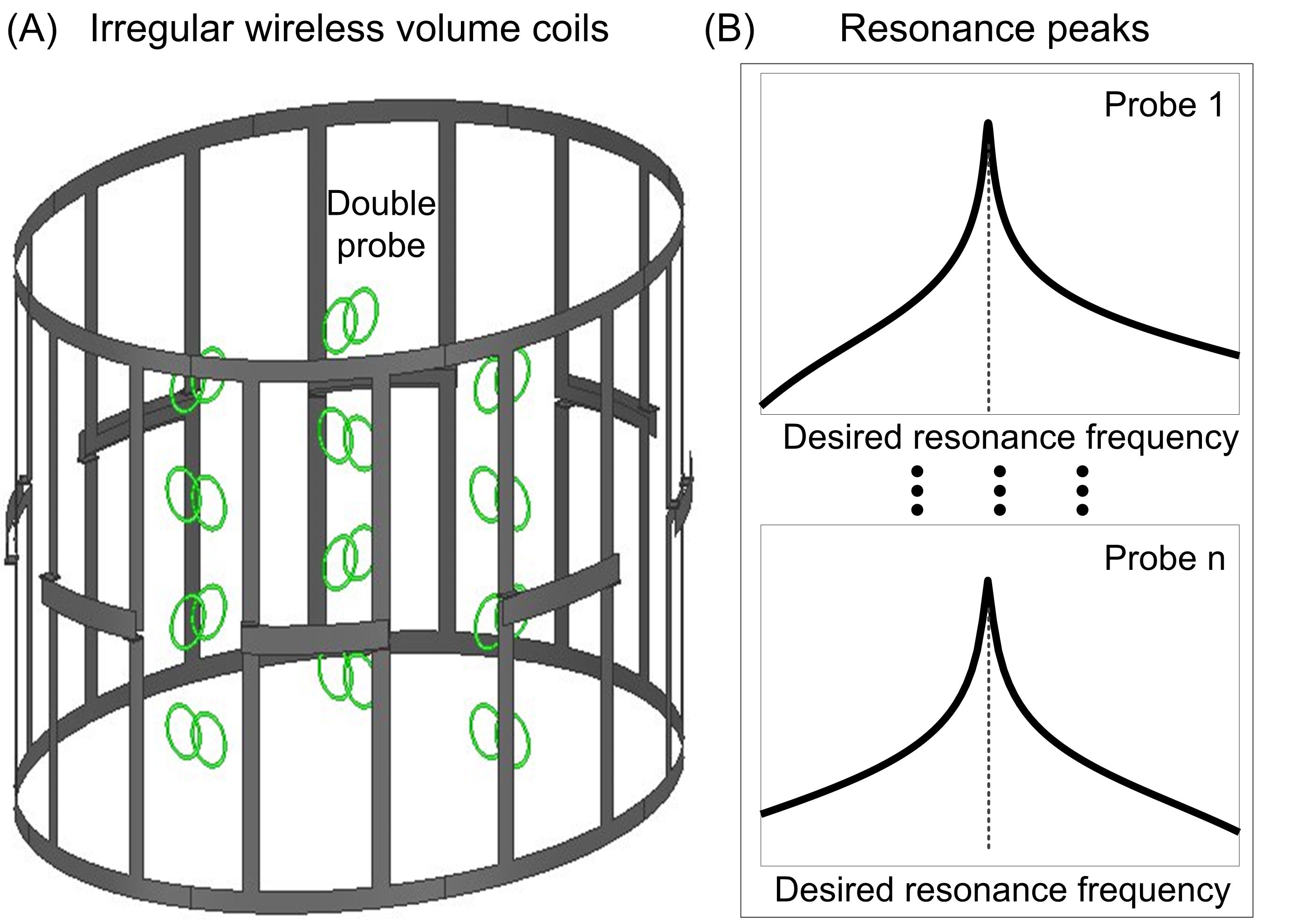
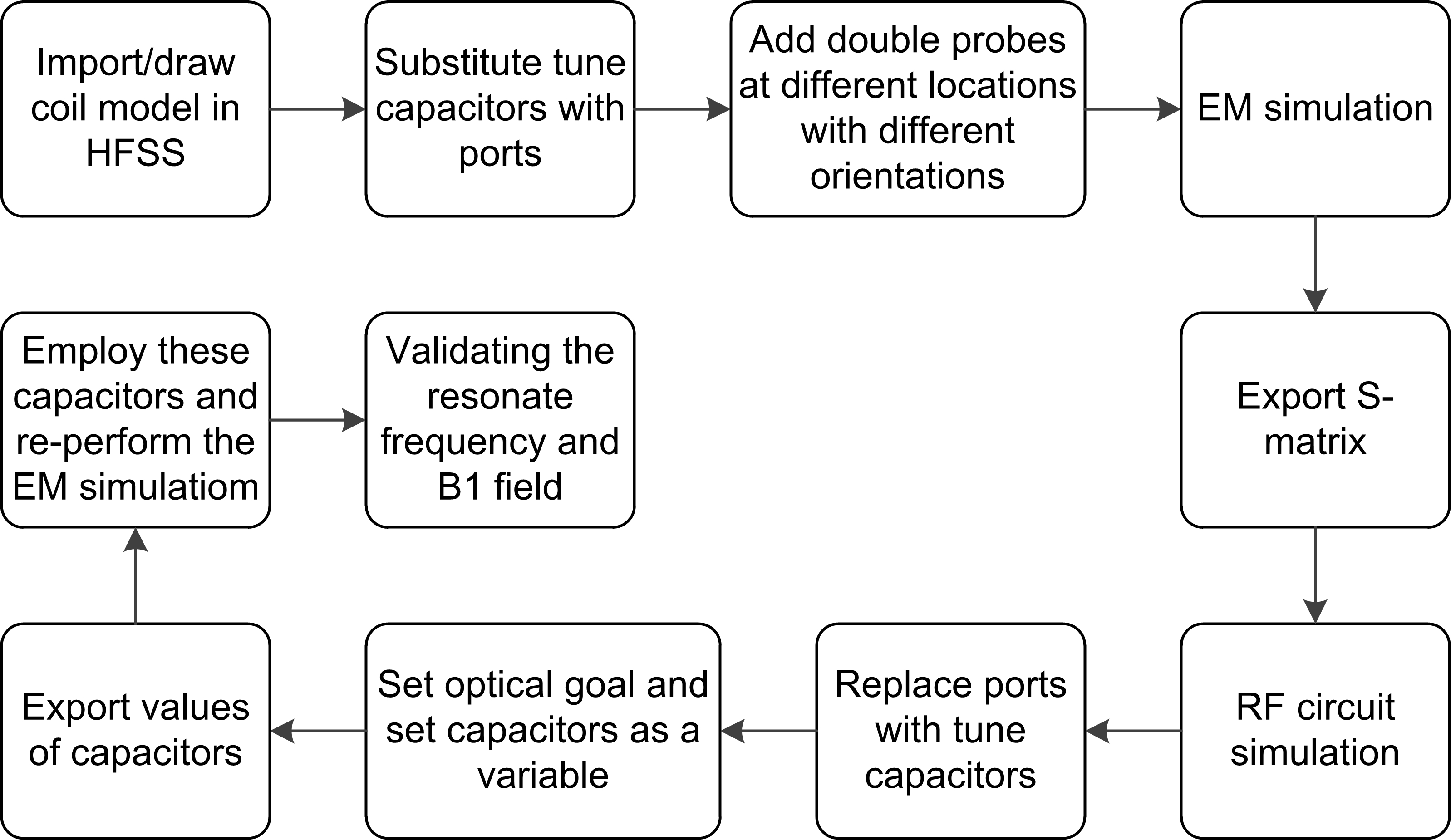
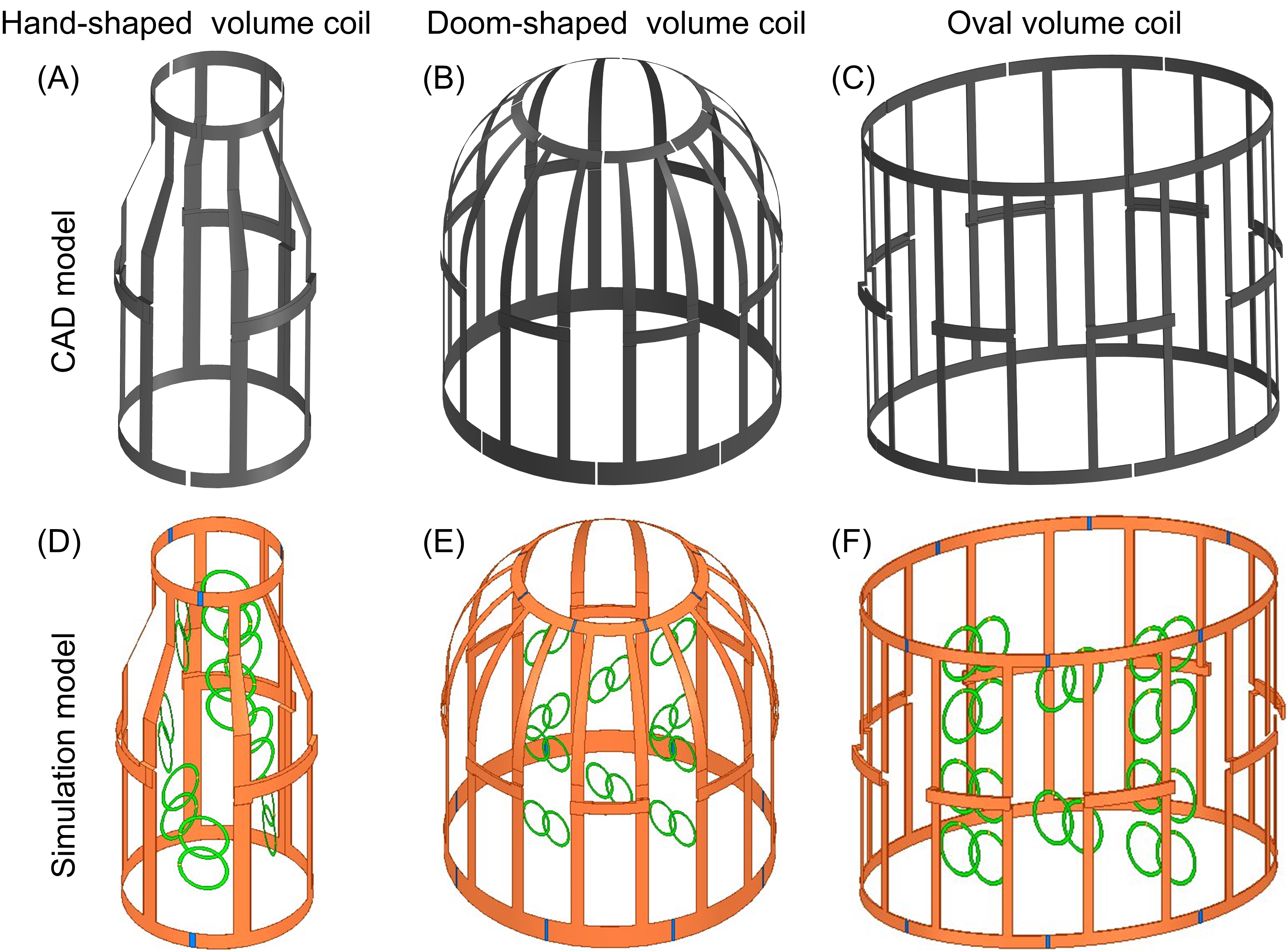
Figure 1 illustrates the proposed probe-based co-simulation method for wireless coils and Figure 2 shows the workflow. Double probes with different orientations are placed in different locations within the wireless coil (Figure 1A). Each pair of double probes will detect a resonant peak (Figure 1B). We first replaced the lumped capacitors with 50-ohm ports like the conventional co-simulation method [4]. Then, we added double probes at different locations and with different orientations. Furthermore, the S-parameter matrix, including the information on the ports in double probes and ports in the wireless coil, was exported into the RF circuit simulation tool for capacitance optimization. After obtaining the optimal capacitances from the RF circuit simulation, we employed these capacitances and re-performed the EM simulation in the Ansys HFSS.The probe-based co-simulation method was validated in bottle-shaped (1.5 T), dome-shaped (1.5 T), and elliptical coils (3 T), as shown in Figure 3. Coils' conductor trace and housing were designed in Solidworks and exported as an exchangeable format (STEP file, Figure 3 A-C). These files were imported into HFSS, and double probes were added (Figure 3 D-F).
RESULTS and CONCLUSION
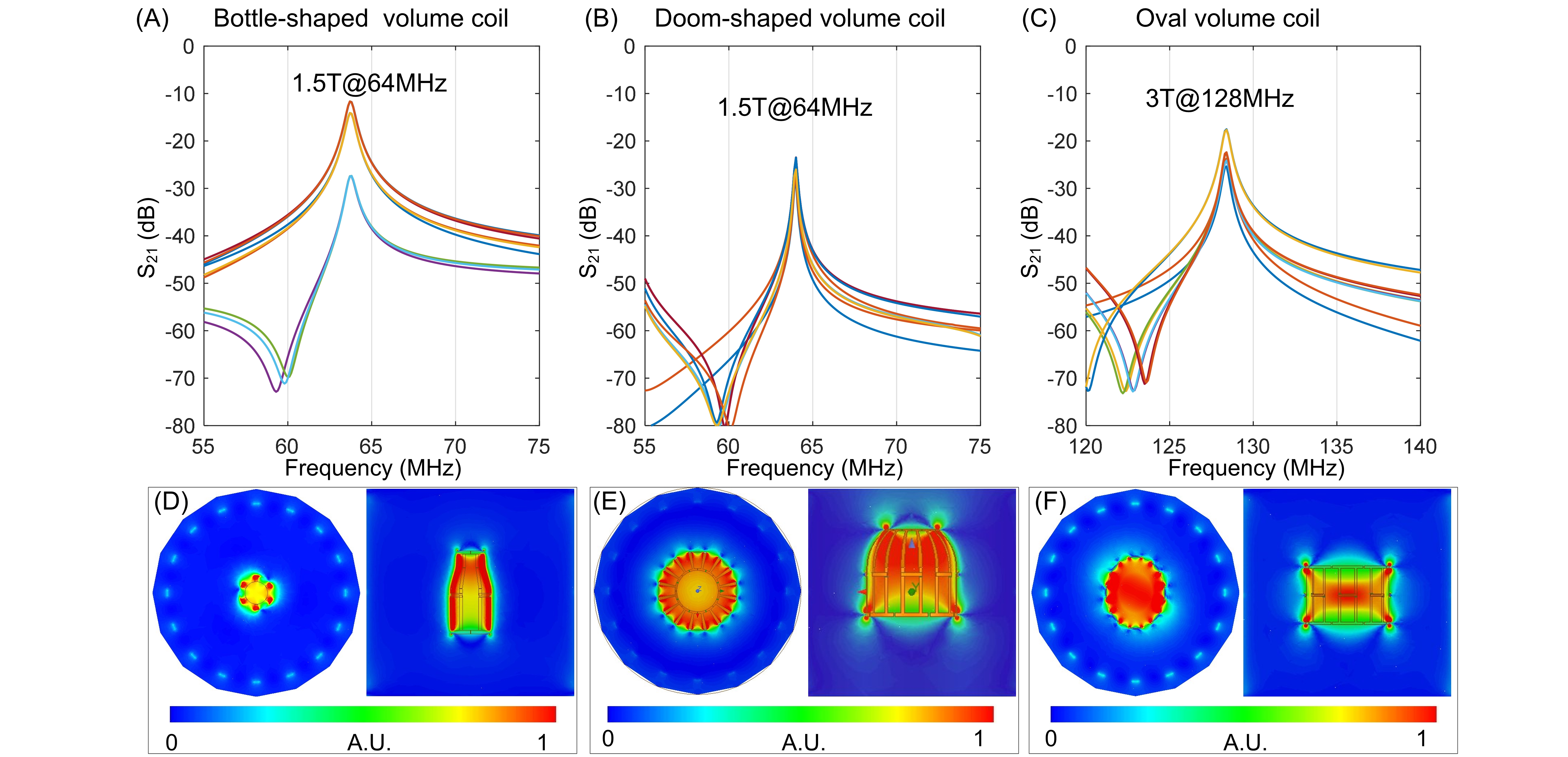
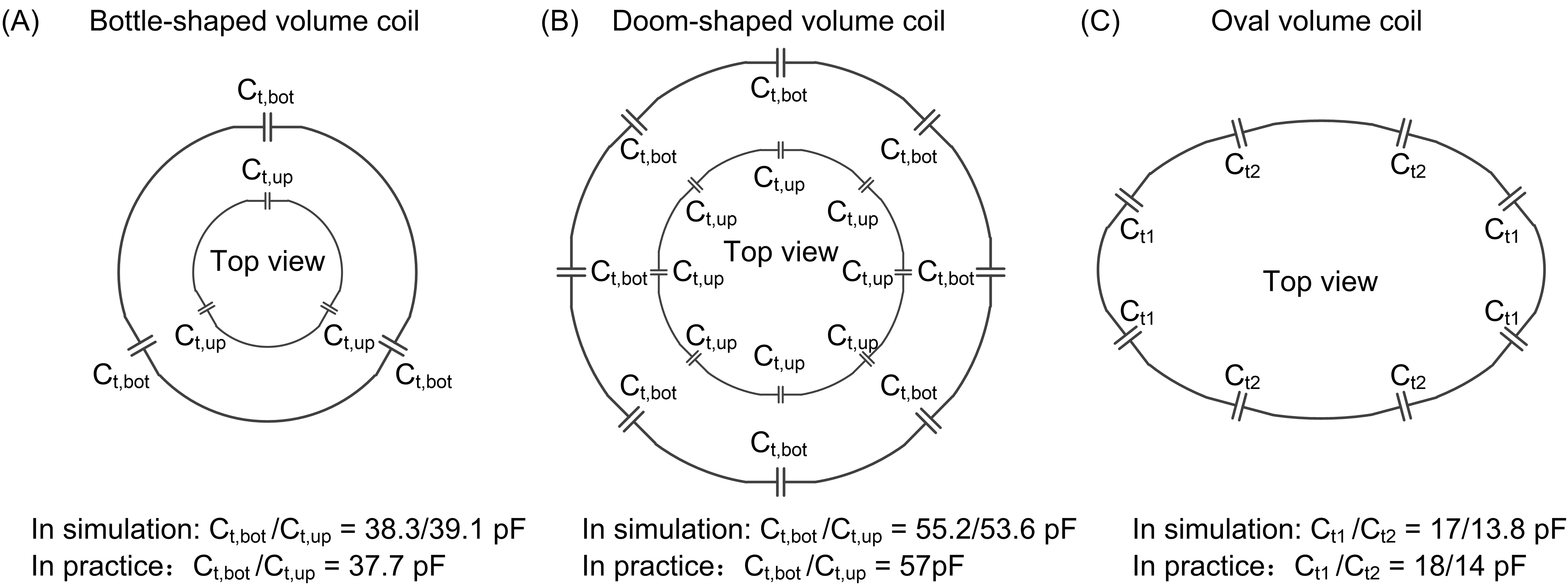
Figures 4A-C display the simulated resonant peaks detected by double probes in bottle-shaped, dome-shaped, and elliptical coils, utilizing the optimal capacitance determined through co-simulation. These resonant peaks were observed at the Larmor frequencies (64 MHz or 128 MHz) for probes located at different positions and orientations, indicating that the wireless coil operates in the desired uniform mode and quadrature mode. Figures 4D-F show the simulated B1 field of the body coil with the presence of the wireless coil. Significant increases in the B1 field within the wireless coil were observed, confirming the efficiency of the wireless coil.To validate the simulation results, we fabricated coils with the exact dimensions in practice. Figure 5 compares the values of capacitors predicted by simulation with those used in practical applications. The consistency between the simulated and practical capacitance further confirms the accuracy and reliability of the proposed probe-based co-simulation methods. We noticed that the probe-based co-simulation method is a general approach and could be extended to more complicated wireless resonators, such as metamaterial-inspired period resonators.
Acknowledgements
This work was in part supported by NIH grants R21 EB029639. The content is solely the responsibility of the authors and does not necessarily represent the official views of the National Institutes of Health.References
- Shchelokova A V, van den Berg C A T, Dobrykh D A, et al. Volumetric wireless coil based on periodically coupled split‐loop resonators for clinical wrist imaging[J]. Magnetic resonance in medicine, 2018, 80(4): 1726-1737.
- Okada T, Handa S, Ding B, et al. Insertable inductively coupled volumetric coils for MR microscopy in a human 7T MR system[J]. Magnetic resonance in medicine, 2022, 87(3): 1613-1620.
- Lu M, Chai S, Zhu H, et al. Low‐cost inductively coupled stacked wireless RF coil for MRI at 3 T. NMR in Biomedicine, 2023, 36(1): e4818.
- Kozlov M, Turner R. Fast MRI coil analysis based on 3-D electromagnetic and RF circuit co-simulation. Journal of magnetic resonance. 2009 Sep 1;200(1):147-52.
Figures