4100
Optimal control pulse design: Solving low tip angle BIR-4 excitation challenges in X-nuclei spectroscopy1Department of Pediatrics, University of British Columbia, Vancouver, BC, Canada, 2Institute for Biomedical Imaging, Graz University of Technology, Graz, Austria, 3Institute for Molecular Biosciences, Karl-Franzens University Graz, Graz, Austria, 4BioTechMed-Graz, Graz, Austria, 5Field of Excellence Biohealth, Karl-Franzens University Graz, Graz, Austria, 6Institute of Biomedical Imaging, Graz University of Technology, Graz, Austria
Synopsis
Keywords: RF Pulse Design & Fields, RF Pulse Design & Fields
Motivation: Adiabatic BIR-4 pulses, employed for $$$B_1^+$$$ robust spectroscopic excitation, exhibit frequency-dependent modulations in received signals, especially at low tilt angles. These modulations interfere with accurate quantitative analysis.
Goal(s): The study aims to examine BIR-4 overshoots at low $$$B_1^+$$$ and introduces optimal control RF pulses to mitigate these issues.
Approach: We investigate and compare BIR-4 and optimal control RF pulses in simulations, phantom experiments, and in-vivo 31P spectroscopy.
Results: We show that optimal control RF pulse design is imperative for obtaining accurate quantitative data. Optimal control RF pulses have the potential to significantly improve in-vivo 31P magnetic resonance spectroscopy.
Impact: Optimal control pulses offer precise excitation, surpassing BIR-4 under low flip angles and challenging transmit conditions. This ensures a stable magnetization steady-state, vital for accurate quantitative analysis in applications such as enzymatic exchange rate measurement via magnetization transfer spectroscopy.
Introduction
Producing a precise tip of the magnetization, as needed for two-angle T1 magnetization transfer spectroscopy1 becomes particularly challenging when surface coils with inhomogeneous excitation fields ($$$B_1^+$$$) are employed. In the past, this challenge was addressed by the use of adiabatic RF pulses that incorporated resilience to $$$B_1^+$$$ inhomogeneities due to their adiabatic passage2. A certain class of adiabatic pulses, BIR-43, are able to produce arbitrary flip angles. In our exploration of optimized RF pulses for challenging transmit conditions, as were introduced at last years ISMRM among others4-6, we observed significant frequency-dependent modulations in the received spectroscopic signals stemming from BIR-4 pulses, particularly for acquisitions with low tilt angles. This study aims to elucidate the phenomenon of BIR-4 overshoots at low $$$B_1^+$$$ levels. In doing so, we employ low energy RF pulse design by optimal control (OC), which we show is imperative specifically for surface coils in order to obtain accurate quantitative data. Our results show that OC pulses have the potential to significantly improve in-vivo 31P MRS.Methods
RF-pulses: Adiabatic BIR-47 (BIR-4, sech/tanh-shape, flip angle $$$\beta=15^\circ$$$, RF-constant = 5.3, $$$\Delta\omega_{\text{max}}=5\,$$$kHz, $$$T_p=4\,$$$ms, $$$B^+_{1\text{peak}}=500\,\mu$$$T) and OC RF pulse (OC, $$$bw(\Delta B_0)=\pm 15\,$$$ppm, $$$\Delta B_1^+=0.4-1.2\times B^+_{1\text{peak}}$$$, $$$T_p=0.7\,$$$ms, $$$\beta=15^\circ$$$, $$$B^+_{1\text{peak}}=500\,\mu$$$T) following4, but with shorter pulse duration and lower energy requirement.Simulations: RF pulses were analyzed within the entire $$$\Delta B_0$$$, and $$$\Delta{B}_1^+=0-1.2\times B^+_{1\text{peak}}$$$. First, the flip angle $$$\beta$$$ and the corresponding transversal phase $$$\varphi$$$ of all simulated magnetization vectors are calculated8. Afterwards, based on the measured $$${B}_1^+$$$ map, the spatial flip angle and phase distribution is used to calculate the transverse steady-state signal
$$S(\beta,\varphi)=\frac{S_0\left(1-\exp(-TR/T_1)\right)\sin\beta}{1-\cos\beta\exp(-TR/T_1)}\cdot\exp^{j\cdot \varphi}$$
with $$$TR\,/ \,T_1=800\,/ \,1700\,$$$ms and $$$S_0$$$ a constant scale.
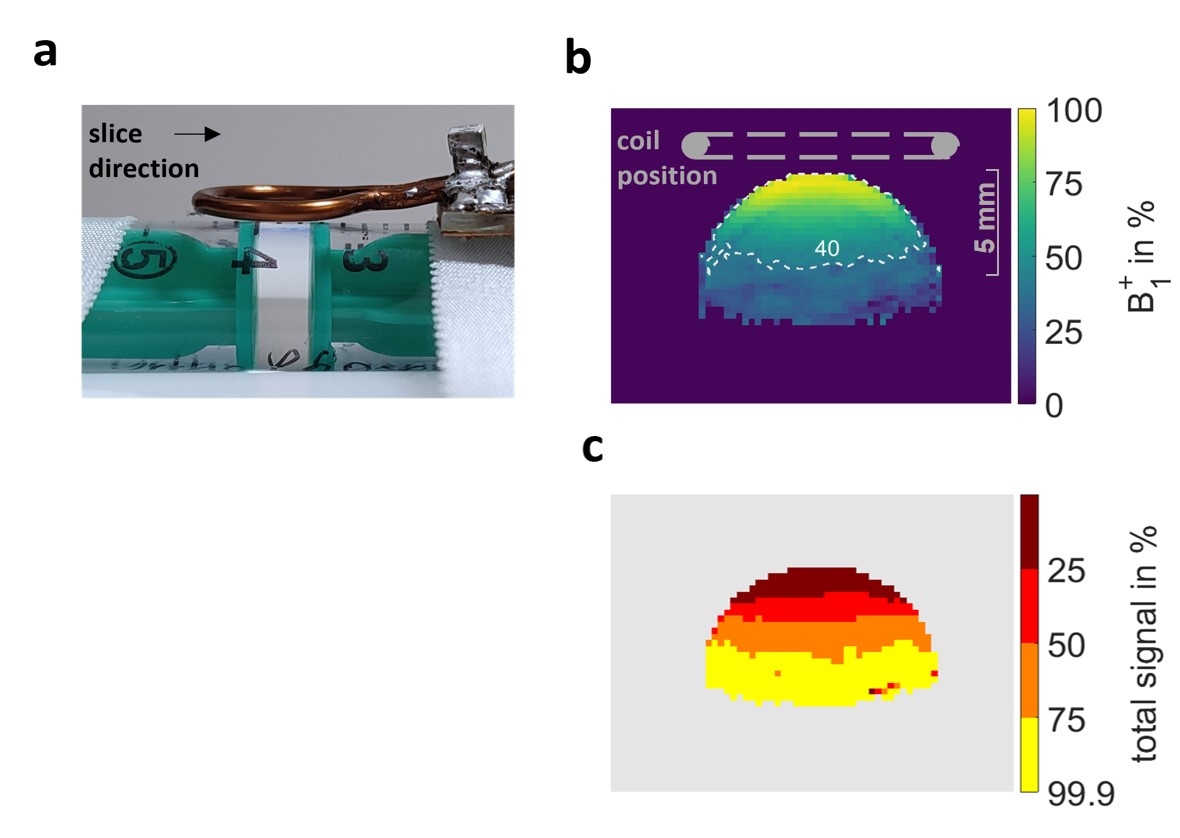
Phantom measurements: RF pulses were implemented on a 7T small animal scanner with a $$$11\,$$$mm T/R coil within a non-selective GRE imaging protocol. A 2D-slice phantom was built filling a $$$5\,$$$ml syringe with $$$\approx500\,\mu$$$l ortho-phosphoric acid ($$$4\,$$$mm slice). Stability to frequency offsets was tested by changing center frequency offset within $$$\pm15\,$$$ppm with a step size of $$$1.5\,$$$ppm, while $$${B}_1^+$$$ was operated at $$$500\,\mu$$$T. The other imaging parameters were: $$$TR\,/\,TE=800\,/\,2\,$$$ms, FOV$$$\,=20\times20\,$$$mm, matrix$$$\,=64\times64$$$, NEX$$$\,=12$$$. A $$$B^+_1$$$ map was acquired with the same parameters as above, but $$$TR = 10\,$$$s, block pulse excitation with two $$$\beta_1=60^\circ\,/\,\beta_2=120^\circ$$$9.
In-vivo measurements: Animal experiments were performed on brains of healthy 5 month old C57BL/6J mice ($$$n=6$$$). The $$$11\,$$$mm coil was placed centered on the cerebral cortex, and a $$$40\,$$$mm quadrature 1H coil was used for high-order shimming. The 31P pulse-acquire protocol was $$$TR=800\,$$$ms, $$$\beta=15^\circ$$$, and 256 averages with 1024 acquisition points at a bandwidth of $$$5000\,$$$Hz. To assess the frequency stability of the excitation pulses, two experiments per animal were conducted, where the center frequency of the 31P excitation was varied from $$$-5.8\,$$$ppm to $$$-7.9\,$$$ppm.
Results
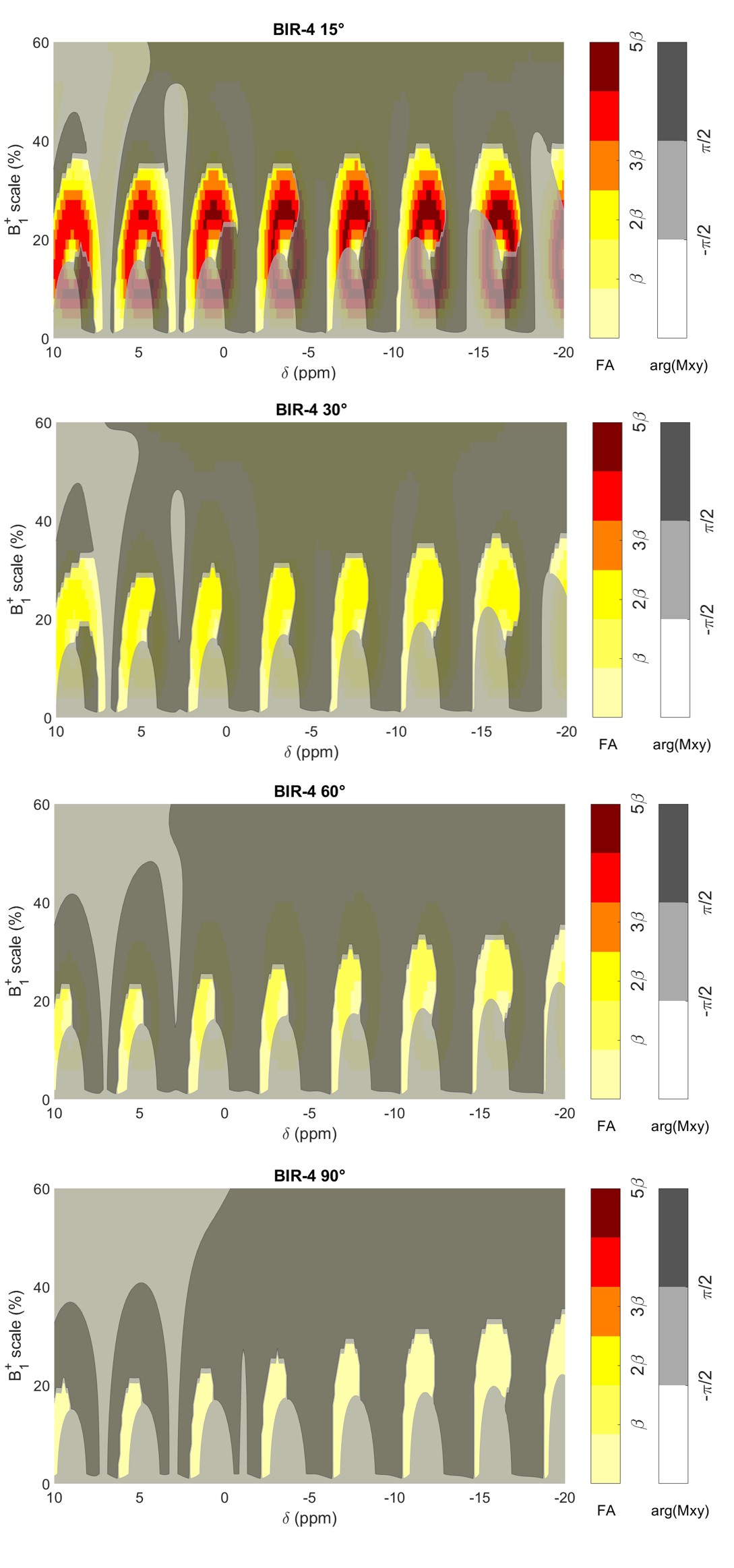
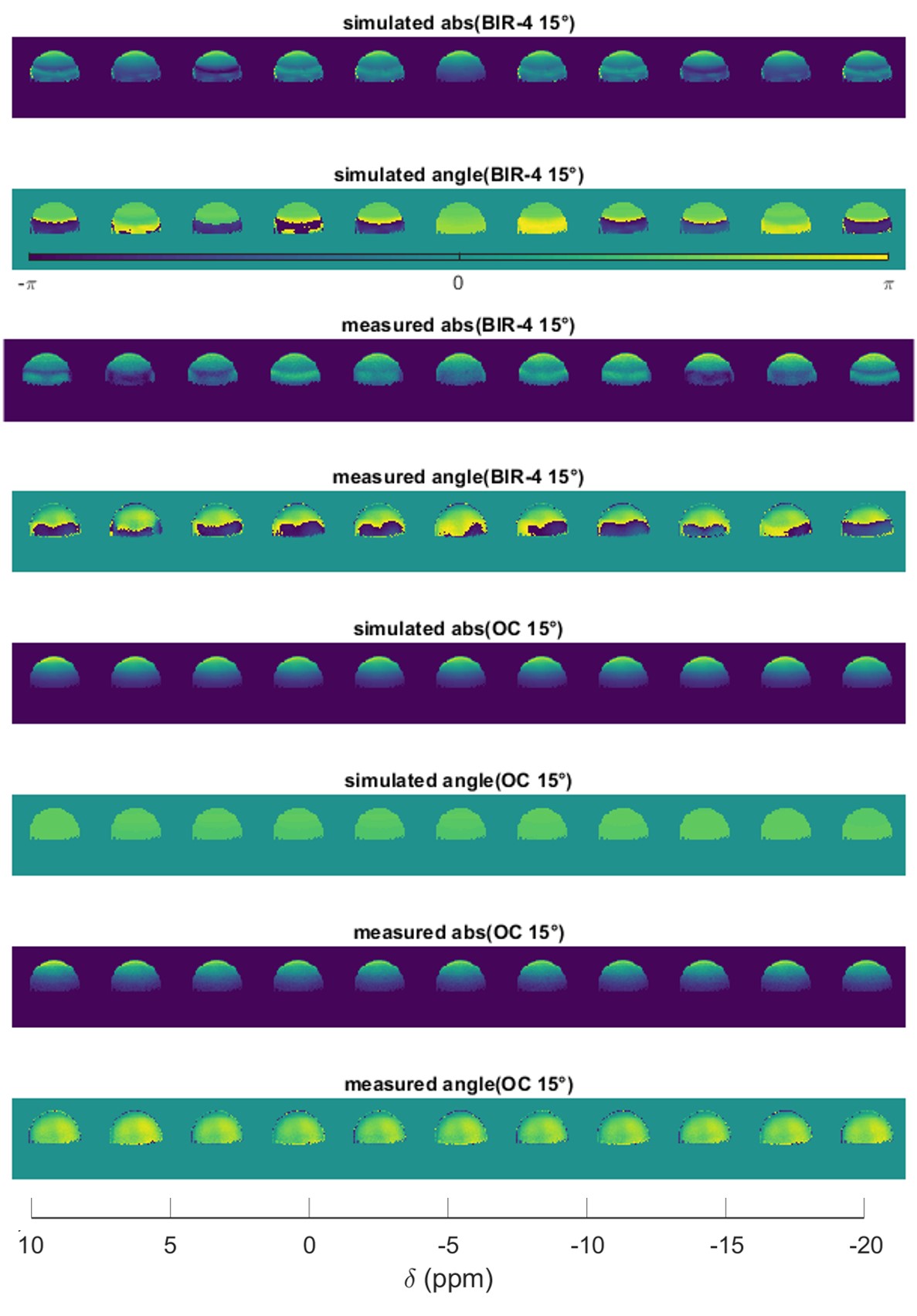
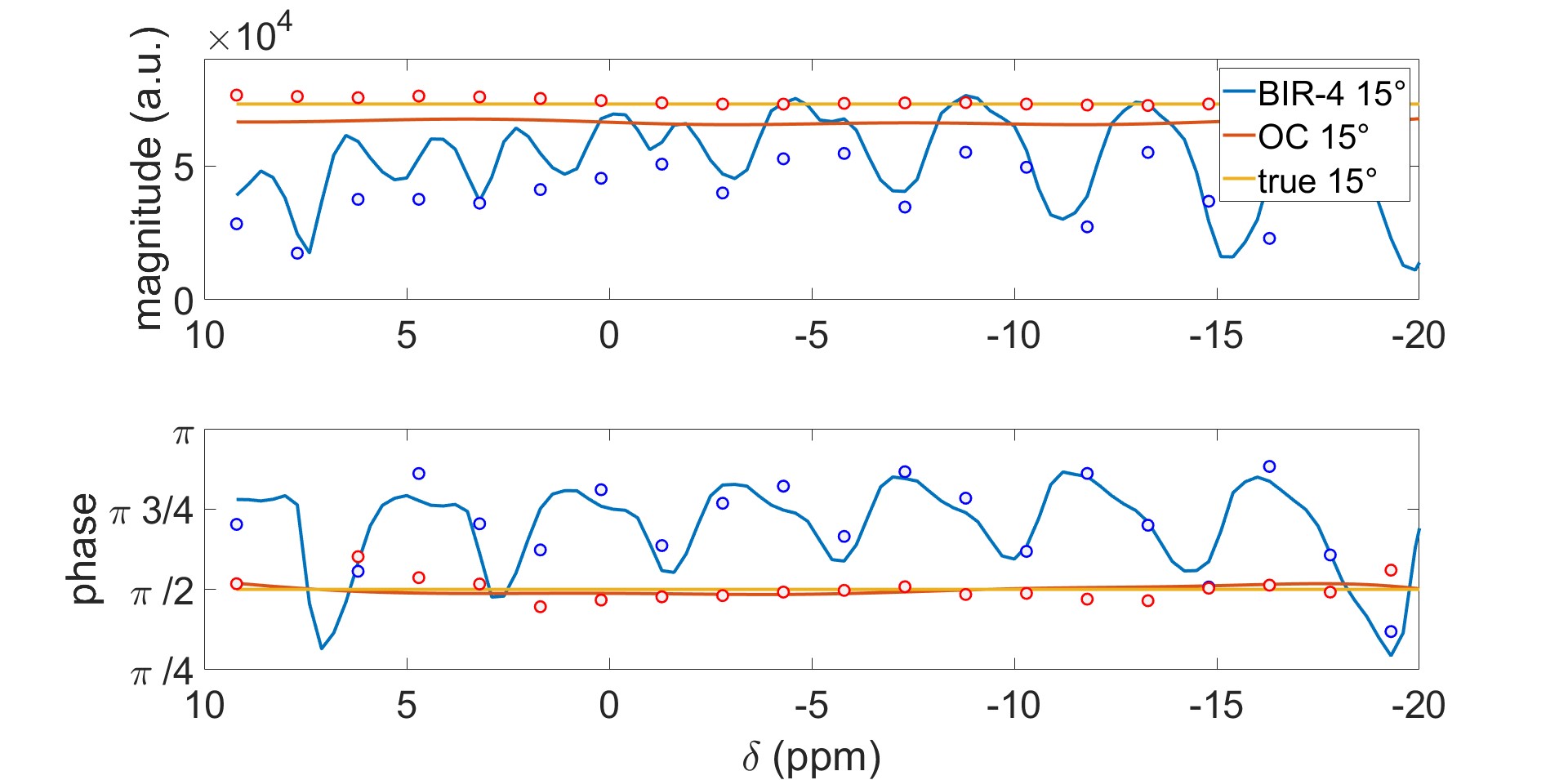
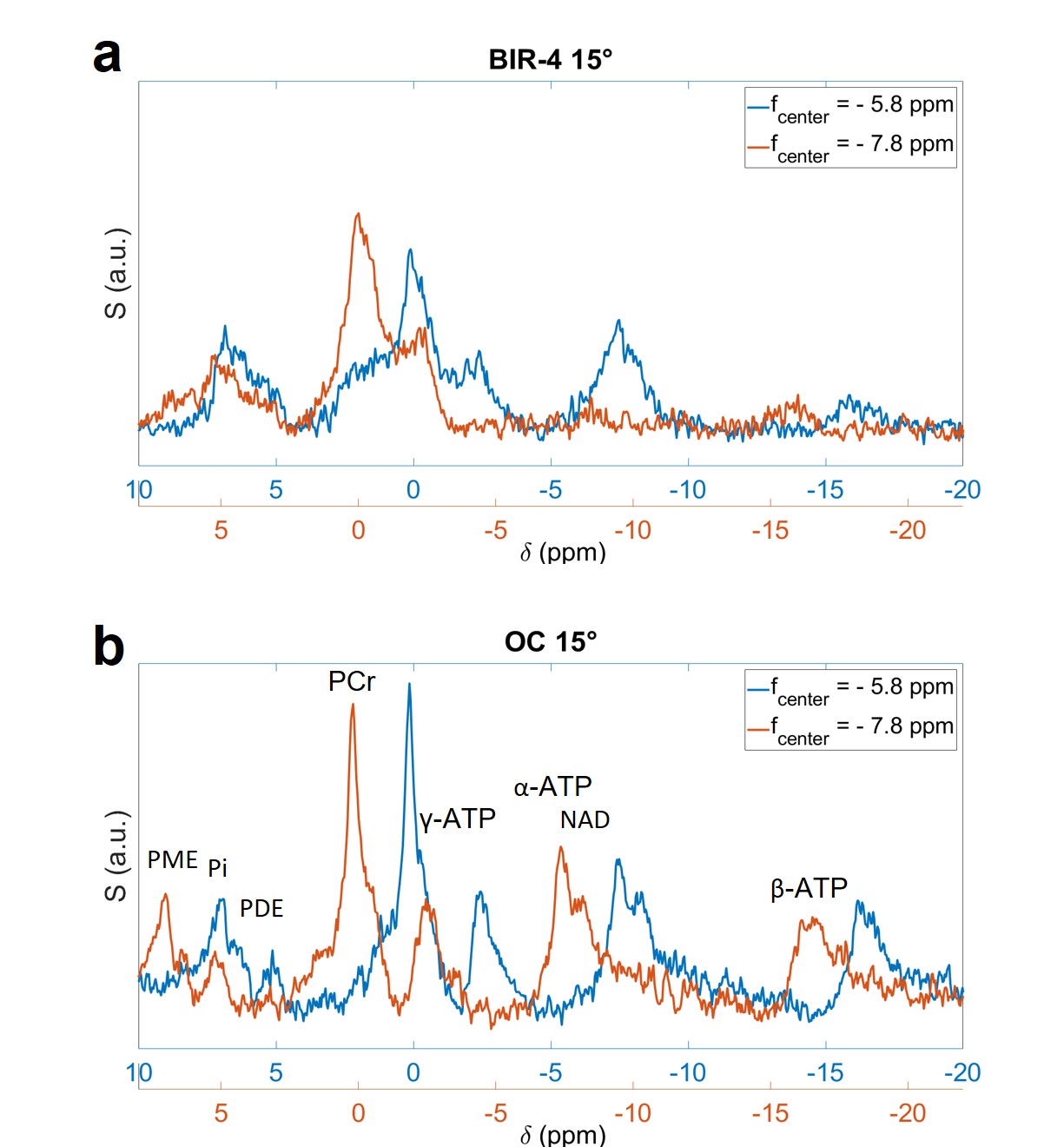
Figure 1 illustrates the frequency-dependent overshoots generated by BIR-4, particularly pronounced at small flip angles. With flip angles above $$$30^\circ$$$, the observed modulation decreases to less than $$$1.5$$$ times the nominal flip angle $$$\beta$$$. However, at $$$15^\circ$$$, regions with low $$${B}_1^+$$$ ($$$<40\%$$$, see Figure 2b) exhibit 2- to 5-times the desired tilt angle. This results in a higher steady-state value and comparable signal intensities between areas close to the coil and areas farther away, despite the reduced receive sensitivity in the latter, as evidenced in both simulated and measured 2D data of BIR-4 $$$15^\circ$$$ (Figure 3). In addition, these areas (contributing to $$$20-25\%$$$ of the coil's receive sensitivity, refer to Figure 2c) have opposing phase. Taken together, this results in a disrupted, frequency-dependent modulation (Figure 4). Within our in-vivo example (Figure 5), BIR-4 excitation led to total signal loss of a single peak ($$$\alpha$$$-ATP) upon the $$$-2\,$$$ppm shifted spectra (mean of 6 animals). OC-designed RF pulses demonstrated consistent magnitude and phase characteristics, closely matching the intended steady-state magnetization and well defined in-vivo spectra.Discussion
At small flip angles, BIR-4 exhibits frequency-dependent amplitude modulations. Notably, these modulations are $$$T_1$$$-dependent, varying based on the Ernst angle of the spin ensemble. Within the OC design, $$$L^2$$$-regularization effectively constrained energy, which is probably the cause for the stability in the lower $$$B_1^+$$$ region. Consequently, OC-designed $$$15^\circ$$$ excitation remained consistent in magnitude and phase across the spectroscopic frequency range.Conclusion
In summary, our study underscores the challenges posed by pure BIR-4 excitation at low flip angles, resulting in spectra that are difficult to interpret. By employing optimal control design, we achieved exceptional stability even under varying $$$B_1^+$$$ conditions. Our findings highlight the potential of OC pulses to greatly enhance in-vivo X-nuclei magnetic resonance spectroscopy, providing stable excitation for reliable quantitative analysis.Acknowledgements
This research was funded in part by the Austrian Science Fund (FWF) $\#$I5618.References
[1] Bottomley P.A., Ouwerkerk R. The Dual-Angle Method for Fast, Sensitive T1 Measurement in Vivo with Low-Angle Adiabatic Pulses. JMR 1994;104(2),159-167. DOI:10.1006/jmrb.1994.1070
[2] Ugurbil K., Garwood M., Bendall R.M. Amplitude- and Frequency-Modulated Pulses to Achieve 90 Plane Rotations with Inhomogeneous B1 Fields. JMR 1987;72:177-185. DOI:10.1016/0022-2364(87)90186-7
[3] Garwood M., Ke Y. Symmetric pulses to induce arbitrary flip angles with compensation for rf inhomogeneity and resonance offsets. JMR 1991;94(3):511-525. DOI:10.1016/0022-2364(91)90137-I
[4] Graf C., Diwoky C., Rund A., Stollberger R. Robust RF pulse optimization for precise excitation in 31P magnetisation transfer spectroscopy. ISMRM 2023;0188.
[5] Diwoky C., Graf C., Rund A., Stollberger R. Optimal control RF pulses for dual-angle T1 measurements in 31P magnetisation transfer spectroscopy. ISMRM 2023;4067.
[6] Graf C., Soellradl M., Aigner C.S., Rund A., Stollberger R. Advanced design of MRI inversion pulses for inhomogeneous field conditions by optimal control. NMR Biomed. 2022. DOI:10.1002/nbm.4790
[7] De Graaf R., Nicolay K. Adiabatic rf pulses: Applications to in vivo NMR. Concepts in Magnetic Resonance 1997;9(4),247-268. DOI:10.1002/(SICI)1099-0534(1997)9:4<247::AID-CMR4>3.0.CO;2-Z
[8] Graf C., Rund A., Aigner C.S., Stollberger R. Accuracy and Performance Analysis for Bloch and Bloch-McConnell Simulation Methods. JMR 2021;329:107011. DOI:10.1016/j.jmr.2021.107011.
[9] Stollberger R., Wach P. Imaging of the Active B1 Field in Vivo. MRM 1996;35(2),246-251. DOI:10.1002/mrm.1910350217
Figures