4096
Stochastic-offset-strategy enhanced RF pulse optimization with auto-differentiation1EECS, MIT, Cambridge, MA, United States, 2Harvard-MIT Health Sciences and Technology, MIT, cambridge, MA, United States, 3Institute for Medical Engineering and Science, MIT, Cambridge, MA, United States
Synopsis
Keywords: RF Pulse Design & Fields, RF Pulse Design & Fields
Motivation: Voxel-wise objective function with auto-differentiation for RF pulse optimization has become prevalent. While benefit from the spatial flexibility of desired pattern, conventional fixed-point representation of a matrix fed into the voxel-wise objective function leads to sub-optimal and undesired resultant profile at courser resolution.
Goal(s): This abstract aims to address the issues of fixed-point artifact in the resultant excitation/refocusing profile.
Approach: We proposed a method called stochastic-offset-approach which assigns random spatial offsets to each point centered at voxel. The objective function is evaluated on this modified set of points.
Results: The results show that our proposed method achieve superior performance compared with fixed-point method.
Impact: This method would significantly speed up and improve the performance of optimizations with voxel-wise objective function evaluated at fixed points under coarser resolution.
Introduction
RF pulse optimization is a crucial aspect of MR imaging and spectroscopy, especially in advanced techniques like parallel imaging1, magnetic resonance spectroscopic imaging (MRSI), and functional MRI (fMRI). The goal of RF pulse optimization is to design RF pulses that achieve specific objectives, such as uniform excitation across a region of interest, minimizing energy deposition (specific absorption rate, SAR)2, mitigating artifacts and spatially selective excitation designs3-5.Various methods have been proposed to optimize RF pulse to achieve desired application, such as excitation k space analysis6, the Shinnar-Le Roux (SLR) algorithm7 and voxel-wise objective function with auto-differentiation optimization algorithm4,5. In this abstract, we aim to improve the voxel-wise objective function algorithm where conventional design is formulated as a voxelwise optimization problem with fixed spatial points for evaluating the loss function. However, especially for coarser resolution, this approach fails to adequately excite magnetization profiles within the intervals of the fixed locations, resulting in suboptimal designs (fixed-point artifact).
To tackle the fix-point issue, one possible approach involves increasing the resolution of the matrix used in the optimization process. However, this strategy encounters a bottleneck in the form of limited computational memory. Additionally, determining the ideal resolution to ensure uniform magnetization within the interval of fixed points often relies on empirical methods. Balancing the need for higher resolution with computational constraints presents a significant challenge in the optimization process, highlighting the intricacies of fine-tuning RF pulses for optimal performance.
We proposed a method named stochastic-offset approach where a random spatial offset is added to the points for loss evaluation. The results show that our method outperforms the conventional designs and the fixed-point artifacts are significantly suppressed.
Methods
We use the same optimization objective function as proposed in previous work. For each iteration, objective loss is evaluated at a set of fixed points centered at each voxel {$$$r_{i,j,k}$$$}, i,j,k is the index of voxel.For each optimization iteration, a new offset $$$\Delta r_{i,𝑗,k}$$$ is applied to each fixed point. As a result, the cost function is calculated on the point set{$$$r_{i,𝑗,k}+\Delta r_{i,𝑗,k}(iter)$$$}. Inspired by the stochastic gradient descent method, the offset $$$r_{i,j,k}$$$ is chosen independently and randomly from a uniform distribution in the range of [−resolution/2,resolution/2] for each optimization iteration. To help improve the convergence of this optimization, an adaptive learning rate is used.This approach is more memory efficient than simply increasing the resolution of the fixed-point approach but requires more optimization iterations.
To demonstrate the effect of our proposed method, we compared our method and baselines on 1D slice excitation for a 2ms RF pulse. That target slice thickness is 12mm and the transition band thickness is 3mm. Linear gradient is used in the slice direction with magnitude of 2mT/m to achieve slice selection. Different resolutions with different stochastic offset coverages are performed to demonstrate the effectiveness of our proposed method. The magnetization is shown with the SLR forward process.
The overall optimization formula is shown as below,
$$\underset{b \in \mathbb{C}^{n_t}}{\operatorname{argmin}} \mathscr{L}=\sum_{\left\{\mathbf{M}_0, \mathbf{M}_{\mathrm{D}}, \Delta r\right\}} \mathrm{f}\left(\mathbf{M}_{T x y}\left(\mathbf{M}_0(r+\Delta r), b\right), \mathbf{M}_{\mathrm{D}}(r+\Delta r)\right) + \lambda \mathscr{R}(b)$$
where $$$b$$$ is the RF pulse, $$$f$$$ is the least square loss on magnitude, $$$\mathbf{M}_0$$$ is the initial magnetization for each voxel, $$$\mathbf{M}_{\mathrm{D}}$$$ is the desired magnetization and $$$\mathbf{M}_{T x y}$$$ is the magnetization after applying optimized RF, $$$ \mathscr{R}$$$ is the l2 regularization.
Results
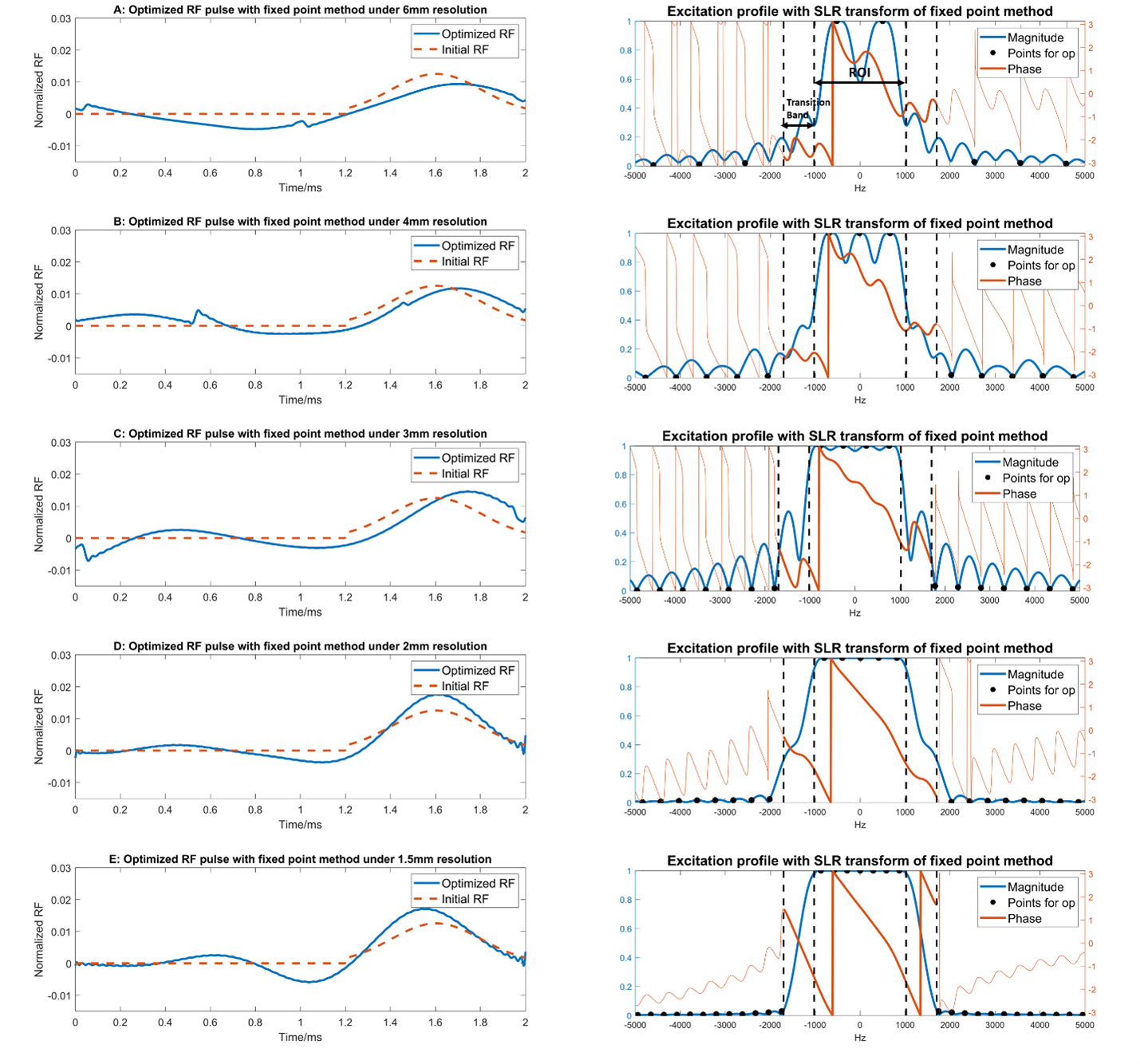
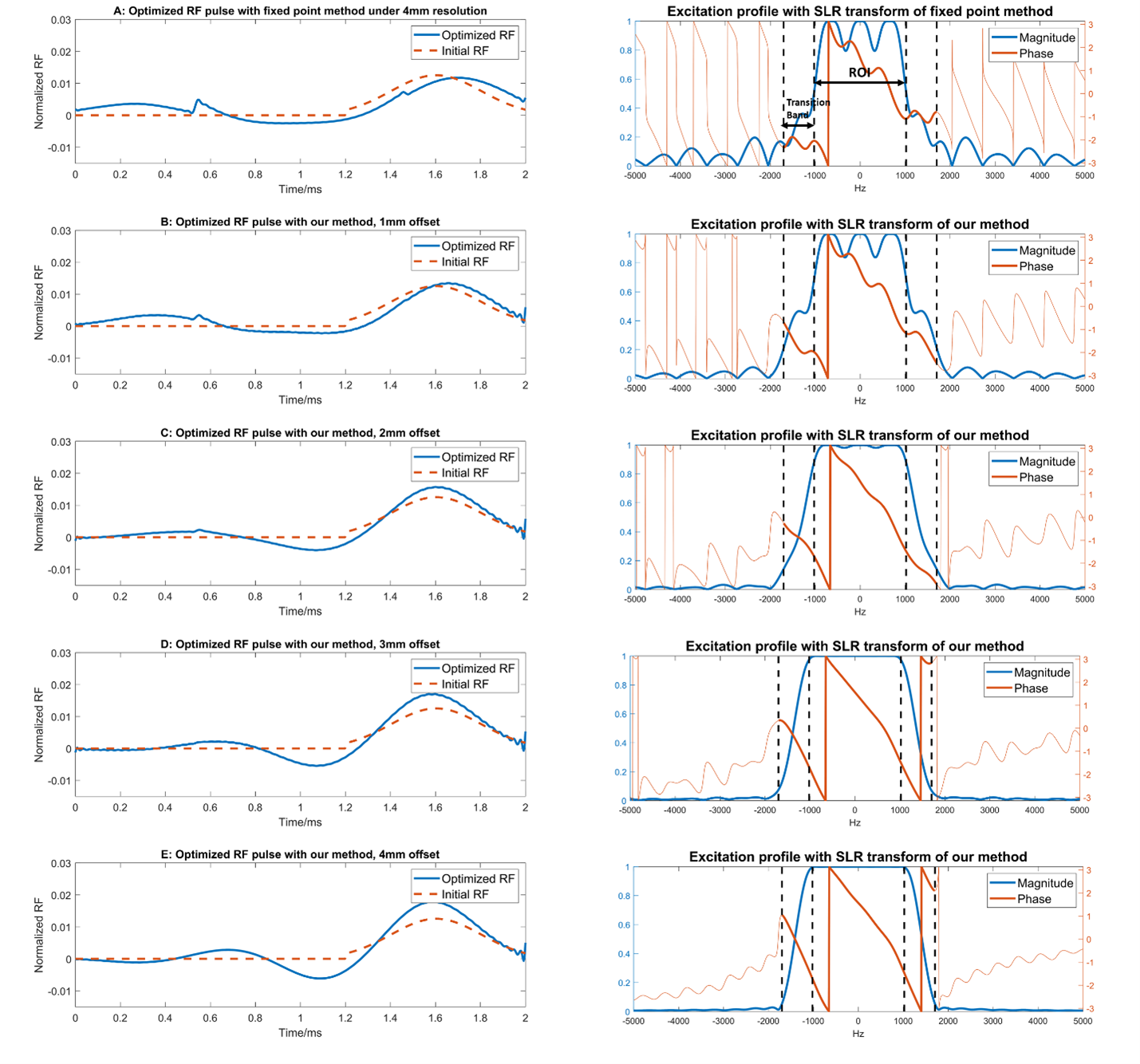
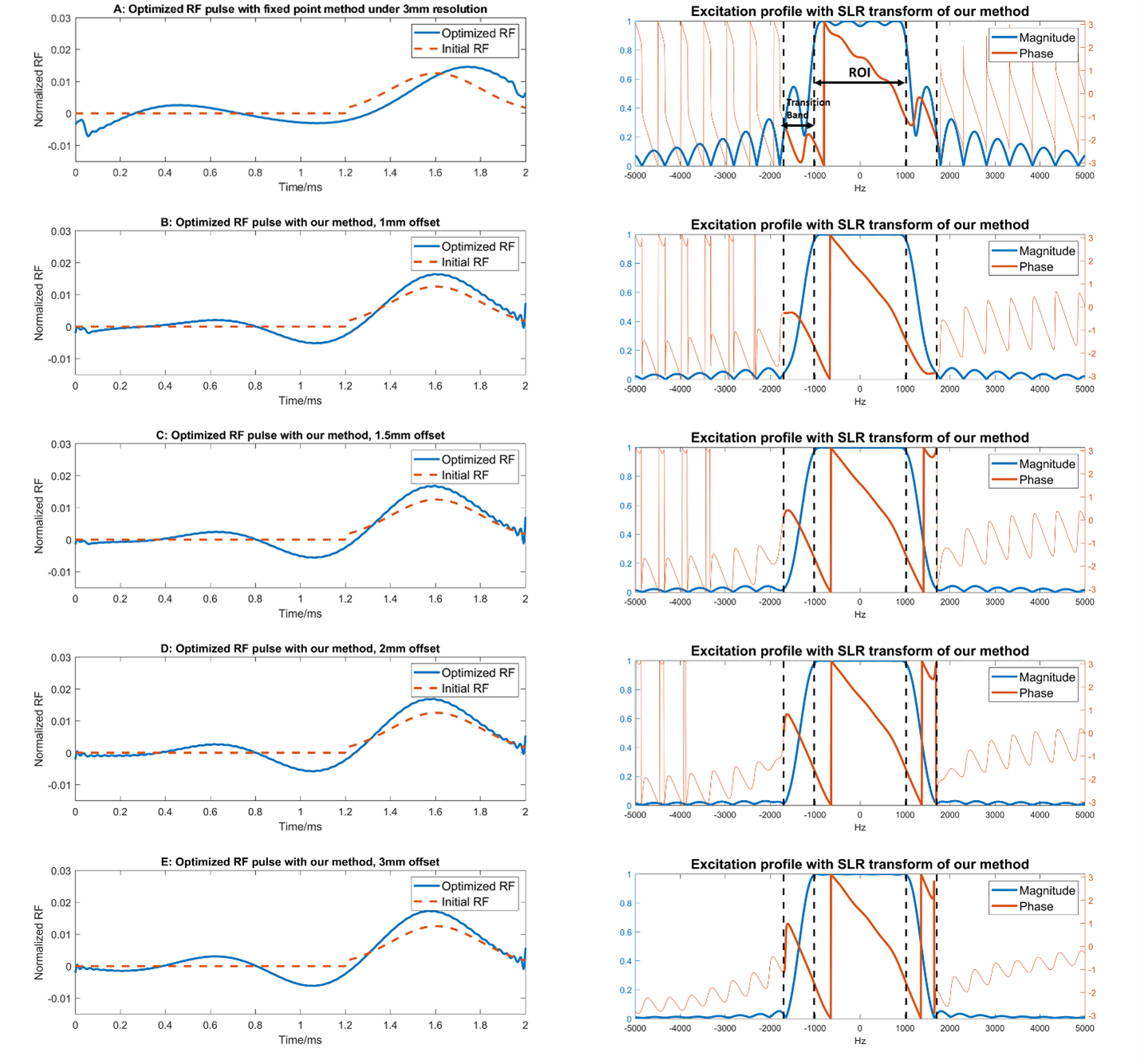
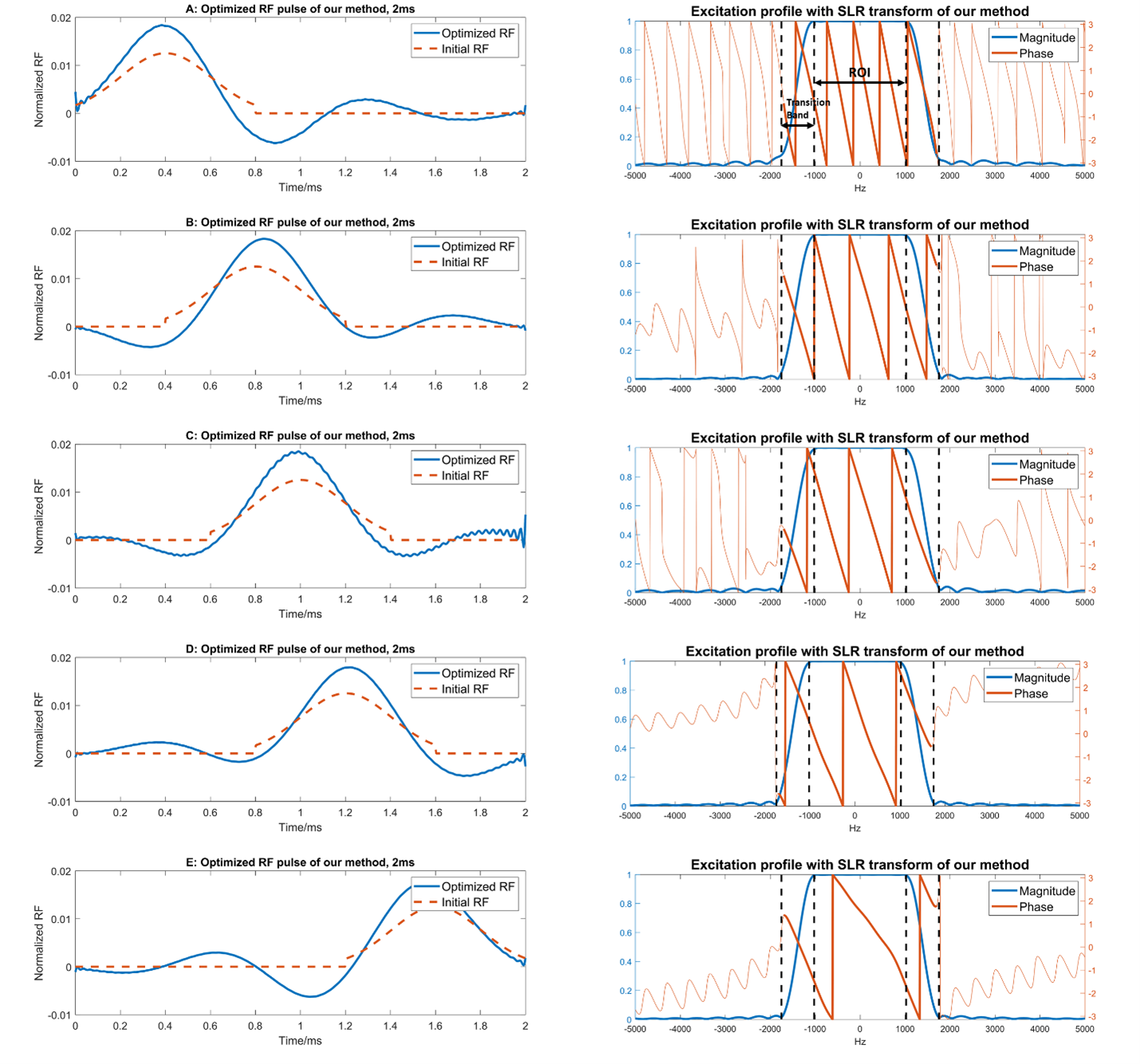
Fig. 1 shows the excitation magnetizations with the fixed point method at different resolutions. Since only fixed points are evaluated and optimized, only the magnetization at the fixed points is well excited (fixed-point artifact). It can be seen from the figure that the fixed-point artifact is reduced while the resolution is increased. 1.5mm achieves desired excitation magnetization. However, the computational burden is increased while the resolution is increased. Fig. 2 shows the excitation magnetizations under 4mm resolution with different offset coverage. When the offset coverage is not enough, the fixed-point artifact is not fully mitigated. The artifact gets suppressed when the coverage increases. Fig. 3 shows the excitation magnetization under 3mm. The minimum offset to achieve a desired excitation profile is 3mm for 4mm resolution while 1.5mm for 3mm resolution.Moreover, fig.4 shows the results of different RF waveform initialization with proposed stochastic offset approach under 4mm resolution. Our proposed method could achieve different RF pulses, such as maximum phase RF and minimum RF.
Conclusions
In this work, we proposed a novel stochastic offset approach to address the issues of fixed-point artifacts. The proposed method achieves better excitation performance and the cost of computation is significantly less (x2.5 for 1D, x6 for 2D, x15 for 3D).Acknowledgements
We are funded by NIH R01 EB032708 and NIH R01 HD100009References
[1]. Setsompop, Kawin, et al. "Magnitude least squares optimization for parallel radio frequency excitation design demonstrated at 7 Tesla with eight channels." Magnetic Resonance in Medicine: An Official Journal of the International Society for Magnetic Resonance in Medicine 59.4 (2008): 908-915.
[2]. Liu, Yinan, and Jim X. Ji. "Minimal-SAR RF pulse optimization for parallel transmission in MRI." 2008 30th Annual International Conference of the IEEE Engineering in Medicine and Biology Society. IEEE, 2008.
[3]. Luo, Tianrui, et al. "Joint design of RF and gradient waveforms via auto-differentiation for 3D tailored excitation in MRI." IEEE transactions on medical imaging 40.12 (2021): 3305-3314.
[4]. Zhang, Molin, et al. "Selective RF excitation designs enabled by time‐varying spatially non‐linear Δ B 0 fields with applications in fetal MRI." Magnetic Resonance in Medicine 87.5 (2022): 2161-2177.
[5]. Zhang, Molin, et al. "Stochastic‐offset‐enhanced restricted slice excitation and 180° refocusing designs with spatially non‐linear ΔB0 shim array fields." Magnetic Resonance in Medicine (2023).
[6]. Pauly, John, Dwight Nishimura, and Albert Macovski. "A k-space analysis of small-tip-angle excitation." Journal of Magnetic Resonance (1969) 81.1 (1989): 43-56.
[7]. Pauly, John, et al. "Parameter relations for the Shinnar-Le Roux selective excitation pulse design algorithm (NMR imaging)." IEEE transactions on medical imaging 10.1 (1991): 53-65.
Figures