4091
Towards Physics-Driven Neural-Network pTx Design with Hard Constraints1Electrical and Computer Engineering, University of Minnesota, Minneapolis, MN, United States, 2Center for Magnetic Resonance Research, University of Minnesota, Minneapolis, MN, United States, 3Siemens Healthcare GmbH, Erlangen, Germany, 4Beth Israel Deaconess Medical Center, Harvard Medical School Department of Medicine, Boston, MA, United States, 5Institute of Radiology, University Hospital Erlangen, Friedrich-Alexander-Universität Erlangen-Nürnberg (FAU), Erlangen, Germany, 6Division of Medical Physics in Radiology, German Cancer Research Centre (DKFZ), Heidelberg, Germany
Synopsis
Keywords: Parallel Transmit & Multiband, Parallel Transmit & Multiband
Motivation: Optimization of parallel transmission (pTx) pulse design with hard constraints on SAR will benefit from faster approaches.
Goal(s): We seek to incorporate hard quadratic constraints for pTx using a physics-driven deep learning (DL) approach.
Approach: We unroll an extension of the log-barrier method to enforce SAR constraints, while learning the optimal gradient step sizes using a neural network. This strategy accelerates optimization with fewer steps, while not sacrificing performance.
Results: Preliminary results show that our method is faster than traditional techniques like CVXPY with similar performance.
Impact: Our proposed method reduces the time-consuming optimization used in conventional pTx and may lead to improvements especially for real-time UHF applications.
INTRODUCTION
Parallel transmission (pTx) for ultrahigh-field MRI typically requires solving a time-consuming optimization problem1,2, which is exacerbated when incorporating SAR limitations3,4. An alternative is universal pulse design, which optimizes pulses for a group of subjects offline, thereby also eliminating B1+ map acquisition5, though its performance lags subject-specific methods6,7. Hybrid methods that integrate subject-specific information to universal pulse initialization have also been proposed8,9. More recently, neural networks (NNs) have emerged as an alternative for rapid pulse generation10-17. However, so far these methods cannot incorporate hard constraints on SAR or power, which is a broader challenge in the artificial intelligence community18,19. In our study, we introduce a novel approach toward this goal by designing a physics-driven NN based on log-barrier formulation to incorporate SAR constraints. Our network learns optimal step-sizes for the central path problem, implemented via gradient descent, with a log-barrier extension20 that allows the network to recover an approximately feasible region. Results show that our approach is faster compared to the highly optimized CVXPY library with similar performance.METHODS
Unrolling approach for optimization with hard constraints:We consider the following optimization problem:
$$\arg\min_{b}||\mathbf{Ab}-\mathbf{m}||_2^2 \\s.t. \; \mathbf{b}^H\mathbf{Qb}<K$$
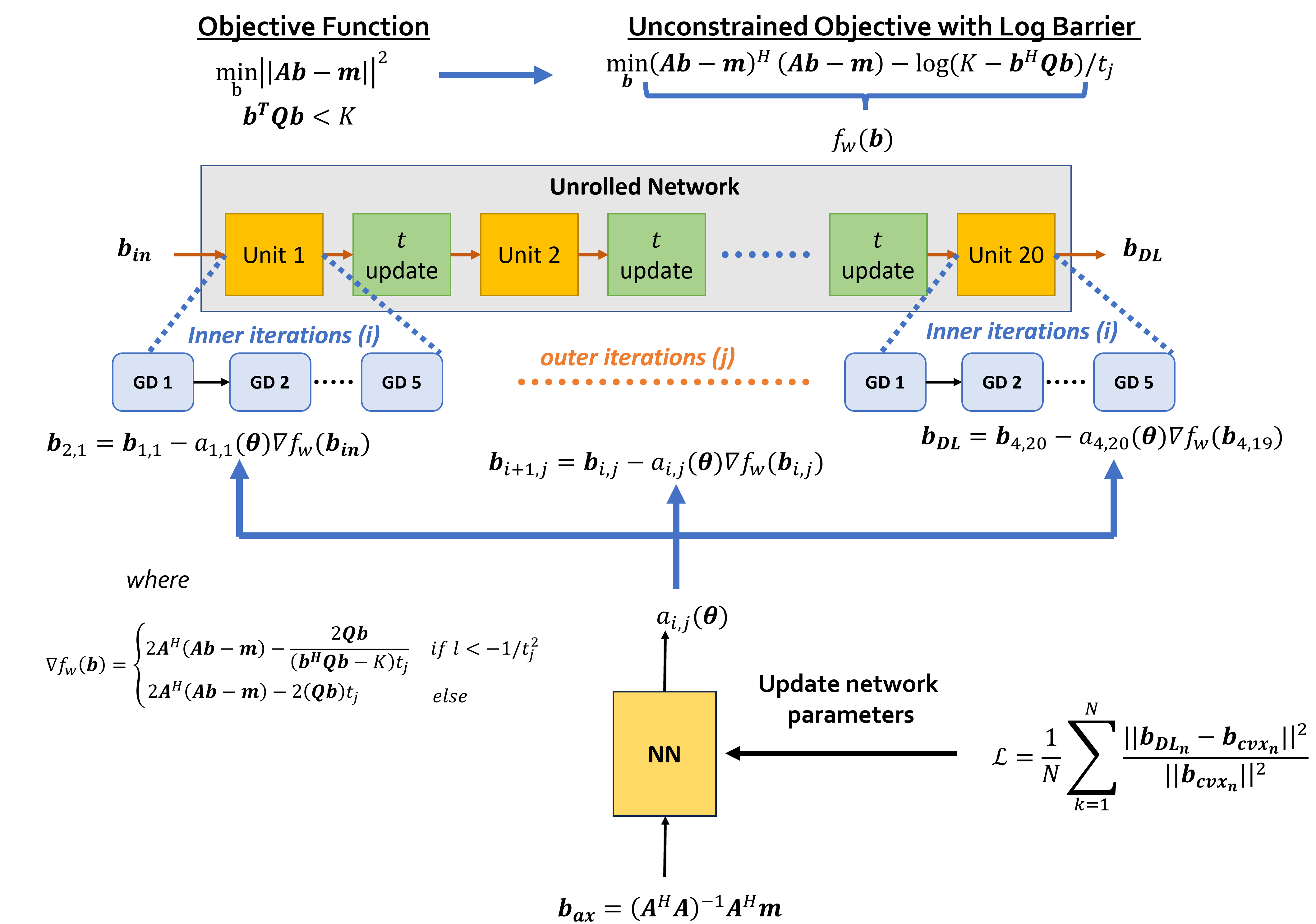
$$$\mathbf{A}$$$ is the system matrix generated via the B1+ maps, $$$\mathbf{m}$$$ is the target flip angle (FA) map, $$$\mathbf{b}$$$ is the target B1+ complex shimming weights for each coil, $$$\mathbf{Q}$$$ is the positive definite global SAR matrix21, and K signifies the global SAR limit. Note that while magnitude least squares is typical in pTx optimization, there are scenarios where phase is important, including TSE acquisitions22,23. We first unroll a log-barrier approach (Fig. 1):
$$\arg\min_{\mathbf{b}}f_w:=(\mathbf{Ab}-\mathbf{m})^H(\mathbf{Ab}-\mathbf{m})-\psi(K-\mathbf{b}^H\mathbf{Qb})$$
where the log-barrier function:
$$\psi(l)=-\frac{1}{t_j} \log (-l)$$
This algorithm minimizes the objective in (1) while approaching feasibility by increasing the barrier parameter(tj) along a central path. Here, the constraint is given by $$$l=K-\mathbf{b}^H\mathbf{Q}\mathbf{b}$$$ and the barrier parameter is selected as $$$t_{j+1}=\mu t_j$$$, where $$$\mu=1.24$$$. For a specific $$$j$$$ (outer loop), we propose to perform the $$$i^{th}$$$ gradient step (inner loop):
$$\mathbf{b}_{i+1,j}=\mathbf{b}_{i,j}-a_{i,j}(\boldsymbol{\theta})\nabla f_w( \mathbf{b}_{i,j})$$
with representing the derivative of the unconstrained function of the outer step. We propose to unroll this algorithm for a fixed number of steps. We further propose to use an NN to learn the step sizes24, $$$ a_{i,j}(\boldsymbol{\theta)}$$$, where $$$\boldsymbol{\theta}$$$ represents learnable parameters, to enhance convergence speed compared to conventional optimization. We also note that the log-barrier function is particularly sensitive close to the barrier's edge. As a result, we employ a modified version of the log-barrier function to overcome this challenge20:
$$\hat{\psi}(l)=\begin{cases}-\frac{1}{t_j}log(-l)&\text{if }l<-\frac{1}{t_j^2}\\t_jl-\frac{1}{t_j}log(\frac{1}{t_j^2})+\frac{1}{t_j}&\text{else}\end{cases}$$
In particular, this function facilitates return to the feasible region. This leads to:
$$\nabla f_w(\mathbf{b}_{i,j})=\begin{cases}2\mathbf{A}^H(\mathbf{A}\mathbf{b}_{i,j}-\mathbf{m})-\frac{2\mathbf{A}\mathbf{b}_{i,j}}{(\mathbf{b}_{i,j}^H\mathbf{Q}\mathbf{b}_{i,j}-K)t_j} &\text{if } (K-\mathbf{b}_{i,j}^H\mathbf{Q}\mathbf{b}_{i,j})<-1/t_{j}^2\\2\mathbf{A}^H(\mathbf{A}\mathbf{b}_{i,j}-\mathbf{m})-2(\mathbf{Q}\mathbf{b}_{i,j})t_j&\text{else}\end{cases}$$
Imaging Data: In-vivo brain B1+ maps were acquired using a 7T MAGNETOM Terra MR system (Siemens Healthcare, Germany) equipped with an 8Tx/32Rx head coil (Nova Medical, Wilmington, MA) on 148 healthy individuals. The training database comprises 3824 2D sagittal slices. 2-dimensional interpolation was applied so that all subjects have the same FOV=200×252mm2, in-plane resolution=4×4mm2 with matrix size of 39×44. Subsequently, B1+ maps were normalized by the 98.5th percentile among all B1+ maps from all subjects to avoid outlier effects9,14.
Network and training details: Proposed NN takes $$$(\mathbf{A}^H \mathbf{A})^{-1} \mathbf{A}^H \mathbf{m} $$$ as its input and outputs the optimized step. It comprises 6 fully-connected layers with a sigmoid activation to ensure non-negativity, while capping the maximum step size. The dataset is randomly split into 90% training and 10% testing. The reference solutions are obtained by solving the convex problem with CVXPY. Subsequently, supervised learning is performed using:
$$\mathcal{L}=\frac{1}{N}\sum_{n=1}^N\frac{\left\|\boldsymbol{b}_{DL_n}-\boldsymbol{b}_{CVX_n}\right\|^2}{\left\|\boldsymbol{b}_{CVX_n}\right\|^2}$$
where N is the number of training samples, $$$\boldsymbol{b}_{DL_n} $$$ is the output of the unrolled algorithm with the NN-optimized step sizes, $$$\boldsymbol{b}_{CVX_n} $$$ is the CVXPY solution.
RESULTS
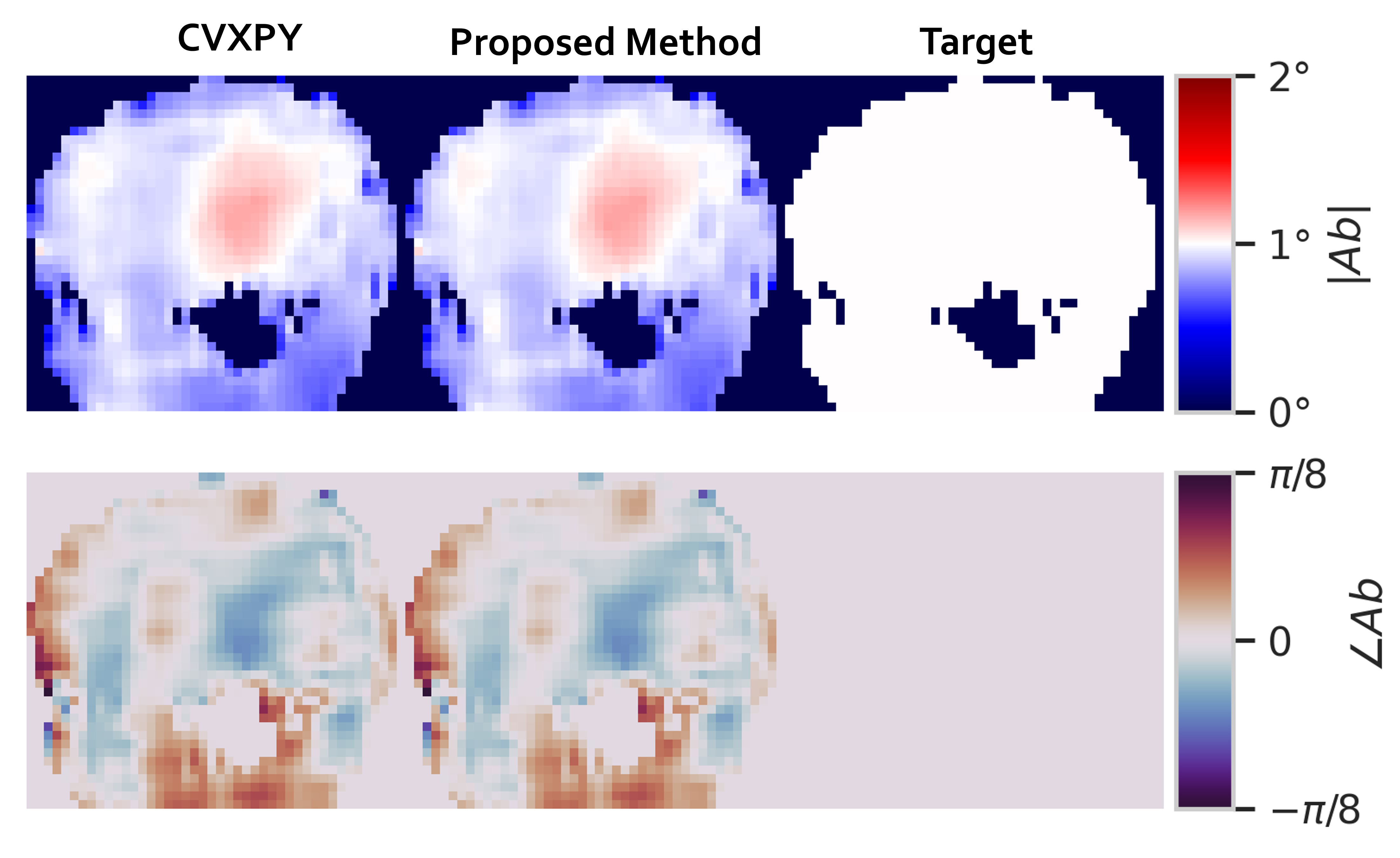
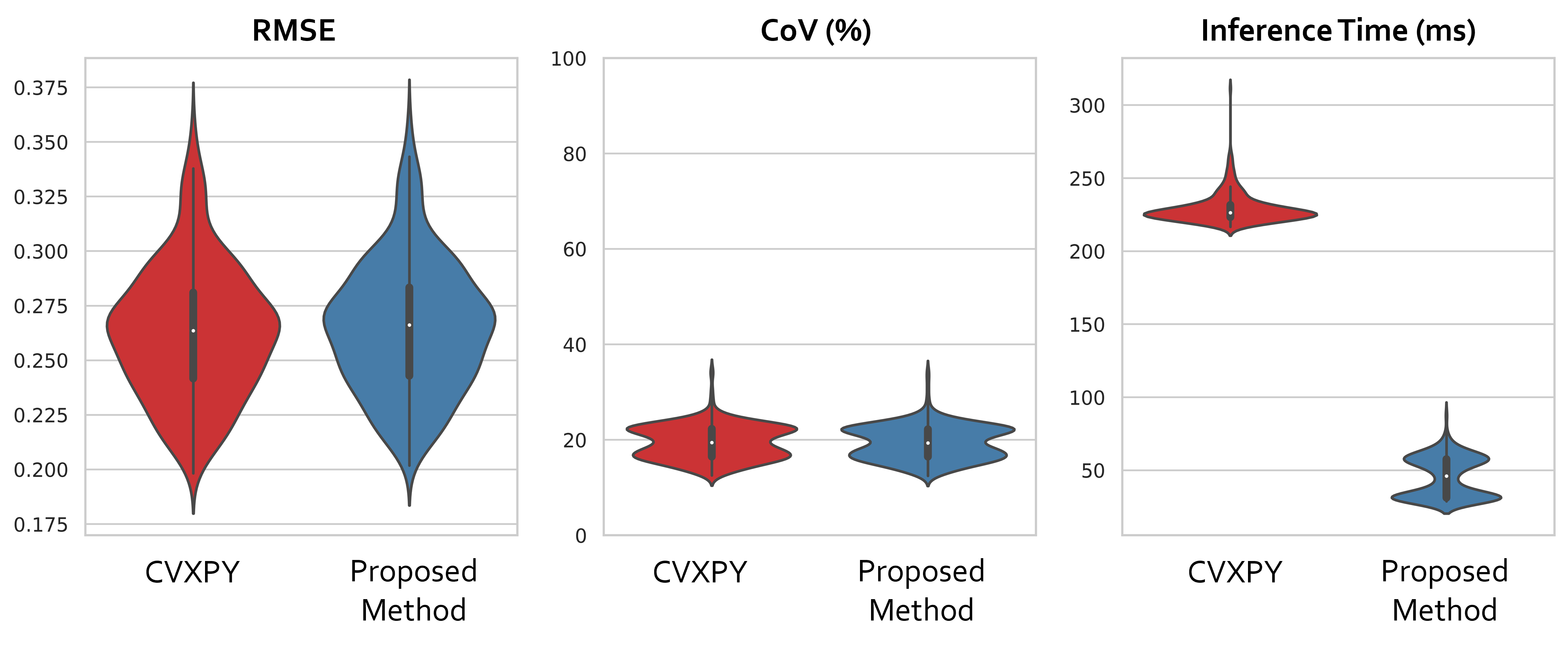
Representative FA profiles for the proposed method and CVXPY are displayed in Fig. 2 for an example target magnetization25 of 1°. Root mean square error (RMSE), coefficient-of-variation (CoV), computation time (violin-plots in Fig.3) and SAR across all subjects (mean±std) for each method is 0.26±0.03, 19.42%±3.50%, 229.05±9.85 ms, 1.499±0.003 for CVXPY; and 0.27±0.03, 19.39%±3.48%, 45.29±13.73 ms, 1.420+0.107 for the proposed method.DISCUSSION AND CONCLUSIONS
In this study, we proposed an NN approach towards ensuring hard constraints for SAR values in pTx design. Our network used physics-driven algorithm unrolling with a novel scheme to learn optimization step sizes. The trained model demonstrates remarkable speed, with excellent performance compared to the convex problem solver CVXPY. Our work focuses on establishing feasibility of the proposed approach in B1+ shimming and may hold promise for real-time B1+ shimming for certain applications26. Future studies will investigate pTx pulse designs for large FA, non-convex magnitude least squares, and dynamic pulses.Acknowledgements
Grant support: NIH U01EB025144, NIH P41EB027061, R01EB032830References
[1] Wu X, Schmitter S, Auerbach EJ, Moeller S, Uğurbil K, Van de Moortele PF. Simultaneous multislice multiband parallel radiofrequency excitation with independent slice‐specific transmit B1 homogenization. Magnetic resonance in medicine 2013;70(3):630-638.
[2] Padormo F, Beqiri A, Hajnal JV, Malik SJ. Parallel transmission for ultrahigh-field imaging. NMR in Biomedicine. Volume 29: John Wiley and Sons Ltd; 2016. p 1145-1161.
[3] Collins CM, Smith MB. Calculations of B1 distribution, SNR, and SAR for a surface coil adjacent to an anatomically‐accurate human body model. Magnetic Resonance in Medicine: An Official Journal of the International Society for Magnetic Resonance in Medicine 2001;45(4):692-699.
[4] Guérin B, Gebhardt M, Cauley S, Adalsteinsson E, Wald LL. Local specific absorption rate (SAR), global SAR, transmitter power, and excitation accuracy trade‐offs in low flip‐angle parallel transmit pulse design. Magnetic resonance in medicine 2014;71(4):1446-1457.
[5] Gras V, Vignaud A, Amadon A, Bihan D, Boulant N. Universal pulses: A new concept for calibration‐free parallel transmission. Magnetic Resonance in Medicine 2017;77(2):635-643.
[6] Le Ster C, Mauconduit F, Massire A, Boulant N, Gras V. Standardized universal pulse: A fast RF calibration approach to improve flip angle accuracy in parallel transmission. Magnetic Resonance in Medicine 2022;87(6):2839-2850.
[7] Aigner CS, Dietrich S, Schaeffter T, Schmitter S. Calibration‐free pTx of the human heart at 7T via 3D universal pulses. Magnetic resonance in medicine 2022;87(1):70-84.
[8] Tomi-Tricot R, Gras V, Thirion B, Mauconduit F, Boulant N, Cherkaoui H, Zerbib P, Vignaud A, Luciani A, Amadon A. SmartPulse, a machine learning approach for calibration-free dynamic RF shimming: Preliminary study in a clinical environment. Magnetic Resonance in Medicine 2019;82(6):2016-2031.
[9] Herrler J, Liebig P, Gumbrecht R, Ritter D, Schmitter S, Maier A, Schmidt M, Uder M, Doerfler A, Nagel AM. Fast online‐customized (FOCUS) parallel transmission pulses: a combination of universal pulses and individual optimization. Magnetic resonance in medicine 2021;85(6):3140-3153.
[10] Ianni JD, Cao Z, Grissom WA. Machine learning RF shimming: Prediction by iteratively projected ridge regression. Magnetic Resonance in Medicine 2018;80(5):1871-1881.
[11] Mirfin C, Glover P, Bowtell R. Optimisation of parallel transmission radiofrequency pulses using neural networks, Proceedings of the 27th Annual Meeting of ISMRM; 2018
[12] Vinding MS, Aigner CS, Schmitter S, Lund TE. DeepControl: 2DRF pulses facilitating B1+ inhomogeneity and B0 off-resonance compensation in vivo at 7 T. Magnetic Resonance in Medicine 2021;85(6):3308-3317.
[13] Vinding MS, Lund TE. Clipped DeepControl: Deep neural network two-dimensional pulse design with an amplitude constraint layer. Artificial Intelligence in Medicine 2023;135:102460.
[14] Herrler J, Liebig P, Majewski K, Gumbrecht R, Ritter D, Meixner CR, Maier A, Dörfler A, Nagel AM. Neural Network-supported Fast Online-Customized (FOCUS) parallel transmit (pTx) pulses for slice-selective, large flip angle excitation. International Society for Magnetic Resonance in Medicine2022.
[15] Plumley A, Watkins L, Treder M, Liebig P, Murphy K, Kopanoglu E. Rigid motion‐resolved prediction using deep learning for real‐time parallel‐transmission pulse design. Magnetic Resonance in Medicine 2022;87(5):2254-2270.
[16] Eberhardt B, Poser BA, Shah NJ, Felder J. B1 field map synthesis with generative deep learning used in the design of parallel-transmit RF pulses for ultra-high field MRI. Zeitschrift für Medizinische Physik 2022;32(3):334-345.
[17] Krueger F, Aigner CS, Hammernik K, Dietrich S, Lutz M, Schulz‐Menger J, Schaeffter T, Schmitter S. Rapid estimation of 2D relative B1+‐maps from localizers in the human heart at 7T using deep learning. Magnetic Resonance in Medicine 2023;89(3):1002-1015.
[18] Donti PL, Rolnick D, Kolter JZ. DC3: A learning method for optimization with hard constraints. arXiv preprint arXiv:210412225 2021.
[19] Pan X, Chen M, Zhao T, Low SH. DeepOPF: A Feasibility-Optimized Deep Neural Network Approach for AC Optimal Power Flow Problems. IEEE Systems Journal 2023;17(1):673-683.
[20] Kervadec H, Dolz J, Yuan J, Desrosiers C, Granger E, Ayed IB. Constrained deep networks: Lagrangian optimization via log-barrier extensions. 2022. IEEE. p 962-966.
[21] Lee J, Gebhardt M, Wald LL, Adalsteinsson E. Local SAR in parallel transmission pulse design. Magnetic Resonance in Medicine 2012;67(6):1566-1578.
[22] He X, Schmidt S, Zbýň Š, Haluptzok T, Moeller S, Metzger GJ. Improved TSE imaging at ultrahigh field using nonlocalized efficiency RF shimming and acquisition modes optimized for refocused echoes (AMORE). Magnetic Resonance in Medicine 2022.
[23] Malik SJ, Hajnal JV. Phase relaxed localized excitation pulses for inner volume fast spin echo imaging. Magnetic Resonance in Medicine 2016;76(3):848-861.
[24] Wei Y, Zhao M-M, Hong M, Zhao M-J, Lei M. Learned conjugate gradient descent network for massive MIMO detection. IEEE Transactions on Signal Processing 2020;68:6336-6349.
[25] Paez A, Gu C, Cao Z. Robust RF shimming and small‐tip‐angle multispoke pulse design with finite‐difference regularization. Magnetic Resonance in Medicine 2021;86(3):1472-1481.
[26] Schmitter S, Schnell S, Uğurbil K, Markl M, Van de Moortele PF. Towards high‐resolution 4D flow MRI in the human Aorta using kt‐GRAPPA and B1+ shimming at 7T. Journal of Magnetic Resonance Imaging 2016;44(2):486 -499.
Figures