4079
Halbach Magnet Design for Low-Field MRI using Higher-Order Halbach Shimming and Layer-independent Segmentation.1Biomedical Engineering, Case Western Reserve University, Cleveland, OH, United States, 2Physics, Case Western Reserve University, Cleveland, OH, United States, 3Radiology, Case Western Reserve University, Cleveland, OH, United States
Synopsis
Keywords: Magnets (B0), Magnets (B0)
Motivation: Existing low-field magnet designs are too heavy. They often have small usable imaging regions and inconvenient bore diameters.
Goal(s): To design a compact, lightweight, and portable low-field magnet system with a large usable imaging region and a small length-to-bore aspect ratio.
Approach: Our approach includes data-driven higher-order Halbach-based shim design. We also employed Mu-metal to enhance the shimming. We further improved the homogeneity by discretizing the multilayered Halbach into segments. We used COMSOL multiphysics for simulation.
Results: In COMSOL-based magnetostatic simulation, we achieved a compact, lightweight magnet design with an imaging region spanning over half the magnet's bore.
Impact: The improvement of the low-field MRI design with a lightweight and inexpensive magnet system with a potential benefit in resource-constrained and point-of-care settings.
Introduction
In resource-constrained settings, developing accessible point-of-care MRI systems can significantly benefit from low-field magnet designs1. Neodymium(NdFeB) magnet-based Halbach cylinders are popular for low-field magnet system designs1,2. Current magnet optimization methods primarily aim to enhance field strength and homogenize these magnets by adding dipole (K=2) Halbach layers, resulting in heavy magnet systems ( where K is the number of poles within the Halbach). These systems are longer than the required ROI to achieve the above goals 3. Here, we investigate the use of higher order (K=4:-Inverted quadrupole) Halbach modes4 and a segmented Mu-metal ring for shimming. Here, we present a 35mT magnet that is homogeneous over half of the magnet bore, resulting in a 1:1.5 aspect ratio, which, to our knowledge, is one of the shortest magnets published to date. This combination of modes and shimming represents a potentially new method for low-field magnet design.Methods
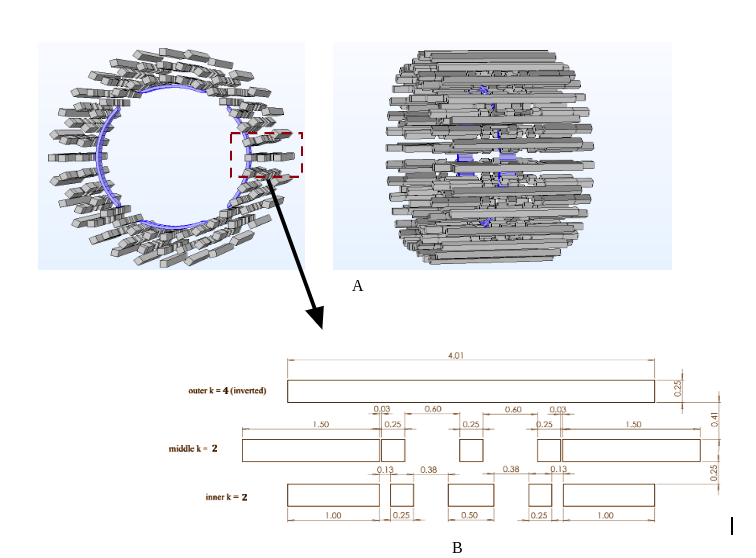
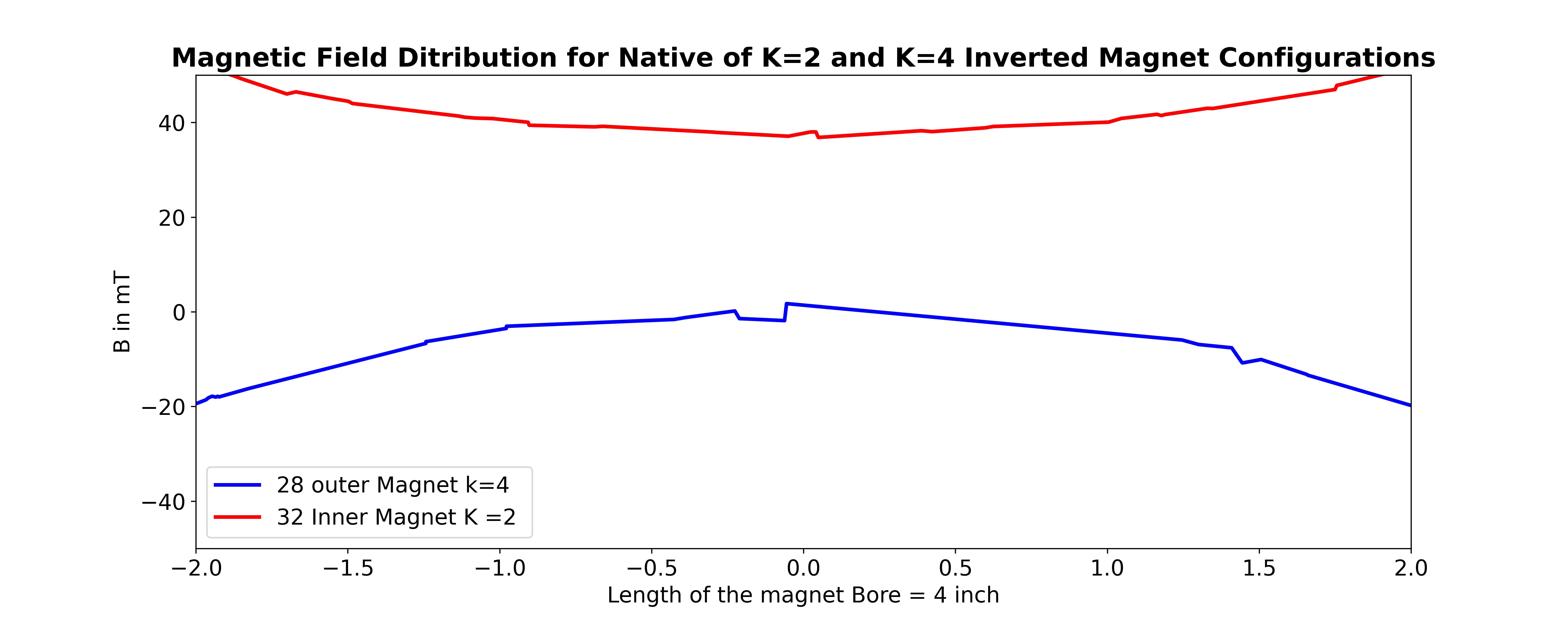
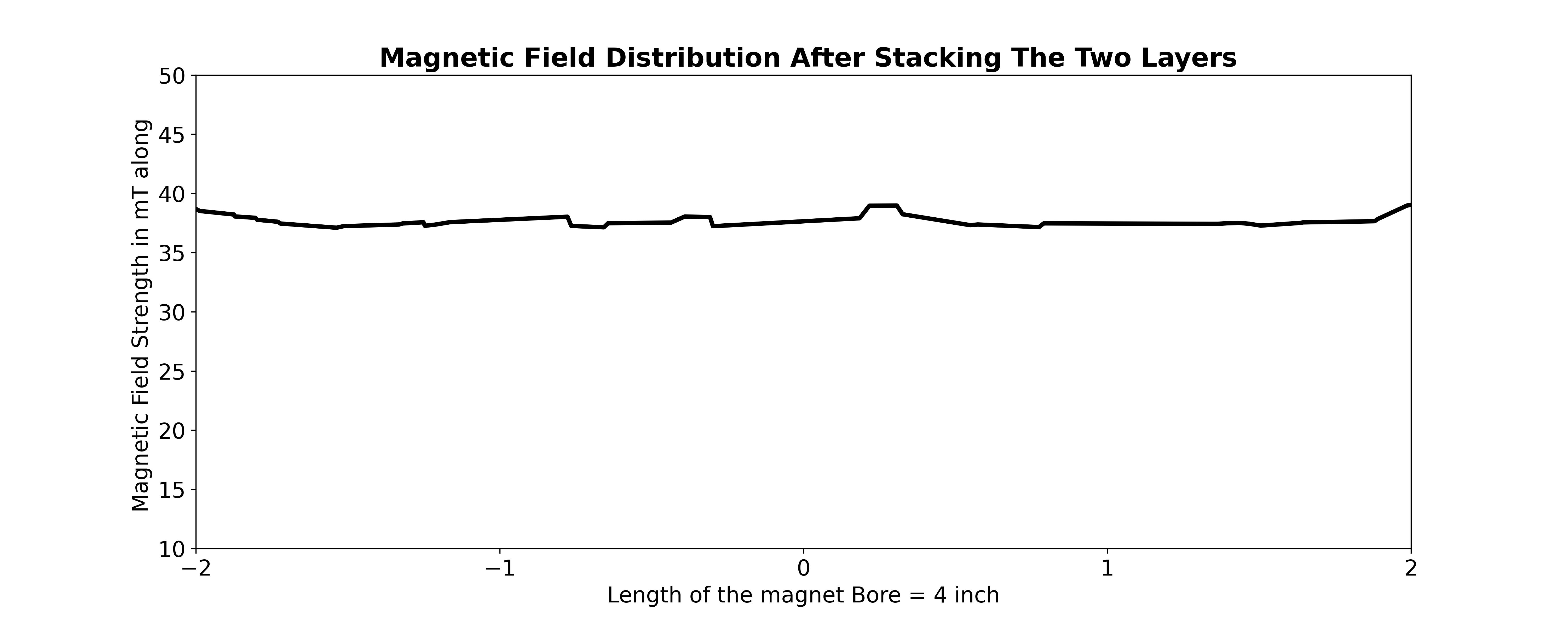
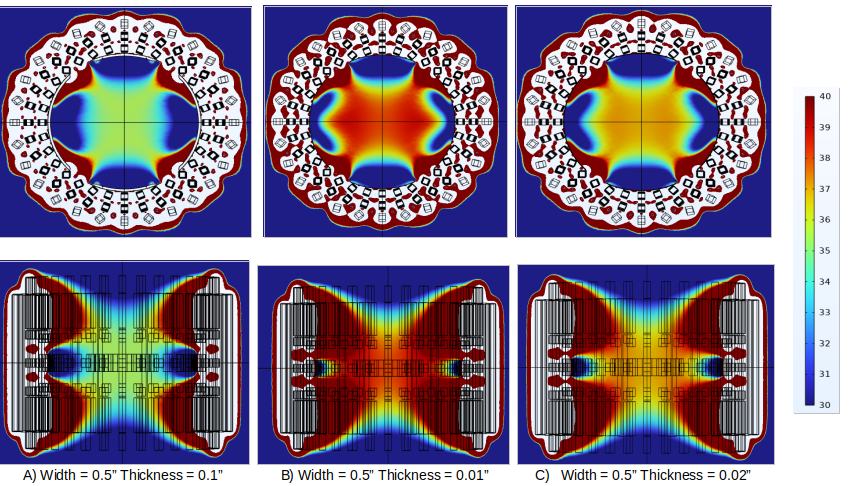
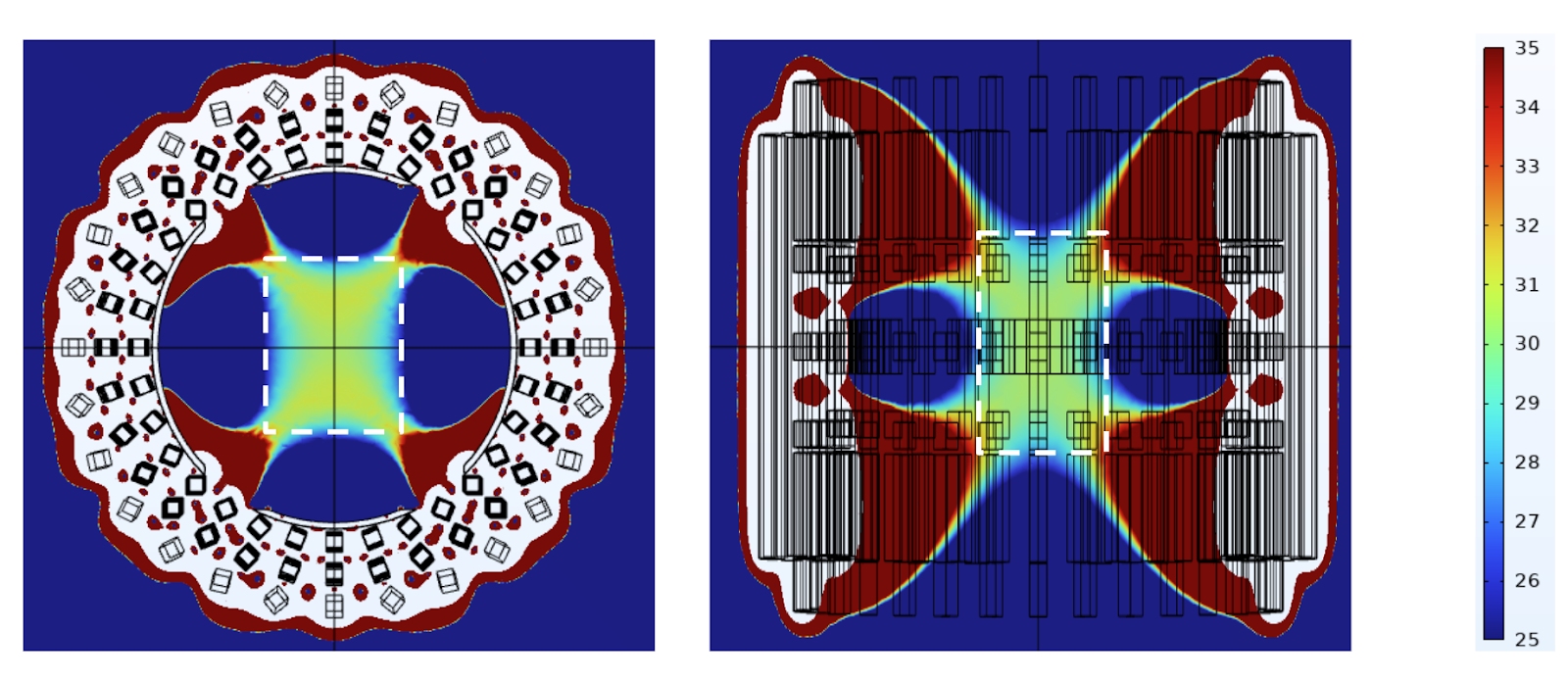
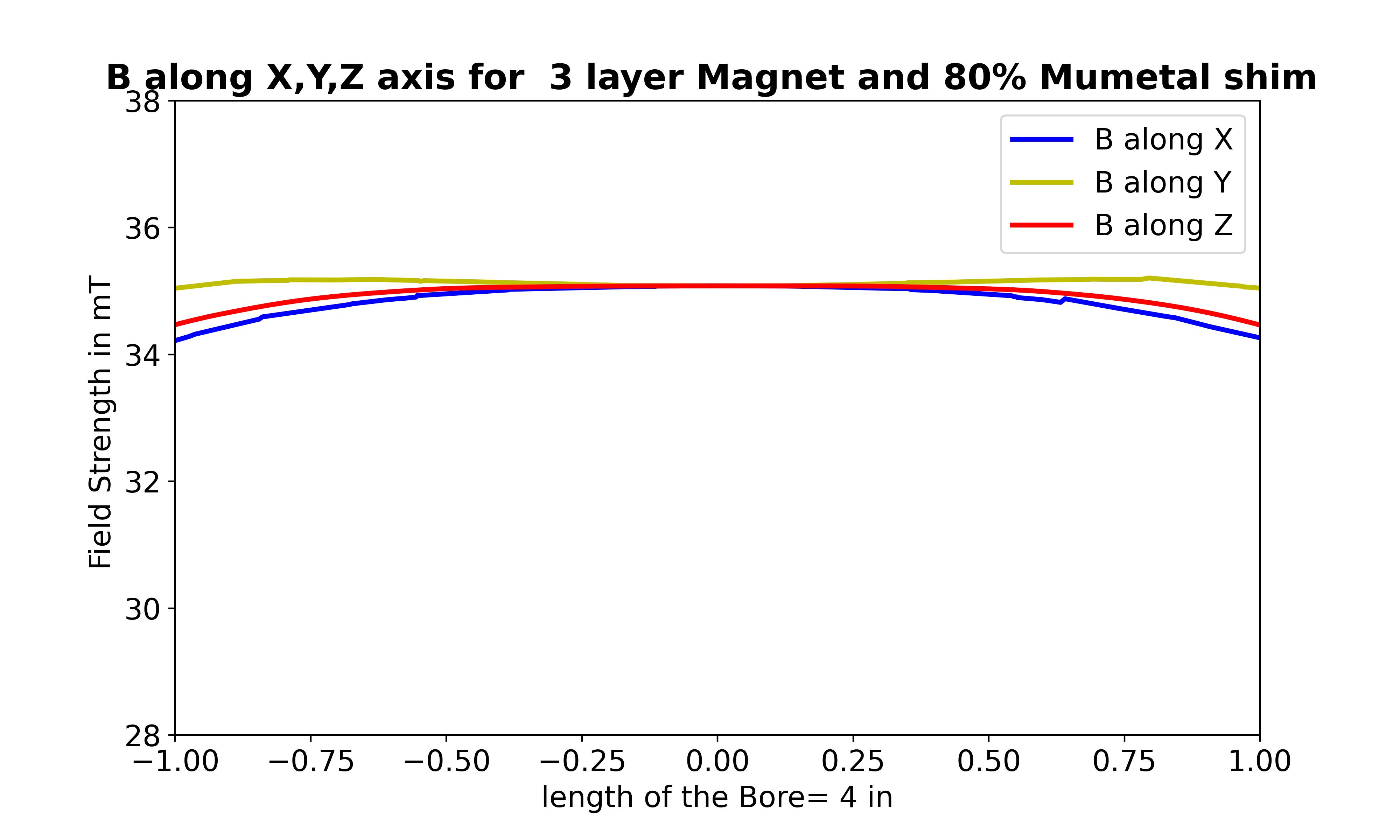
We followed three fundamental procedures using COMSOL Multiphysics for simulation. We started by characterizing K=2 and K=4 order Halbach cylinders using magnetostatic simulation. We used ¼-inch NbFeB cube magnets in our simulations. From the simulation, we selected a Halbach dipole (K=2) with a radius=7.62 cm (3in) and a length =10.16cm (4 in) to generate the primary magnetic field. This allowed us to quantitatively assess the resulting inhomogeneity by curve fitting to the fifth-degree polynomial basis function to the field maps. Our primary objective in our magnet design was the constant term A from the fifth-degree polynomial basis B(x)=A+BX+CX2+DX3+EX4+FX5, where X is the spatial location and B(x) is the generated field strength. To eliminate the undesirable basis terms for our design, we introduced a 1800 rotated K=4 order (quadrupole) on the outer layer. The inverted K = 4 Halbach stacked on the outer layer, with 28 magnets having length = 10.16 cm (4 in) and radius = 10.57cm (4.16 in), over-corrected the main field. To resolve this, we inserted a second dipole Halbach layer between the existing layers, extending 0.5 inches longer on both sides. Figure 1 shows the simulated design of the magnet. As shown in Figure 3, discretizing the inner two Halbach layers independently into short cylindrical segments4, with varying gap dimensions independently at each layer, rectified the field deviation. We placed a segmented Mu-metal ring inside the inner Halbach to further enhance shimming. The effectiveness of Mu-Metal depends on its geometric parameters and its placement location. To determine the optimal location and achieve the best shimming capability, we placed the Mu-Metal at various locations and used different geometric combinations, as shown in Figure 4 . A Mu-metal with a width of 0.5 inches and a thickness of 0.1 inches showed improved field homogeneity, as shown in Figure 5.Results
We attained a homogeneous magnet with a field strength of 35 mT on a COMSOL-based magnetostatic simulation(Figure 1) . The generated usable imaging region spanned over half of the magnets' bore. We used a highly permeable Mu-metal, which greatly rectified the field deviation. Mu-metal's shimming effectiveness in low-field MRI magnet design is highly dependent on both its geometric parameters and the specific location at which it is placed(Figure 4). We achieved an aspect ratio of 1:1.5 (4-inch length/6-inch inner diameter). Our compact design has a larger bore radius and shorter length than existing heavily weighted designs and is also estimated to weigh 7-10 kilograms. Our design has an estimated cost of less than $1500.Discussion and Conclusion
Our low-field MRI magnet design prioritizes enhancing field homogeneity through a layer-based discretization approach using higher-order Halbach arrays and Mumetal-based shimming techniques. The characterization of magnets with varying aspect ratios, combined with curve fitting, helped us understand the contribution of each term from fifth-degree polynomial basis functions, ultimately guiding the identification of important magnet design parameters. This procedure revealed that odd-degree polynomials had a negligible impact, primarily due to the cylinder's symmetry, leading to their cancellation. But even-degree polynomials mainly contributed to inhomogeneity, which our shimming aims to resolve. We added an inverted quadrupole Halbach layer to address this. However, stacking Halbach layers resulted in an undesirable effect, introducing extra inhomogeneities. To further optimize our system, an additional dipole Halbach was positioned between the two layers to increase the field strength, followed by segmentation of the middle and inner layers, thus creating spatially periodic fields. Our approach demonstrates the effectiveness of the inverted K=4 native Halbach configuration and discretized Mu-metal for shimming, providing a compact, low-field Halbach magnet system with exceptional field homogeneity and an ideal aspect ratio for rectangular imaging fields.Acknowledgements
No acknowledgement found.References
1- Cooley, C. Z., Stockmann, J. P., Witzel, T., LaPierre, C., Mareyam, A., Jia, F., Zaitsev, M., Wenhui, Y., Zheng, W., Stang, P., Scott, G., Adalsteinsson, E., White, J. K., & Wald, L. L. (2020, January). Design and implementation of a low-cost, tabletop MRI scanner for education and research prototyping. Journal of Magnetic Resonance, 310, 106625. https://doi.org/10.1016/j.jmr.2019.106625
2- A. R. Purchase et al., "A Short and Light, Sparse Dipolar Halbach Magnet for MRI," in IEEE Access, vol. 9, pp. 95294-95303, 2021, doi: 10.1109/ACCESS.2021.3093530.
3- O’Reilly, T, Teeuwisse, WM, de Gans, D, Koolstra, K, Webb, AG. In vivo, 3D brain and extremity MRI at 50 mT using a permanent magnet Halbach array. Magn Reson Med. 2020; 85: 495–505.
4- Blümler, P., & Soltner, H. (2023, October 10). Practical Concepts for Design, Construction and Application of Halbach Magnets in Magnetic Resonance. Applied Magnetic Resonance. https://doi.org/10.1007/s00723-023-01602-2
Figures