4074
Eliminating banding artifacts in bSSFP using Parallel Transmission in vivo1Centre for Advanced Imaging, University of Queensland, Brisbane, Australia, 2ARC Training Centre for Innovation in Biomedical Imaging Technology, University of Queensland, Brisbane, Australia, 3School of Electrical Engineering and Computer Science, University of Queensland, Brisbane, Australia, 4Siemens Healthcare Pty Ltd, Brisbane, Australia
Synopsis
Keywords: Parallel Transmit & Multiband, Parallel Transmit & Multiband, RF Pulse Design
Motivation: The bSSFP sequence is a highly efficient acquisition strategy that provides high SNR. At ultra-high field it becomes more susceptible to B0 inhomogeneities which leads to banding artifacts and signal loss.
Goal(s): To eliminate banding artifacts without SNR loss or time penalty.
Approach: A pair of parallel transmit (pTx) pulses was designed to compensate for the off-resonance dephasing accumulated over the duration of one TR in the human brain at 7T.
Results: With a tailored pair of pTx pulses it was possible to compensate for off-resonance effects which lead to banding artifacts whilst also providing a uniform excitation in a single bSSFP acquisition.
Impact: Parallel transmit is well known for efficient radiofrequency pulse designs that produce uniform excitations. We showed that pTx pulses can simultaneously address other off-resonance effects accumulated over the duration of one TR in the human brain at 7 Tesla.
Introduction
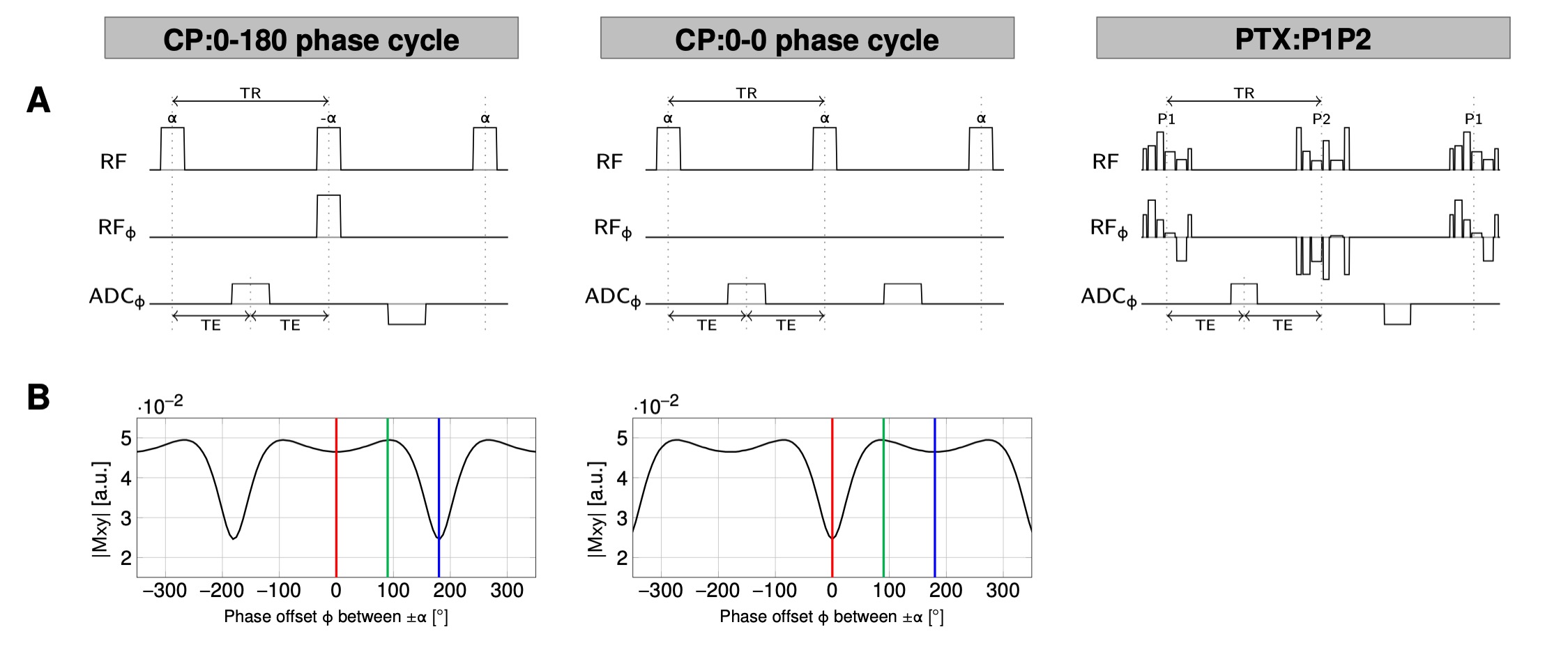
The balanced steady-state free precession (bSSFP) sequence is one of the most efficient acquisition strategies in terms of SNR per unit acquisition time1. The signal formed is a result of steady-state oscillation which maintains a large magnetisation. However, bSSFP is highly sensitive to B0 inhomogeneities, which are manifested as banding artifacts. These banding artifacts can be shifted spatially by altering the phase cycling pattern between RF pulses. Combining multiple acquisitions with different phase cycling schemes (e.g. one with 0-180° and another with 0-0°, Fig.1) can mitigate these signal voids2. However, this comes at a cost of scan efficiency and increased motion sensitivity. A pair of tailored parallel transmit (pTx) pulses can be used to enforce the spatially variant phase cycling, to match the variation in the main magnetic field3. This approach captures all signal in one acquisition without banding artifacts whilst providing uniform excitation despite the heterogeneous B1 distribution at 7 Tesla (7T). Here we demonstrate the feasibility of designing a pair of tailored pTx pulses in vivo where B1+ and B0 variations are more challenging than in phantoms at 7T.Methods
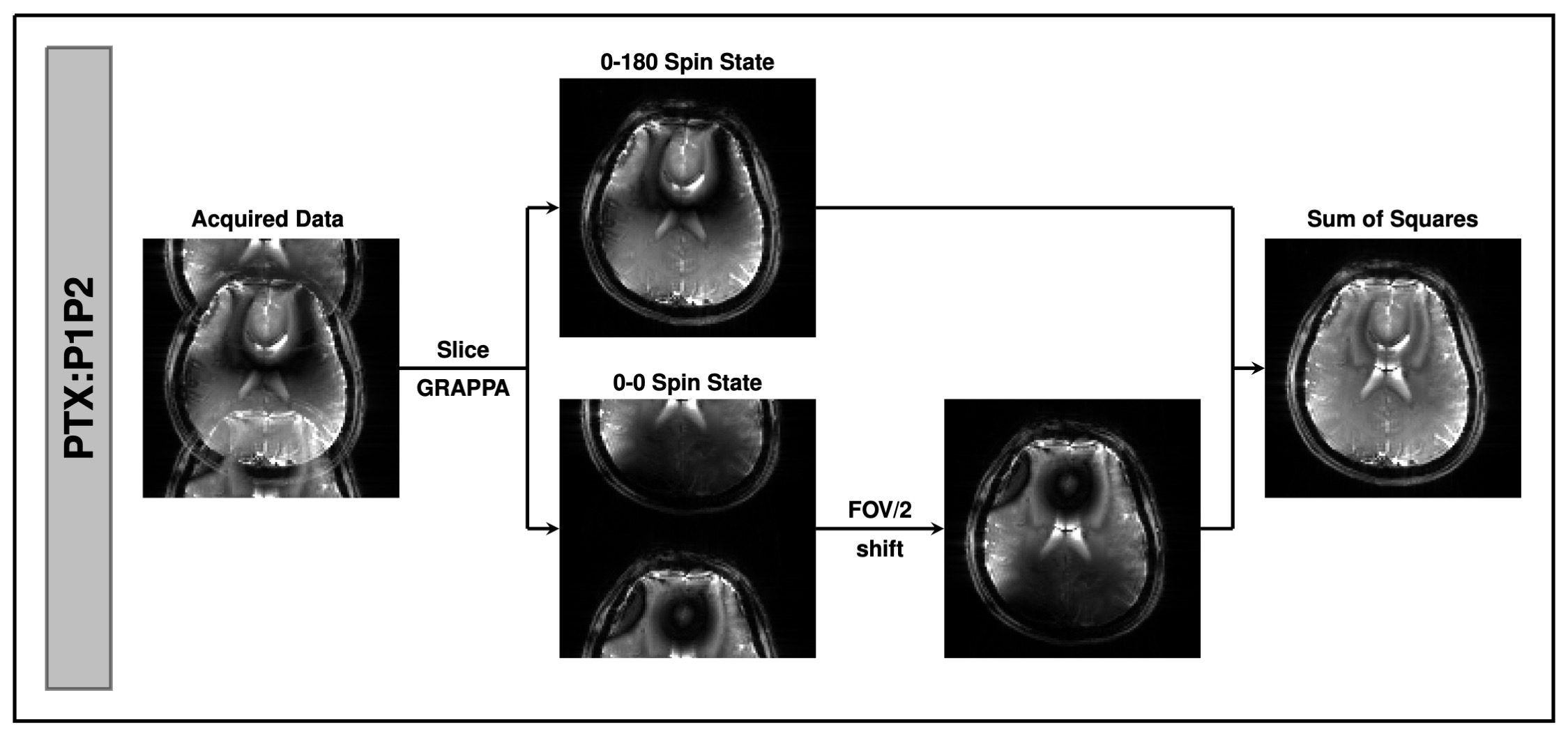
All data was collected using a whole-body 7T scanner (MAGNETOM 7T plus, Siemens Healthcare, Erlangen, Germany) equipped with an 8x2kW pTx RF system, and an 8Tx/32Rx head coil (Nova Medical, Wilmington, MA, USA). A healthy volunteer was scanned, having provided written informed consent. Parallel transmitter calibration data was acquired as previously shown by Wu et al4. Multi-echo T2*-weighted images (TR=1500ms, TE1,2=11,12ms, 2x2x2mm3) was acquired for ΔB0 mapping. The bSSFP sequence (FA=10°, TR=10ms, TE=5ms, 1.7x1.7x2mm3) was acquired in circularly polarized (CP) mode, using individual pTx pulses, and the proposed pTx pulse pair.Pulse design: Conventional excitation pulses in a research bSSFP sequence were replaced with pTx pulse pairs (P1 and P2) played out over alternating TRs (Fig.1). The pair of pTx pulses (6 kT-points5) were designed using MLS-SDM6,7 approach. A phase difference of -ΔB0·TR was enforced between the target phase profiles of the pulse pair in the design optimization. This compensates for the spatially variable spin dephasing accumulated due to off-resonance over one TR. Additionally, sub-pulse durations were optimized to reduce RF power. With the pTx pulse pair, steady-state behaviour is enforced for all on-resonance and off-resonance spins with each subgroup experiencing different RF phase cycling. Spatially, spins with ΔB0 off-resonance will experience 0°-(180-ΔB·TR)° RF phase cycling. For example, on resonant spins will experience 0-180° RF phase whereas the spins accumulating close to 180° dephasing will experience 0-0° RF phase cycling. As a result, the phase of one population of spins will be 180° out of phase relative to the ADC for every second TR. This effectively shifts the signal by half FOV within the image. The two resultant superimposed virtual slices can be separated using slice-GRAPPA8. Sum of Squares (SoS) method was used to combine the complementary images respective to the spin states to produce a final image.
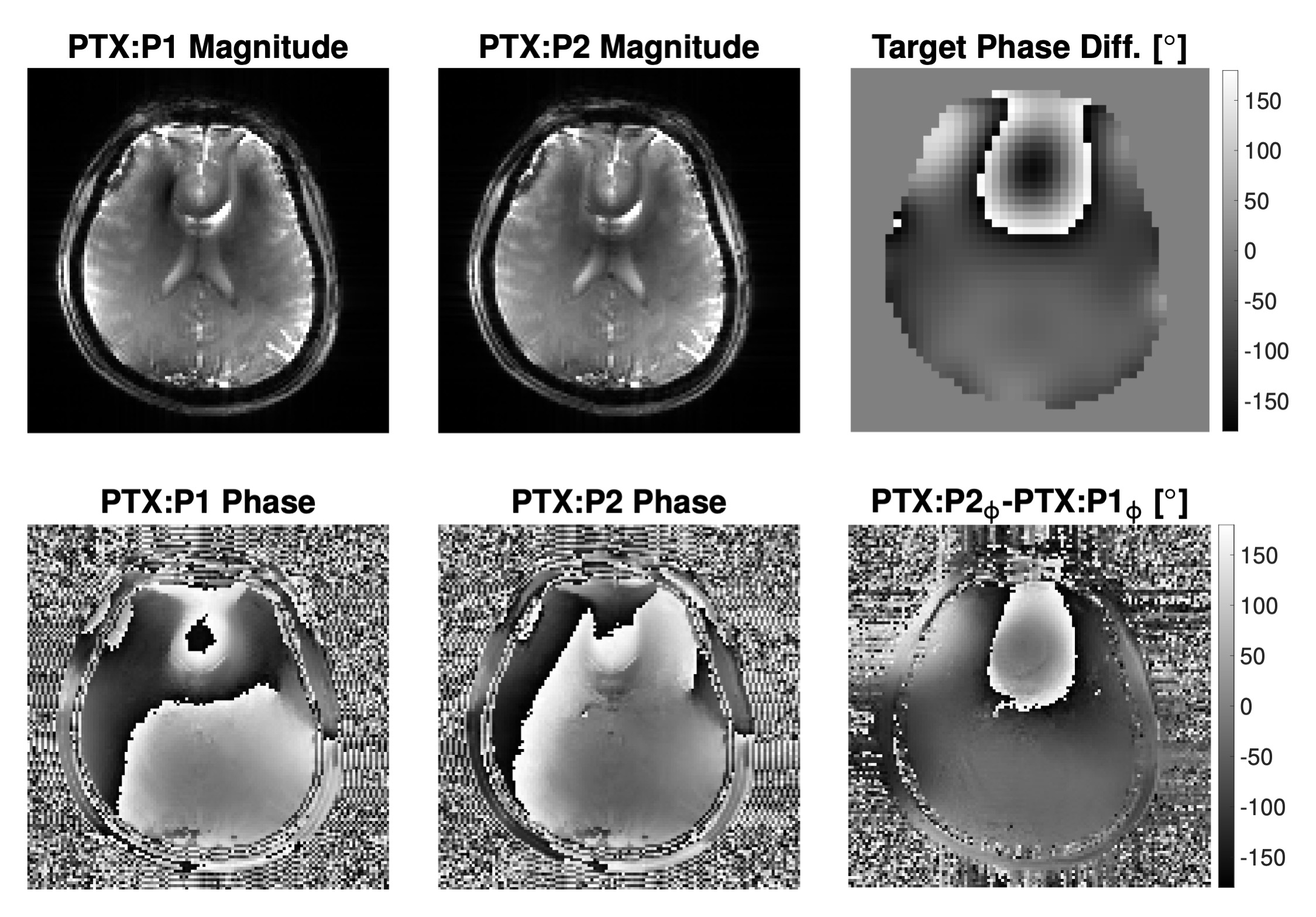
To verify target phase difference, the bSSFP sequence was acquired using PTX:P1 and PTX:P2 independently. The phase difference between PTX:P1 and PTX:P2 was compared to the target phase difference used in the pulse design.
Results and Discussion
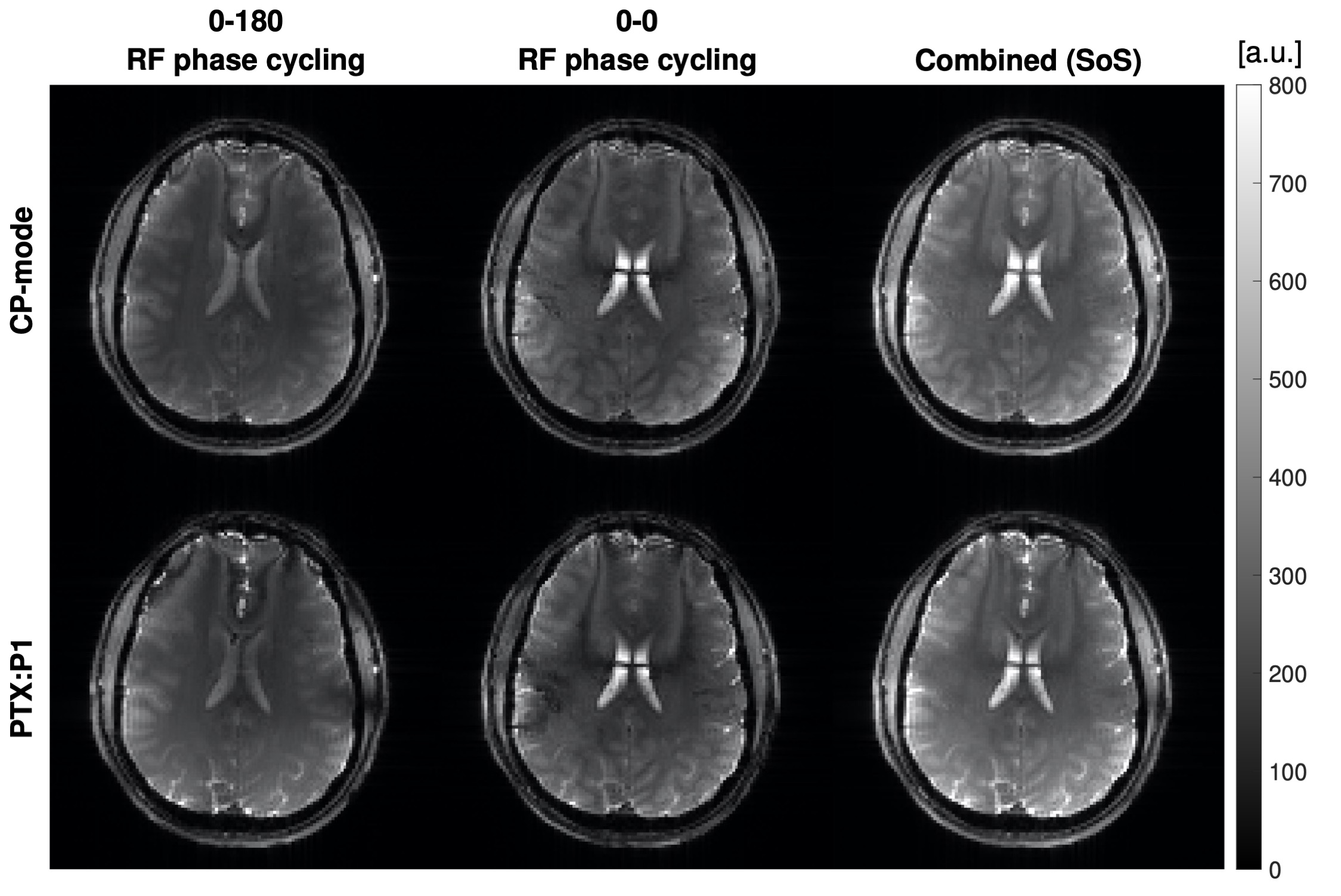
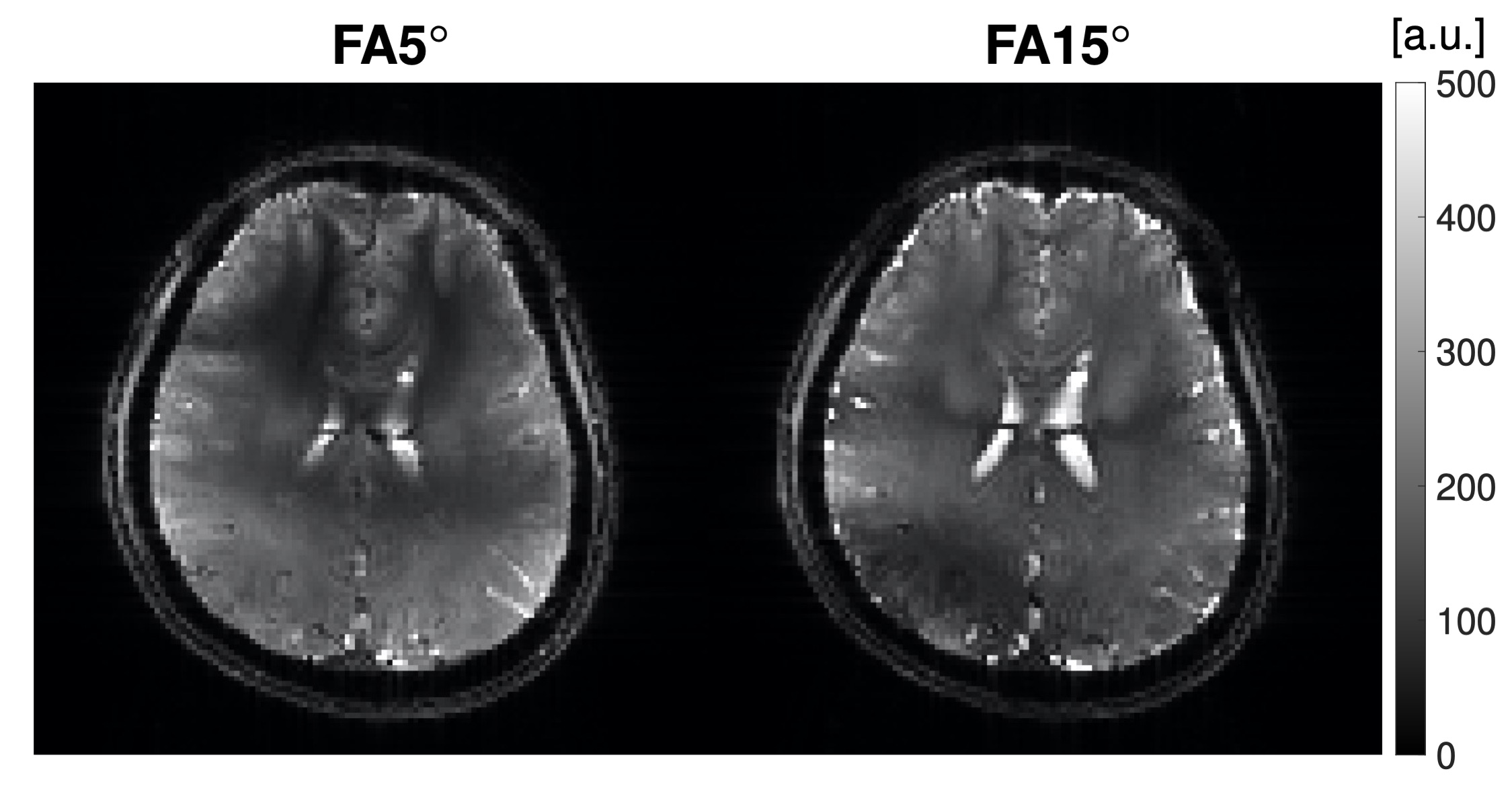
Figure 2 shows that replacing the CP mode excitations with tailored pTx pulses improves the signal and contrast around peripheral regions. The pTx pulses achieve the target phase profile whilst providing uniform flip angle. Figure 3 shows the phase difference between PTX:P1 and PTX:P2 phase acquisitions matches well with the target phase difference (Fig.3). However, the achieved phase difference between the pTx pulse pair deviated more from the target in vivo than previous observed in phantom experiments. Presumably due to the more complex ΔB0 variation containing higher spatial frequencies. As expected, the FOV/2 shift aliasing could be reconstructed using slice-GRAPPA (Fig.4). Figure 5 shows two maps acquired using PTX:P1P2 with different flip angles. Higher flip-angles, allow better mitigation of banding artifacts. However, to increase the flip angle, sub-pulse durations needed to be increased to accommodate the SAR constraints at 7T. This in turn adds sensitivity to B0 during the pulse itself. Perhaps VOP based optimisation9 including SAR hopping10 could help alleviate these constraints.Conclusion
We have shown that one single bSSFP acquisition with a tailored pair of pTx pulses can simultaneously achieve spatially varying phase cycling patterns and a uniform excitation magnitude in vivo. However, additional SAR optimisation and more rigorous pulse design methods are needed to enable higher flip-angles and further improve the methods robustness.Acknowledgements
This research was supported by the Australian government through Australian Research Council (ARC) Training Centre for Innovation in Biomedical Imaging Technology (IC170100035) and ARC Future fellowship grant (FT200100329). The authors acknowledge the facilities of the National Imaging Facility at the Centre for Advanced Imaging.References
[1] Scheffler K, Lehnhardt S. Principles and applications of balanced SSFP techniques. Eur Radiol. 2003;13(11):2409-2418.
[2] Zur Y, Wood ML, Neuringer LJ. Motion-insensitive, steady-state free precession imaging. Magn Reson Med. 1990;16(3):444-459.
[3] Wu C, Jin J, Barth M, et al. Eliminating banding artifacts in bSSFP using Parallel Transmission. In Proc. of the 32nd Joint Annual Meeting of ISMRM-ESMRMB, Toronto, Canada. 2023;0206.
[4] Wu C, Jin J, Dixon C, et al. Velocity selective arterial spin labelling using parallel transmission. In Proc. of the 31st Annnual Meeting of ISMRM, London, England UK. 2022;2936.
[5] Cloos MA, Bouland N, Ferrand E, et al. kT-points: Short three-dimensional tailored RF pulses for flip-angle homogenization over an extended volume. Magn Reson Med. 2012;67(1):72-80.
[6] Grissom W, Yip C, Zhang Z, et al. Spatial Domain Method for the Design of RF Pulses in Multicoil Parallel Excitation. Magn Reson Med. 2006;56(3):620-629.
[7] Setsompop K, Wald LL, Alagappan V, et al. Magnitude least squares optimization for parallel radio frequency excitation design demonstrated at 7 Tesla with eight channels. Magn Reson Med. 2008;59(4):908-915.
[8] Setsompop K, Gagoski B, Polimeni J, et al. Blipped-Controlled Aliasing in Parallel Imaging for Simultaneous Multislice Echo Planar Imaging with Reduced g-Factor Penalty. Magn Reson Med. 2012;67(5):1210-1224.
[9] Eichfelder G, Gebhardt M. Local specific absorption rate control for parallel transmission by virtual observation points. Magn Reson Med. 2011;66(5):1468-1476.
[10] Guerin B, Adalsteinsson E, Wald LL. Local SAR reduction in multi-slice pTx via “SAR hopping” between excitations. In Proc. of the 20th Annual Meeting of ISMRM, Melbourne, Australia, 2012;0642.
Figures