4073
Comparison at 7T of the Impulse head gradient and whole-body SC72 gradient transfer functions.1CEA, CNRS, BAOBAB, NeuroSpin, University of Paris-Saclay, Saclay, France, 2University of California, San Francisco, CA, United States, 3San Francisco VA Health Care System, San Francisco, CA, United States, 4McGill University, Montreal Neurological Institute-Hospital, Montreal, QC, Canada, 5Brain imaging center and Helen Wills Neuroscience institute, Berkeley, CA, United States, 6Advanced MRI technologies, Sebastopol, CA, United States
Synopsis
Keywords: System Imperfections, System Imperfections: Measurement & Correction
Motivation: Ultra-high field MRI requires high performance and accurate gradients to push forward the spatio-temporal resolution, especially for fMRI scans.
Goal(s): Compare two commercial gradient coils (whole-body SC72 and head-only Impulse) available on 7T scanners.
Approach: Characterization of the gradient transfer function (GTF) and measurement of field perturbations following a spoiler gradient using a field camera.
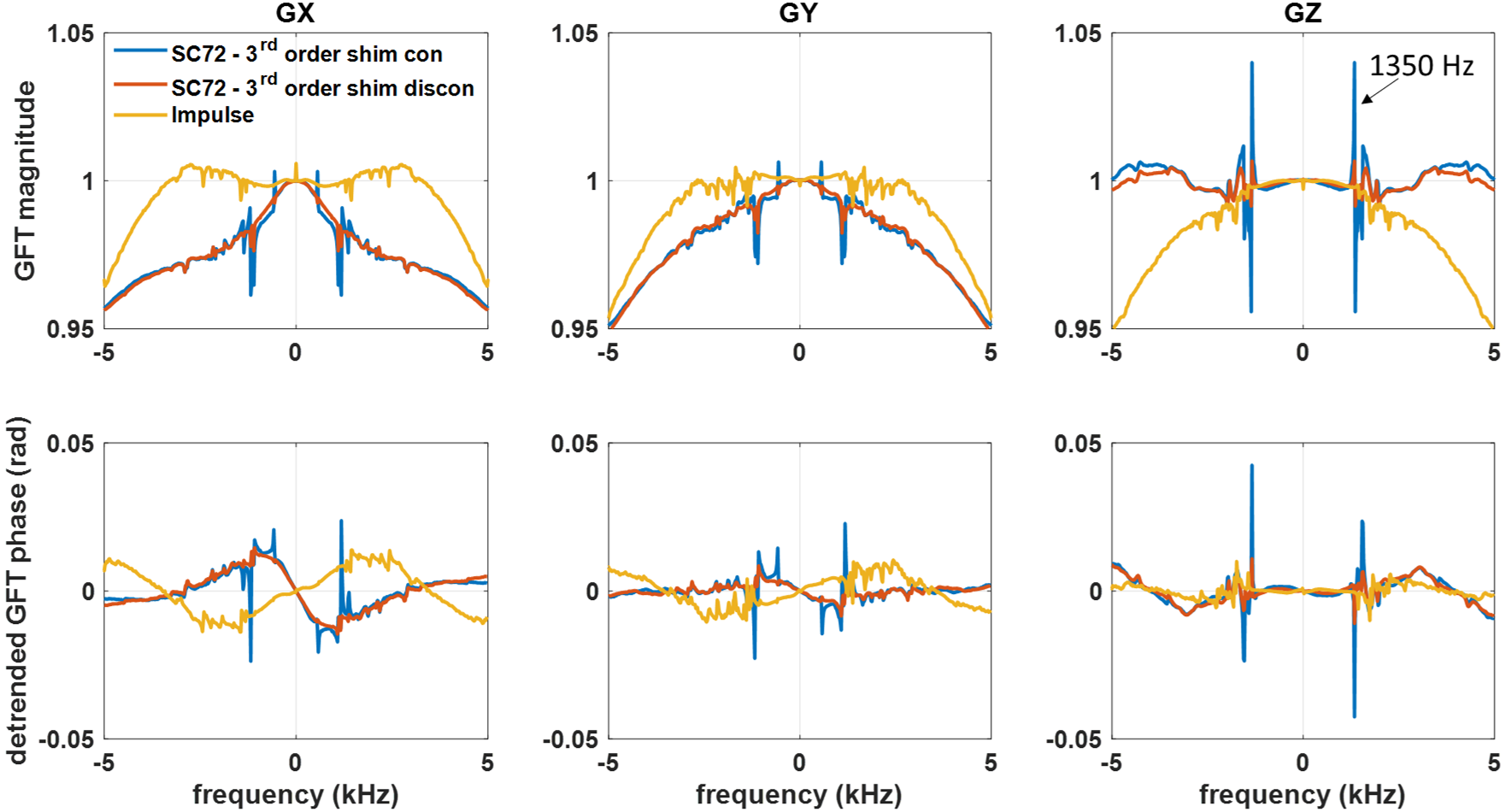
Results: The Impulse gradient coil revealed a smooth GTF profile while the SC72 gradient coil exhibited strong resonances. Field oscillations following a spoiler gradient were greatly reduced with the Impulse gradient. Disconnecting the 3rd order shim coils on the SC72 gradient coil improved the quality of its response.
Impact: The GTF of the head-only Impulse gradient coil yields interesting prospects. It remains to be determined whether the apparent benefits versus the SC72 are due to the absence of third order shim coils.
Introduction
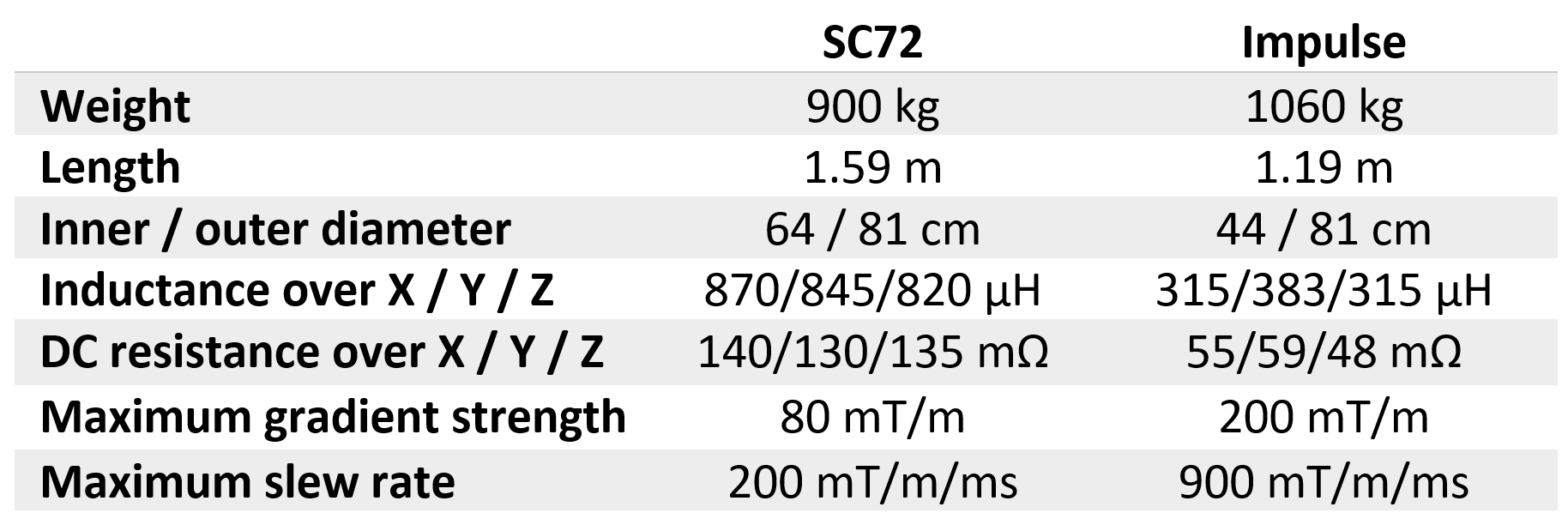
The race towards higher spatio-temporal resolution in MRI calls for stronger static magnetic fields and gradients with higher slew rates and amplitudes. Consequently, the complexity of the magneto-mechanical coupling between the gradient and the magnet increases and can lead to hardware damage or image artefacts, especially during EPI acquisitions. In addition, more powerful gradients require new designs, e.g. with limited coverage, in order to comply with the physiological limits, such as the recently developed Impulse head gradient [1] that allows reaching 200mT/m amplitude and 900mT/m/ms slew rate, versus 80mT/m amplitude and 200mT/m/ms slew rate for the standard SC72 whole-body gradient integrated in most state-of-the-art Siemens 7T scanners. The goal here was to compare the Gradient Transfer Functions (GTF) of these two systems.Methods
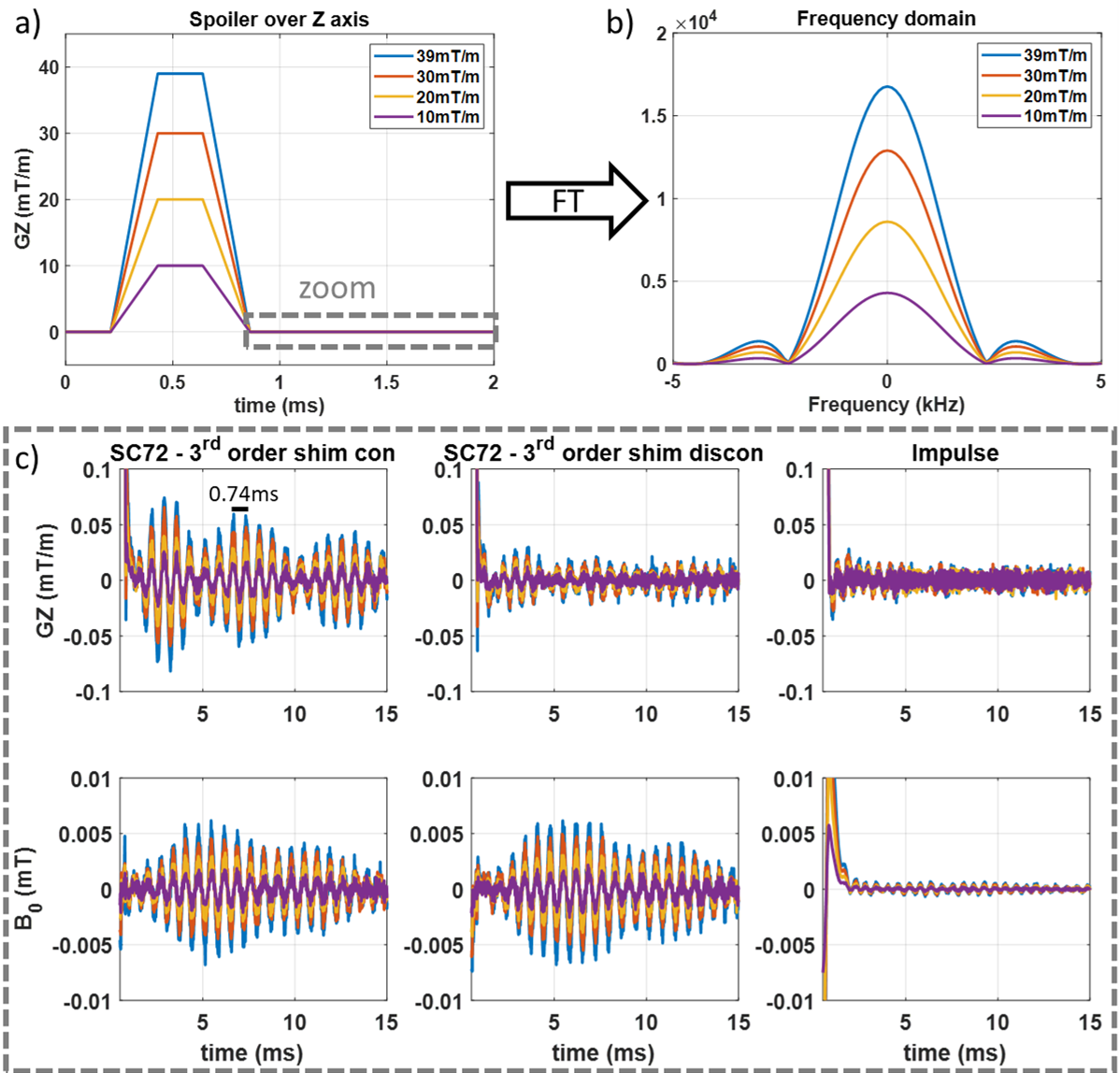
Measurements were performed on two Terra scanners (Siemens Healthcare AG, Erlangen, Germany) respectively equipped with the SC72 whole-body (at MNI, Montreal, Canada) and Impulse (at Berkeley, CA, USA) gradients (Table 1). The GTF was estimated on the two systems using a field camera (Skope MRT, Zürich, Switzerland) [2,3]. To visualize the potential consequences of the peaks and dips (in the GTF), B0 and GZ oscillations following the application of a spoiler gradient were also measured. The spoiler gradient was played along the Z axis and had an amplitude ranging from 10mT/m to 39mT/m, a duration of 650µs and a plateau of 210µs. Measurements on the SC72 gradient were performed in two different configurations: with the third order shim coils connected and disconnected at the filter plate inside the Faraday cage. The Proportional Integral Derivative (PID) of the GPAs was tuned for each scenario.Results
Figure 1 shows that the strong peaks/dips observed on the SC72 gradient over the three axes were greatly reduced on both the magnitude and phase of the GTF spectrum when disconnecting the third order shim coils at the filter plate. Although some resonances were also visible on the Impulse GTF, they were located at slightly higher frequencies, thus more difficult to excite with imaging gradients. Overall, the GTF of the Impulse gradient exhibited less severe resonances. Figure 2 shows an example of the consequences of imperfect GTF in the time-domain. The spoiler gradients, as usually found in the MPRAGE sequence for instance, here on the Z axis excite a wide range of frequencies that make B0 and GZ oscillate for some time following their application. On the SC72 gradient coil, these oscillations had a main frequency of 1350Hz, corresponding to the mechanical resonance on the gradient Z axis visible in the GTF on Figure 1 (top right) [4], and lasted for tens of milliseconds for GZ and B0. After the spoiler gradient of 39mT/m, GZ oscillations were on the order of 0.05mT/m when the third order shim was connected. The GZ oscillations were attenuated by more than 3-fold when the third order shim coils were disconnected. Such reduction of the B0 field oscillations was however not visible in that configuration. Despite short term eddy currents, oscillations were considerably lower with the Impulse gradient coil.Discussion
The Impulse gradient revealed less field oscillations, especially regarding B0, compared to the SC72 gradient where they persisted for tens of milliseconds as shown before [5]. The spoiler measurements here focused on the Z axis, which is the most problematic on the SC72 gradient due to a strong mechanical resonance at 1350Hz [4]. Attenuation of the oscillations with the SC72 gradient when disconnecting the third order shim coils at the filter plate inside the Faraday cage is the subject of an ongoing investigation. At the time of the measurement, the Impulse head gradient coil of the NexGen 7T scanner did not embed third order shim coils at all, which could possibly explain some of the apparent benefits versus the SC72. Imperfections in the GTF spectrum are problematic when resonances are excited, for instance when applying strong spoiler gradients or when the echo-spacing of an EPI train is set to one of these specific frequencies. Deviations from the nominal gradient waveform occurring during a gradient readout can be corrected for in the reconstruction [6,7]. When they occur during an RF excitation, e.g. following a spoiler gradient, they may interfere with the RF pulses and lower their performance.Conclusion
The enhanced performance of the Impulse gradient allows improving the spatiotemporal resolution of brain MRI. The gradient transfer function is also improved with respect to the SC72 gradient, resulting in more accurate imaging. It remains to be determined whether these apparent benefits versus the SC72 are due to the absence of third order shim coils.Acknowledgements
This work received financial support from the European Union Horizon 2020 Research and Innovation program under grant agreement no. 885876 (AROMA).References
1. Davids M, Dietz P, Ruyters G, Roesler M, Klein V, Guérin B, Feinberg DA, Wald LL. Peripheral nerve stimulation informed design of a high‐performance asymmetric head gradient coil. Magn Reson Med 2023.
2. Barmet C, De Zanche N, Pruessmann K. P. Spatiotemporal magnetic field monitoring for MR. Magn Reson Med 2008; 60:187-197.
3. Vannesjo SJ, Haeberlin M, Kasper L, Pavan M, Wilm BJ, Barmet C, Pruessmann KP. Gradient system characterization by impulse response measurements with a dynamic field camera. Magn Reson Med 2013; 69: 583-593.
4. Boulant N, Quettier L et al. Commissioning of the Iseult CEA 11.7 T whole-body MRI: current status, gradient-magnet interaction tests and first imaging experience. MAGMA 2023 Apr;36(2):175-189. doi: 10.1007/s10334-023-01063-5.
5. Scholten H, Lohr D, Wech T, Köstler H. Fast measurement of the gradient system transfer function at 7T. Magn Reson Med 20223;89:1644-1659.
6. Vannesjo SJ, Graedel NN, Kasper L, Gross S, Busch J, Haeberlin M, Barmet C, Pruessmann KP. Image reconstruction using a gradient impulse response model for trajectory prediction. Magn Reson Med 2016;76:45-58.
7. Vannesjo SJ, Duerst Y, Vionnet L, Dietrich BE, Pavan M, Gross S, Barmet C, Pruessmann KP. Gradient and shim pre-emphasis by inversion of a linear time-invariant system model. Magn Reson Med 2017;78:1607-1622
Figures