4072
A Low-cost, Small-footprint Gradient Amplifier for Low Field MRI Based on GaN FETs1Physics, Case Western Reserve University, Cleveland, OH, United States, 2Biomedical Engineering, Case Western Reserve University, Cleveland, OH, United States, 3Radiology, Case Western Reserve University, Cleveland, OH, United States
Synopsis
Keywords: Gradients, Gradients
Motivation: The gradient system can be the most expensive part of a low field MRI system with minimal construction costs. Current solutions have linear amplifiers which may not reach power requirements, requiring pricey off-the-shelf amplifiers.
Goal(s): Reduce the cost of the gradient drivers by taking amplifier efficiency into consideration to enable better low field MRI system creations.
Approach: Uses an amplifier topology more commonly used at higher power, an H-bridge, but a high switching frequency reduces filtering requirements. A modular design eases construction.
Results: The amplifier we created attains an increased efficiency, a smaller size, and a lower cost to attain useful power.
Impact: Gradient drivers can dominate the overall cost of low-field MRI scanners. Our amplifier costs under 80USD and is capable of a 120V 15A DC output with a bandwidth of 150kHz. It contributes to cost reduction of gradient drivers significantly.
Introduction
Efforts to democratize MRI in low resource settings have focused some research on the upfront costs of MRI systems. To date, most human imaging systems have used expensive, off-the-shelf amplifiers, which can dominate the overall cost of a low-field MRI scanner. A more efficient and compact amplifier design using lower loss switching elements has the potential to reduce the cost of this system significantly. While common on commercial high-field MRI systems, most low-field gradient systems have not used switching amplifier topologies. Those that have used switching topologies place a significant burden on the output filtering network to provide a sharp attenuation at the switching frequency, while maintaining high frequencies for rapid gradient operation. Finally, most previous designs are large in size, which contributes to the cost. Here, we take advantage of our prior work on low loss GaN field effect transistors (FETs) to design a gradient amplifier with higher current and switching speeds.Methods
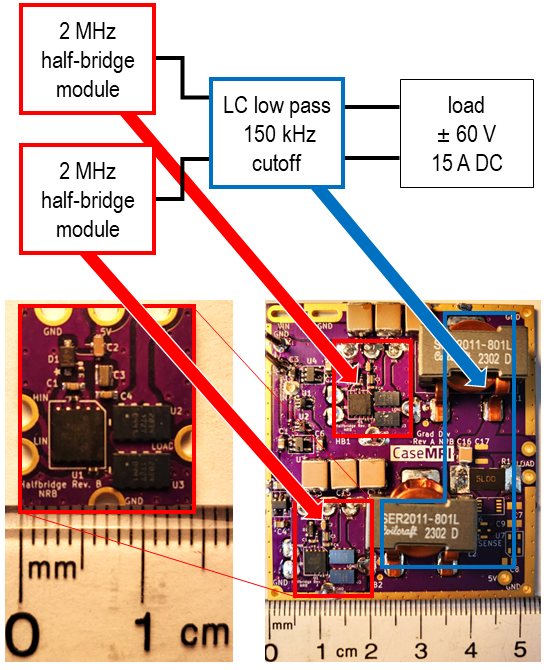
The amplifier is configured as an H-bridge with a modular construction allowing for small and high frequency components to remain on separate modules for easy construction. Two half bridge modules each contain two GaN FETs rated to 200V and 48A continuous current and a high speed gate driver capable of operating at 2MHz with a top voltage of 100V.Switching at 2MHz allows for a simple 150kHz cutoff LC low-pass filter at the output using two high current inductors and a split capacitor. A higher frequency cutoff and lower order requires smaller and fewer inductors and capacitors. This provided higher output bandwidth while retaining switching frequency attenuation and taking up less space and fewer resources.
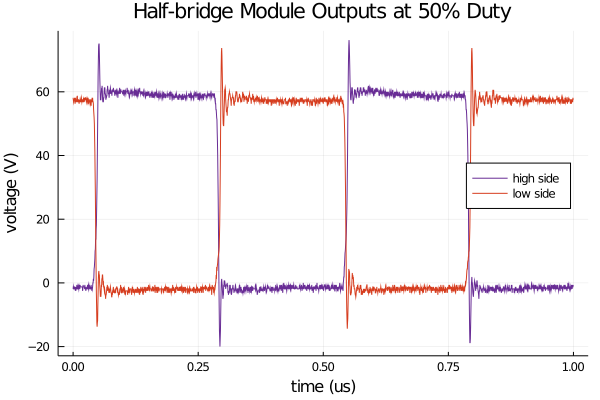
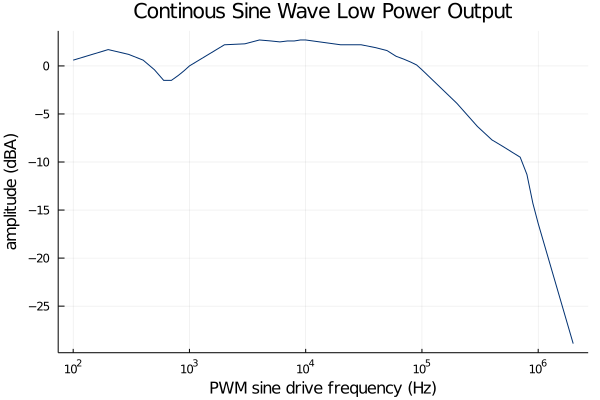
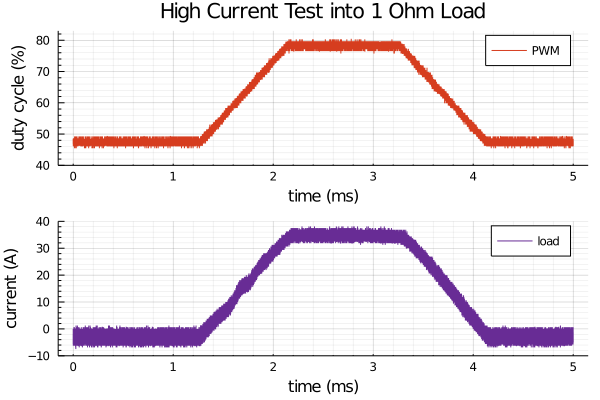
We verified switching performance, filter performance, DC power output, and dynamic high current performance in a series of tests to validate the design. Switching performance is verified by observation of the half bridge output waveforms when operating at 2MHz. For efficient and reliable operation, switching must happen in the minimal time with as little ringing as possible. Filter performance is determined by observing output of pulse width modulated (PWM) sine waves into a resistive load at various frequencies. The output power determines the slew and gradient strength in application and is verified by driving a load at high DC power. Lastly, dynamic performance was demonstrated with driving a 1ms trapezoid into a 1 ohm load.
Results
The half bridge modules allow switching of up to 100V bidirectionally with 48A of current continuously. Allowing a safety factor puts this in the range of acceptable gradient amplifiers for low field MRI, providing 15A through a 1 ohm load with a large voltage overhead to increase slew. A test at DC with switching a 30V input at 80% duty cycle into a 1 ohm load confirmed 15A DC capability. Figure 2 shows switching at 2MHz with a 60V input and 50% duty cycle into a 1 ohm load.Figure 3 shows sine wave PWM output amplitudes at low power demonstrating output bandwidth. Figure 4 shows the dynamic performance of the amplifier with a 1ms 36A trapezoid into a 1 ohm load.
As of November 2023, the total material cost to build one half-bridge module is under 24USD. The total for this amplifier is under 76USD, not including the power supply.
Discussion
The results show this amplifier is capable of a wide bandwidth high power output with up to 120 V and 15 A output. Given the typical impedance of a low field head gradient system (R=0.04 Ohms, L=200uH), these specs are adequate for conventional imaging for an amplifier that costs under $80. Clean switching is demonstrated which allows for high efficiency operation. A 1ms trapezoid shows the amplifier’s ability to operate at high current. Active feedback will be necessary for low distortion performance with inductive loads.Conclusion
This gradient amplifier delivers adequate power for low field imaging with exceptional output bandwidth, up to 60 volts bidirectionally and 15A DC up to 150kHz. This is provided in a small and inexpensive form factor, 5.2x5.8cm, with a material cost of 76USD not including the power supply. Future work will be control logic including active feedback to reduce distortion in inductive loads.Acknowledgements
No acknowledgement found.References
Wald, L.L., McDaniel, P.C., Witzel, T., Stockmann, J.P., Cooley, C.Z., 2020. Low‐cost and portable MRI. Magnetic Resonance Imaging 52, 686–696. https://doi.org/10.1002/jmri.26942
S Anand, JP Stockmann, LL Wald, T Witzel (eds.). A low-cost (<$500 USD) FPGA-based console capable of real-time control. In: Proc 26th Annual Meeting ISMRM, Paris; 2018. p 948.
N. Evetts and M. S. Conradi, “Low-cost gradient amplifiers for small MRI systems,” Journal of Magnetic Resonance, vol. 335, p. 107127, Feb. 2022, doi: 10.1016/j.jmr.2021.107127.
Yu H, Littin S, Jia F, Kroboth S, Zaitsev M. Output filter design for gradient amplifier and shimming amplifier of MRI: an overview. In: Proceedings of the 26th Annual Meeting of ISMRM, Paris, France, 2018. Abstract 4428.
Figures