4061
Glymphatic activity changes in patients with chronic insomnia:a DTI-ALPS study1Guizhou medical university, Guiyang, China, 2Philips Healthcare, Shanghai, China
Synopsis
Keywords: Other Neurodegeneration, Brain, glymphatic system, chronic insomnia
Motivation: Long-term chronic insomnia is considered to be a high risk factor for dementia,but the relationship between insomnia and glymphatic activity is unclear.
Goal(s): Aim to explore the relationship between the changes of DTI-ALPS index and mental and psychological performance in chronic insomnia patients.
Approach: 20 patients diagnosed with chronic insomnia (CR) and 20 control subjects (HC) , MRI scanning, and DTI-ALPS analysis.
Results: The glymphatic function activity of individuals with chronic insomnia is lower compared to the normal control group, and age independently influences this. There were significant correlation between the DTI-ALPS index, the scores of PSQI and MMSE.
Impact: Chronic insomnia can cause a decrease in brain glymphatic function, and age is an independent factor that affects glymphatic function. Additionally, sleep quality and neuropsychological performance are also related to changes in glymphatic function.
Introduction
Epidemiology has shown that long-term chronic insomnia is associated with a higher risk of developing Alzheimer's disease[1-2]. The glymphatic system, which is involved in the waste removal process of cerebrospinal fluid, can predict cognitive impairment. DTI-ALPS is a proven and effective noninvasive method for exploring human brain lymphoid activity[3-4]. Our aim was to investigate the glymphatic functional activity in individuals with chronic insomnia and its relationship to altered cognitive function. This research helps us better understand the neural basis of cognitive decline and provides promising neuroimaging biomarkers for early detection in AD patients.Methods
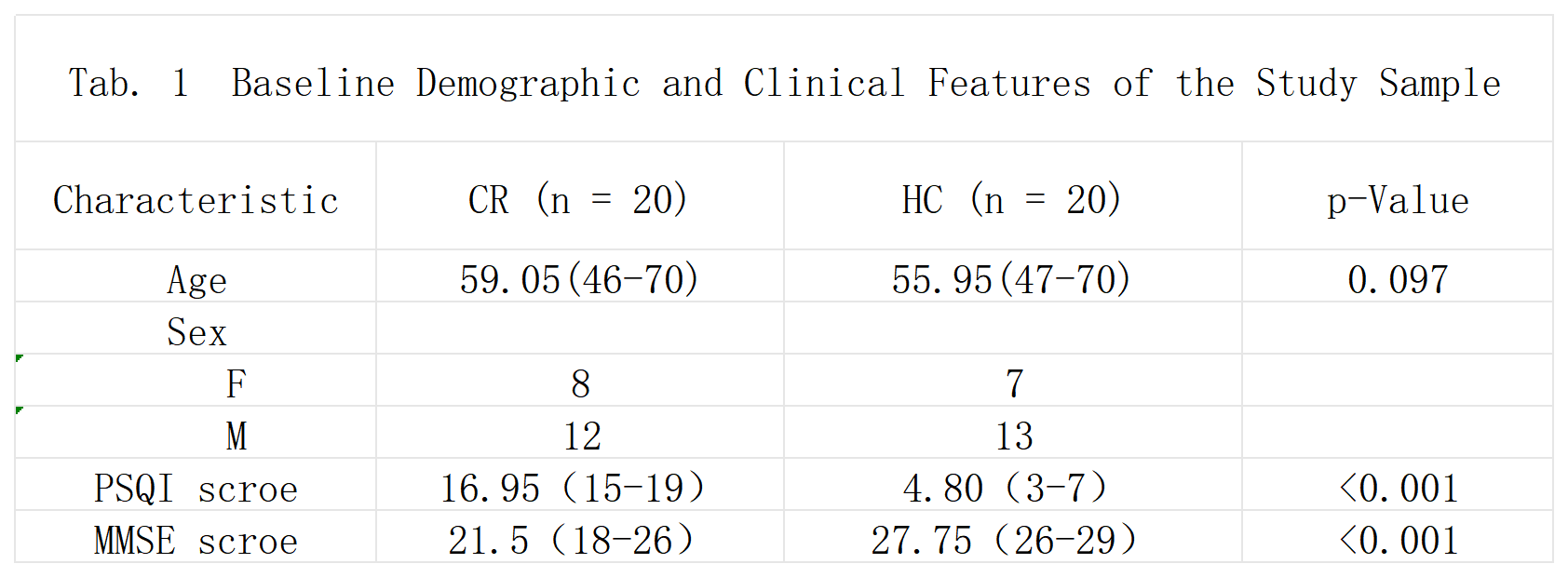
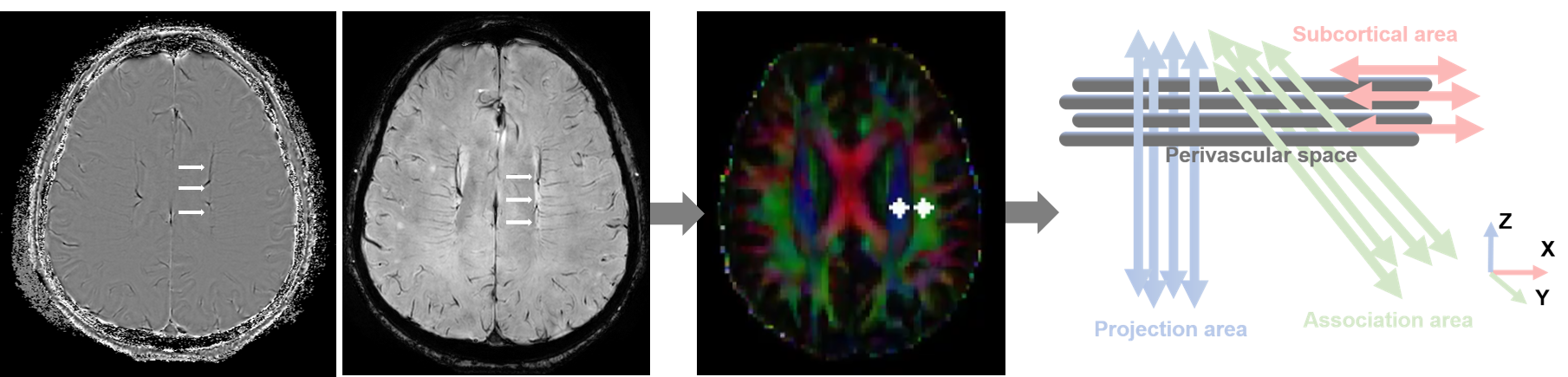
20 patients diagnosed with chronic insomnia (CR) and 20 control subjects (HC) were included in the study. They were assessed using relevant psychiatric scales, namely the Mini-Mental State Examination (MMSE) and the Pittsburgh Sleep Quality Index (PSQI). The DTI scanning was performed using the 3.0T Elition system. After image preprocessing, the color-coded fractional anisotropy (FA) and diffusivity map were analyzed. Subsequently, the diffusivity along the x, y, and z axes was calculated, and the DTI-AlPS index was determined for each patient, matched with a healthy control (HC) of the same age and sex. The difference in DTI-ALPS between the case group and the control group was evaluated using SPSS 21.0. Additionally, the correlation between DTI-ALPS, age, and neuropsychological performance (MMSE, PSQI score) was analyzed.Results
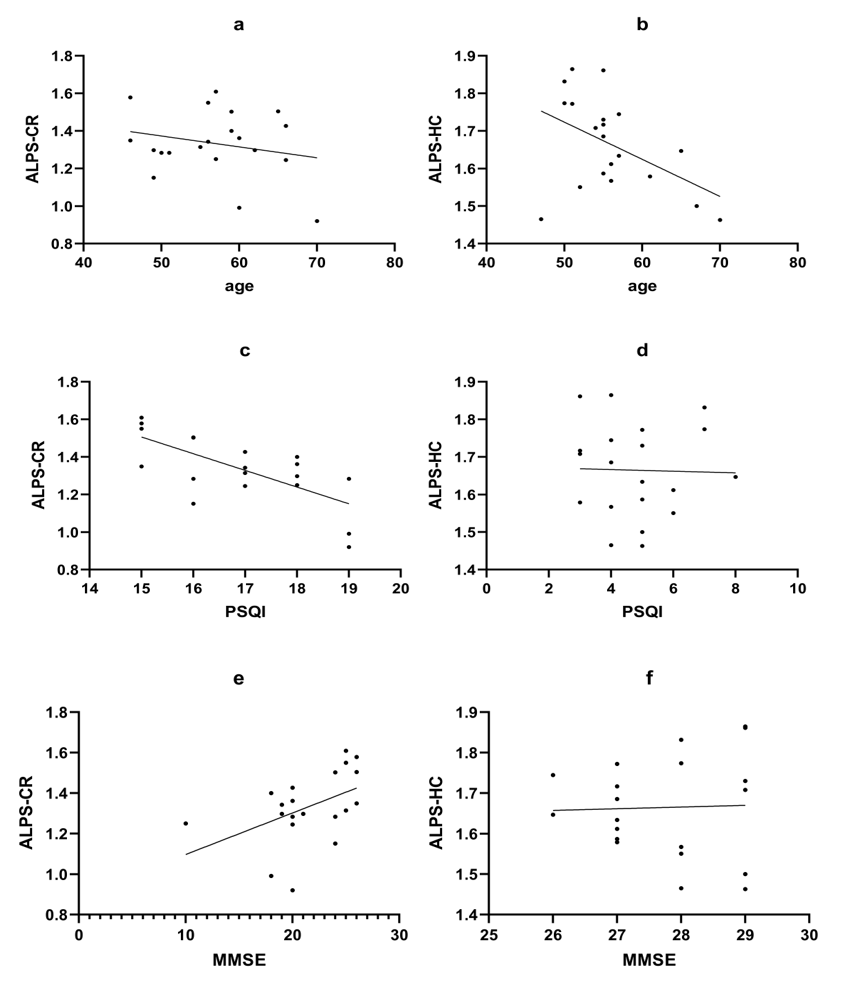
The study analyzed 20 patients from both the chronic insomnia group (CR) and the normal control group (HC). The average DTI-ALPS value in the CR group was significantly lower than that in the HC group (t=-6.842, p < 0.05), yet no significant change in DTI-ALPS was observed in either the case group or the healthy control group (p>0.05). Furthermore, the average DTI-ALPS value in both groups decreased with age (r=0.454, p=0.044; In the HC group, r=0.467, p=0.038). In the CR group, DTI-ALPS also correlated with the scores of PSQI and MMSE. A higher PSQI score (r=0.698, p=0.001) indicated a more significant decline in DTI-ALPS, while a lower MMSE score (r=0.457, p=0.043) suggested a more significant decrease in DTI-ALPS. However, no significant correlation was found between PSQI and MMSE scores and DTI-ALPS in the HC group.Discussion
The DTI-Alps method offers a non-invasive quantitative assessment of glymphatic function, a fact corroborated by prior human-based studies [5]. In our research, we simultaneously injected DTI-Alps and an intrathecal contrast agent for glymphatic analysis, discovering a correlation between the DTI-ALPS index and delayed lymph clearance. In a separate DTI-ALPS analysis of patients with REM sleep behavior disorder [6], we observed a more significant decrease in glymphatic system function in individuals who developed alpha-synaptic nuclear disorder. In another evaluation of the lymphatic system in elderly community members using DTI-ALPS [7], we found a strong correlation between the DTI-ALPS value, gray matter volume, and neuropsychological score. Our study revealed that the DTI-ALPS value in chronic insomnia sufferers is lower than in the control group, and it significantly correlates with sleep quality (PSQI score), suggesting a strong link between glymphatic function activity and the brain's waste clearance process during sleep. Furthermore, we observed that in both the chronic insomnia group and the control group, the DTI-Alps value decreases with age. This suggests that age independently impacts glymphatic functional activity. While these findings hint at sleep's influence on glymphatic functional activity, we need to delve deeper into the underlying mechanism, possibly through analyzing the glymphatic system's microstructure components. This will be the focus of our future research.Conclusion
According to DTI-ALPS analysis, the glymphatic function activity of individuals with chronic insomnia is lower compared to the normal control group, and age independently influences this. Additionally, there is a certain correlation between the glymphatic function of individuals with chronic insomnia and their neuropsychological performance.Acknowledgements
No acknowledgement found.References
1. Raghavan S, Reid RI, Przybelski SA, et al. Diffusion models reveal white matter microstructural changes with ageing, pathology and cognition. Brain Commun. 2021;3(2):fcab106.
2. Bakker EN, Bacskai BJ, Arbel-Ornath M, et al. Lymphatic Clearance of the Brain: Perivascular, Paravascular and Significance for Neurodegenerative Diseases. Cell Mol Neurobiol. 2016;36(2):181-194.
3. Holth JK, Fritschi SK, Wang C, et al. The sleep-wake cycle regulates brain interstitial fluid tau in mice and CSF tau in humans. Science. 2019;363(6429):880-884.
4. Shen T, Yue Y, Ba F, et al. Diffusion along perivascular spaces as marker for impairment of glymphatic system in Parkinson's disease. NPJ Parkinsons Dis. 2022;8(1):174.
5. Zhang W, Zhou Y, Wang J, et al. Glymphatic clearance function in patients with cerebral small vessel disease. Neuroimage. 2021;238:118257.
6. Bae YJ, Kim JM, Choi BS, et al. Altered Brain Glymphatic Flow at Diffusion-Tensor MRI in Rapid Eye Movement Sleep Behavior Disorder. Radiology. 2023;307(5):e221848.
7. Grau-Rivera O, Operto G, Falcón C, et al. Association between insomnia and cognitive performance, gray matter volume, and white matter microstructure in cognitively unimpaired adults. Alzheimers Res Ther. 2020;12(1):4.
Figures