4007
The GRAPH-CRAFITY Score: a novel prognostic tool for patients with hepatocellular carcinoma treated with targeted therapy and immunotherapy1Cancer Hospital, Chinese Academy of Medical Sciences and Peking Union Medical College, Beijing, China, 2Magnetic Resonance Imaging Research, General Electric Healthcare, Beijing, China, Beijing, China
Synopsis
Keywords: Liver, Liver, Hepatocellular Carcinoma, Targeted Therapy, Immunotherapy, Prognostic Prediction ·
Motivation: Biomarkers that predict the efficacy of immunotherapy-based systematic therapy remain an unmet need in HCC.
Goal(s): To establish an optimized model by integrating magnetic resonance (MR) features and CRAFITY score to predict overall survival (OS) of HCC patients treated with targeted therapy and immunotherapy.
Approach: The clinical variables and MR features were assessed by univariate and multivariate Cox regression analyses.
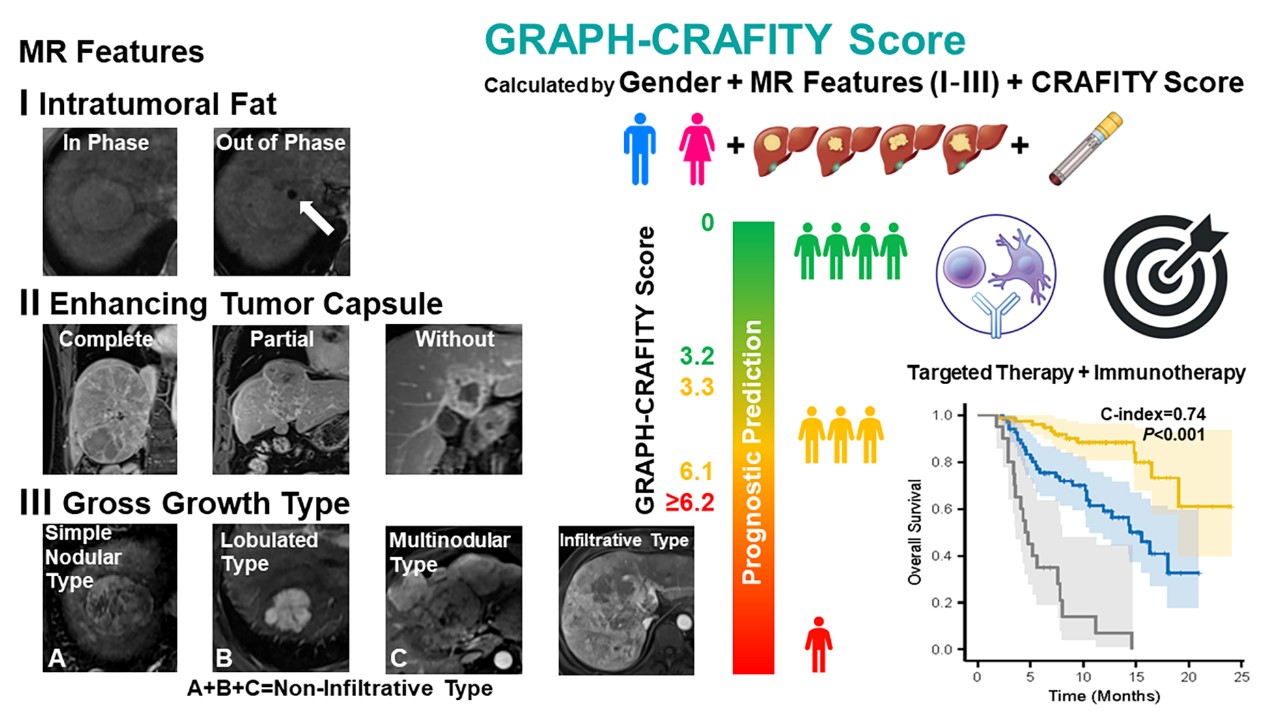
Results: Based on independent risk factors (Gender, intRatumoral fAt, enhancing tumor caPsule, gross growtH type and CRAFITY Score) identified by the multivariate analysis, a novel prognostic tool named GRAPH-CRAFITY Score was developed to predict OS.
Impact: A novel prognostic tool by integrating gender, MR features and laboratory tests was developed to predict OS of HCC patients treated with targeted therapy and immunotherapy, which will help oncologists for decision-making.
Background
The CRAFITY score based on serum C-reactive protein (CRP) and alpha-fetoprotein (AFP) levels is an easily applicable prognostic score for HCC patients treated with anti PD-1/PD-L1-based immunotherapy [1]. The efficacy of CRAFITY score has also been validated in a Chinese cohort treated with combined targeted therapy and immunotherapy by our team[2]. However, the C-index for the CRAFITY score was less than 0.7, which is limited for its clinical application. Biomarkers that predict the efficacy of immunotherapy-based systematic therapy remain an unmet need in HCC[3].Purpose
To establish an optimized model by integrating magnetic resonance (MR) features and CRAFITY score to predict overall survival (OS) of hepatocellular carcinoma (HCC) patients treated with targeted therapy and immunotherapy.Methods
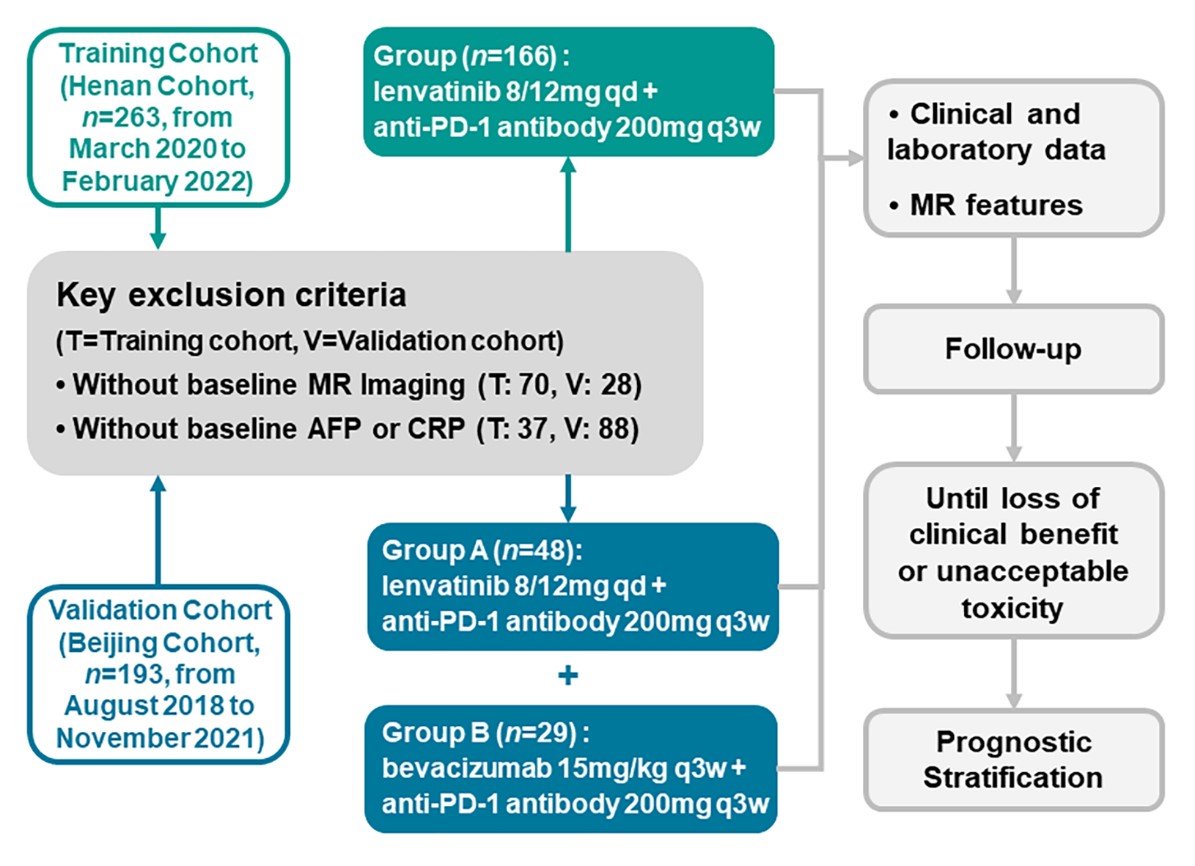
This retrospective study included patients with HCC who received targeted therapy and immunotherapy at two hospitals in China from August 2018 to February 2022. The clinical variables and MR features were assessed by univariate and multivariate Cox regression analyses.Results
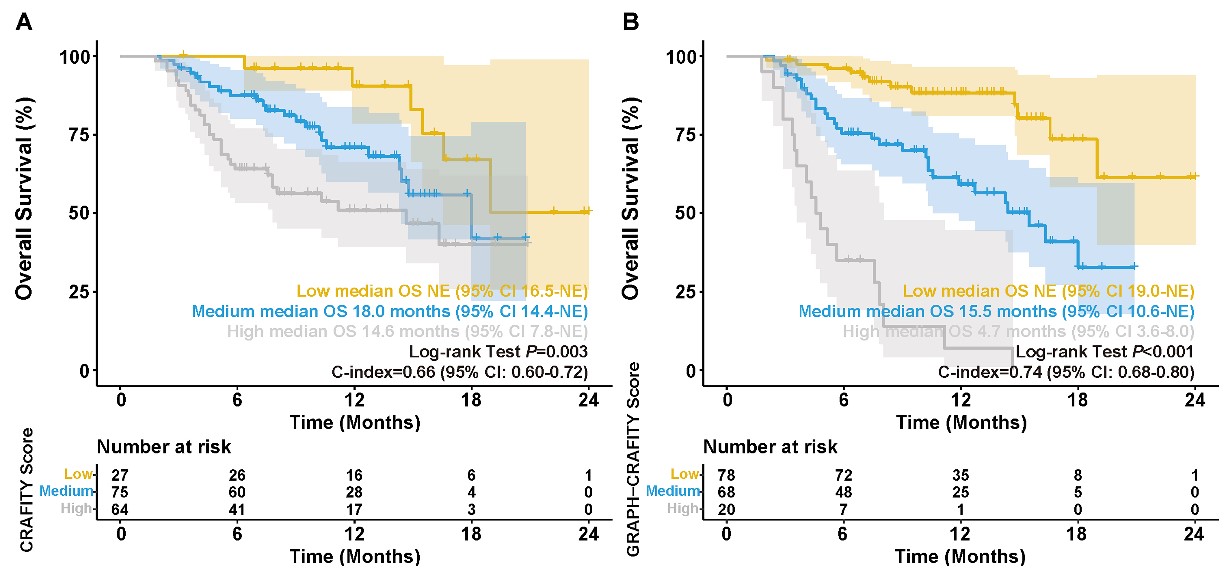
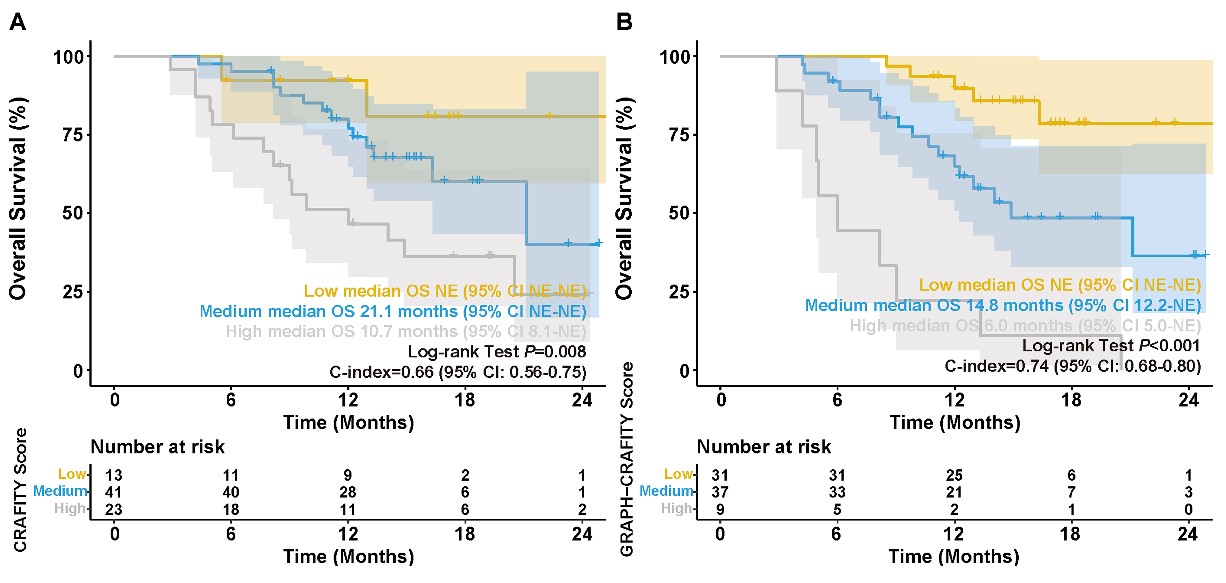
One-hundred and sixty-six patients (55.6±10.4 years) treated with lenvatinib plus anti-PD-1 antibody were included in training cohort and 77 patients (55.4±10.7 years) treated with lenvatinib or bevacizumab plus anti-PD-1 antibody were included in validation cohort. Based on independent risk factors (Gender, intRatumoral fAt, enhancing tumor caPsule, gross growtH type and CRAFITY Score) identified by the multivariate analysis, a novel prognostic tool named GRAPH-CRAFITY Score was developed to predict OS. The OS was significantly different among the 3 groups according to GRAPH-CRAFITY score (≤3.2, 3.3-6.1, ≥6.2; p<0.001) and C index of GRAPH-CRAFITY Score was 0.74 in both training cohort and validation cohort. Area under the time-dependent receiver operating characteristic curve (ROC) for discrimination at 6, 12, 18, 24 months were 0.80, 0.79, 0.77, 0.72 and 0.87, 0.75, 0.73, 0.78 in training cohort and validation cohort, respectively.Conclusion
GRAPH-CRAFITY Score by integrating Gender, MR features and laboratory tests is an effective and user-friendly tool to predict OS of HCC patients treated with targeted therapy and immunotherapy, which may help oncologists for decision-making.Acknowledgements
None.References
[1] Scheiner B, Pomej K, Kirstein MM et al (2022) Prognosis of patients with hepatocellular carcinoma treated with immunotherapy - development and validation of the CRAFITY score. J Hepatol 76:353-36310
[2] Yang Y, Ouyang J, Zhou Y, Zhou J, Zhao H (2022) The CRAFITY score: A promising prognostic predictor for patients with hepatocellular carcinoma treated with tyrosine kinase inhibitor and immunotherapy combinations. J Hepatol 77:574-576
[3] Llovet JM, Kelley RK, Villanueva A et al (2021) Hepatocellular carcinoma. Nat Rev Dis Primers 7:62
Figures