3990
Predictive value of mrSSS score for pathological complete response after neoadjuvant chemoradiotherapy for patients with rectal cancer1Department of Radiology, Changhai Hospital, Shanghai, China
Synopsis
Keywords: Digestive, Cancer, Rectal cancer · Neoadjuvant chemoradiotherapy · Magnetic resonance imaging · Split scar sign · Complete response
Motivation: Patients with rectal cancer who have pathological complete response (pCR) after neoadjuvant chemoradiotherapy (nCRT) are the best candidates to receive nonoperative management. An optimized method to identify these patients remains to be developed.
Goal(s): To measure the diagnostic performance of modified MRI-based split scar sign (mrSSS) score.
Approach: The sensitivity, specificity, and accuracy of modified mrSSS score, endoscopic gross type, and MRI-based tumor regression grading (mrTRG) score, in the prediction of pCR, were compared. The prognostic value was also studied.
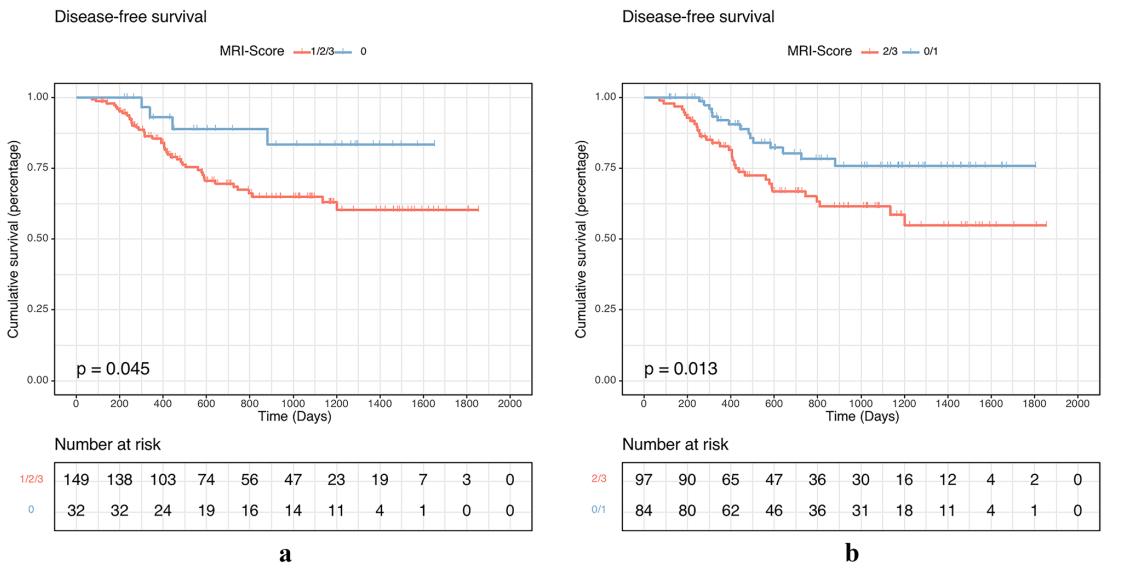
Results: The modified mrSSS score had significantly higher sensitivity in predicting pCR. Patients with lower modified mrSSS scores had significantly longer disease-free survival.
Impact: The modified mrSSS score showed satisfactory interobserver agreement and higher sensitivity in predicting pCR after nCRT in patients with rectal cancer. The modified mrSSS score is also a predictor of disease-free survival.
Purpose
To measure the diagnostic performance of modified MRI-based split scar sign (mrSSS) score for the prediction of pathological complete response (pCR) after neoadjuvant chemoradiotherapy (nCRT) for patients with rectal cancer.Methods
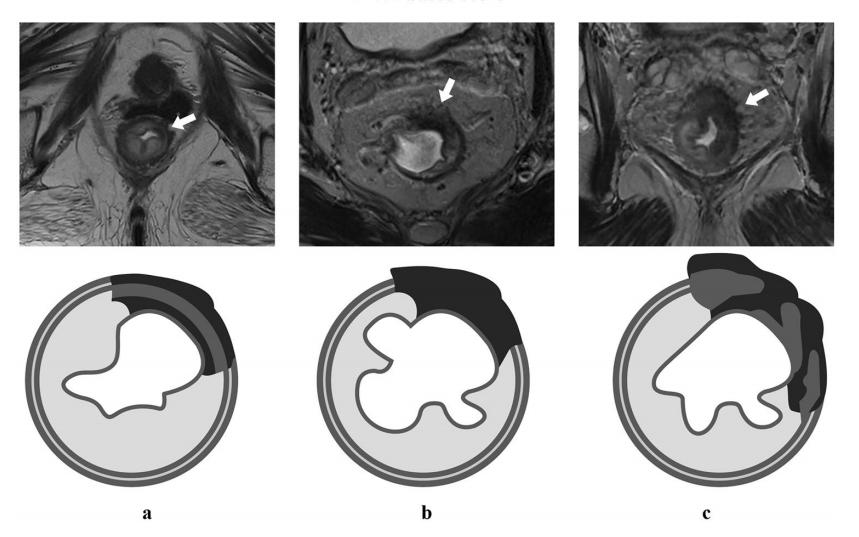
The modified MRI-based split scar sign (mrSSS) score, which consists of T2-weighted images (T2WI)-based score and diffusion-weighted images (DWI)-based score. The sensitivity, specificity, and accuracy of modified mrSSS score, endoscopic gross type, and MRI-based tumor regression grading (mrTRG) score, in the prediction of pCR, were compared. The prognostic value of the modified mrSSS score was also studied.Results
A total of 189 patients were included in the study. The Kendall’s coefficient of interobserver concordance of modified mrSSS score, T2WI-based score, and DWI-based score were 0.899, 0.890, and 0.789 respectively. And the maximum and minimum k value of the modified mrSSS score was 0.797 (0.742–0.853) and 0.562 (0.490–0.634). The sensitivity, specificity, and accuracy of prediction of pCR were 0.66, 0.97, and 0.90 for modified mrSSS score; 0.37, 0.89, and 0.78 for endoscopic gross type (scar); and 0.24, 0.92, and 0.77 for mrTRG score (mrTRG=1). The modified mrSSS score had significantly higher sensitivity than the endoscopic gross type and the mrTRG score in predicting pCR. Patients with lower modified mrSSS scores had significantly longer disease-free survival (P<0.05).Conclusion
The modified mrSSS score showed satisfactory interobserver agreement and higher sensitivity in predicting pCR after nCRT in patients with rectal cancer. The modified mrSSS score is also a predictor of disease-free survival.Acknowledgements
We thank Huirong Li from the Department of Colorectal Surgery, Changhai Hospital, for her contribution in database extraction.References
No reference found.Figures