3981
The value of DWI for predicting pathologic response to neoadjuvant immunotherapy combined with chemotherapy in locally advanced resectable ESCC1Radiology, Zhongshan Hospital, Fudan University, Shanghai, China, 2Thoracic Surgery, Zhongshan Hospital, Fudan University, Shanghai, China, 3Central Research Institute, United Imaging Healthcare, Shanghai, China
Synopsis
Keywords: Treatment Response, Cancer
Motivation: Neoadjuvant immunotherapy (nIT) combined with standard chemotherapy is the innovative treatment for esophageal squamous cell carcinoma (ESCC). Some patients may not respond to nIT.
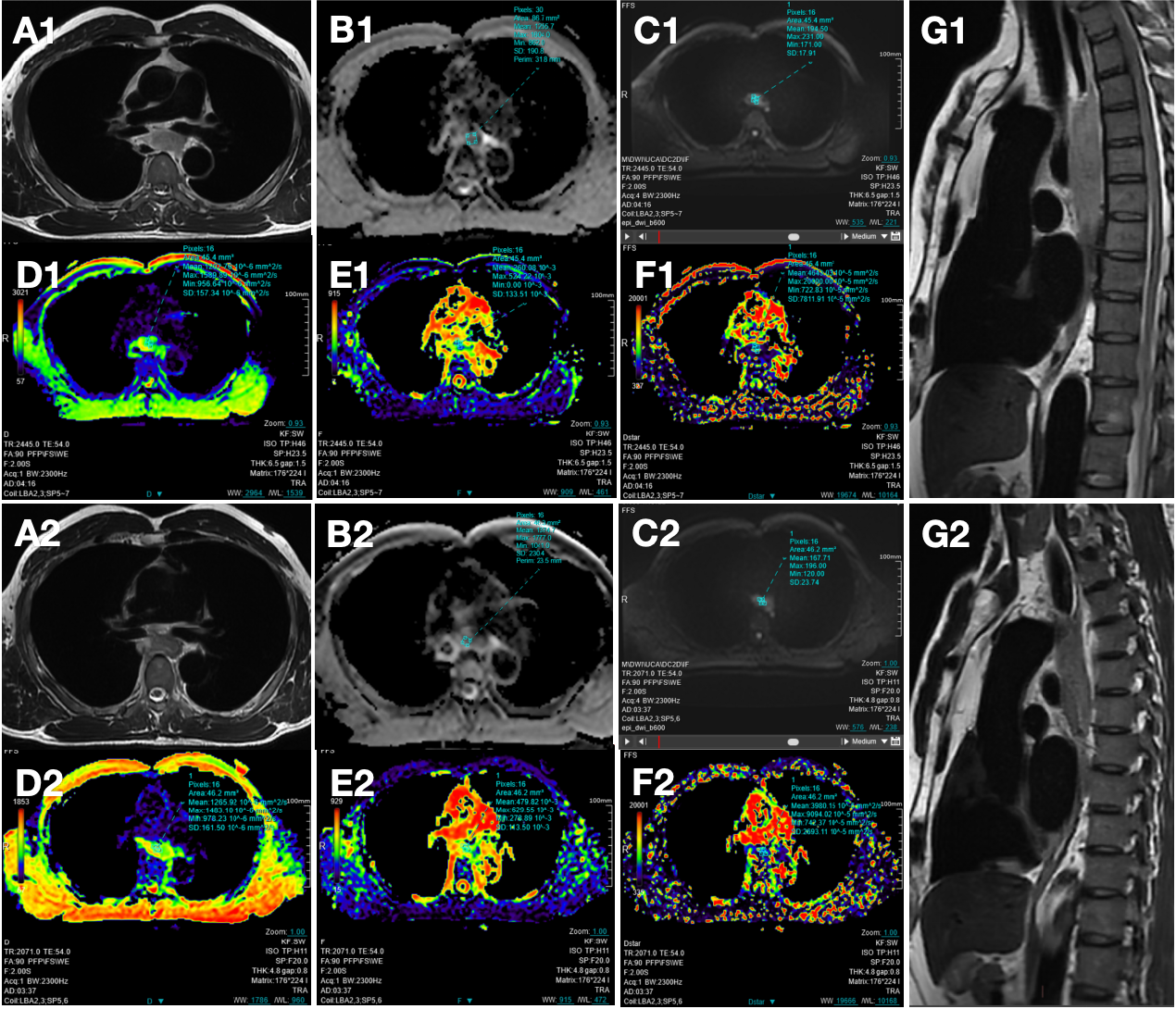
Goal(s): To investigate the value of DWI-derived parameters for the assessment of pathologic response and detection of minimal residual cancer cell (MRC) to nIT.
Approach: The patient population was a sub-cohort from the clinical trial (ClinicalTrials.gov ID: NCT02611700). The pathological response evaluation according to the TRG system proposed by AJCC. DWI-derived parameters including ADC, D, D* and f.
Results: ΔADC and ΔD values were highlighting in assessment of pathologic response and detection of MRC to nIT.
Impact: Nowadays, evaluation of the response to neoadjuvant therapy for cancer mainly relies on the measurement of tumor size according to RECIST. Pseudo-progression with immunotherapy is often observed. fMRI techniques can quantify therapy-induced changes before anatomic variation in tumor size.
Introduction
Esophageal squamous cell carcinoma (ESCC) has high incidence and mortality rate. Neoadjuvant immunotherapy (nIT) is promising because of its therapeutic efficacy. However, there are still only limited studies on preoperative immune checkpoint inhibitor in combination with chemotherapy followed by surgery for the locally advanced ESCC. Some patients will not respond to nT but will be exposed to side effects. Functional magnetic resonance imaging (fMRI) techniques can reflect tumors biological and microstructural features, so they can quantify therapy-induced changes before anatomic variation in tumor size. Diffusion weighted imaging (DWI) is a functional imaging technique that is widely used in therapeutic efficacy evaluation and prediction. This study was conducted to explore the value of DWI-derived parameters for the prediction of pathologic response to nIT combined with chemotherapy in locally advanced resectable ESCC.Methods
Thirty-two patients with locally advanced ESCC who were treated with nIT combined with chemotherapy followed by surgery were prospectively enrolled from May 2022 to May 2023. DWI was performed within 1 week (median 2 days) before nT, and 2 to 5 weeks (median 25 days) after completion of nT, prior to surgery. The tumor size was depicted by three-dimensional position. Parameters including apparent diffusion coefficient (ADC), true diffusion coefficient (D), pseudo diffusion coefficient (D*), and pseudo diffusion fraction (f) before and after nT were measured. Pathologic response was evaluated according to tumor regression grade (TRG) system. We grouped patients with TRG 0-2 into responders, while TRG 3 into non-responders; we also grouped patients with TRG 0 into complete response (CR), while TRG 1-2 into minimal residual cancer cell (MRC). The changes in tumor size measurement and DWI-derived values before and after nT in different TRG groups were assessed. Receiver operating characteristic (ROC) curves analysis was used to determine the best cutoff value for predicting the pathologic response or MRC to nT.Results
Twenty-one patients were identified as TRG 0-2 (responders), and eleven as TRG 3 (non-responders) in pathologic evaluation. While seven patients were identified as TRG 0 (CR), and fourteen as TRG 1-2 (MRC) for minimal residual disease detection. The ADC, D, and f values increased significantly after nT. The Δtumor size, post-ADC, post-D ΔADC and ΔD values of responders were significantly higher than those of non-responders. The Δtumor size, ΔADC and ΔD values of patients achieved CR were significantly higher than those with MRC. The area under curve (AUC) values of the post-ADC, post-D, ΔADC and ΔD for prediction of pathologic response to nT were 0.801-0.857, 0.688-0.758, 0.879-0.913 and 0.805-0.861. The AUC values of ΔADC and ΔD for MRC identification after nT were 0.776-0.796 and 0.786-0.867.Discusion
Our study investigated the prediction capability for pathologic response to neoadjuvant immunotherapy combined with chemotherapy in locally advanced resectable ESCC by DWI sequences and achieved acceptable results.All 32 patients received Nivolumab combined with standard chemotherapy. Twenty-one (65.625%) patients achieved TRG 0-2, who were divided into responders, while 11 (34.375%) were divided into non-responders (TRG 3). There were also 7 (21.875%) patients achieved CR (TRG 0), compared to 14 (43.75%) patients who remained MRC (TRG 1-2). Another study aimed to explore the value of IVIM-DWI for the prediction of pathologic response to nCT in locally advanced ESCC1. We aimed to increase the predictable sensitivity, which meant more accurate to identify people who are responders for nT. The post-ADC, post-D, ΔADC and ΔD values had favorable predictable performance in identifying treatment response in locally advanced resectable ESCC with sensitivity and specificity of 90.5%-95.2% and 54.5%-63.6, 71.4%-81.0% and 54.5%, 95.2% and 81.8%-90.6%, 90.5%-95.2% and 54.4%-63.6%, respectively. The diagnostic performance of ΔADC value (AUC = 0.879-0.913) in our study is superior to ΔD value (AUC = 0.859) reported in prior study, while that of ΔD value was like our study (AUC = 0.805-0.861)1. There were also other studies investigating the utility of DWI-MRI in predicting nT response of EC concluded that changes in ADC were highly predictive of histopathological response with high specificity2,3. ΔADC and ΔD in patients without tumor residual (CR/ TRG 0) were significantly higher than those in patients with MRC after nT (TRG 1 and 2). The diagnostic performance of ΔADC and ΔD for identification MRC after nT were favorable (AUC = 0.776-0.796 and 0.786-0.867) with sensitivity and specificity of 85.7% and 50%-57.1%, 85.7% and 57.1%-64.3%, respectively. To our knowledge, there have been no previous studies detecting the MRC in ESCC patients after nT.
Conclusion
DWI may be used as an effective functional imaging technique to predict pathologic response and detect minimal residual disease to nIT combined with chemotherapy in locally advanced resectable ESCCAcknowledgements
NoneReferences
1.Song T, Yao Q, Qu J, Zhang H, Zhao Y, Qin J, Feng W, Zhang S, Han X, Wang S, Yan X, Li H. The value of intravoxel incoherent motion diffusion-weighted imaging in predicting the pathologic response to neoadjuvant chemotherapy in locally advanced esophageal squamous cell carcinoma. Eur Radiol. 2021;31(3):1391-1400.
2.Pellat A, Dohan A, Soyer P, Veziant J, Coriat R, Barret M. The Role of Magnetic Resonance Imaging in the Management of Esophageal Cancer. Cancers (Basel). 2022;14(5).
3.Jiang W, de Jong JM, van Hillegersberg R, Read M. Predicting Response to Neoadjuvant Therapy in Oesophageal Adenocarcinoma. Cancers (Basel). 2022;14(4).
Figures