3965
Reduction of the temperature coefficient in high permittivity dielectric resonators for pre-clinical MRI purposes1Pennsylvania State University, State College, PA, United States, 2Huck Institute of Life Sciences, Pennsylvania State University, State College, PA, United States, 3HyQ Solutions, College Station, TX, United States, 4Center for Magnetic Resonance Research, Minneapolis, MN, United States
Synopsis
Keywords: Probes & Targets, Preclinical, Resonators, Transmit-Receive Coil
Motivation: High permittivity dielectric resonators for high resolution MRI are fabricated ferroelectric materials and have a large temperature coefficient, which produces a significant frequency variation in a small temperature range.
Goal(s): Reduce the temperature coefficient in dielectric resonators through a composite design.
Approach: Depending on the Curie temperature of BST, single layered dielectric resonators have positive or negative temperature dependance of resonant frequency. Bi-layered resonators combine positive and negative coefficients to create a temperature stable resonant frequency.
Results: Bi-layered resonators show on average a 75% reduction in frequency variation compared to single layers.
Impact: Bi-layered resonators are a first step in overcoming high temperature coefficients present in high permittivity dielectric resonators. With further improvements, this method can be used to significantly increase SNR in preclinical studies.
Introduction
Dielectric resonators have been implemented in MRI for years to increase transmit and receive signal of the RF coil [1,2,3,4]. Due to their electromagnetic properties, dielectric resonators can focus and intensify the magnetic field near the region of interest. High permittivity materials, with permittivities above 1000, are necessary to achieve the resonant frequencies in the 50 to 500MHz range in a compact geometry. However, the ferroelectric materials with these properties have a very high temperature coefficient which makes it almost impossible to attain a stable resonant frequency for a significant temperature range. For that reason, there is great interest in developing a composite dielectric resonator to reduce this effect.The three main factors that affect the resonant frequency of a dielectric resonator are the diameter, thickness and permittivity, expressed in this equation $$$fMHz=(3.4*[(10)]^3)/(a*sqrt(εr))(a/L+3.45)$$$[5] for a cylindrical resonator with radius a in cm, thickness L in cm and permittivity εr. Due to the limited bore size in most pre-clinical MRI machines, the size of the dielectric resonator is limited, therefore needing a permittivity in the order of thousands. Barium Strontium Titanate, (BST) is a high permittivity material used for dielectric resonators that is made of a mixture of Barium Titanate (BT) and Strontium Titanate (ST). Within a defined temperature range, BST dielectric resonators can have a positive or negative temperature coefficient depending on the barium and strontium proportions in the material. A defined mixture of BST can be mixed with barium titanate (BT) to attain different compositions and different temperature coefficients. The single layered resonators can then be combined to produce a bi-layered resonator combining the properties of the two existing ones.
Methods
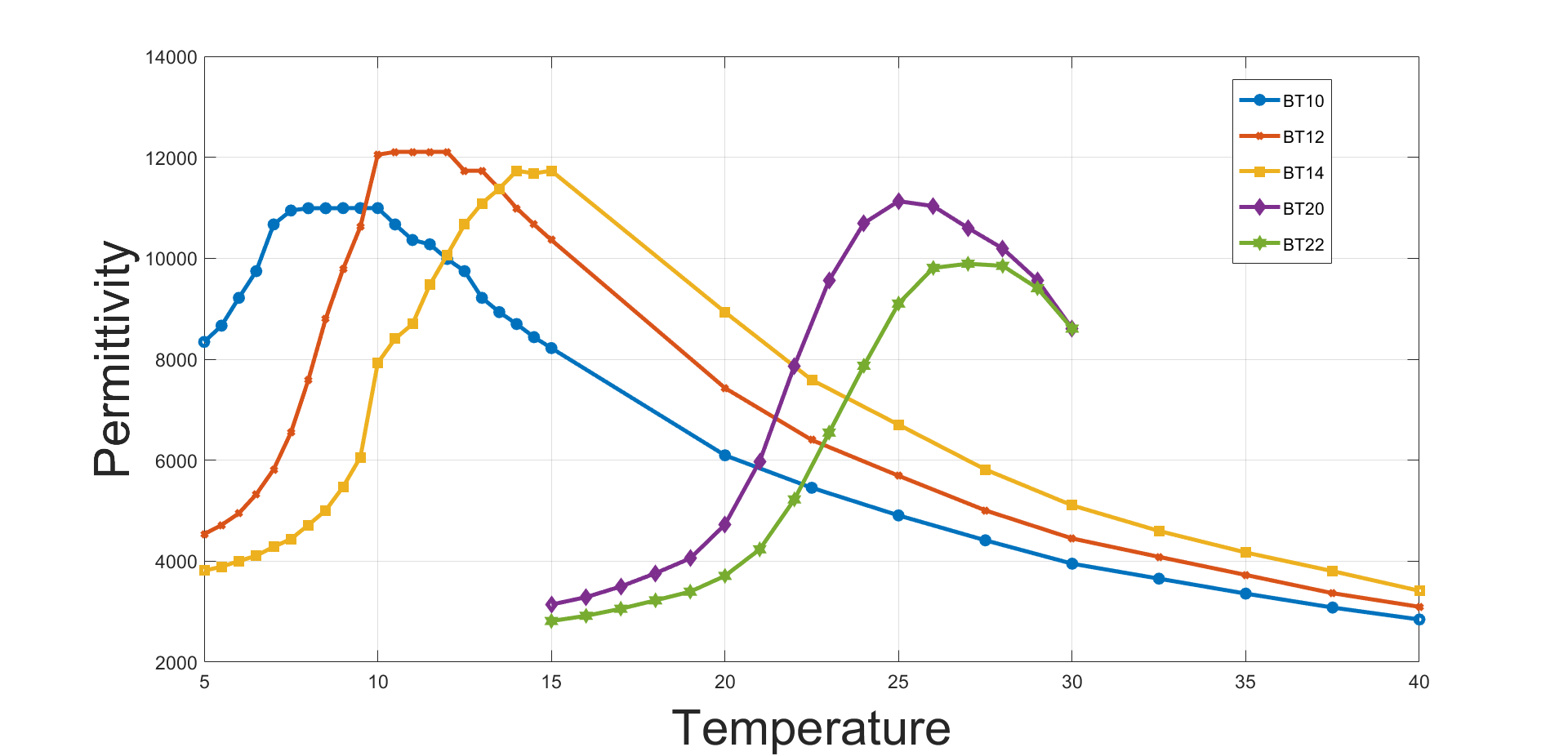
A few single layered dielectric resonators with different BST and BT compositions are fabricated and characterized to identify their temperature coefficients for different temperature ranges. The specific compositions used are BST 60-40 (60% barium and 40% strontium) and varying percentages of BT, specifically 10%, 12%, 14%, 20% and 22%. The resonators are identified by their barium titanate percentage, BT10 means 10% of barium titanate and so on. [Fig. 1] The temperature range of 20ºC to 25ºC is selected as the range of interest for being considered the room temperature of operation for MRI. Within that range, resonators are identified by whether having a positive temperature coefficient or a negative one. It is the intention that by using bi-layered resonators, one layer with a positive coefficient and one with negative coefficient, their permittivity variation will cancel each other out achieving a more stable frequency over the temperature range.Results
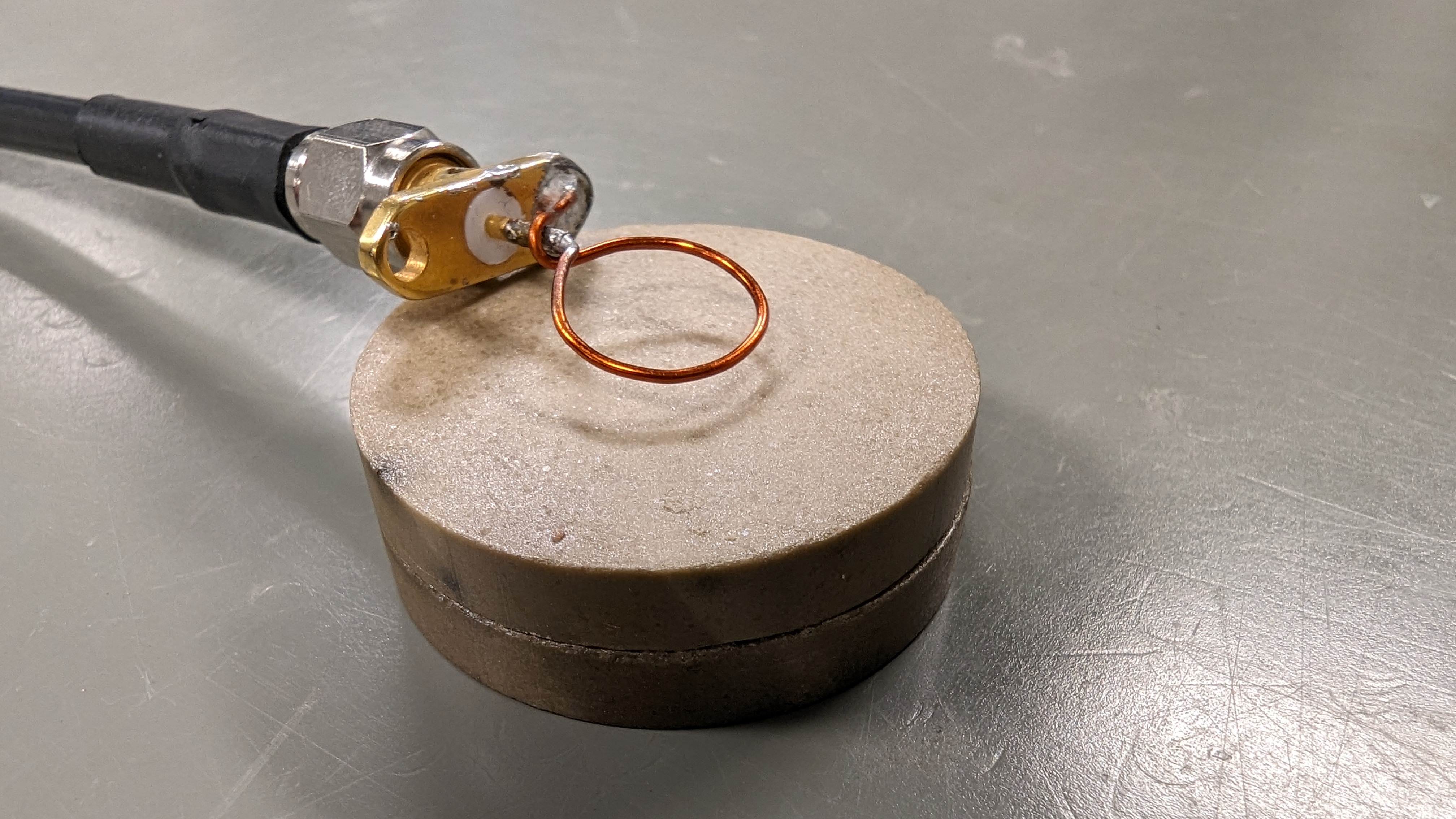
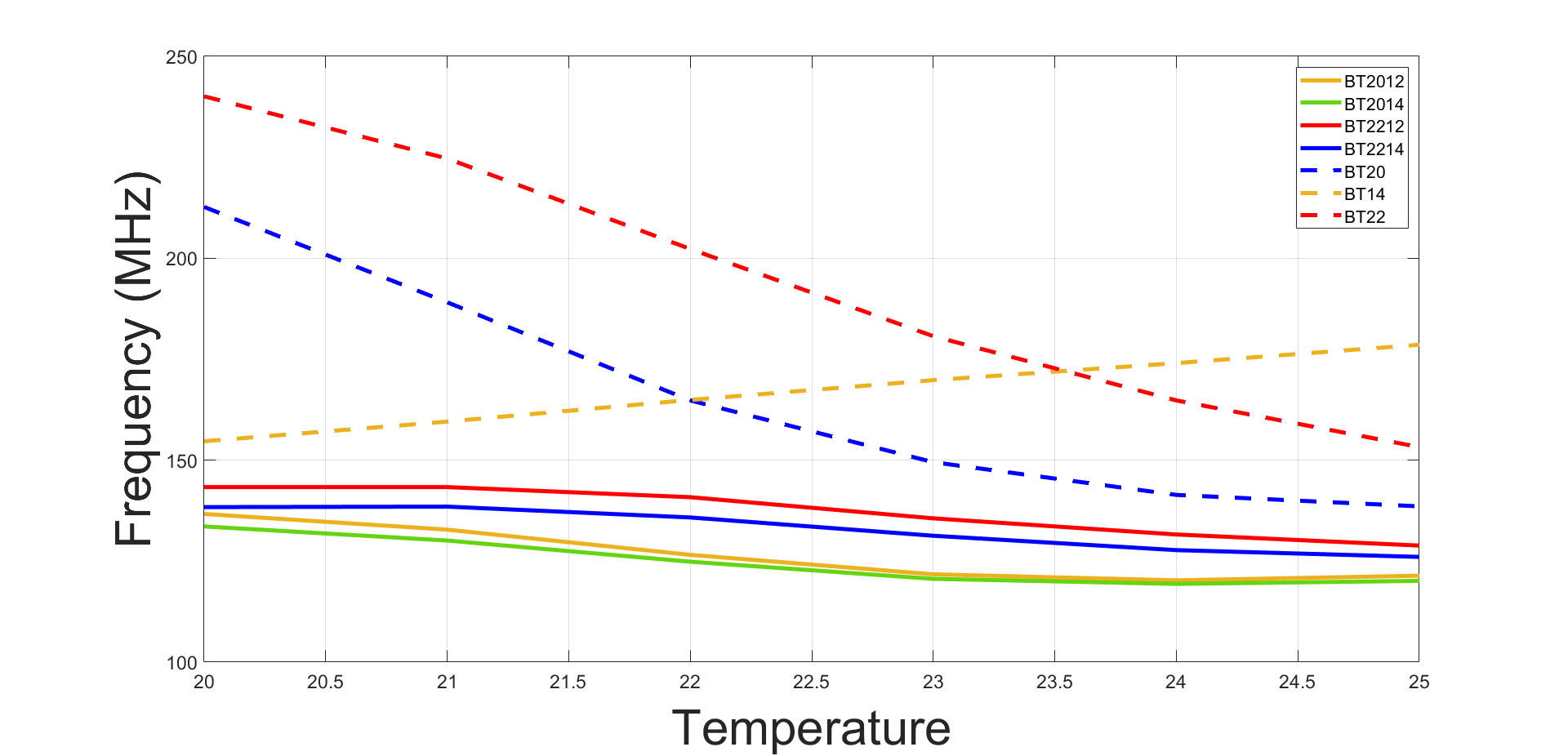
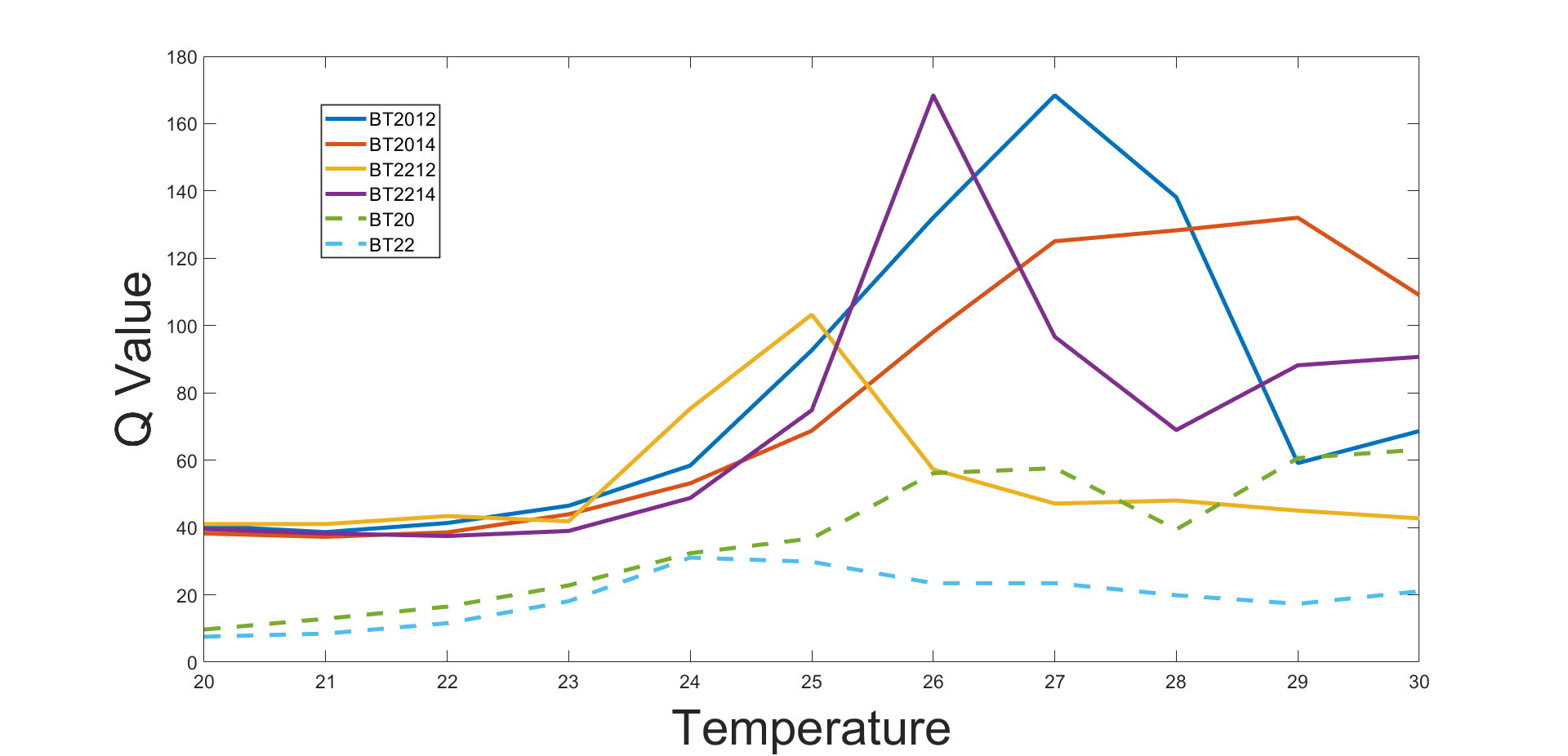
Different combinations of bi-layered resonators are investigated, and their frequency variation over the defined temperature range is measured using the setup from Fig. 2 in an oven with precise temperature control. The bi-layered resonators are identified by the barium titanate percentage of its layers, BT2012 means one layer with 20% barium titanate and the other with 12% and so on for the other resonators [Fig. 3]. On average, the frequency variation of bi-layered resonators is 23% of the frequency variation of their single layered counterparts. All bi-layered resonators present a smaller frequency variation than their single layered counterparts. The largest improvement observed is the frequency variation of a bi-layered resonator being 13% of the value of the single layered material while the smallest improvement is a bi-layered resonator having a frequency variation of 60% compared to that of the single layered. It is also observed that Q values in general are larger in bi-layered resonators than they are in resonators with the highest concentration of BT [Fig. 4].Discussion
When performing an MRI scan, temperature actually does not change by a lot. However, the resonant frequency of single layered dielectric resonators can increase or decrease from 20MHz to 80MHz (depending on the composition) with a single degree of temperature change. The results presented here show that bi-layered resonators have on average a frequency variation of 13MHz, which is a marked improvement from single layer resonators. While still not optimal, further improvements may be possible by altering other parameters, like relative size of the resonators and number of layers in resonators.Acknowledgements
This work was supported in part by NIH grants of U01 EB026978 and P41 EB027061.References
1-Rupprecht, S., Sica, C. T., Chen, W., Lanagan, M. T., & Yang, Q. X. (2018). Improvements of transmit efficiency and receive sensitivity with ultrahigh dielectric constant (uHDC) ceramics at 1.5 T and 3 T. Magnetic Resonance in Medicine, 79(5), 2842–2851.
2-Aussenhofer, S. A., & Webb, A. G. (2013). High-permittivity solid ceramic resonators for high-field human MRI. NMR in Biomedicine, 26(11), 1555–1561.
3-Fu, C., Yang, C., Chen, H., Wang, Y., & Hu, L. (2005). Microstructure and dielectric properties of BaxSr 1-xTiO3 ceramics. Materials Science and Engineering B: Solid-State Materials for Advanced Technology, 119(2), 185–188.
4-Neuberger, T., Tyagi, V., Semouchkina, E., Lanagan, M., Baker, A., Haines, K. and Webb, A.G. (2008), Design of a ceramic dielectric resonator for NMR microimaging at 14.1 tesla. Concepts Magn. Reson., 33B: 109-114. https://doi.org/10.1002/cmr.b.20114
5-Wen, H., Jaffer, F. A., Denison, T. J., Duewell, S., Chesnick, A. S., & Balaban, R. S. (1996). The Evaluation of Dielectric Resonators Containing H 2 O or D 2 O as RF Coils for High-Field MR Imaging and Spectroscopy. In JOURNAL OF MAGNETIC RESONANCE, Series B (Vol. 110).
Figures