3964
Echo-planar spectroscopic imaging with flyback readout: ghost peaks and micro-imaging1Department of Medical Physics, Uppsala University Hospital, Uppsala, Sweden, 2Mediso Medical Imaging Systems, Budapest, Hungary, 3Department of Medicinal Chemistry, Preclinical PET-MRI Platform, Uppsala, Sweden
Synopsis
Keywords: Biology, Models, Methods, Data Acquisition, EPSI, flyback readout, ghost artifacts, micro-imaging, water-fat imaging
Motivation: To assess echo-planar spectroscopic imaging (EPSI) with flyback readout gradients in preclinical MR system.
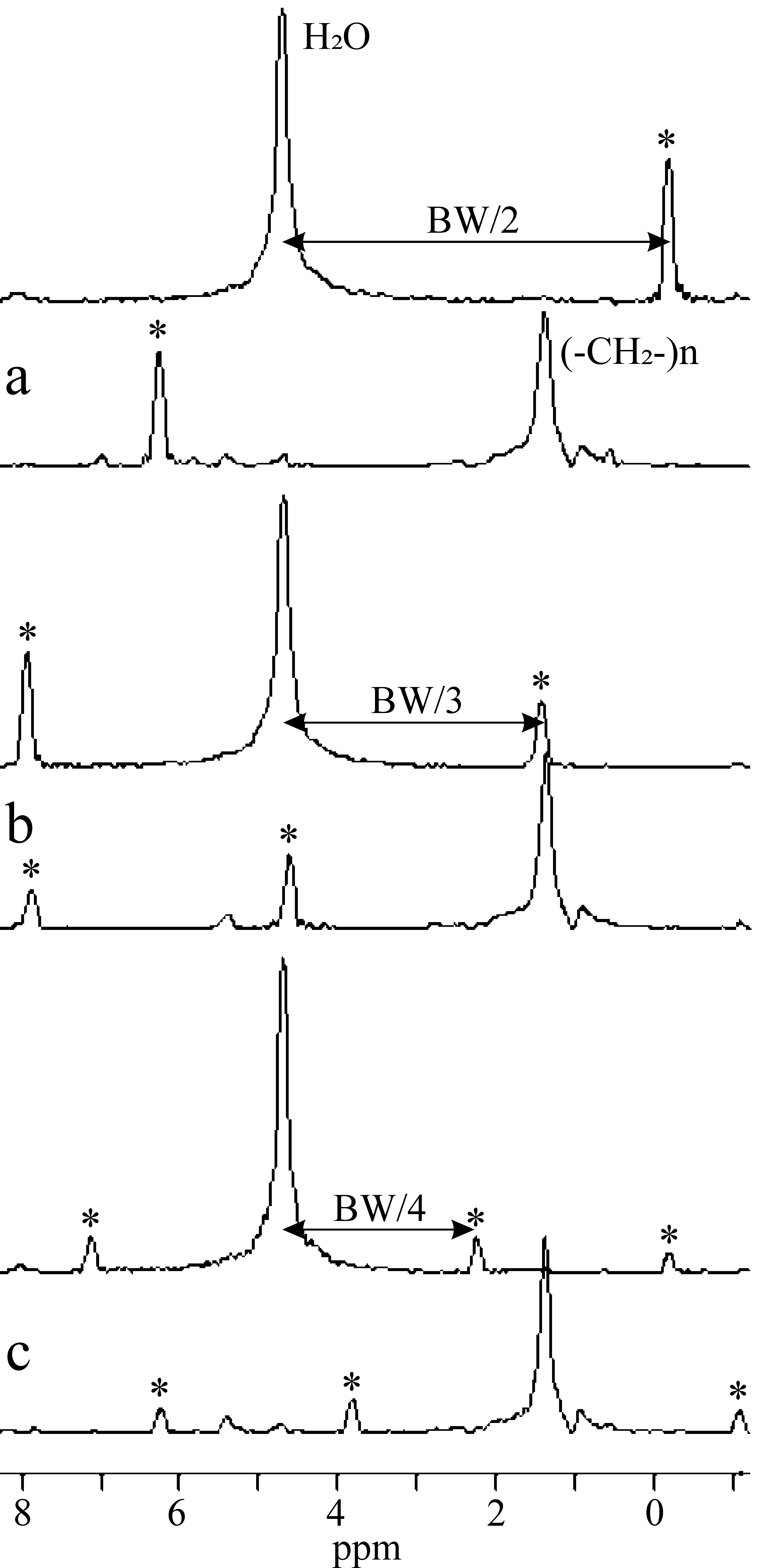
Goal(s): To demonstrate spectral ghost artifacts produced by two, three, and four interleaved gradient echo trains and to measure water, fat, and water-fat shift artifacts free images.
Approach: Flyback EPSI with two, three, and four interleaved gradient echo trains.
Results: The proposed approach with four interleaved gradient echo trains and with four echoes in each train enables high spectral bandwidth in combination with narrow receiver bandwidth and a very good water/fat signals separation. It improves SNR without the undesired consequence of water-fat shift artifacts.
Impact: Echo-planar spectroscopic imaging with flyback readout enables measurement of water, fat, and water-fat shift artifact-free images. Four interleaved echo trains with four echoes in each train provide high spectral, and narrow receiver bandwidth, and a very good water-fat separation.
Introduction
Water and fat unsuppressed echo-planar spectroscopic imaging (EPSI) with high spatial resolution was previously used on clinical scanners for water and fat imaging and spectroscopy1-3. The weakness of such an approach is the presence of Nyquist ghost artifacts caused by inconsistency between odd and even echoes. An alternative to the gradient echo train created by trapezoidal positive and negative gradient pulses is the “flyback” gradient echo train in which only one polarity of the readout gradient is applied4,5. Gradient waveform is asymmetric and combines strong rewind gradients with lower ones for the readout. It simplifies data processing. However, a high-power gradient system is required to achieve sufficient spectral bandwidth (sBW). In this study, the flyback EPSI sequence was implemented in a preclinical MR scanner. The main aim of this work is to demonstrate spectral ghost artifacts and the potential of the interleaved flyback EPSI in preclinical MR systems.Methods
Experiments were performed on a nanoScan® PET/MRI 3T preclinical scanner (Mediso Medical Imaging Systems, Budapest, Hungary). The scanner was equipped with gradients with a maximum amplitude of 550 mT/m and a maximum slew rate of 4500 T/m/s. Flyback EPSI sequence begins with slice selection followed by phase encoding. Gradient echoes were acquired with two, three, or four interleaved gradient echo trains with linear ramps of 0.15 ms duration. The resultant spacing between echoes was 0.8 ms (sBW 9.74 ppm). Ghost peaks of water and fat spectral lines were visualized with a phantom (Fig. 1) containing vegetable oil and water solution of MnCl2 (~0.23 mM)6. Phantom’s T2 relaxation times mimics subcutaneous fat (T2 ~70 ms) and muscle water (T2 ~30 ms). All experiments were performed with maximum available FOV 80x80 mm, 192 phase-encoding steps, 256 points/echo (resolution in-plane 0.31x0.42 mm2) and 2 averages. Phantom experiments were performed with slice thickness 2 mm, TR/TE1=200/3 ms, and flip angle 30o. Receiver bandwidth (rBW) was either 434028 Hz (readout gradient gread=127 mT/m) or 114280 Hz (gread=33.7 mT/m). Animal experiments were performed using four interleaved gradient echo trains with four echoes in each train. 27 coronal slices (thickness 1.3 mm) were measured with TR/TE1=500/3 ms, flip angle 60o, and with rBW 114890 Hz. The acquisition time was ~13 minutes. Data processing software was developed in-house and has been described elsewhere7-9.Results and discussion
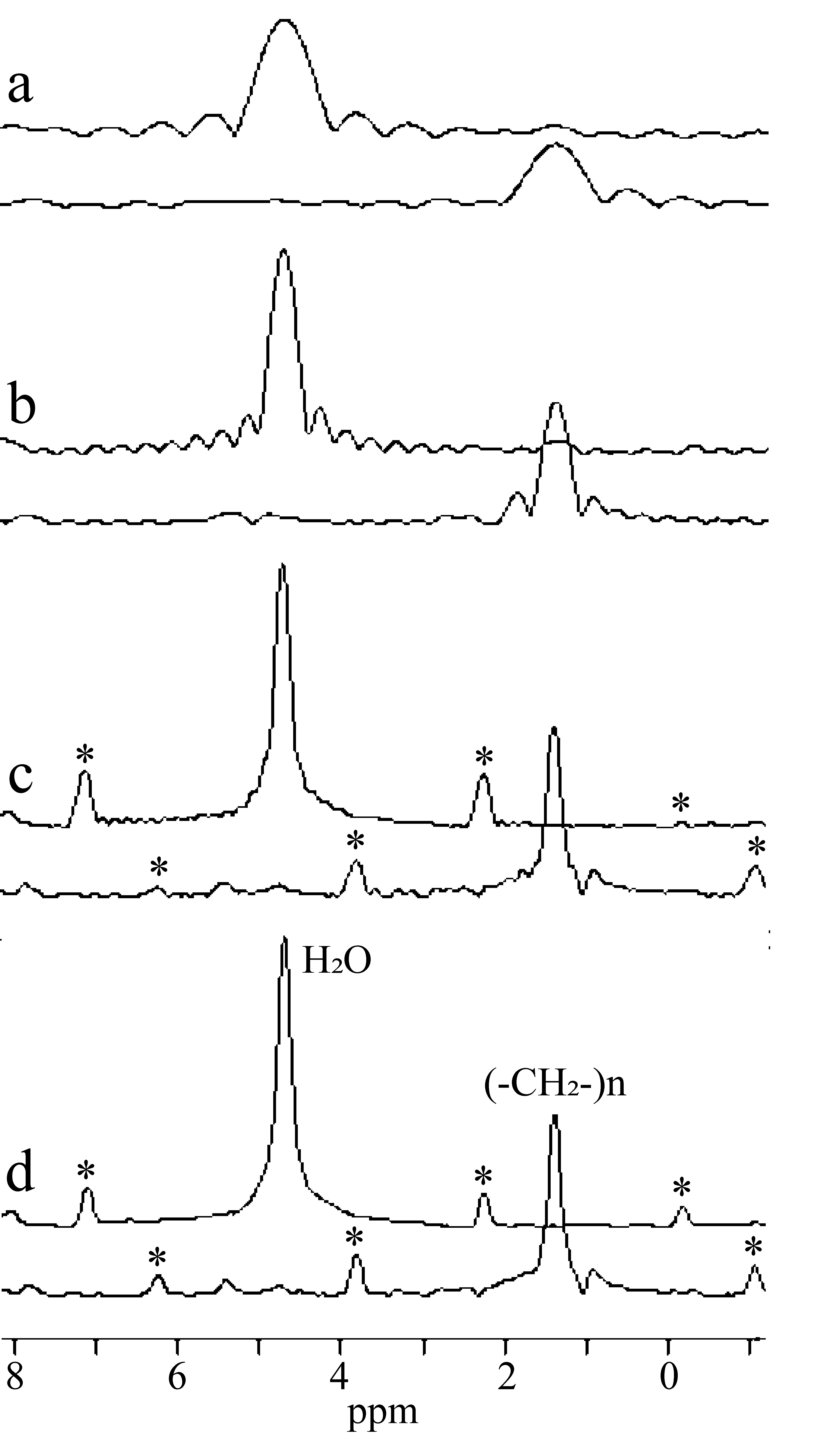
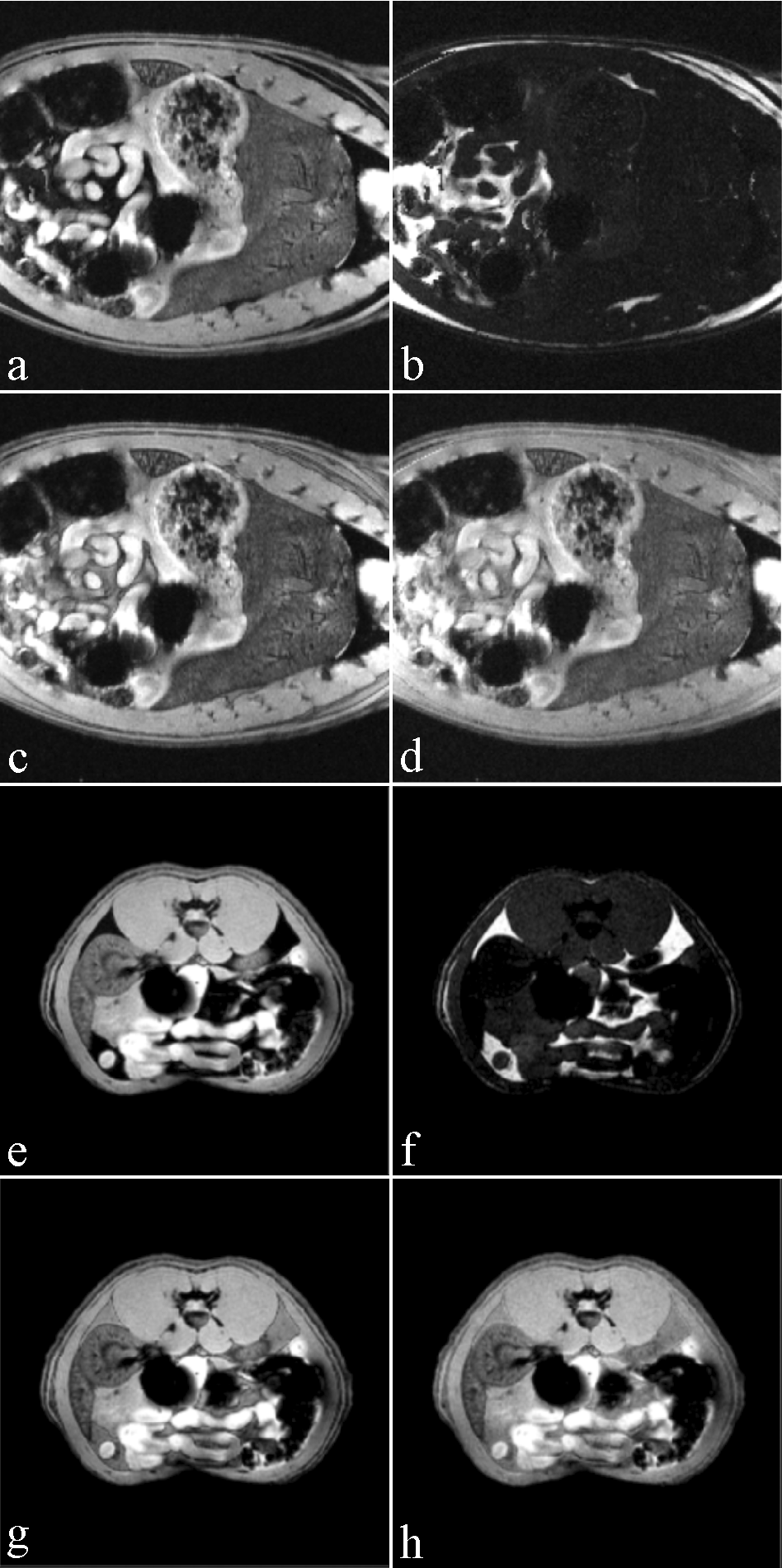
The described technique provides magnitude spectra, water, fat, and water-fat shift (WFS) artifact free images7-9. Water and vegetable oil spectra were computed from the volume of interests 51 mm3 (Fig. 1). As expected, the interleave of two, three, and four echo trains produce one, two, and three ghost spectral lines, respectively (Fig. 2). Distances between ghost peaks and main water or methylene (-CH2-)n lines are sBW/2, sBW/3, sBW/4 (or 2xsBW/4) for spectra acquired with two, three, and four interleaved echo trains, respectively. Only ghost peaks from the highest methylene (-CH2-)n line can be recognized. Ghost peaks of other fat spectral lines are too small to be detected in our case. Water and fat images were computed by integration of water and (-CH2-)n spectral lines. Therefore, suitable sBW has to be chosen to avoid the superposition of water and fat ghost peaks with water and fat (-CH2-)n lines. Figure 2b demonstrates such superpositions. The advantage of the EPSI micro-imaging approach over the conventional imaging is the fact that WFS artifacts are eliminated during data processing7. Since signal-to-noise ratio (SNR) is directly proportional to WFS1/2 and WFS is indirectly proportional to receiver bandwidth (WFS ~1/rBW), narrow rBW, i.e. larger WFS artifacts during acquisition can be chosen for SNR improvement without penalty of WFS artifacts. Narrow rBW can be achieved by increasing the number of the echo trains. Four interleaved echo trains enabled rBW 114890 Hz in our case. The resulting spectra and images are shown in Figs. 3 and 4. Intensities of both water and fat ghost peaks are less than truncation artifacts up to ~32 echoes (Fig. 3 a, b). Truncation artifacts are small already for 64 echoes (Fig. 3c). Figure 4 shows examples of the rat’s images. Separation of water and fat intensities is very good although only 16 echoes were used for imaging.Conclusion
This work demonstrates the applicability of echo-planar spectroscopic micro-imaging with flyback readout gradients in preclinical MR systems with small magnets and high-power gradients. The proposed approach provides higher sBW and very good water and fat signal separation already for 16 gradient echoes while intensities of ghost peaks are negligible. Narrow rBW was achieved by increasing the number of interleaved echo trains. It improves SNR without the undesired consequence of increased WFS artifacts.Acknowledgements
No acknowledgement found.References
1. Du W, Du YP, Bick U, et al. Breast MR imaging with high spectral and spatial resolutions: preliminary experience. Radiol. 2002;224:577-585.
2. Du W, Du YP, Fan X, et al. Reduction of spectral ghost artifacts in high-resolution echo-planar spectroscopic imaging of water and fat resonances. Magn Reson Med. 2003;49:1113-1120.
3. Medved M, Ivancevic MK, Olopade OI, et al. Echo-planar spectroscopic imaging (EPSI) of the water resonance structure in human breast using sensitivity encoding (SENSE). Magn Reson Med. 2010;63:1557-1563.
4. Hennel F, Nedelec J-F. Interleaved asymmetric echo-planar imaging. Magn Reson Med. 1995;34:520-524.
5. Cunningham CH, Vigneron DB, Chen AP, et al. Design of flyback echo-planar readout gradients for magnetic resonance spectroscopic imaging. Magn Reson Med. 2005;54:1286-1289.
6. Thangavel K, Saritas EÜ. Aqueous paramagnetic solutions for MRI phantoms at 3 T: a detailed study on relaxivities.Turk J Elec Eng & Comp Sci. 2017;25:2108-2121.
7. Weis J, Ericsson A, Hemmingsson A, Chemical shift artifact-free microscopy: spectroscopic microimaging of the human skin. Magn Reson Med. 1999;41:904-908.
8. Weis J, Courivaud F, Schacht Hansen M, et al. Lipid content in the musculature of the lower leg: evaluation with high-resolution spectroscopic imaging. Magn Reson Med. 2005;54:152-158.
9. Weis J, Bruvold M, Ortiz-Nieto F, et al. High-resolution echo-planar spectroscopic imaging of the human calf. PLOS ONE. 2014; 9:e87533.
Figures