3950
Shear-induced Sodium Dynamics within Red Blood Cells membrane using advanced 23Na Single and Triple Quantum Filtered Rheo-NMR methods.1Sir Peter Mansfield Imaging Centre, University of Nottingham, Nottingham, United Kingdom, 2Royal Derby Hospital, University of Nottingham, Derby, United Kingdom, 3Centre for Kidney Research and Innovation, University of Nottingham, Derby, United Kingdom
Synopsis
Keywords: Biology, Models, Methods, Spectroscopy, sodium, rheology, red blood cells
Motivation: Increased blood viscosity has been reported in red blood cell senescence and pathologies of decreased perfusion such as chronic kidney disease.
Goal(s):
- Rheological NMR is a powerful, although still underutilized, tool to assess the molecular-mechanical links in flowing media. This study's primary objective was to explore the dynamic alterations in Na+ interaction with glycocalyx of red blood cells exposed to the physiological shear forces experienced within the microvasculature in health and disease.
Approach: 23Na multiple quantum filtered (MQF) rheo-NMR in RBCs suspensions at varied haematocrit.
Results: 23Na MQF rheo-NMR are efficient to detect Na+ interaction with glycocalyx of red blood cells under deformation
Impact: Potential sodium “rheo-markers” reflective of blood viscosity in health and disease are proposed.
Introduction
Increased blood viscosity has been reported in red blood cell senescence and pathologies of decreased perfusion such as chronic kidney disease [1]. Often this is associated with impaired Na+ transport across cell membrane and can be probed by 23Na Nuclear Magnetic Resonance (NMR) spectroscopy. Specifically, 23Na multiple quantum filtered (MQF) methods have been used to probe sodium dynamics inside and outside red blood cells (RBCs) [2] and sodium transport across the cell membrane [3]. In addition, rheo-NMR methods [4] allow one to monitor changes in molecular responses during flow, hence can be used to probe possible alterations in sodium dynamics in red blood cell suspensions induced by shear.We have applied 23Na MQF rheo-NMR methods to explore possible dynamic alterations in Na+ interaction with glycocalyx of RBC membrane under deformation.
Methods
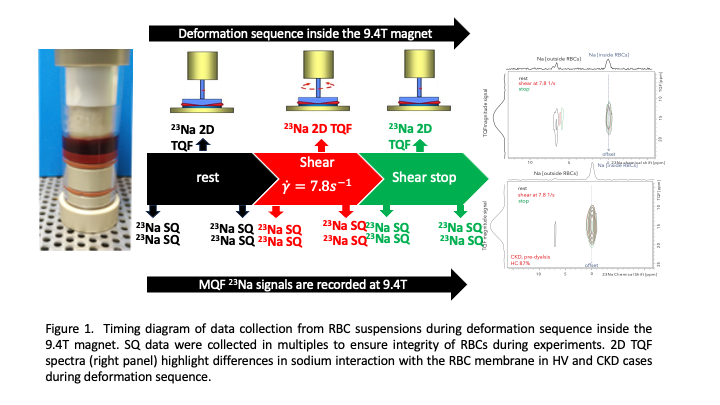
Blood samples (n=5) were obtained from healthy male volunteers, age (27.6 ± 5.7) years), and 1 male CKD patient (age 72), under full ethical approval. Samples were centrifuged, washed twice, resuspended in PBS in the presence of Tm-DOTP5- shift reagent (SR). Hct was varied to approximately 58, 70, 80 & 90% to simulate increases in RBC cell packing with increased vascular branching. Hct dependent viscosity was confirmed using bulk rheology using the state-of-the-art DHR II Rheometer (TA Instruments, USA). To assess shear-induced Na+ dynamics, blood samples (400µl) were transferred into a commercial cone & plate rheo-NMR cell (Bruker, Germany) and placed inside the 9.4T magnet. Shear rate was adjusted to 7.8 s-1 . 9.4T Avance III microimaging system, 25 mm 23Na coil tuned to 105.86 MHz, and RheoSpin (Bruker, Germany) were used for all rheo-NMR experiments. 23Na singe quantum (SQ) and two-dimensional (2D) triple quantum filtered (TQF) spectroscopy was performed in all RBC suspensions at 37C. 23Na SQ spectra were acquired using 1024 complex points with recycle delay 200 mS. 2D TQF data were collected using complex data points. All data were collected at rest, , and upon cessation of the shear. The timing diagram of data collection is shown in Figure 1. TQF data were processed in TopSpin3.6 using 2D magnitude FFT to determine sodium chemical shifts experiencing triple quantum interactions, Figure 1 (right panel). Time domain TQF data were analysed using IgorPro8 (Wavemetrics, USA) to extract fast (T2fast) and slow (T2slow) sodium transverse relaxation times. All statistical analysis was performed using IgorPro8.Results
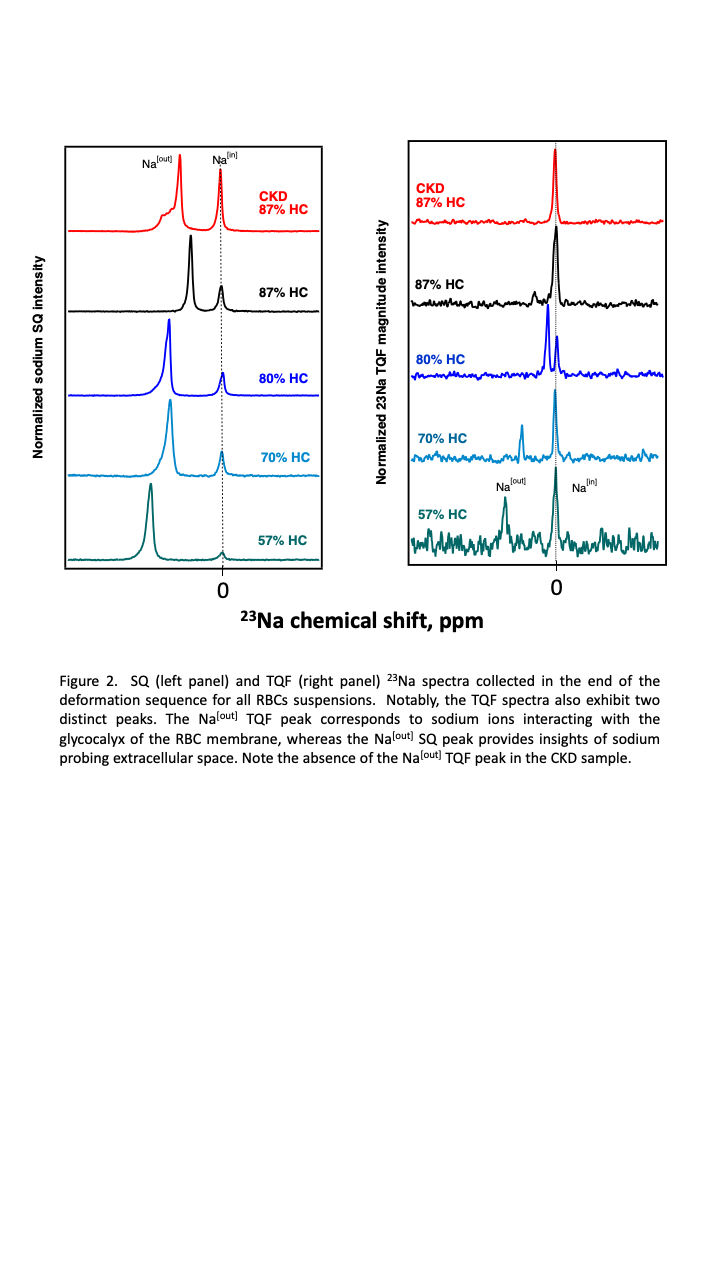
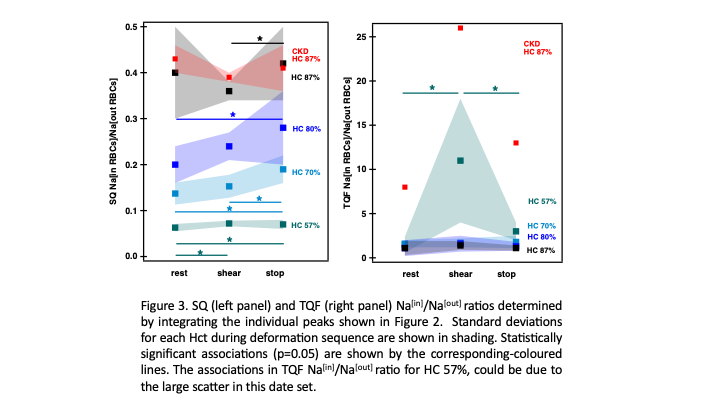
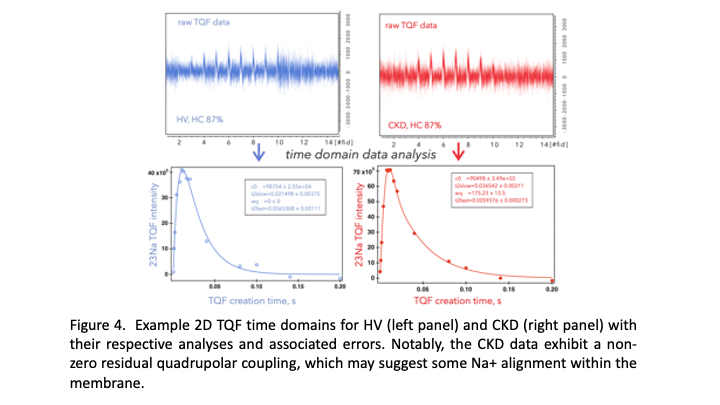
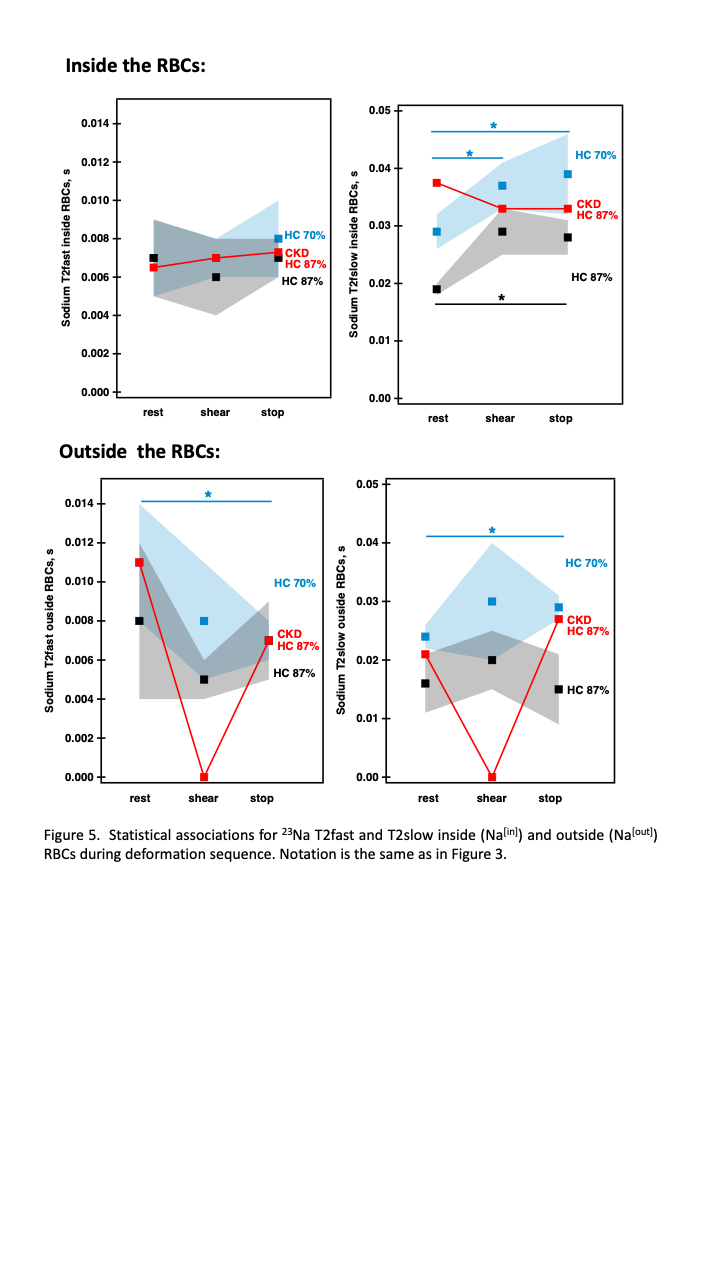
1D SQ and 2D TQF spectra projections in the end of the deformation sequence for all Hcts are displayed in Figure 2. The SQ and TQF Na[in]/Na[out] ratios derived from the integrated intensities of spectra collected during deformation sequence are displayed in Figure 3. TQF time domain data and their analysis [5] after 1D FT are shown in Figure 4. Time domain TQF data analysis (Figure 4) result in sodium T2fast and T2slow displayed in Figure 5 for selected Hcts in the deformation sequence.Discussion
We observed Na[out] after TQF (Figure 2) for all HV Hcts as observed before [2,6]. As our blood samples were washed twice before resuspension in PBS, TQF Na[out] represent sodium interaction with glycocalyx of the RBC membrane.SQ and TQF Na[in]/Na[out] ratios during the deformation sequence are shown in Figure 3. HV SQ Na[in]/Na[out] highlight shear-induced alteration of sodium distribution in RBCs suspensions. This association was absent in the CKD case. The HV TQF Na[in]/Na[out] ratios were largely independent on shear for all Hct, The CKD sample, in contrast with SQ Na[in]/Na[out] was reactive to the shear with significant increase in the TQF Na[in]/Na[out] ratio. This might be indicative of diminished sodium interaction with glycocalyx of the RBC membrane with further verification needed.
T2fast and T2slow determined during deformation sequence are displayed in Figure 5. T2fast inside the RBCs were independent on shear and Hct in health and disease. T2slow inside the HV RBCs was increased upon shear and its cessation, suggesting shear-induced increase in the RBC size. The CKD sample had longer T2slow at rest hinting on the larger size of RBCs in CKD with further contraction upon shear. Shear-induced alteration of sodium interaction with external glycocalyx of the RBC membrane was observed in HVs and was absent in the CKD sample. This could be indicative of the potential disease-associated glycocalyx marker.
Conclusion
Multi-dimensional sodium multiple quantum rheo-NMR methods help to uncover shear driven glycocalyx sodium dynamics in health and disease. These potential shear-induced sodium markers need to be further probed and refined for disease cases.Acknowledgements
We acknowledge MRC Discovery for support of this workReferences
[1] Brimble KS, McFarlane A, Winegard N, Crowther M, Churchill DN. Effect of chronic kidney disease on red blood cell rheology. Clin Hemorheol Microcirc. 2006;34(3):411-20.
[2] Knubovets T., et al. Quantification of the Contribution of Extracellular Sodium to23Na Multiple-Quantum-Filtered NMR Spectra of Suspensions of Human Red Blood Cells, Journal of Magnetic Resonance, Volume 131, Issue 1, 1998, Pages 92-96.
[3] Knubovets TL, et al. 23Na NMR measurement of the maximal rate of active sodium efflux from human red blood cells. Magn Reson Med. 1989 Feb;9(2):261-72. doi: 10.1002/mrm.1910090211
[4] Paul T Callaghan, Rep. Prog. Phys. 62 599 (1999)
[5] Pavlovskaya G, et al. A molecular–mechanical link in shear-induced self-assembly of a functionalized biopolymeric fluid, Soft Matter, 19, 3228-3237, (2023) http://dx.doi.org/10.1039/D2SM01381A
[6] Wimperis, S. Relaxation of Quadrupolar Nuclei Measured via Multiple-Quantum Filtration, Encyclopedia of Magnetic Resonance, Online: 2007–2011 John Wiley & Sons, Ltd.
Figures