3944
Enabling Two-way Audio Communication and Real-time Monitoring of Acoustic Noise Exposure during MRI Acquisition1Radiology, Mayo Clinic, Jacksonville, FL, United States, 2EERS Global, Montréal, QC, Canada
Synopsis
Keywords: Hybrid & Novel Systems Technology, New Devices, Safety, Prevention, Safety, Prevention , Audio Communication, Patient Comfort, Acoustic Noise Reduction, Hearing Protection
Motivation: : Improve audio communication, patient comfort and safety during MRI exams.
Goal(s): Enable verbal communication without interrupting MRI acquisition and real-time monitoring of acoustic noise exposure and protection.
Approach: Use microphones inside and outside of acoustic noise insulated earpiece and advanced signal processing algorithms to remove MR gradient noise while preserving audio signal and to measure the sound pressure level (SPL) in the ear canal.
Results: Good intelligibility in two-way audio communication is demonstrated during MR acquisitions in a trial of healthy volunteers. No significant artifact from earpieces in clinical brain imaging.
Impact: A novel MRI audio system can provide clear and seamless two-way communication, real-time monitoring of acoustic noise exposure and protection, high-quality audio for patient comfort during the entire MRI exam.
INTRODUCTION
The high level of acoustic noise produced by MR scanner is not only a major source of discomfort during the exam but can also be a risk for temporary hearing loss if the patient is not well protected1. Under such high level of noise, MRI scans often must be interrupted for the patient and the operator to hear and understand each other using the MRI audio systems currently available. A novel audio system for MRI has been developed to allow clear and uninterrupted two-way verbal communication during MRI acquisitions and to continuously monitor the sound pressure level (SPL) in the patient ears in real-time to ensure adequate protection.METHODS
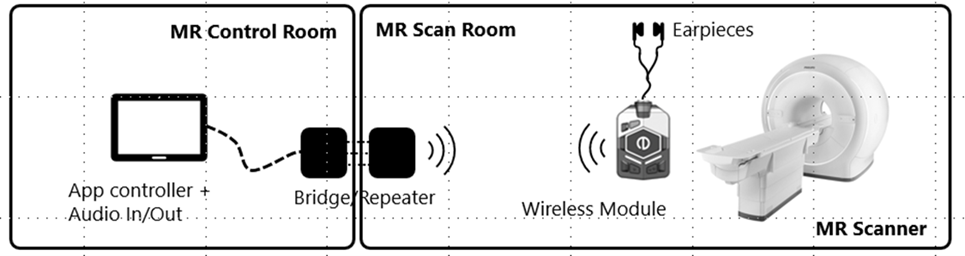
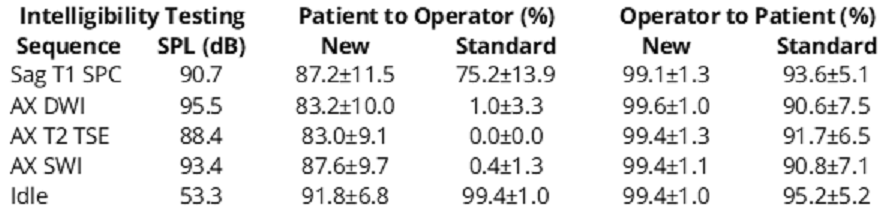
The novel audio system for MRI has specially designed earpieces for robust acoustic isolation. Each earpiece has a small MR compatible speaker to deliver high quality audio and two microphones: one to detect the patient’s voice and measure SPL directly inside the patient’s ear canal and the other for the ambient sound in the MR gantry. Advanced signal processing algorithm enables noise cancellation and voice activation. The earpieces are connected to a small wearable unit linked wirelessly to an operator console outside of MR exam room as shown in Figure 1. The wearable units can also communicate with each other if additional units are present.To evaluate the performance of this new audio system, it was compared directly against the manufacturer’s built-in audio system as the standard in a trial of 10 healthy volunteers. Each volunteer was scanned on a Siemens 3T Magnetom Vida scanner with 5 clinical brain MRI sequences as listed in Figure 2. The intelligibility of verbal communication in both directions using the new and the standard audio systems was measured in random order during 4 sequences and while the scan was idling, a total of 10 measurements for each subject where each measurement consists of hearing 10 sentences of 5 words. The intelligibility was scored based on the accuracy of recognizing the words in those sentences2.
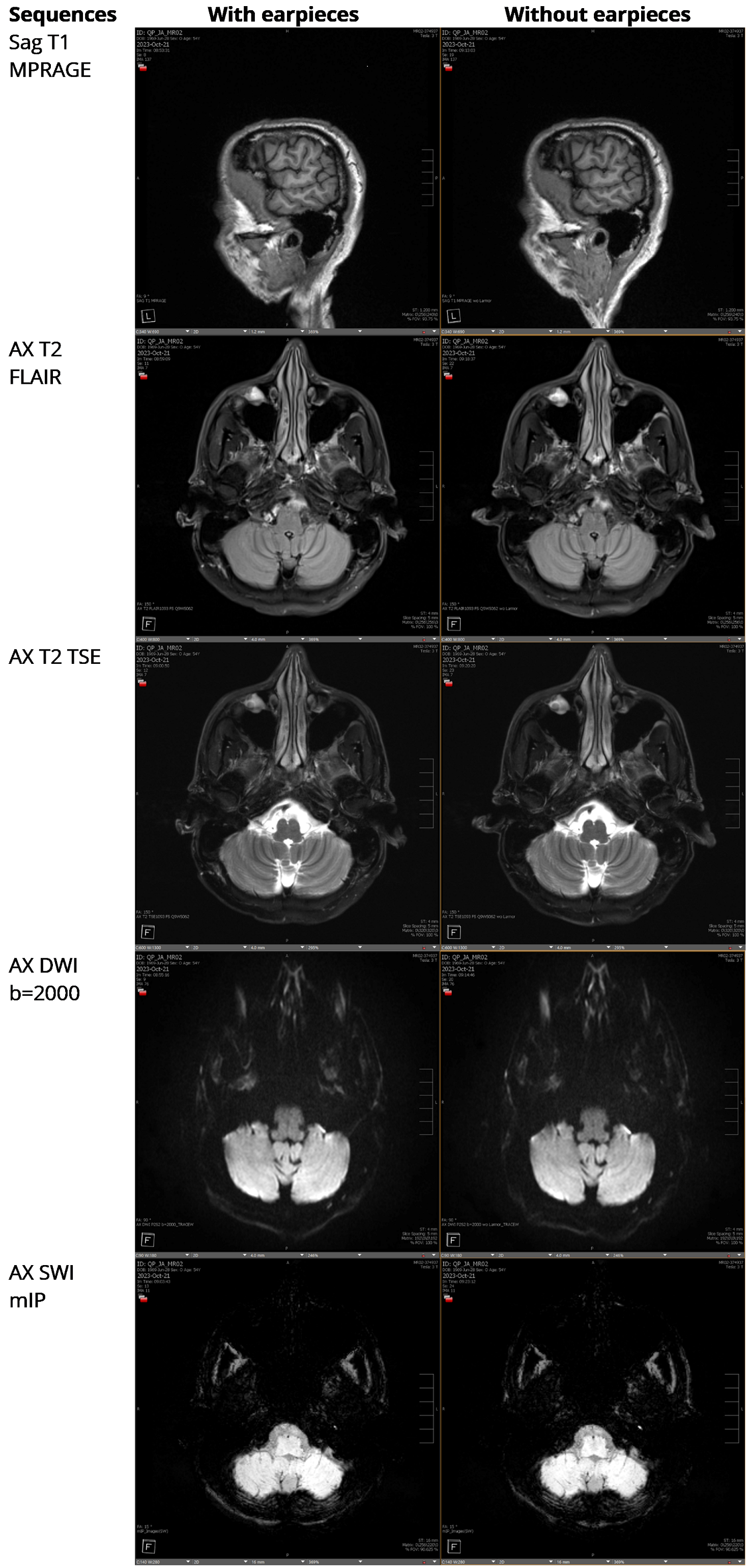
Preliminary testing of potential artifacts was performed by scanning a volunteer with and without the earpieces back-to-back with a clinical brain exam protocol. Direct comparison was made by a neuro-radiologist to identify the artifacts and assess their impact.
RESULTS
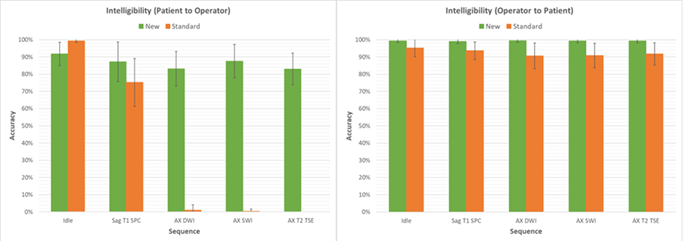
As shown in Figure 3, the average intelligibility for patient to operator communication is much higher with the new audio system for most sequences except Sag T1 SPC which has short gaps of silence, while the average intelligibility for operator to patient communication is slightly, but still significantly, higher.There is no perceptible artifact caused earpieces in SAG MPRAGE, AX DWI and AX SWI images and only minimal artifact in AX T2 FLAIR and AX T2 TSE images with no significant impact on image quality as determined by a radiologist and illustrated in Figure 4.
DISCUSSION
The artifacts caused by the earbuds of the prototype audio system were found to be negligible and does not negatively impact the diagnostic quality of clinical MRI images. More rigorous and quantitative assessment of artifacts will be performed per ASTM standard once the design is finalized.With a microphone inside the earpiece, the novel audio system can measure the SPL in the ear canal. Such architecture allows real-time monitoring of acoustic noise exposure to ensure the safety limit is not exceeded. However, this functionality is still under development.
The new audio system is compatible with and can benefit from other acoustic noise reduction methods and additional layers of acoustic noise isolation such as earmuff when acceptable. However, using small earpieces alone allow the patient to be fitted with the smallest head coil possible to maximize image quality.
CONCLUSION
The novel audio system offers superior audio quality and greater intelligibility in two-way communication during a simulated brain MRI exam. Clear two-way verbal communication between the patient and the operator is possible without suspending or interrupting the scan.Acknowledgements
No acknowledgement found.References
- McJury MJ. Acoustic Noise and Magnetic Resonance Imaging: A Narrative/Descriptive Review. J Magn Reson Imaging. 2022 Feb;55(2):337-346.
- Kollmeier B, Warzybok A, Hochmuth S, Zokoll MA, Uslar V, Brand T, Wagener KC. The multilingual matrix test: Principles, applications, and comparison across languages: A review. Int J Audiol. 2015;54 Suppl 2:3-16.
Figures