3941
Enhanced parallel imaging with pseudo-linear magnetic fields using multi-channel matrix gradient coil1Interdisciplinary Institute of Neuroscience and Technology, College of Biomedical Engineering & Instrument Science, Zhejiang University, Hangzhou, China, Hangzhou, China, 2MOE Frontier Science Center for Brain Science and Brain-machine Integration, Zhejiang University, Hangzhou, China, Hangzhou, China, 3ZJU-Xitou Brain-Machine Intelligence Research Center, Hangzhou, China, Hangzhou, China, 4College of Electrical Engineering, Zhejiang University, Hangzhou, China, Hangzhou, China, 5Paul C. Lauterbur Research Centre for Biomedical Imaging, Institute of Biomedical and Health Engineering, Shenzhen Institutes of Advanced Technology (SIAT), Chinese Academy of Sciences (CAS), Shenzhen, China, Shenzhen, China, 6Second Affiliated Hospital of Zhejiang University School of Medicine, Hangzhou, China, Hangzhou, China
Synopsis
Keywords: Data Acquisition, Data Acquisition
Motivation: Nonlinear magnetic fields have been used as an effective alternative to linear counterparts to offer improved spatial encoding efficiency.
Goal(s): Nonlinear encoding methods often encounter center imaging blurring and require additional information for non-bijective encoding fields to differentiate mis-localized intensities.
Approach: We propose to use pseudo-linear spatial encoding magnetic fields to address these challenges and enhance encoding efficiency. Based on that, two encoding strategies were proposed.
Results: Center resolution discrepancy could be mitigated according to numerical simulations and preliminary experiments.
Impact: The mitigation of the center blurring presents a reference for future research employing nonlinear gradient encoding.
INTRODUCTION
Spatial encoding methods employing nonlinear magnetic fields (SEMs) have emerged as an effective alternative to their linear counterparts to offer improved spatial encoding efficiency1, 2. In those nonlinear encoding schemes, utilizing multipolar SEMs can result in non-bijective mapping and reconstruction ambiguities. Multi-channel RF receiver coils are able to address the problem but may lead to sub-optimal encoding efficiency. Besides, flat gradients in the center are likely to cause under-encoding and thus may result in central blurring problem.It has been proven that the engagement of linear SEMs is capable of mitigating center blurring3-5. In this study, we opt for the use of linear-like SEMs, specifically referred as 'pseudo-linear SEMs' (abbreviated as pl-SEMs), to address central blurring and enhance encoding efficiency. Single pl-SEMs, by virtue of their dual nature encompassing linear and nonlinear attributes, facilitate the equilibrium of resolution within the FOV while reducing encoding complexity. Here, we introduce an encoding strategy that involves a set of smoothly rotating pl-SEMs and expand it into a single-shot strategy for highly-accelerated acquisition with low power requirements. The method was evaluated through a series of numerical simulations and preliminary imaging experiments.
METHODS
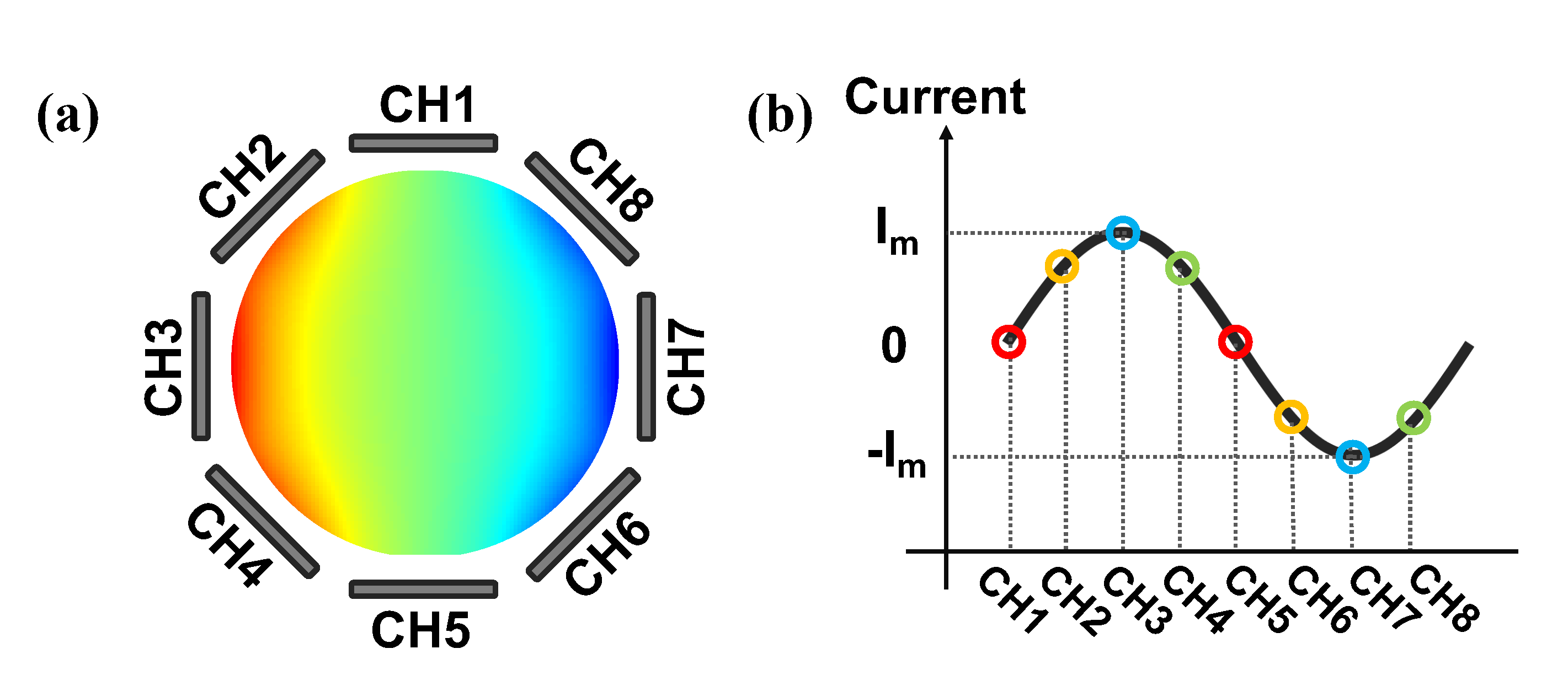
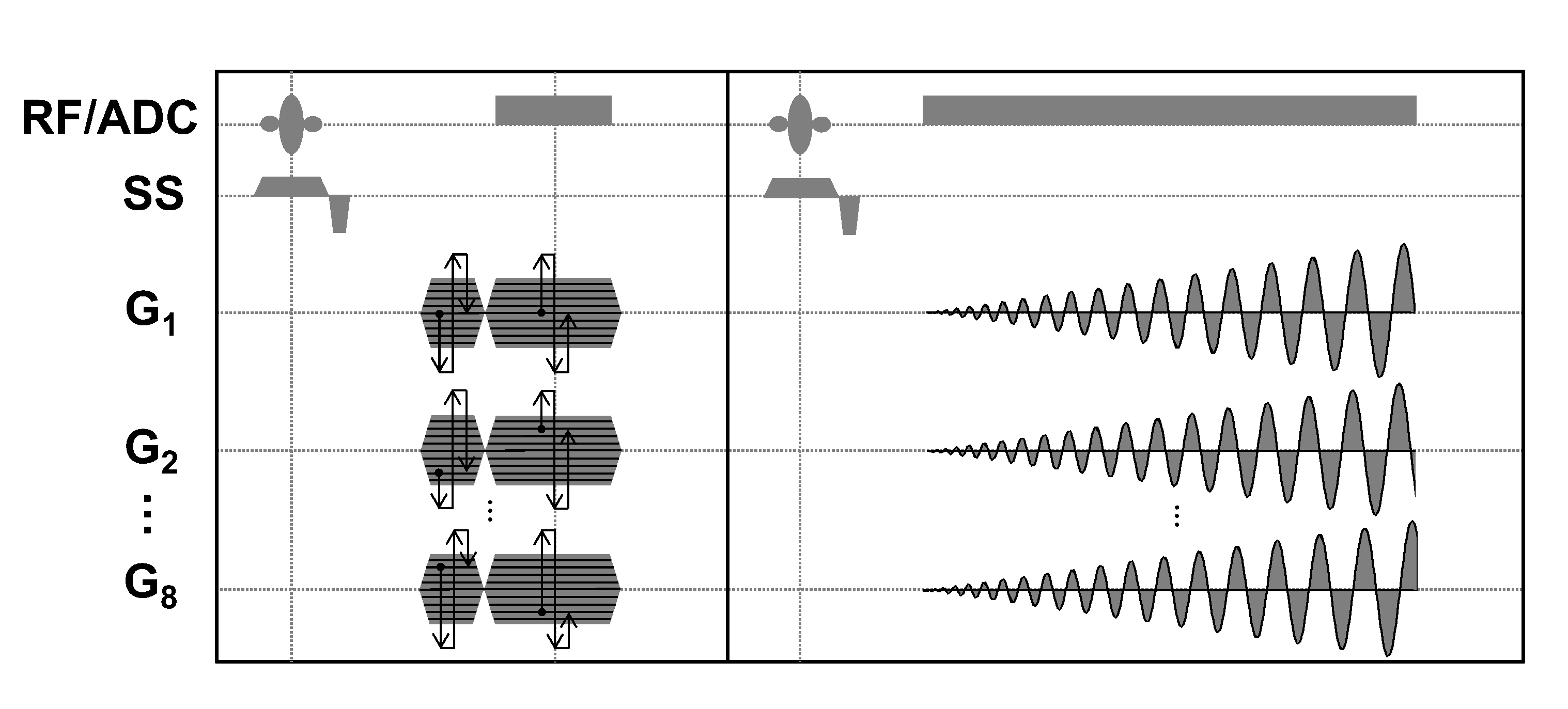
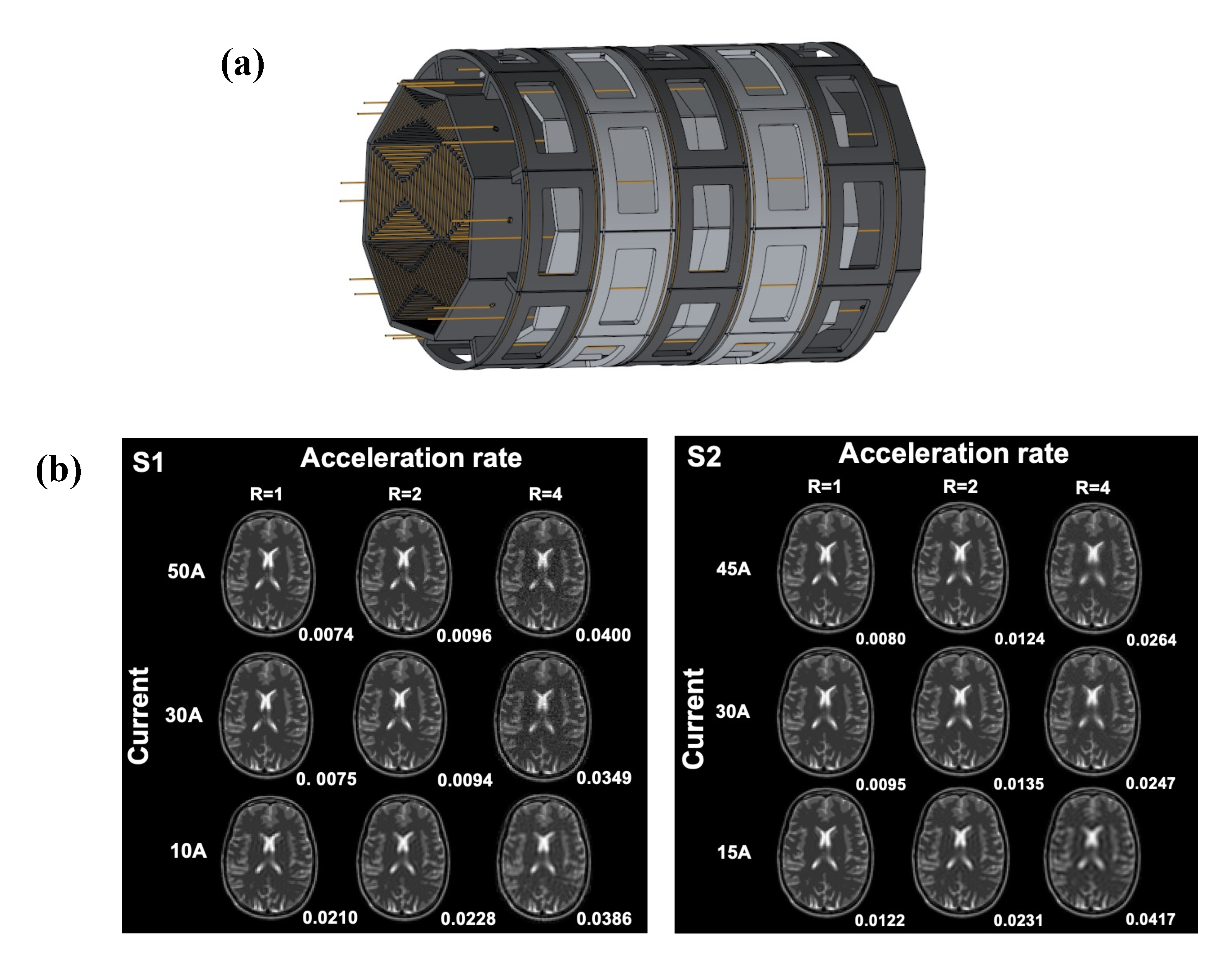
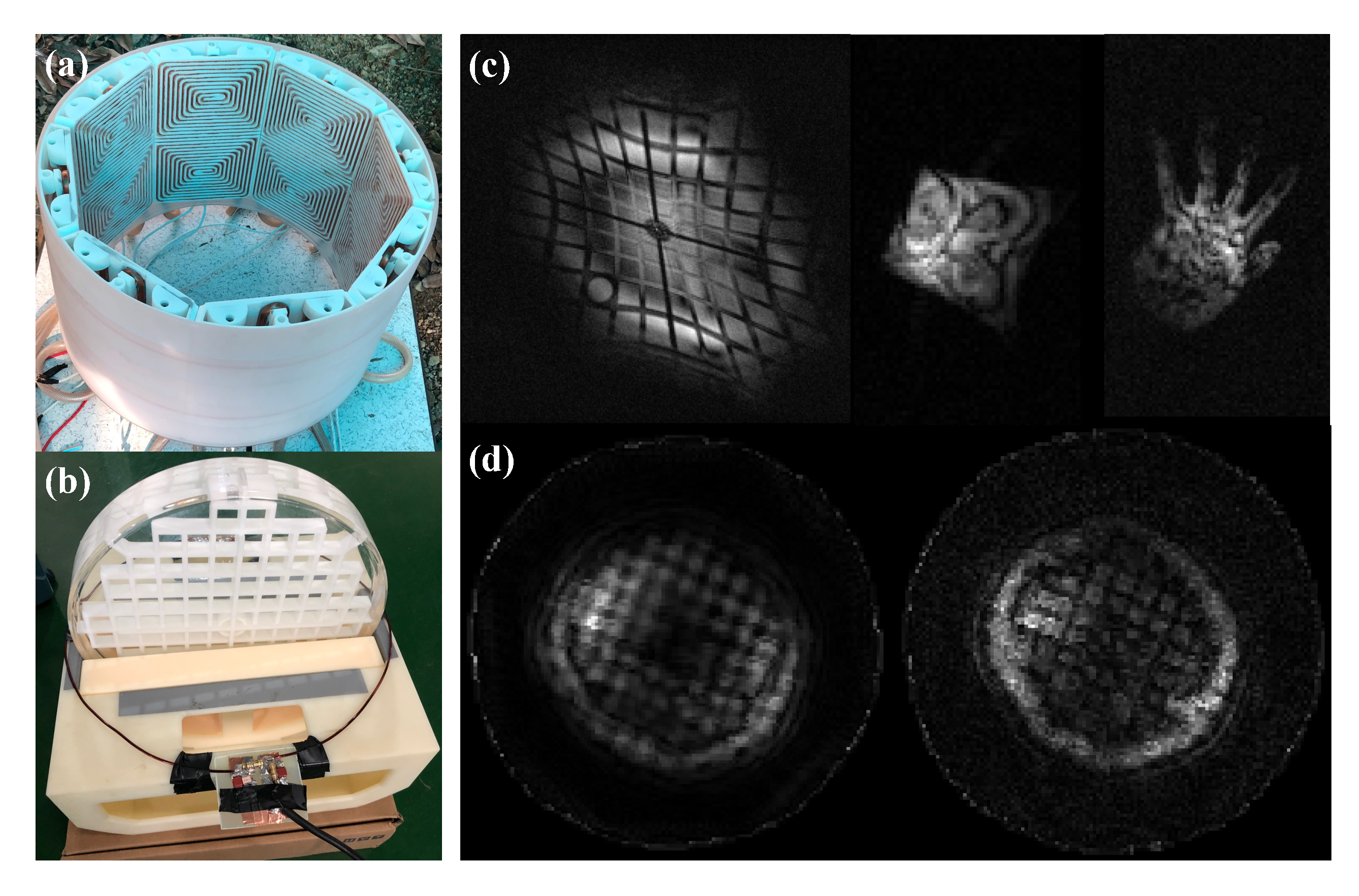
Fig.1 shows an illustrative example of the spatial encoding approach using an 8-channel matrix gradient coil (referred to as $$$N_k$$$=8). A set of current weights ($$$I_{i,q}$$$) distributed over the sine wave with same phase difference is assigned to the eight coil elements to achieve the rotating pl-SEMs: $$I_{i}(q)=I_{m}\sin(\pi/4*i+step*(q-1))$$where $$$q=0, 1, ... , N-1$$$, $$$I_m$$$ is the maximum value of the sine wave, and the step denotes the added phase term which is determined by the total number of SEM configurations in one encoding cycle $$$N$$$: $$$step=\pi/N$$$. The spatial pattern signifies a bijective mapping, ensuring that each voxel within the FOV receives a unique code. The rotating pl-SEMs are then integrated into a projection-type pulse sequence and expanded into a single-shot sequence incorporating an additional linear amplitude modulation for driven currents, as shown in Fig.2. The spatially-varied gradient makes it complex to define the k-space as in linear encoding issues; therefore, the signal equation is given as a function of encoding magnetic fields $$$b_i(r)$$$: $$s_j(q)=\int_{V}m({\bf r})c_j({\bf r})e^{i\gamma\int_{0}^{t}\sum_{i=1}^{N_k}I_i(q)b_i({\bf r})dq}d{\bf r}$$ Numerical simulations were conducted over a model of a 40-channel matrix gradient coil, as shown in Fig.3a. In preliminary imaging experiments, a simplified 8-channel matrix gradient coil was constructed as shown in Fig.4, and the field map for each single coil element was obtained by inserting the coil into a 3T scanner (Prisma 3T, Siemens Healthcare, Erlangen, Germany) and with a double-echo GRE pulse sequence performed. To demonstrate the feasibility of the proposed method, the matrix coil was then equipped in a prototype scanner of 1.5 T that was not equipped with any gradient system nor B0-shim coils. To provide reference images for comparison, we employed the fields depicted in Fig.1a and the same field rotated by 90° to mimic conventional linear acquisition. A homemade RF transceiver loop coil (with the diameter of 25 cm) and a saline phantom were used throughout the experiments.RESULTS
Fig.3b shows reconstructed results of two encoding strategies. Images with varying rotation numbers and maximum current inputs were reconstructed and compared. Specifically, we selected three typical values for both of the maximum drive currents and encoding steps (both approximately corresponding to acceleration rate of R = 1, 2, and 4). Fig.4 shows preliminary results of imaging experiment. Considering the lack of slice selection, besides the phantom, a cropped watermelon and a human hand in vivo were chosen as thin scanning objects to reduce image aliasing in axial direction, as shown in Fig.4c. Images acquired by the first strategies with maximum drive currents 10A and 20A were shown in Fig.4d. As a consequence, image with 10A led to imaging blurring and signal drop-out in the center compared to the one with 20A, which is consistent to the simulation results. Increasing the current can improve the precision of the fields for spatial encoding, thereby mitigating these imaging artifacts.CONCLUSION
A novel approach to enhanced parallel imaging through the utilization of nonlinear magnetic fields has been presented. Specifically, we designed a 40-channel matrix gradient coil capable of generating spatially rotating pl-SEMs while effectively reducing the required drive sources. Leveraging the dual nature of these magnetic fields, encompassing both linear and nonlinear properties, the issue of anisotropic resolution across the FOV could be mitigated, whilst achieving accelerated acquisition.Acknowledgements
The authors thank Zhiyan Quan, Chenlu Guo, Xiaocui Tang and Yi Tang for technical support and helpful discussions.References
1. Hennig J, Welz AM, Schultz G, et al. Parallel imaging in non-bijective, curvilinear magnetic field gradients: a concept study. Magn Reson Mater Phy. 2008;21(1-2):5. doi:10.1007/s10334-008-0105-72. Stockmann JP, Ciris PA, Galiana G, Tam L, Constable RT.
2. O‐space imaging: Highly efficient parallel imaging using second‐order nonlinear fields as encoding gradients with no phase encoding. Magn Reson Med. 2010;64(2):447-456. doi:10.1002/mrm.224253.
3. Gallichan D, Cocosco ChrisA, Dewdney A, et al. Simultaneously driven linear and nonlinear spatial encoding fields in MRI. Magn Reson Med. 2011;65(3):702-714. doi:10.1002/mrm.226724.
4. Lin FH. Multidimensionally encoded magnetic resonance imaging. Magn Reson Med. 2013;70(1):86-96. doi:10.1002/mrm.244435.
5. Lin FH, Witzel T, Schultz G, et al. Reconstruction of MRI data encoded by multiple nonbijective curvilinear magnetic fields. Magn Reson Med. 2012;68(4):1145-1156. doi:10.1002/mrm.24115
Figures