3940
Simultaneous Multi B0 Shim-Coil Calibration1Massachusetts institute of Technology, Cambridge, MA, United States, 2Institute for Medical Engineering and Science, Massachusetts Institute of Technology, Cambridge, MA, United States
Synopsis
Keywords: Shims, Shims
Motivation: Multicoil B0 shimming improves signal quality in many MRI applications but either requires pre-calibrated ridged shim coils or lengthy coil re-calibration scans.
This has precluded the use of flexible arrays and limited body applications.
Goal(s): Accelerate B0 shim coil re-calibration to enable body-conforming flexible shim coil arrays.
Approach: Field calibration is accelerated using physics-based reconstruction, interleaving few measured slices, and de-tangling contributions of simultaneously active shim coils.
Results: Measured data is used to demonstrate the effectiveness of shim field recovery from few-slice measurements, and simulation is used to demonstrate simultaneous multi shim coil calibration, resulting in a 6.7x total acceleration.
Impact: Physics-based reconstruction of coil fields from few interleaved slices, and detangling fields from simultaneous B0 shim coil activation, achieves rapid calibration. Fast subject-specific calibration will enable the use of body-conforming, flexible B0 shim arrays.
Introduction
Multi-coil B0 shim arrays improve MRI image quality in a variety of applications [1]. Shim current optimization requires both subject-specific fields and calibrated shim coil field patterns. In most brain applications coil field precalibration is a multi-hour 1-time subject-agnostic procedure that may only be used if the shim array is installed in a fixed position relative to the scanner. Recent work in body imaging [2 ,3], implant imaging [4] and flexible an non-fixed shim coils systems [6] shows the benefits of body-conforming multicoil shim arrays, but the needed recalibration is impractically lengthy.Below we show that field calibration can be accelerated 7 fold using a combination of physics-based reconstruction, interleaving few measured slices, and de-tangling contributions of simultaneously active shim coils.
Methods:
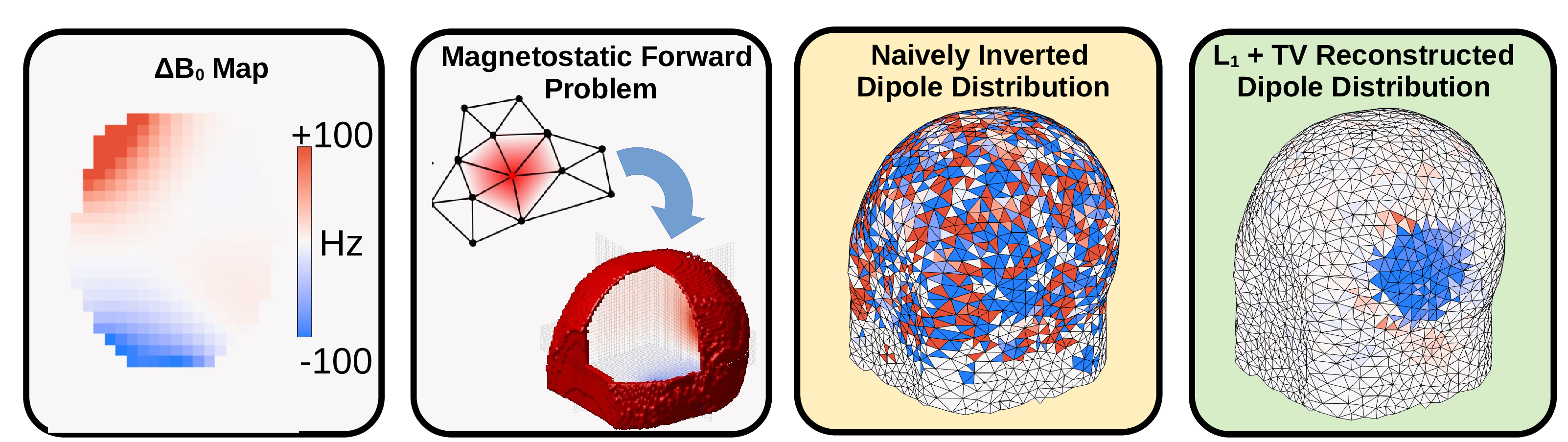
We solved a magnetostatic inverse problem using TV and L1 regularization to estimate shim coil fields everywhere in space with few measurements as shown in Figure 1 [7]. A forward mangetostatic calculation computes B0 directed magnetic fields in a body domain due to currents on a surface outside of that domain. Naive inversion is highly ill-posed while L1+TV regularization of the surface-current equivalent dipole distribution produces spatially compact, current distributions with extrapolation power.Recovering B0 shim fields from few-slices of calibration data:
We use the L1+TV regularized field recovery with data from only six planes peripheral to the volume; that is, two peripheral slices from each an axial, sagittal, and coronal coil B0 map.
With a magnetostatic forward model from a surface dipole distribution A sampled to fields in slices, Ai and measured fields due to a unit current through slices bi we solve for a surface dipole distribution x by solving the optimization problem:
$$x_{opt} = argmin_x \sum_i\left|A_i x – b_i\right|_2^2 + TV(x) + |x|_1$$
We solve this optimization problem using ADMM [5] and compute the coil field anywhere in the body domain with the product $$$Ax_{opt}$$$
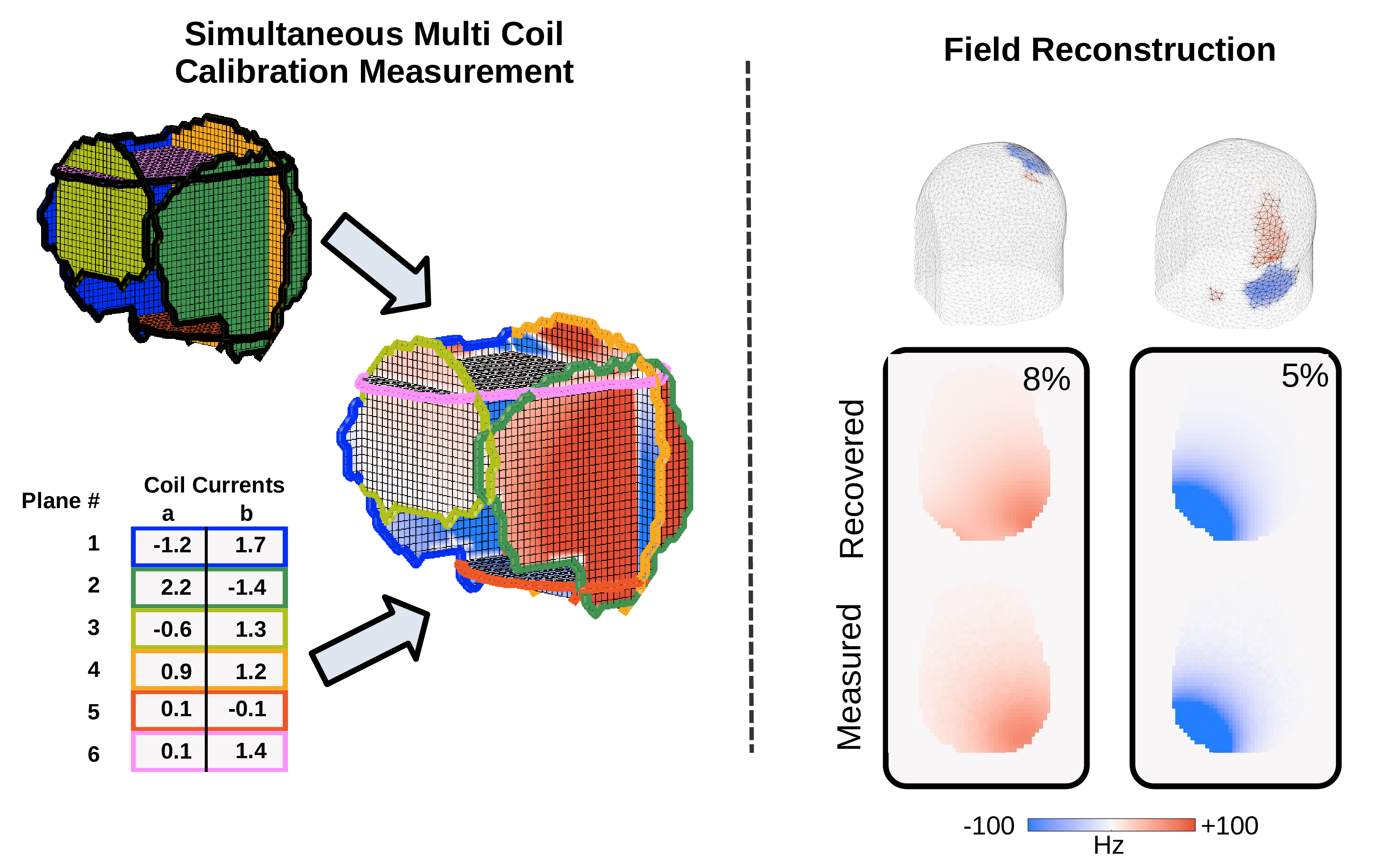
We extend the L1+TV regularized field recovery to the simultaneous multi coil case by slightly modifying the experiment and optimization problem. We acquire fieldmap planes bi with random currents W with current wij applied to the jth active coil on the ith slice. Fields, xj are recovered by solving:
$$X_{opt} = argmin_X \sum_i\left|\sum_j(w_i^jA_i x^j) – b_n\right|_2^2 + TV(x) + |x|_1$$
Measurements:
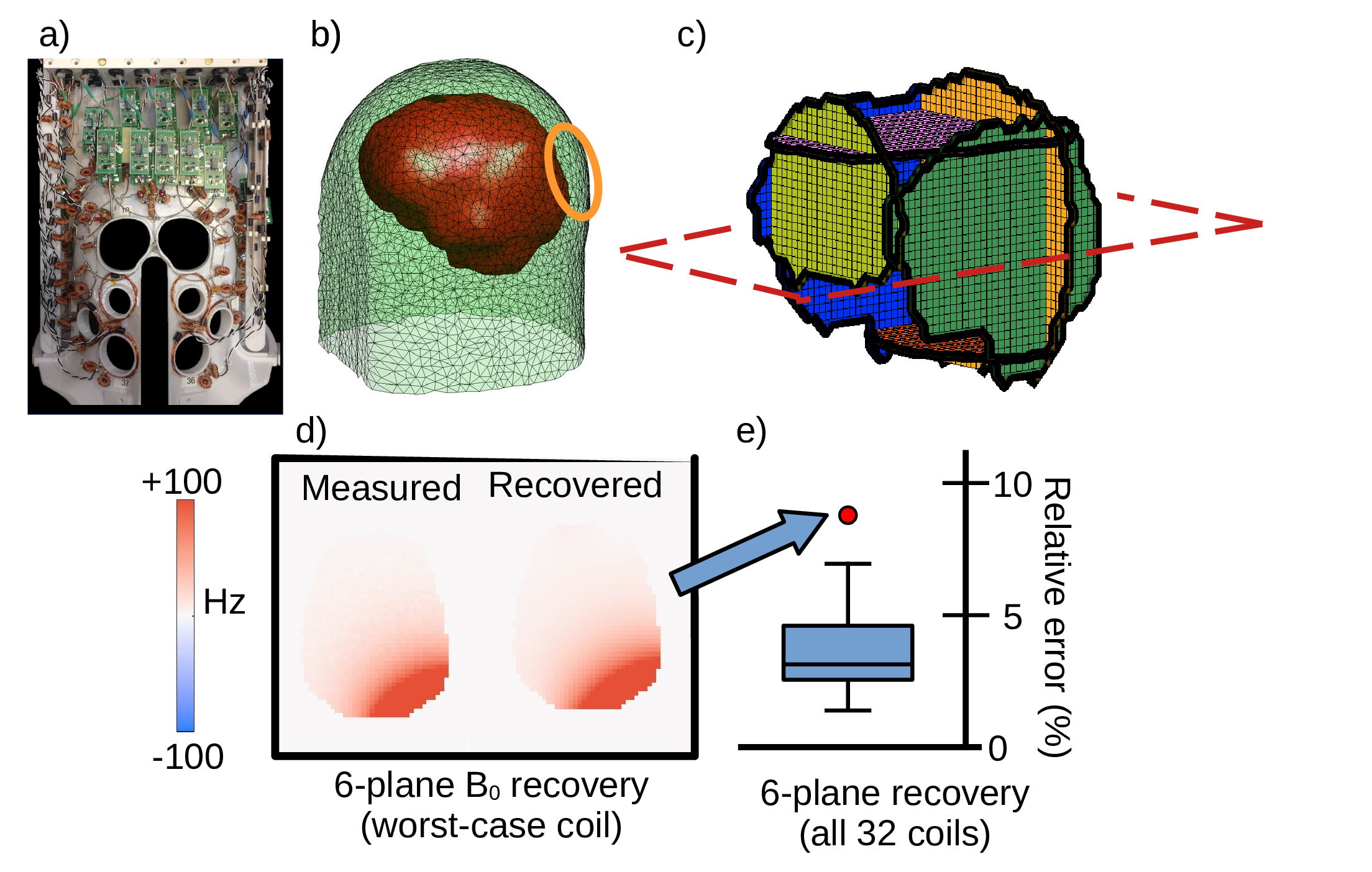
Field recovery experiments were performed using 2D GRE (1.7 x 1.7 x 2 mm, 110x110x75 matrix,TA = 150 s), field maps of each B0 shim coil of the 32 channel AC/DC multicoil shim array [1], figure 2a). B0 maps were resampled into axial, sagital, and coronal slices. Simultaneous multi shim-coil data were synthetically constructed by scaling and summing resampled fieldmap slices.
We perform single coil recovery experiments with three central planes and six peripheral planes as shown in figure 2c). Simultaneous Multi Shim coil recovery experiments were performed with two, three, and four simultaneous coils using 6, 9, and 12 planes respectively. In each case the same six peripheral planes were used with additional evenly spaced planes in each axis.
Results and Discussion
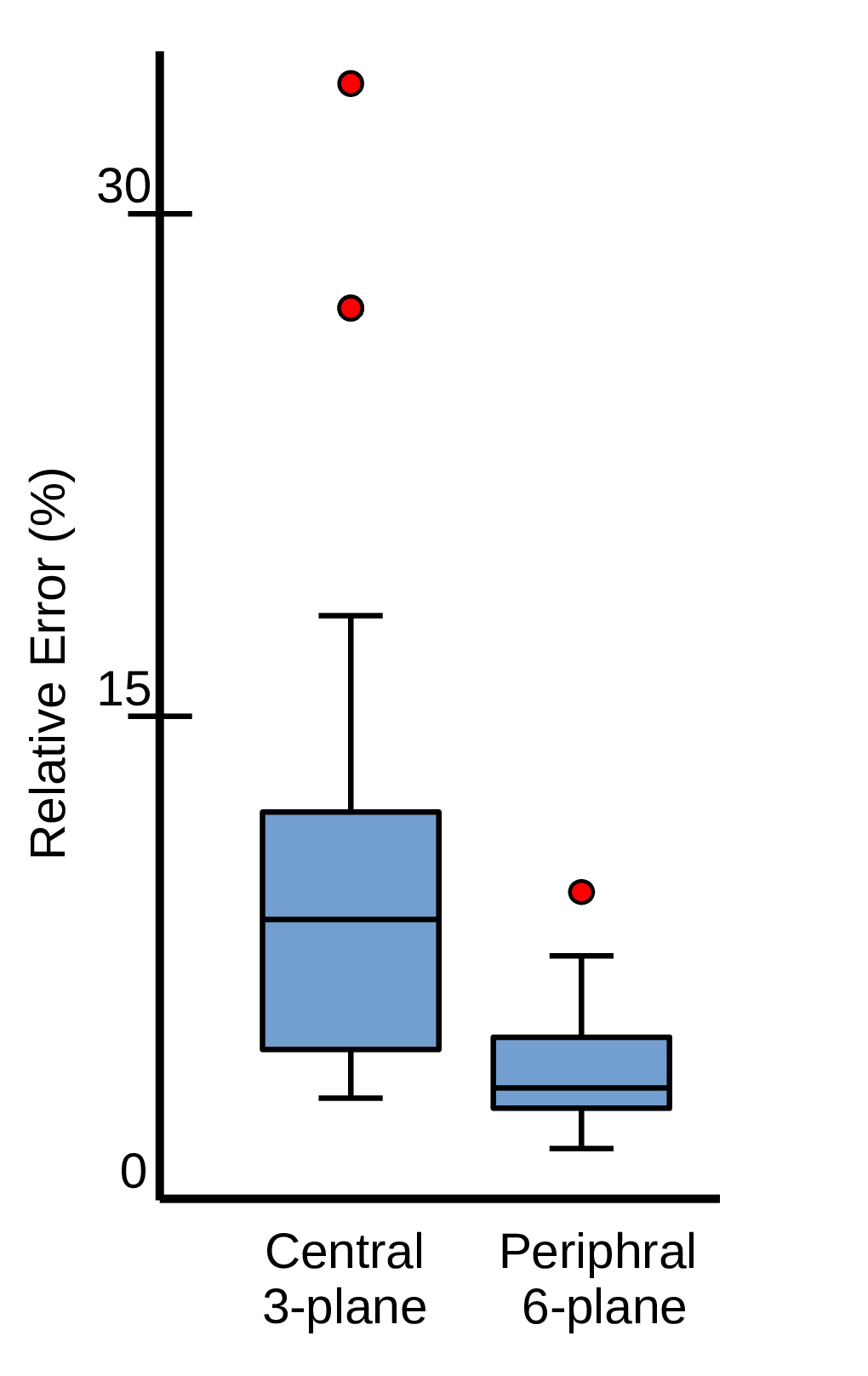
Figure 2 shows the recovery of the worst-case coil of the AC/DC shim array from measurements from six planes peripheral to a brain volume. The recovered fieldmap is shown as sampled along an axial plane not used in solving the inverse problem. The worst-case shim coil fields were recovered over the brain domain with a relative error of 8%. Over all 32 coils, mean relative error was 4%.Robust recovery of a single coil requires six planes near the periphery of the body volume. Only five sets non-identical slices are sufficiently peripheral for recovery. Single coil recovery from six planes achieves an acceleration of 1.6x over 32 coils. Due to geometric symmetries, central slices alone are not sufficient to accurately recover shim coil fields everywhere in space as shown in figure 3. We make use of central slices in simultaneous multi shim coil recovery even if insufficient to recover single coils.
Figure 4 shows an example of recovery of two coil B0 fields from six acquired planes with a relative error of 8% and 5% for the two channels. Using the same five sets of peripheral coils we achieve an acceleration of 3.3x. Higher simultaneous factors were also simulated. 3-channel 9-plane acquisition achieves 5x speedup and 4-channel 12-plane acquisition achieves 6.7x speedup with comparable error.
Conclusion
Physics-based reconstruction of coil fields from few interleaved slices, and detangling fields from simultaneous B0 shim coil activation, achieves rapid calibration. Fast subject-specific calibration will enable the use of body-conforming, flexible B0 shim arrays.Acknowledgements
No acknowledgement found.References
[1] Jason P Stockmann, Thomas Witzel, Boris Keil, Jonathan R Polimeni, Azma Mareyam,Cristen LaPierre, Kawin Setsompop, and Lawrence L Wald. A 32-channel combined rf andb0 shim array for 3t brain imaging. Magnetic resonance in medicine, 75(1):441–451, 2016. [2] Hsin-Jung Yang, Fardad Serry, Peng Hu, Zhaoyang Fan, Hyunsuk Shim, AnthonyChristodoulou, Nan Wang, Alan Kwan, Yibin Xie, Yuheng Huang, et al. Ultra-homogeneous b0 for high field body magnetic resonance imaging with unified shim-rf coils. 2021. [3] Lieke van den Wildenberg, Quincy van Houtum, Wybe JM van der Kemp, Alex Bhogal,Paul Chang, Sahar Nassirpour, and Dennis WJ Klomp. B0 shimming simulations of the liver using a local array of shim coils in the presence of respiratory motion at 7 t. Tools for quantitative MR imaging and spectroscopy for the improvement of therapy evaluation in oncology, page 37, 2020. [4] Fardad Michael Serry, Junzhou Chen, Anthony G Christodoulou, Yuheng Huang, FeiHan, Won Bae, Christine Chung, Richard Richard Handlin, John Stager, MatthewMatthew Dausch, Yubin Cai, Yujie Shan, Yucen Liu, Yibin Xie, Xiaoming Bi, RohanDharmakumar, Zhaoyang Fan, Debiao Li, Hsin-Jung Yang, and Hui Han. Improving mri near metal with local b0 shimming using a uniied shim-rf coil (unic): First case study, hip prosthesis in phantom. 2021. [5] Stephen Boyd, Neal Parikh, and Eric Chu. Distributed optimization and statistical learning via the alternating direction method of multipliers. Now Publishers Inc, 2011 [6] Overson, Devon Karl, et al. "Flexible multi‐purpose integrated RF/shim coil array for MRI and localized B 0 shimming." Magnetic Resonance in Medicine, 2023
[7] Nicolas Arango, Jacob White, and Elfar Adalsteinsson "A Fast Magnetostaic Inverse Approach for Subject-Specific∆ B 0 Shim Coil Calibration." ISMRM #1374, 2022
Figures