3939
Feasibility of active B1+ shimming using remote switching of coupled dielectric pads1TU Delft, Delft, Netherlands, 2Universiteit Twente, Twente, Netherlands
Synopsis
Keywords: High-Field MRI, System Imperfections: Measurement & Correction, dielectric pads
Motivation: At ultra-high fields, B1+ inhomogeneities induce unwanted signal loss or hyper-intensity. Current shimming approaches lack an easy-to-apply solution like dielectric pads, that would also allow subject-specific tailoring.
Goal(s): To evaluate a novel remote shimming device based on actively-coupled dielectric pads.
Approach: A switchboard was constructed using MR-compatible PIN-diodes. Previously proposed dielectric pocket manual coupling configuration was compared to the equivalent remotely enabled connection, in a 3x3 dielectric pad array.
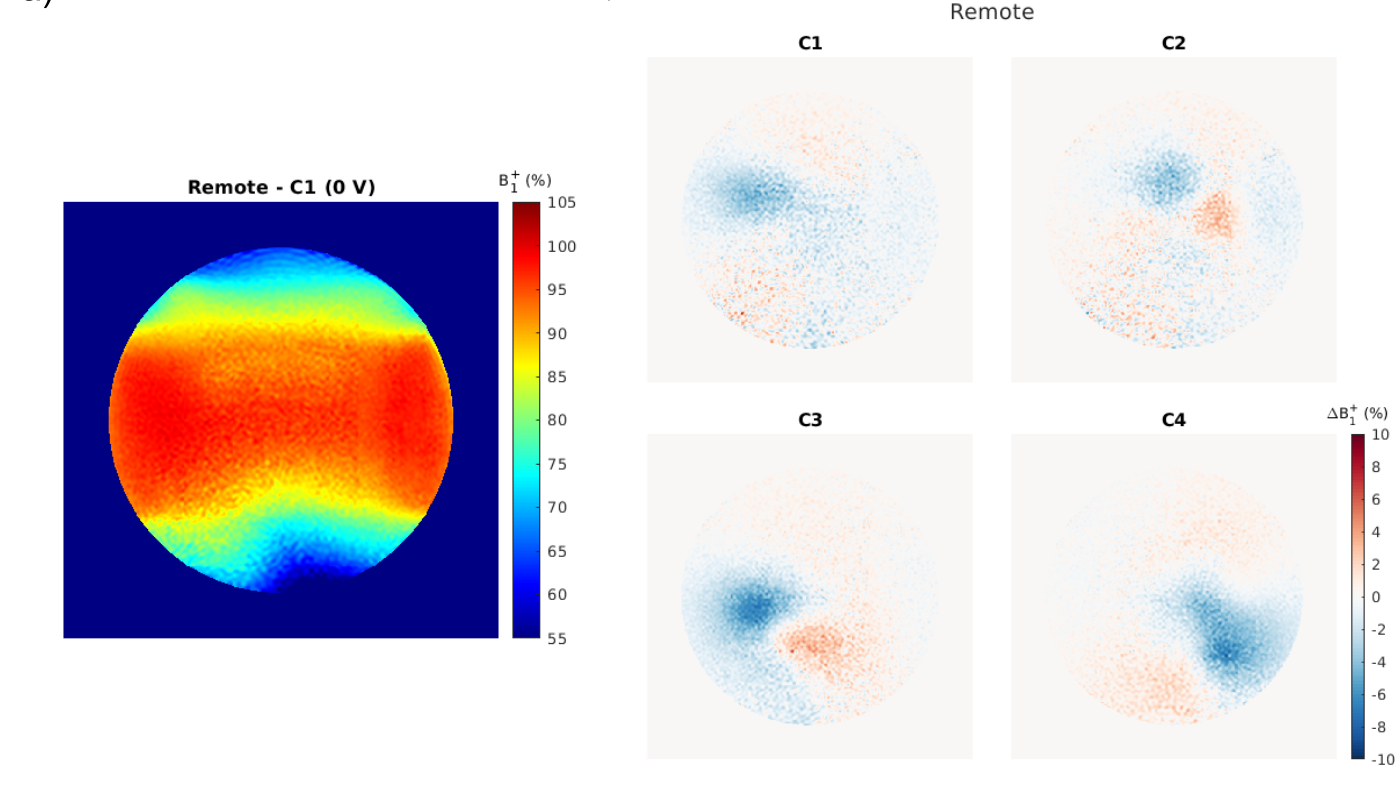
Results: Remote shimming device achieved up to 8% modulation across the ROI, compared to X% in the equivalent manual coupling. Shimming location was movable with the choice of coupled dielectric pockets within the array.
Impact: At ultra-high field imaging, B1+ inhomogeneities become increasingly prominent. Current shimming approaches lack wide-availability with an option for subject-specific tailoring. In this work, we evaluate a novel remote shimming device based on a dielectric pad array with PIN-diode switchboards.
Introduction
Ultra-high field imaging (3T and above) is gaining popularity due to the promise of improved signal-to-noise ratios (SNR). However, as the radiofrequency wavelength in tissue approaches body dimensions, B1+ field inhomogeneities form standing waves, leading to localized signal loss or enhancement [1]. Multiple B1+ shimming methods have been proposed to alleviate this issue [2-4]. Active shimming using multiple transmit coils is highly effective but may only be available at top-line scanners. Passive shimming with dielectric pads is greatly cost-effective but often needs to be tailored for each anatomy and subject. A novel hybrid approach using an array of electrically coupled dielectric pads has recently demonstrated the capability for controllable shimming without the need for multiple transmit coils [5]. In this study, we designed and evaluated a remotely switchable array of small dielectric pockets, allowing for active control of the B1+ field modulation. Various switching configurations are evaluated for localized shimming and directly compared to the equivalent manually wired dielectric pockets.Methods
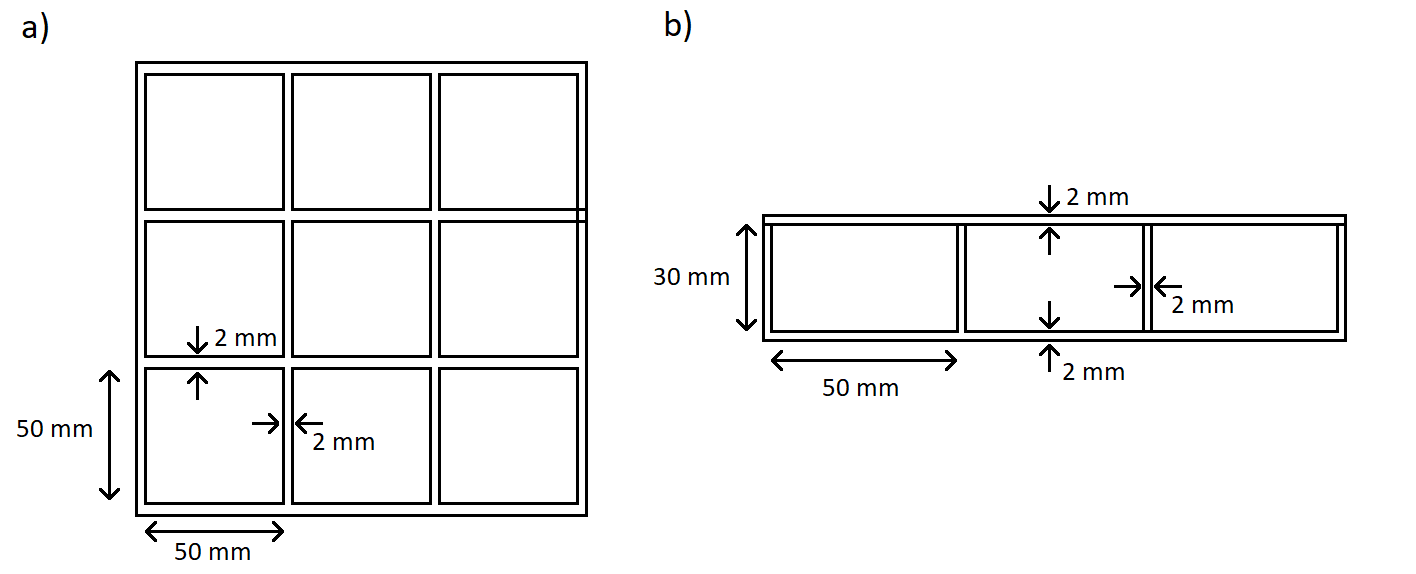
A 3x3 array with 50x50x30 mm3 pockets (Fig. 1) was 3D printed (Sigma D25, BCN3D Technologies) using PLA. The pockets were filled with BaTiO3 (Thermo Scientific Chemicals) slurry in distilled water (25% v/v). The suspension was at the saturation limit of barium titanate in water, yielding an expected relative permittivity of 165 at 128MHz [4,6].Figure 1 shows the design of the dielectric cask. In the top left and bottom right corner of each pocket, two header pins (PRPC040SACN-RC, Sullins Connector Solutions) were inserted via contact holes in the lid and fixed using epoxy. A 27mm copper wire was soldered to the bottom of the header pins to act as an electrode in the dielectric slurry. The inside of the dielectric cask was sealed with epoxy to prevent leakage and evaporation.
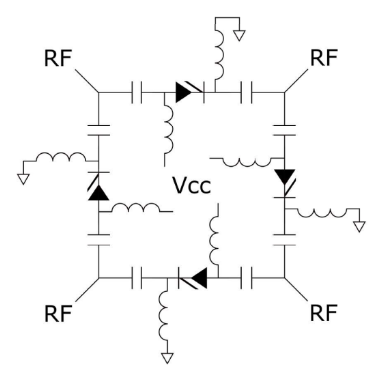
Remote control was enabled using a PCB-based switch board. Each pocket was connected with a PIN-diode circuit as illustrated in Figure 2. The PIN-diodes (MA4P7470F-1072T, Macom Technology Solutions) on the switchboards were switched on by a 10V DC signal from a function generator (Tektronix, AFG31002), or switched off by using 0V DC.
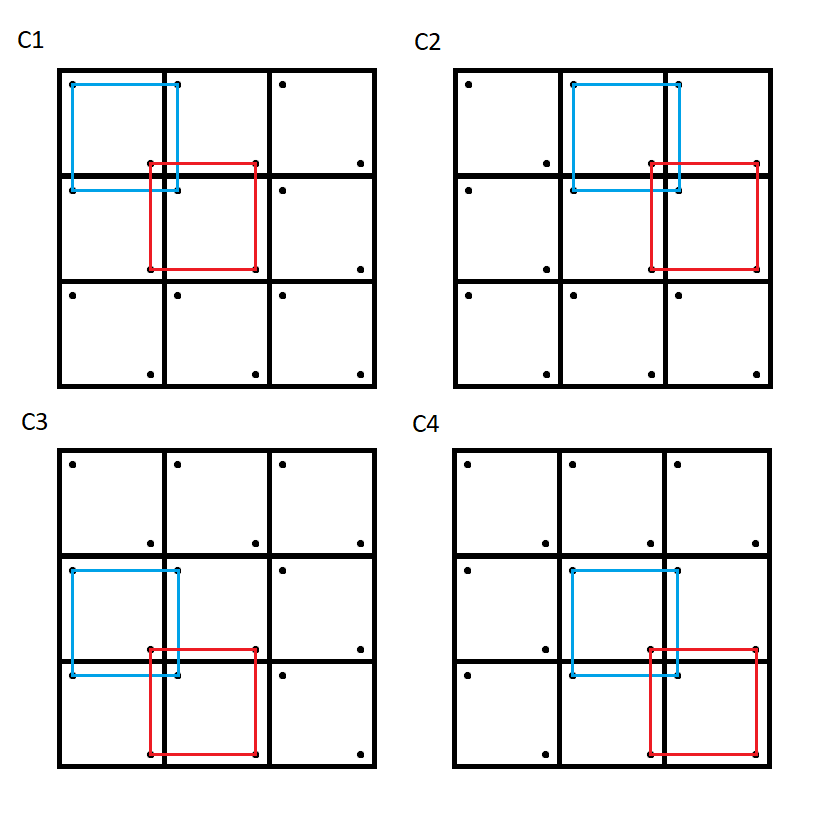
B1+ magnitude maps were acquired in a cylindrical system phantom, to mimic the torso dimensions. Imaging was performed at 3T (Ingenia, Philips), using DREAM B1+ mapping [6]. Imaging parameters were TE/TE= 4.9/1.6ms and voxel size/FOV = 3x3x10/450x450x10 mm3. With the dielectric cask placed on top of the phantom, images were acquired 2 cm below the surface. Two sets of experiments were performed: 1) Manual wiring, 2) Remotely controlled wiring using the switchboard. Four positions of the parallel coupling configuration (Fig. 3) were evaluated. The localized B1+ field modulations were evaluated for all configurations in areas of 9x9 mm2 across ten repeated measurements. The modulation was statistically compared to an unwired cask or to the configuration with 0 V on the PIN-diodes, for the manual and remote setting, respectively, assuming normal distribution in the B1+ maps.
Results
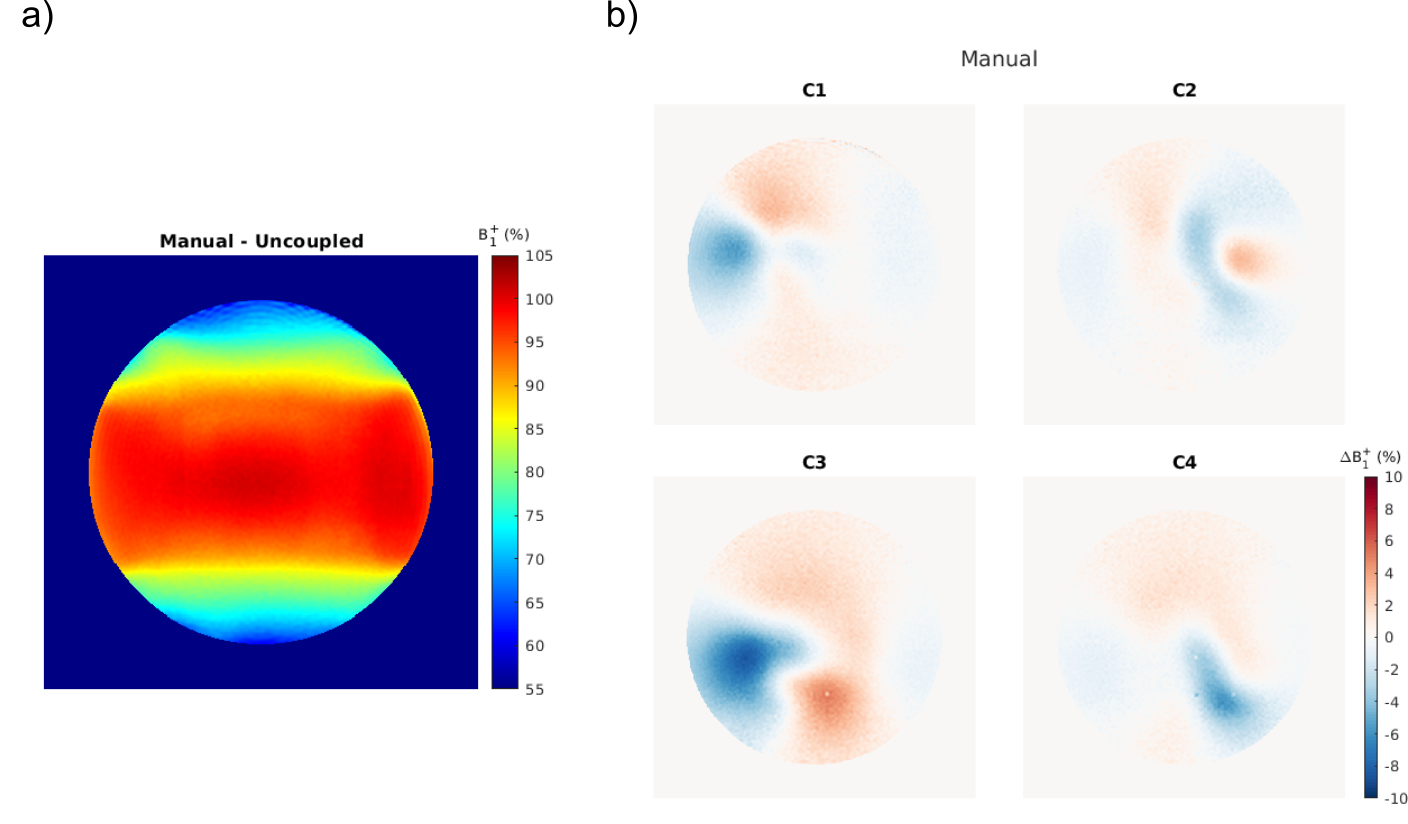
Absolute B1+ magnitude maps for uncoupled configuration and modulation maps are shown in Figs. 4 and 5 for the manual and remote coupling. The reference B1+ maps showed increased variability in the presence of the remote switchable device, likely due to residual B0 field distortions originating in the switching wire. Statistically significant field modulations were achieved for all wiring configurations. For manual wiring, the maximum localized modulation were 5.74±0.17%, 3.66±0.34%, 8.72±0.25%, and 6.76±0.17%, for C1 through C4, respectively (p<0.0001 for all). Mostly similar modulation amplitudes were achieved with remote switching, with small losses in amplitude for some configurations. However, increased variability was observed for all circuits: C1: 7.00±2.14% p=0.0005, C2: 6.81±2.42% p=0.0024, C3: 7.67±1.15% p<0.0001, and C4: 8.77±0.70% p<0.001.Discussion
In this work, we show a proof-of-principle for a remotely-controlled dielectric shimming device, based on barium titanate slurry pockets coupled with PIN-diodes. The results show significant modulation of the B1+ field when being remotely switched, however, with slightly reduced maximum field modulation compared to manual wiring. This loss in the effect magnitude warrants a future investigation, and could potentially be attributed to the switchboard components, such as residual resistance of the PIN-diode.In both manual and remote configurations, the shimming effect was movable by coupling different cask pockets within the 3x3 array, enabling the desired shimming location. This approach could be scaled to larger arrays to cover the entire torso and achieve localized field homogenization.
Conclusions
Remotely controlled B1+ modulation of up to 8% was achieved with actively coupled dielectric pockets. The shimming location is controllable with the choice of coupled pockets, making the approach promising for active remote shimming at ultra-high field MRI.Acknowledgements
S.W. acknowledges funding from the NWO (Start-up STU.019.024), and the European Union (ERC, VascularID, StG 101078711).References
[1] Zhenhua S, Xuchen Z, Shihong H, Fuyi F, Wei L, Shao C, Zidong W, Jinguang Z, Yongquan Ye, Bo L, Shuheng Z, Anthony V, Weiguo Z, and Guobin L. Initial Experience of Body Imaging at 5 T. volume 29 of Proc. Intl. Soc. Mag. Reson. Med., page 3120. ISMRM, 2021
[2] Wald L, Adalsteinsson E, and Martinos A. Parallel Transmit Technology for High Field MRI. 2009; MAGNETOM Flash, 40(1).
[3] Williams SN, McElhinney P, and Gunamony S. Ultra-high field MRI: parallel-transmit arrays and RF pulse design. 2023; Physics in Medicine and Biology, 68(2):02TR02.
[4] Teeuwisse WM, Brink WM, Haines KN, and Webb AG. Simulations of high permittivity materials for 7 T neuroimaging and evaluation of a new barium titanate-based dielectric. 2012; Magnetic Resonance in Medicine, 67(4):912–918.
[5] Šiurytė P, de Boer F, Akgun C, and Weingartner S. Actively coupled dielectric pads for adaptive B1+ field shimming. In Proc. ISMRM 2022.
[6] Webb AG. Dielectric materials in magnetic resonance. Concepts in Magnetic Resonance Part A. 2012; 38A(4):148–184.
[7] Nehrke K, Versluis MJ, Webb A and Börnert P. Volumetric B1+ Mapping of the Brain at 7T using DREAM. 2014; Magn. Reson. Med., 71: 246-256.
Figures