3937
B0 Eddy Current Compensation of an Unshielded Pulsed Z2 Gradient for Applications in Human Brain Proton MRSI1Radiology and Biomedical Imaging, Yale University, New Haven, CT, United States
Synopsis
Keywords: Hybrid & Novel Systems Technology, Spectroscopy, ECLIPSE
Motivation: ECLIPSE1 is a novel method to achieve robust outer volume suppression (OVS) in 1H-MRSI of the human brain. To-date ECLIPSE has been performed with an unshielded-Z2 coil that led to significant B0-eddy currents, necessitating the use of pre/post gradient pulses2,3 for MEGA-edited MRSI acquisitions.
Goal(s): An inner volume selection (IVS) based ECLIPSE approach would provide B1 and T1 independent lipid suppression, however editing efficiency is compromised due to B0-eddy currents.
Approach: A home-built 64-channel gradient controller4 was extended with B0-compensation capabilities to drive a Z0-shim coil.
Results: B0-eddy currents were attenuated by 200-fold following B0-compensation, and allows robust MEGA-edited ECLIPSE-IVS based MRSI acquisitions.
Impact: Constructing a shielded-Z2 coil for ECLIPSE is complex compared to an unshielded coil. A simpler approach is to construct an unshielded-Z2 with B0 compensation and gradient pre-emphasis, provided that eddy currents induced by switching an unshielded-Z2 gradient can be well-characterized.
Introduction
The utility of pulsed second order gradient coils (ECLIPSE1) have previously been reported to provide unparalleled extracranial lipid suppression and axial slice coverage for human brain MR Spectroscopic Imaging (MRSI)2-3. For simplicity, previous ECLIPSE gradient coil constructions have been home-built, consisting of unshielded Z2 and X2Y2 coils1,5. However, switching the unshielded Z2 coil leads to substantial eddy current-induced B0 modulations. These were previously negated using pre/post gradient pulses for ECLIPSE-based outer volume suppression (OVS), and in post-processing with an acquired reference water scan for ECLIPSE based inner volume selection (IVS) MRSI methods1-3. Both methods, however, cannot be applied for an ECLIPSE-IVS localized J-difference edited MRSI sequence, since narrow-band editing pulses following ECLIPSE gradients will be compromised due to induced B0 modulations. As an alternative to ECLIPSE-IVS-based MEGA-editing, ECLIPSE can also be executed in OVS mode, for which we demonstrated that ECLIPSE-OVS methods provide >100-fold in lipid suppression over a B1+ span of ± 60%3. The requirement for a finite B1+-span may not be met for all head shapes without performing dynamic B1 shimming. Furthermore, head coils constructed with a Tx array optimized for a homogeneous B1+ within the brain at ultra-high fields, may produce B1+ nulls around the scalp, resulting in B1+ heterogeneity exceeding ± 60% for ECLIPSE-OVS. In this work we demonstrate the integration of a digital B0 compensation filter for the Z2 gradient coil virtually eliminates Z2-induced B0 modulations, thus allowing MEGA-edited ECLIPSE IVS-localized MRSI for B1+ and T1-independent extracranial lipid suppressed proton MRSI in human brain.Methods
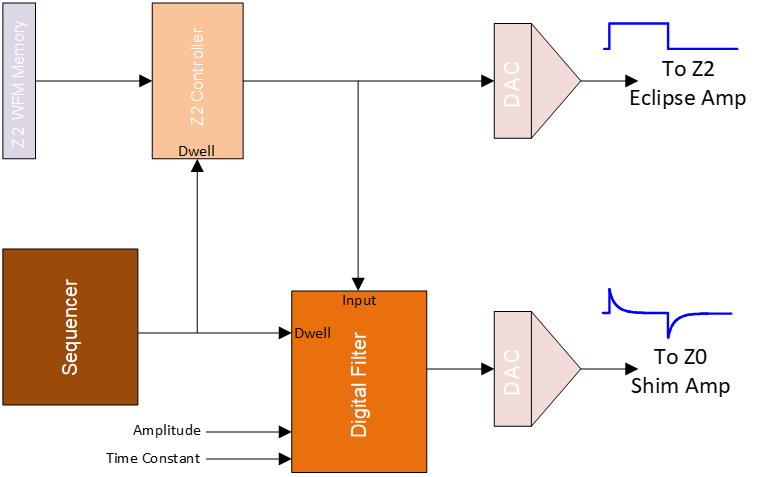
All MR experiments were performed on a 4 T 94 cm Medspec scanner (Bruker corporation. Ettlingen, Germany) with gradients capable of switching 30 mT/m in 1150 µs. The ECLIPSE gradient coil is driven by Techron 7780 amplifiers (AE Techron, Elkhart, IN, USA) with 130V and 100A each. The 54-channel MC-array is driven by 54 MXA current amplifiers capable of 2A per channel (Resonance Research Inc., MA, USA). The combined MC-ECLIPSE system is controlled by a home-built 64-channel gradient controller4. The 64-channel gradient controller was extended with digital B0 compensation capabilities (Fig. 1) on an unused channel, to drive a Z0 shim coil within the system shim set. The Z2-induced B0 modulation was characterized by a mono-exponential decay function (detailed in Methods), as such a programmable first-order digital high pass filter was implemented within the 64-channel gradient controller with user-adjustable amplitude and time constant parameters (Fig. 1). The input to the digital high pass filter is the digital Z2 gradient waveform, and the output drives the Z0 shim amplifier within the system shim set. A MEGA edited ECLIPSE-IVS localized MRSI sequence (TR/TE = 2000/68 ms) was developed with narrowband editing pulses (~25 Hz BW for < 90% inversion) for whole axial slice GABA mapping with extracranial lipid suppression in the human brain. LCModel6 was used for fitting of edited and unedited spectra.Results
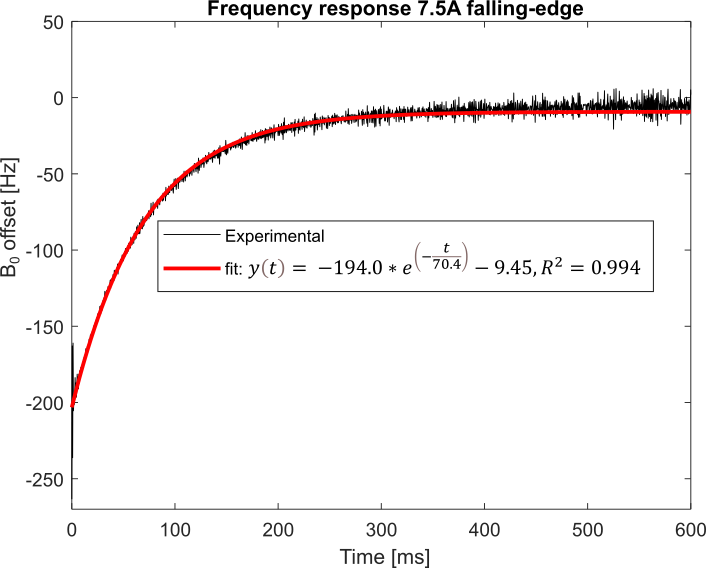
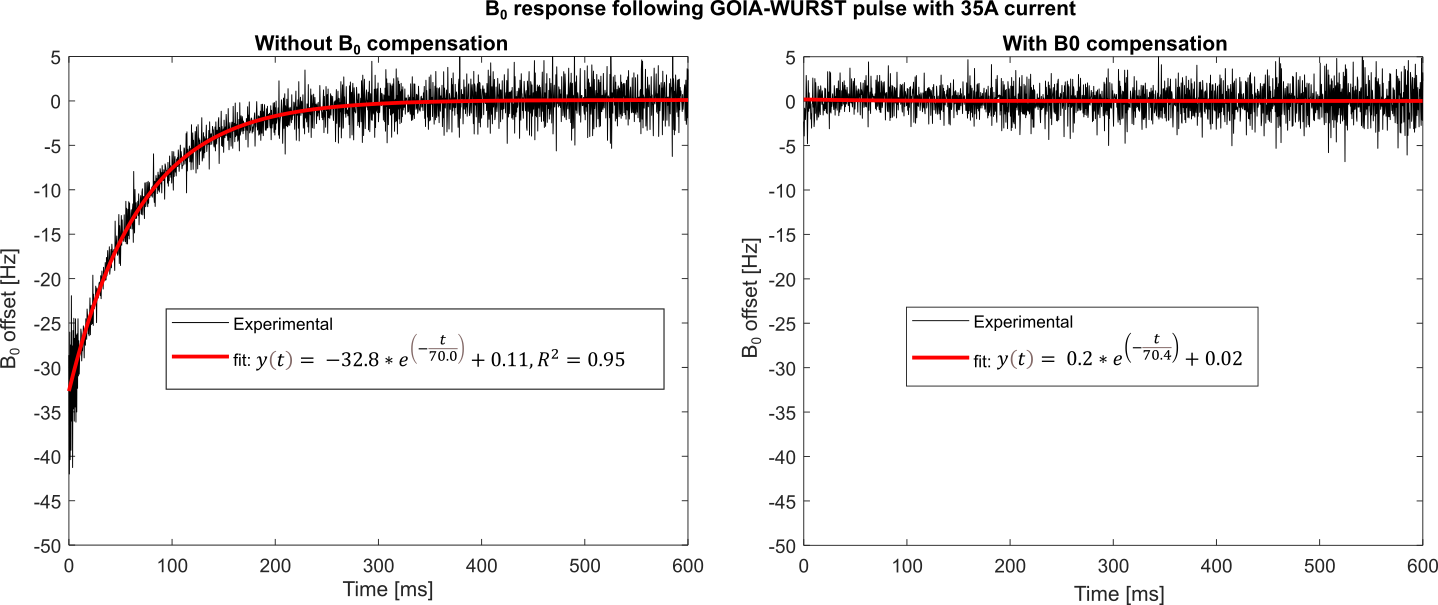
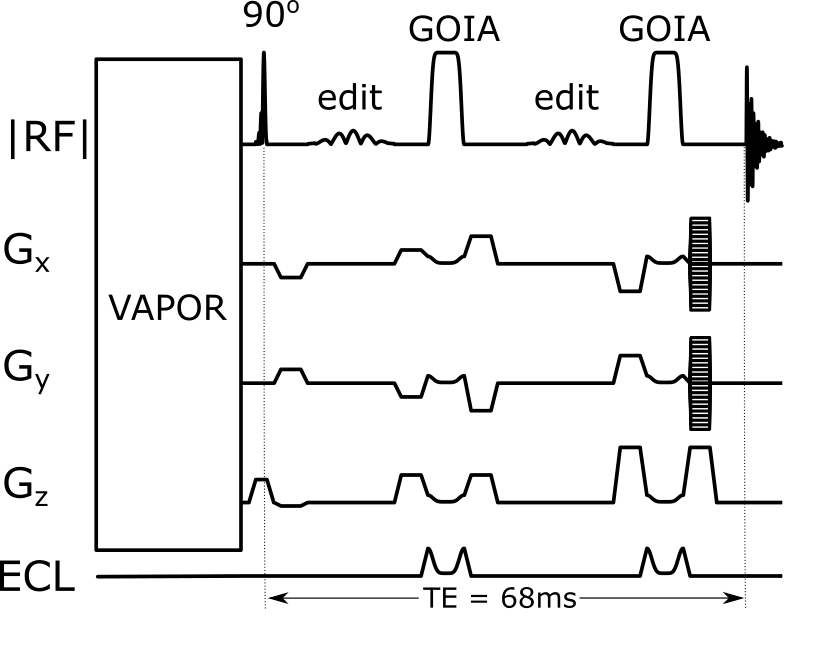
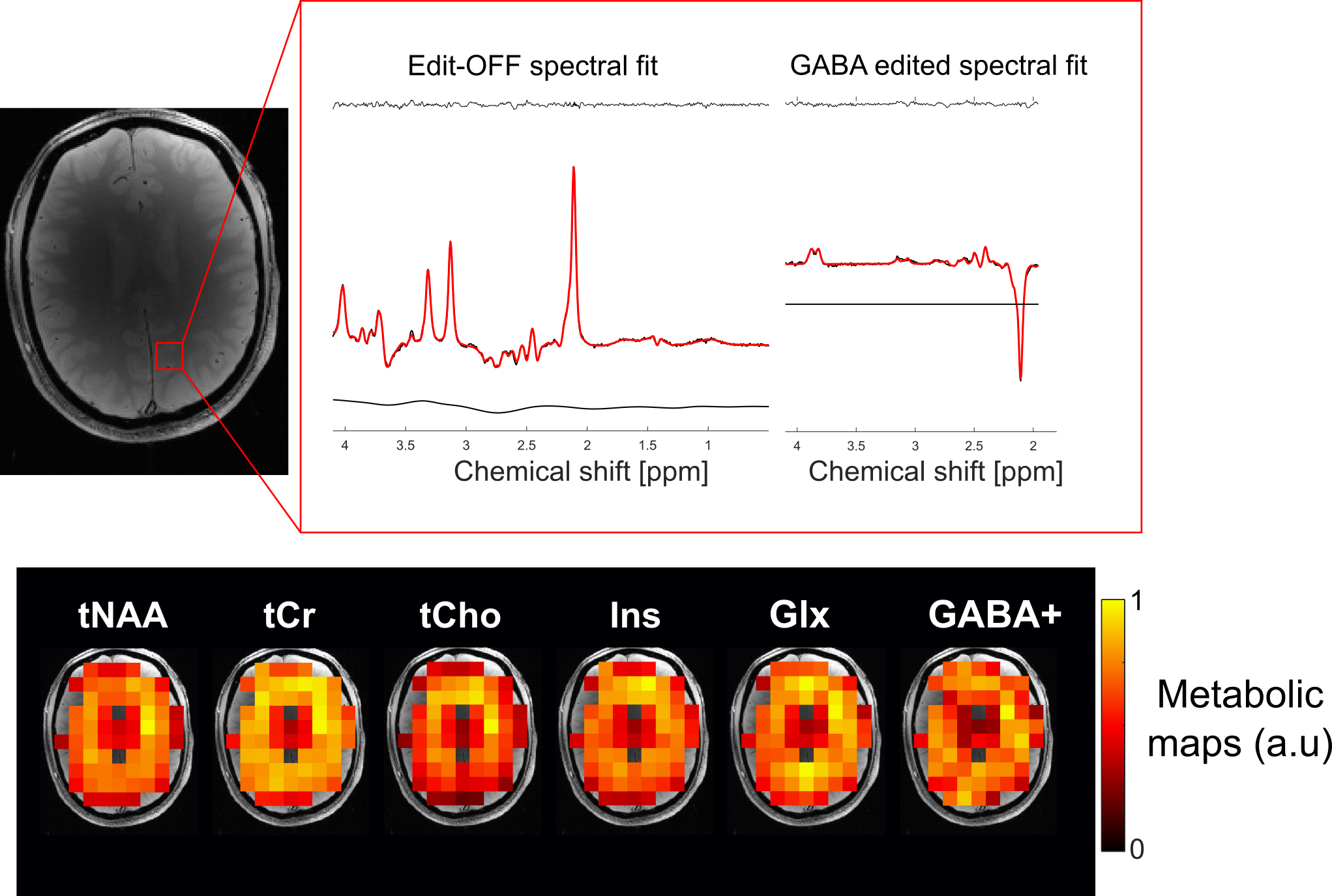
The eddy current induced B0 modulations following switching of the Z2 gradient was well characterized by a mono-exponential fit with an amplitude 25.9 Hz/A, and decay constant of 70.4 ms (Fig. 2). Spatial characterization of the Z2 induced eddy currents confirmed a predominant B0 component with negligible higher order terms. Figure 3 illustrates B0 eddy currents induced following a 35A amplitude GOIA-WURST RF pulse on the Z2 gradient without B0 compensation (A) and after B0 compensation (B). B0 compensation attenuated the induced B0 modulation by > 200-fold with no observable frequency shifts, thus allowing the placement of narrow-band editing pulses immediately after the GOIA7-WURST8 RF pulse as illustrated in the MEGA edited ECLIPSE-IVS localized MRSI sequence (Fig. 4). GABA edited MRSI data were acquired on one healthy volunteer with B0 compensation enabled on the Z2 coil. Figure 5 illustrates high quality and whole-slice GABA maps, in addition to NAA, Cr, Cho, Ins, and Glx following LCModel fitting.Discussion
The construction of an actively shielded Z2 gradient coil is beneficial as part of an ECLIPSE system; however, the construction of a shielded Z2 coil is relatively complex (relative to unshielded Z2 coils, as demonstrated in previous home-built ECLIPSE constructions1,5), and reduces coil efficiency. Provided that switching an unshielded Z2 gradient leads to a pure B0 modulation as found in this work, a simpler solution is to implement B0 compensation as demonstrated here. Inclusion of the B0-compensation module provides B1 and T1-independent extracranial lipid suppression for robust implementations of j-difference edited MRS methods without compromised editing efficiency due to eddy current-induced B0 modulations.Acknowledgements
This research was supported by NIH grants R01- EB014861 and R21-EB033911.References
[1] de Graaf RA, Brown PB, De Feyter HM, McIntyre S, Nixon TW. Elliptical localization with pulsed second-order fields (ECLIPSE) for robust lipid suppression in proton MRSI. NMR in biomedicine 2018;31(9):e3949. [2] Kumaragamage C, De Feyter HM, Brown P, McIntyre S, Nixon TW, de Graaf RA. Robust outer volume suppression utilizing elliptical pulsed second order fields (ECLIPSE) for human brain proton MRSI. Magnetic Resonance in Medicine, 2020; 83(5):1539-1552. [3] Kumaragamage C, De Feyter HM, Brown P, McIntyre S, Nixon TW, de Graaf RA. ECLIPSE utilizing gradient-modulated offset-independent adiabaticity (GOIA) pulses for highly selective human brain proton MRSI. NMR in Biomedicine 2020; 34:e4415. [4] Nixon TW, McIntyre S, de Graaf RA. The design and implementation of a 64 channel arbitrary gradient waveform controller. Proc Int Soc Magn Reson Med. 2017;25:969. [5] Kumaragamage C, Brown P, McIntyre S, Nixon T, De Feyter H, de Graaf R., “MC-ECLIPSE for arbitrary ROI shaping and whole brain shimming for 3D MRSI”, 30th Annual meeting ISMRM Conference, 2022. [6] Provencher SW. Estimation of metabolite concentrations from localized in vivo proton NMR spectra. Magnetic Resonance in Medicine 1993; 30:672-679. [7] Tannus A, Garwood M. Adiabatic Pulses. NMR in Biomedicine 1997;10:423-434. [8] Andronesi OC, Ramadan S, Ratai E, Jennings D, Mountford C, Sorensen AG. Spectroscopic imaging with improved gradient modulated constant adiabaticity pulses on high-field clinical scanners, Journal of Magnetic Resonance 2010; 203: 283-293.Figures