3905
Effect of diagnostic and genetic status on the relationship between rs-fMRI complexity and tau & amyloid PET in Alzheimer’s disease.1USC Stevens Neuroimaging and Informatics Institute, University of Southern California, Los Angeles, CA, United States, 2Department of Neurology, University of Southern California, Los Angeles, CA, United States, 3Department of Public Health, California State University Fullerton, Fullerton, CA, United States
Synopsis
Keywords: Alzheimer's Disease, Alzheimer's Disease, fMRI (resting state), Complexity, Amyloid, Tau, APOE4
Motivation: Decreased brain function in Alzheimer’s Disease can be assessed by complexity of resting-state fMRI. Specifically, in precuneus and medial temporal lobe rsfMRI-complexity is reduced in MCI and AD and negatively associated with tau-PET uptake. However, its association with amyloid deposition or effects of genetic characteristics (APOE4) remains unknown.
Goal(s): To investigate the association between rsfMRI-complexity, tau-PET and amyloid-PET as well as influence of APOE4 status.
Approach: Multivariate linear models assessing rsfMRI-complexity, tau-PET, amyloid-PET and APOE4 in select regions of interest.
Results: rsfMRI-complexity shows a strong significant inverse relationship with tau but not amyloid and APOE4 increases this effect.
Impact: We show that rsfMRI-complexity shows a strong association with tau but not amyloid deposition and that genetic risk in form of APOE4 strengthens this effect. Thus rsfMRI-complexity adds a novel tool to investigate impaired brain functionality in AD progression.
Background
Non-linear statistical analyses on resting-state fMRI (rs-fMRI) time series using complexity measure have demonstrated progressive decline in complexity from cognitively normal subjects (CN) to patients with Mild Cognitive Impairment (MCI) and patients with Alzheimer’s disease (AD) [1]. Accordingly, complexity appears related to worsening cognitive deficits in the AD progression. With recent studies hinting at the relevance of tau pathology as more critical pathophysiological catalyzer of neurodegeneration and subsequent cognitive decline than amyloid [2], we hypothesized that decreased complexity is indicative of tau rather than amyloid. We recently showed that complexity in precuneus and medial temporal lobe is negatively associated with tau-PET uptake [3], however, its association with amyloid deposition or effects of genetic characteristics (APOE4) remains unknown.Methods
From the Alzheimer’s Disease Neuroimaging Initiative phase 3 (ADNI3) we identified participants with tabulated SUVR values for amyloid and tau as well as one resting state fMRI scan for the same visit. The rs-fMRI Complexity was calculated by using Multiscale Sample Entropy (MSE) (LOFT complexity toolbox [4]) with pattern sensitivity threshold r=0.5, pattern matching length m=2 and temporal scale 6 (for low signal fluctuations at 0.05Hz). A pair of SUVR values from for the same region, including precuneus, parahippocampal, inferior temporal and entorhinal regions respectively, was used in a multivariate generalized linear model to investigate the adjusted independent effects to corresponding rs-fMRI complexity. Whether such effects were modified by either diagnosis (CN, MCI, AD) or APOE4 status (# alleles) were tested using the interaction terms in the multivariate model. Age and gender were controlled for all models. SAS 9.4 was used for statistical analyses.Results
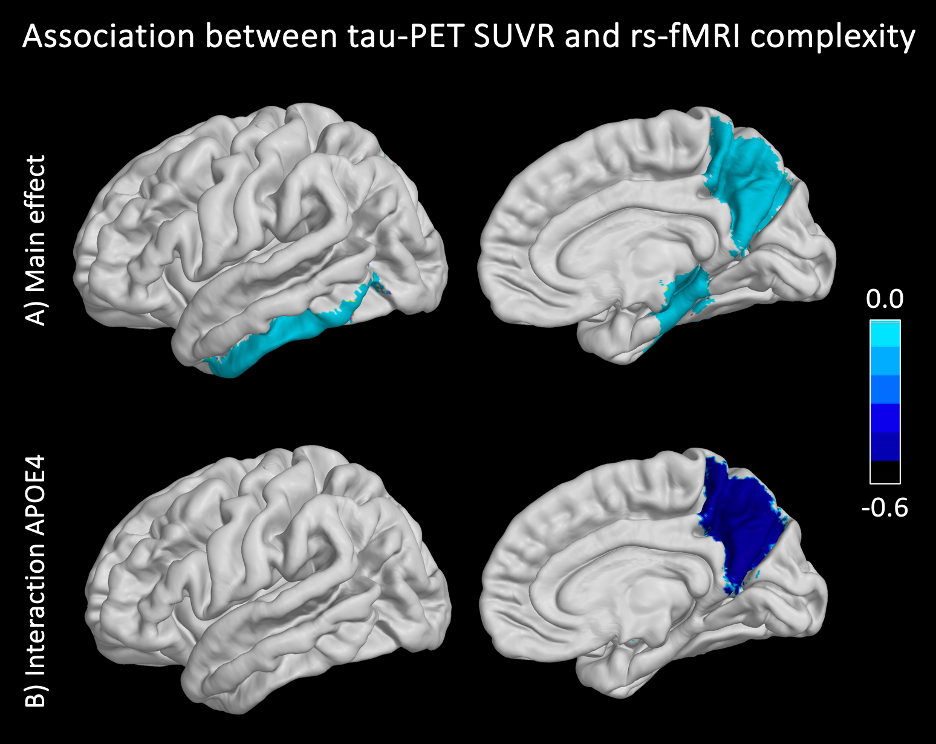
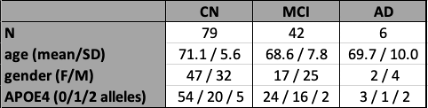
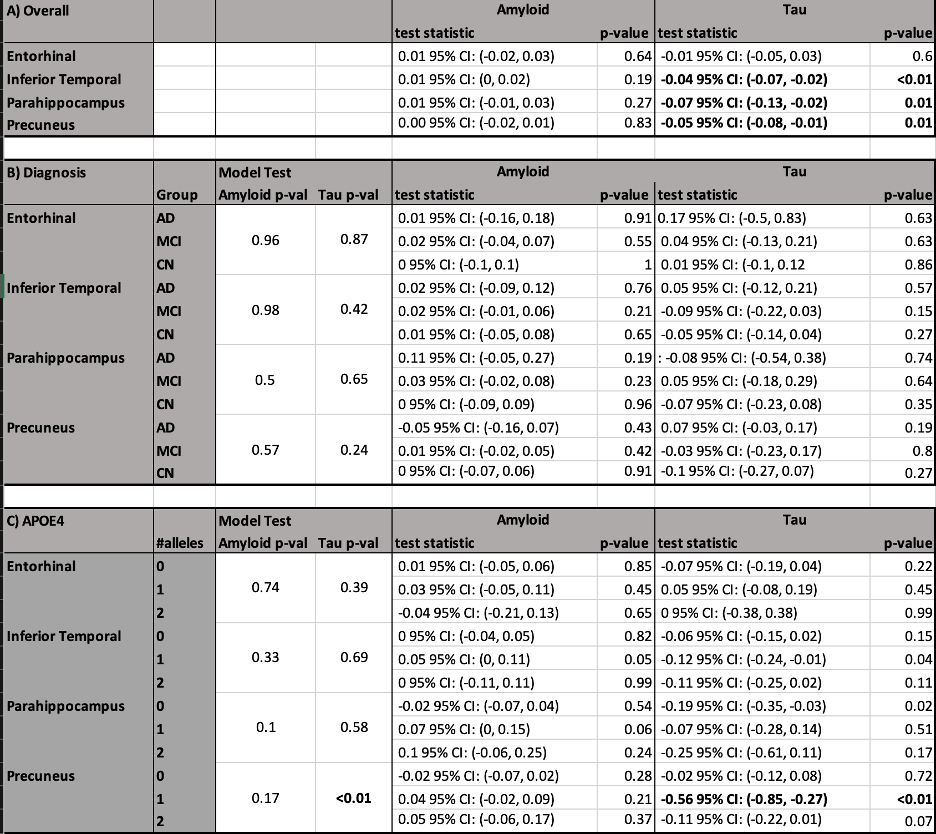
The final cohort consisted of 127 subjects (Table1). We observed statistically significant negative associations between complexity and tau in parahippocampal, inferior temporal and precuneus but not in entorhinal ROIs (Table2A). No statistically significant relationships with amyloid were found. Furthermore, diagnostic status does not modify these associations, however, APOE4 status showed a statistically significant interaction effect for tau and complexity (<0.01) in precuneus (Table2C). This interaction indicates that one allele has the strongest association between tau and complexity (-0.56 95% CI: (-0.85, -0.27), P: <0.01), followed by a trend with two alleles (-0.11 95% CI: (-0.22, 0.01), P: 0.07) while no allele had no association (-0.02 95% CI: (-0.12, 0.08), P: 0.72). For amyloid no interaction effect was found (Table2B).Discussion and Conclusion
Our study confirmed previously reported statistically significant inverse relationship between rs-fMRI complexity and tau-PET, which is indicative of disfunction of neuronal signaling in the presence of tauopathy. Furthermore, while diagnostic classification showed no effect on the relation between rs-fMRI and complexity, the presence genetic risk in form of APOE4 alleles had a strong modifying effect leading to a stronger negative relationship. Finally, we did not find any association or interactions with amyloid, which was expected, since while the presence of amyloid increases risk for cognitive decline it is the occurrence of tau that leads to cognitive decline and neurodegeneration. Overall, genetic risk potentially increases the prevalence of amyloid in this cohort and consequentially leads to a cumulative and more pronounced decrease in rs-fMRI complexity in the presence of tau,Acknowledgements
This project was funded by NIA R01AG066711 (Jann/Wang).
Data collection and sharing for this project was funded by the Alzheimer’s Disease Neuroimaging Initiative (ADNI) (National Institutes of Health Grant U01 AG024904) and DOD ADNI (Department of Defense award number W81XWH-12-2-0012). ADNI is funded by the National Institute on Aging, the National Institute of Biomedical Imaging and Bioengineering, and through generous contributions from the following: AbbVie, Alzheimer’s Association; Alzheimer’s Drug Discovery Foundation; Araclon Biotech; BioClinica, Inc.; Biogen; Bristol-Myers Squibb Company; CereSpir, Inc.; Cogstate; Eisai Inc.; Elan Pharmaceuticals, Inc.; Eli Lilly and Company; EuroImmun; F. Hoffmann-La Roche Ltd and its affiliated company Genentech, Inc.; Fujirebio; GE Healthcare; IXICO Ltd.; Janssen Alzheimer Immunotherapy Research & Development, LLC.; Johnson & Johnson Pharmaceutical Research & Development LLC.; Lumosity; Lundbeck; Merck & Co., Inc.; Meso Scale Diagnostics, LLC.; NeuroRx Research; Neurotrack Technologies; Novartis Pharmaceuticals Corporation; Pfizer Inc.; Piramal Imaging; Servier; Takeda Pharmaceutical Company; and Transition Therapeutics. The Canadian Institutes of Health Research is providing funds to support ADNI clinical sites in Canada. Private sector contributions are facilitated by the Foundation for the National Institutes of Health (http://www.fnih.org). The grantee organization is the Northern California Institute for Research and Education, and the study is coordinated by the Alzheimer’s Therapeutic Research Institute at the University of Southern California. ADNI data are disseminated by the Laboratory for Neuro Imaging at the University of Southern California.
References
[1] Niu et al. 2018 Front Neurosci. 12: doi10.3389
[2] van der Kant et al 2020 nature reviews neuroscience 21:21-35
[3] Jann et al. J 2023 Alzheimers Dis. 95(2):437-451
[4] www.github.com/kayjann/complexity
Figures