3867
Longitudinal brain age is informative of future executive function in Asian children and elderly1Yong Loo Lin School of Medicine, National University of Singapore, Singapore, Singapore, 2Integrative Sciences and Engineering Programme, NUS Graduate School, National University of Singapore, Singapore, Singapore, 3Singapore Institute for Clinical Sciences (SICS), A*STAR Research Entities (ARES), Singapore, Singapore, 4National University Health System, Singapore, Singapore, 5Liggins Institute, University of Auckland, Auckland, New Zealand, 6Douglas Mental Health University Institute, McGill University, Montreal, QC, Canada, 7Strategic Research Program, A*STAR Research Entities (ARES), Singapore, Singapore, 8Department of Electrical and Computer Engineering, National University of Singapore, Singapore, Singapore, 9N.1 Institute for Health & Institute for Digital Medicine (WisDM), National University of Singapore, Singapore, Singapore
Synopsis
Keywords: Aging, Brain
Motivation: Brain age models have not been well-tested in non-Caucasian populations or longitudinally.
Goal(s): We aimed to determine whether brain age models generalize to an Asian population and whether longitudinal changes in brain age associate with future cognition.
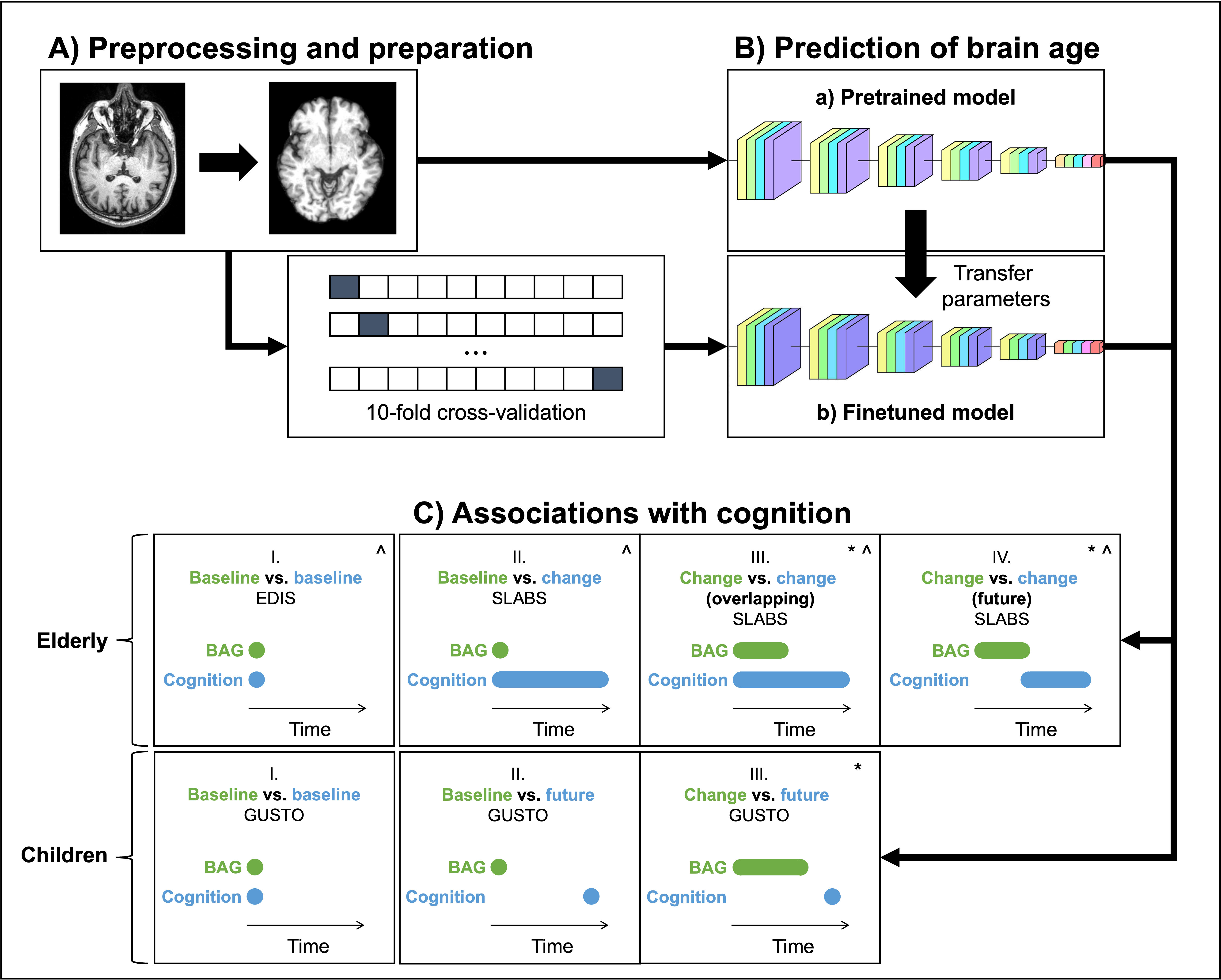
Approach: We applied a pretrained brain age model to Singaporean elderly and children, compared our results after finetuning the model, and examined cross-sectional and longitudinal associations with cognition.
Results: The model could be directly applied to elderly, but finetuning was necessary for children. The longitudinal change in brain age gap significantly associated with future executive function performance in both elderly and children.
Impact: We show that there is real potential for generalizing brain age models to diverse populations, and that the longitudinal change in brain age contains additional information about future executive function, compared to baseline brain age.
Introduction
Brain age, which uses machine learning to estimate age based on brain features, has emerged as a useful tool to understand neuroanatomical aging and its link to health outcomes like cognition. However, most brain age models use cross-sectional data from primarily Caucasian, adult participants1. It is thus unclear how well these models generalize to non-Caucasian populations, especially children. Furthermore, longitudinal studies in healthy populations are scarce. Previous work found baseline brain age gap (BAG) associated with baseline cognition2, but not future age-related cognitive decline3. Notably, BAG was only measured at one time point. Cross-sectional and longitudinal brain measures may reflect different factors4, suggesting combining them could provide more predictive power. However, to our knowledge, the utility of longitudinal changes in BAG have not been tested in healthy participants. In this work, we tested the generalizability of a pretrained brain age model to Singaporean participants and examined the longitudinal utility of brain age in associating with future cognition.Methods
We used the state-of-the-art Simple Fully Convolutional Network (SFCN) pretrained on 34,285 T1 MRI scans from 21 datasets across the lifespan1. While an unusually large and heterogenous training set, there was still a relative lack of training data from very young and/or non-Caucasian participants. Thus, to test the model on Asian participants from Singapore, we used T1 MRI scans from three Singaporean datasets: 1) the cross-sectional Epidemiology of Dementia in Singapore (EDIS) study5,6,7 (N=694 non-demented elderly, 226 with no cognitive impairment (NCI) and 468 with cognitive impairment no dementia (CIND)); 2) the longitudinal Singapore Longitudinal Aging Brain Study (SLABS)8 (N=215 healthy elderly); and 3) the longitudinal Growing Up in Singapore Towards healthy Outcomes (GUSTO) study9 (N=678 healthy children). We used the same preprocessing pipeline as the pretrained model1. We generated brain age predictions by directly applying the pretrained model, then by finetuning the model for each dataset using 10-fold cross-validation.Global and domain-specific cognitive scores were obtained in all studies. SLABS collected 5 phases with both T1 and cognitive data, while GUSTO collected T1 at 4.5, 6.0, 7.5, and 10.5 years old and cognitive scores at 4.5 and 8.5 years old. To investigate associations with cognition, we used all 694 participants from EDIS and identified subsets of SLABS and GUSTO with the requisite data available. For SLABS, we identified 81 participants with longitudinal T1 and cognitive data. For GUSTO, we identified 217 participants at baseline and 239 participants longitudinally. We tested cross-sectional and longitudinal associations using multiple linear regression models in several stages (Figure 1C). For longitudinal data, annual rates of change were calculated from a linear regression with time for each participant. For BAG, we used the first 3 phases of SLABS and 4.5 to 7.5 years old for GUSTO. For cognition, we used all 5 phases of SLABS and cognition at 8.5 years old for GUSTO (longitudinal cognition was not available). Models included chronological age, sex, years of education (for elderly), and baseline BAG (for change in BAG) as covariates. Statistical results were corrected for multiple comparisons across cognitive domains using the Holm-Bonferroni method10,11.
Results
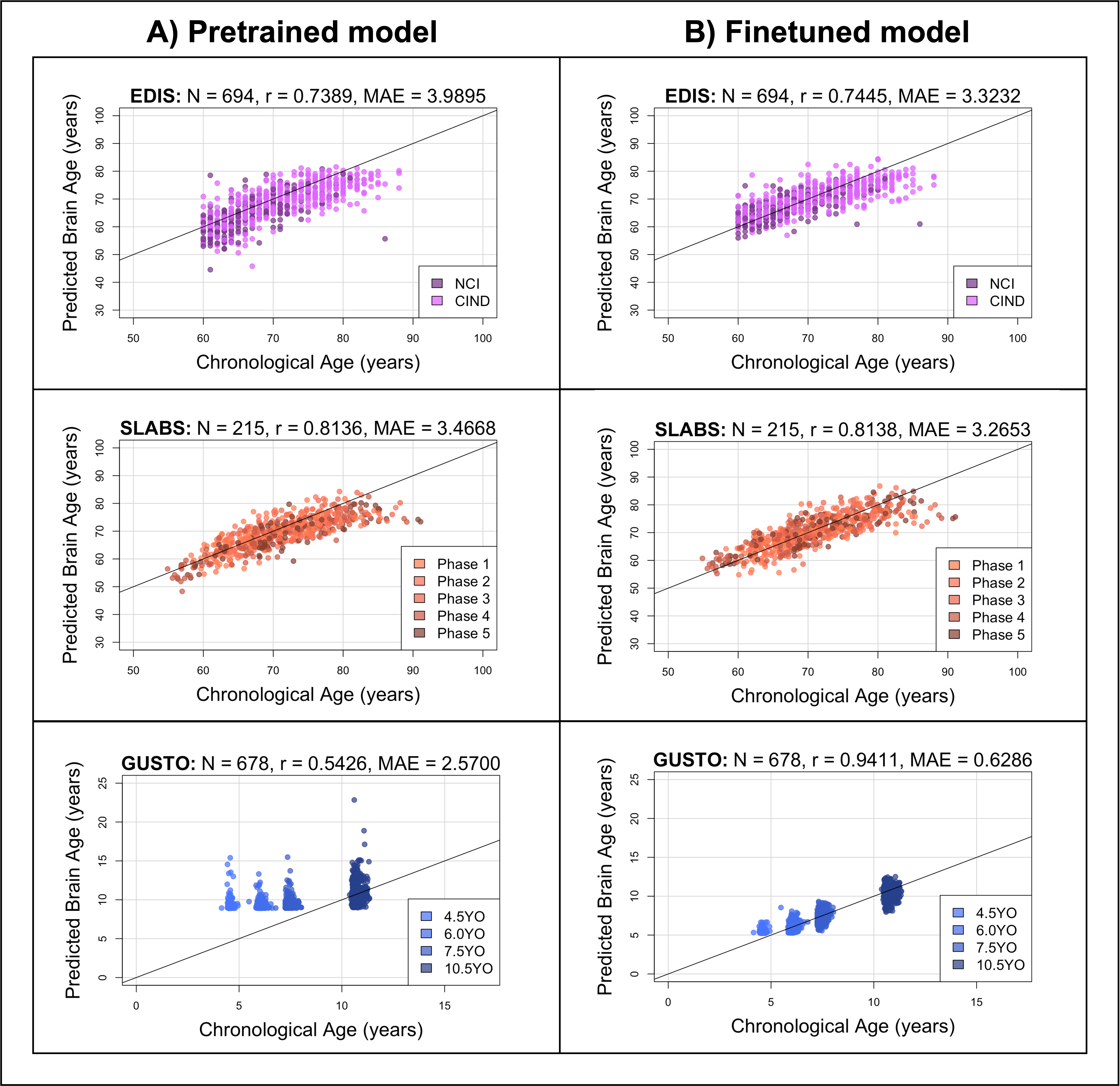
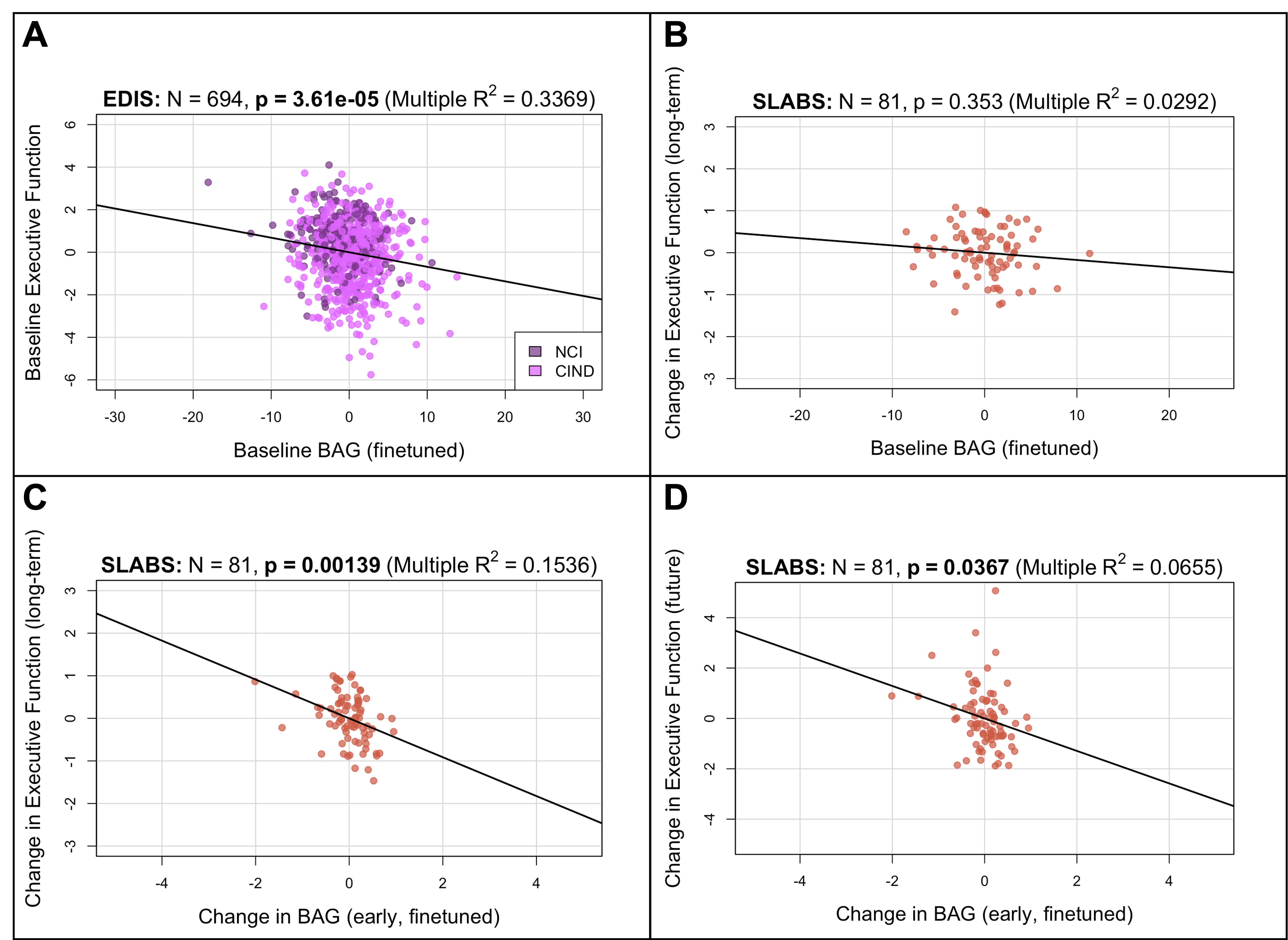
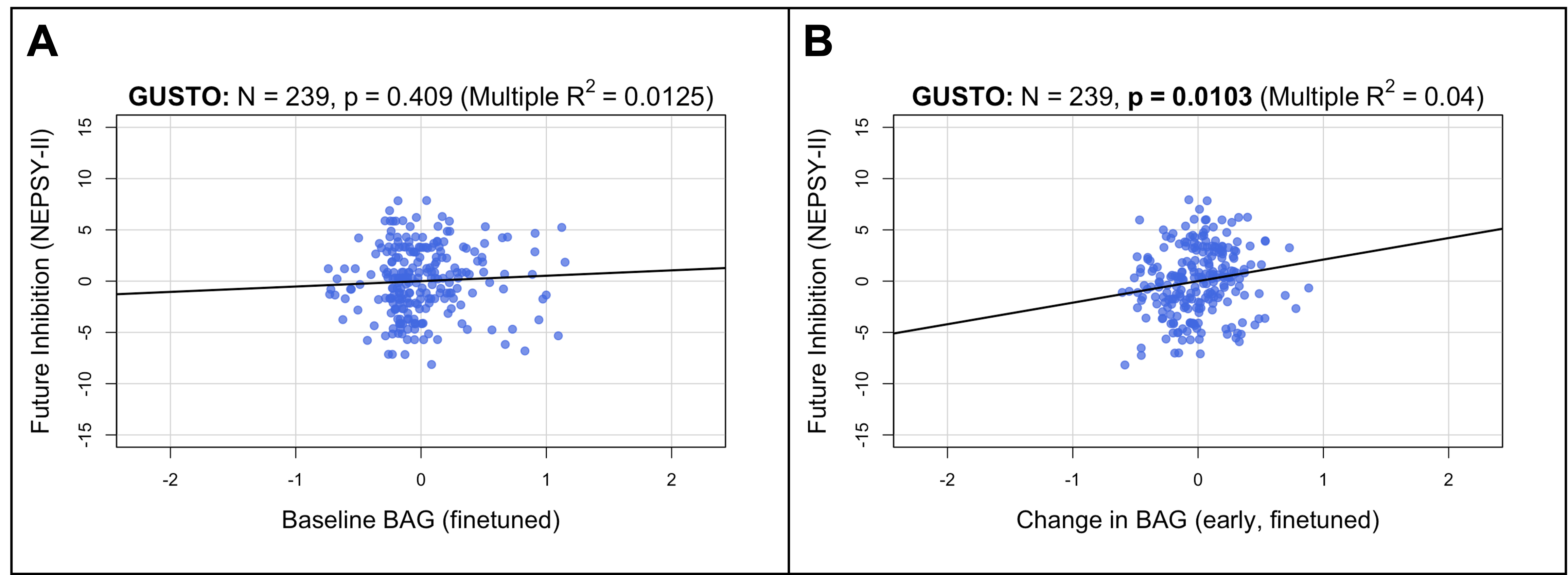
Figure 2 shows brain age predictions on all datasets. In EDIS and SLABS (elderly), the pretrained model performed well, with marginal improvement after finetuning. In contrast, the pretrained model did not perform as well in GUSTO (children), with a drastic improvement after finetuning.In elderly, higher baseline BAG was associated with lower baseline executive function (pcorr=0.0002, Figure 3A) but not long-term decline (p=0.3531, Figure 3B). In contrast, early rate of BAG change was negatively associated with long-term (pcorr=0.0084, Figure 3C) and future executive function change (p=0.0367, Figure 3D). All results in elderly held using the pretrained model. In children, baseline BAG was not associated with baseline IQ (p=0.3809) or future cognition (p=0.4086, Figure 4A). However, adding early rate of BAG change was positively associated with future inhibition (pcorr=0.0411, Figure 4B). This association was only present after finetuning for children.
Discussion
Our results suggest the pretrained model could be directly applied to Singaporean elderly, but it needed to be finetuned for Singaporean children. Thus, model performance was likely influenced by the relative abundance and lack of training data from elderly and children, respectively, rather than ethnic differences. Furthermore, our results suggest a "brain maintenance" account of aging, where individuals start with similar offsets reflecting early life factors, while different slopes in development result in increased variability over the lifespan4.Conclusion
We provide early evidence of the population generalization capability of the brain age model and the ability of longitudinal measurements to capture ongoing aging process in the brain.Acknowledgements
We would like to thank all participants and the research teams of GUSTO, EDIS, and SLABS for their contributions. We would also like to thank Esten Leonardsen and team for making the SFCN pretrained model and code available and for providing suggestions on hyperparameters. Finally, we would like to thank Zijiao Chen, Yilei Wu, Yichi Zhang, and Yao Feng Chong for helpful discussions.
The Epidemiology of Dementia in Singapore (EDIS) study is supported by the National Medical Research Council (NMRC), Singapore (NMRC/CG/NUHS/2010 [Grant no: R-184-006-184-511]). The research conducted in this study is also supported by the Singapore National Research Foundation under the Translational and Clinical Research (TCR) Flagship (GUSTO), Healthy Longevity Catalyst Awards (Zhou), Open-fund Young Individual Research Grant (Ng), Open Fund Large Collaborative Grant (OFLCG) Programmes (Zhou) by Singapore Ministry of Health’s National Medical Research Council (NMRC) (Singapore – NMRC/TCR/004-NUS/2008; NMRC/TCR/012-NUHS/2014; HLCA23Feb0004; OFLCG/MOH-000504; MOH-OFYIRG19may-0012), National Medical Research Council Singapore Grants NMRC/STaR/0004/2008, NMRC/STaR/015/2013, and STAR19may-0001 (Chee), NMRC/CIRG/1446/2016 (Chen), NMRC/CIRG/1390/2014 and NMRC/CBRG/0088/2015 (Zhou), and from the Biomedical Research Council, Singapore (BMRC 04/1/36/372, Zhou). Additional funding is provided by the Duke-NUS Medical School Signature Research Program funded by Ministry of Health, Singapore, and Centre for Sleep and Cognition funded by Yong Loo Lin School of Medicine, National University of Singapore and the Brain – Body Initiative of A*STAR.
References
1. E. H. Leonardsen, H. Peng, T. Kaufmann, et al., “Deep neural networks learn general and clinicallyrelevant representations of the ageing brain,” NeuroImage, vol. 256, p. 119 210, Aug. 2022, issn:1053-8119. doi: 10.1016/j.neuroimage.2022.119210.
2. J. Wrigglesworth, P. Ward, I. H. Harding, et al., “Factors associated with brain ageing - a systematic review,” BMC Neurology, vol. 21, no. 1, p. 312, Aug. 2021, issn: 1471-2377. doi: 10.1186/s12883-021-02331-4.
3. J. Wrigglesworth, N. Yaacob, P. Ward, et al., “Brain-predicted age difference is associated with cognitive processing in later-life,” Neurobiology of Aging, vol. 109, pp. 195–203, Jan. 2022, issn: 0197-4580. doi: 10.1016/j.neurobiolaging.2021.10.007.
4. K. B. Walhovd, M. Lovden, and A. M. Fjell, “Timing of lifespan influences on brain and cognition,” Trends in Cognitive Sciences, vol. 27, no. 10, pp. 901–915, Oct. 2023, Publisher: Elsevier, issn:1364-6613, 1879-307X. doi: 10.1016/j.tics.2023.07.001.
5. S. Hilal, M. K. Ikram, M. Saini, et al., “Prevalence of cognitive impairment in Chinese: Epidemiology of Dementia in Singapore study,” Journal of Neurology, Neurosurgery & Psychiatry, vol. 84, no. 6,pp. 686–692, Jun. 2013, Publisher: BMJ Publishing Group Ltd Section: Cognition, issn: 0022-3050,1468-330X. doi: 10.1136/jnnp-2012-304080.
6. S. Hilal, C. S. Tan, X. Xin, et al., “Prevalence of Cognitive Impairment and Dementia in Malays– Epidemiology of Dementia in Singapore Study,” Current Alzheimer Research, vol. 14, no. 6,pp. 620–627, May 2017, issn: 15672050. doi: 10.2174/1567205012666151002123813.
7. M. Y. Z. Wong, C. S. Tan, N. Venketasubramanian, et al., “Prevalence and Risk Factors for CognitiveImpairment and Dementia in Indians: A Multiethnic Perspective from a Singaporean Study,” en,Journal of Alzheimer’s Disease, vol. 71, no. 1, pp. 341–351, Jan. 2019, Publisher: IOS Press, issn: 1387-2877. doi: 10.3233/JAD-190610.
8. M. W. L. Chee, K. H. M. Chen, H. Zheng, et al., “Cognitive function and brain structure correlations in healthy elderly East Asians,” NeuroImage, vol. 46, no. 1, pp. 257–269, May 2009, issn: 1053-8119. doi: 10.1016/j.neuroimage.2009.01.036.
9. S.-E. Soh, M. T. Tint, P. D. Gluckman, et al., “Cohort Profile: Growing Up in Singapore Towards healthy Outcomes (GUSTO) birth cohort study,” International Journal of Epidemiology, vol. 43, no. 5, pp. 1401–1409, Oct. 2014, issn: 0300-5771. doi: 10.1093/ije/dyt125
10. S. Holm, “A Simple Sequentially Rejective Multiple Test Procedure,” Scandinavian Journal of Statistics, vol. 6, no. 2, pp. 65–70, 1979.
11. R Core Team, R: A language and environment for statistical computing, Vienna, Austria, 2022
Figures