3808
CloudBrain-MRS: An Artificial Intelligence Cloud Computing Platform for MRS Processing1Department of Electronic Science, Fujian Provincial Key Laboratory of Plasma and Magnetic Resonance, Xiamen University, Xiamen, China, 2Departments of Radiology, Shandong Provincial Hospital Affiliated to Shandong First Medical University, Jinan, China, 3Medical Imaging of Southeast Hospital, Medical College of Xiamen University, Zhangzhou, China, 4School of Computer and Information Engineering, Xiamen University of Technology, Xiamen, China
Synopsis
Keywords: AI/ML Software, Data Processing
Motivation: Magnetic resonance spectroscopy (MRS) is a powerful tool for disease diagnosis, but one of its limitations is the lack of user-friendly processing software or platforms.
Goal(s): Developing an integrated platform that is easy to use, provides powerful hardware, and incorporates advanced processing algorithms.
Approach: CloudBrain-MRS is a cloud-based online platform that has been developed. The platform can be accessed through a web browser without requiring any program installation on the user's side, and it integrates advanced artificial intelligence algorithms.
Results: The platform supports: 1): Automatic statistical analysis to find biomarkers for diseases;2) Consistency verification between classic and artificial intelligence quantification algorithms; 3)Visualize results.
Impact: This is the first user-friendly cloud computing platform for in vivo MRS with an artificial intelligence processing. The biomedical researchers can do clinical research effectively, and it greatly reduces the requirements for the technical skill of users.
Purpose
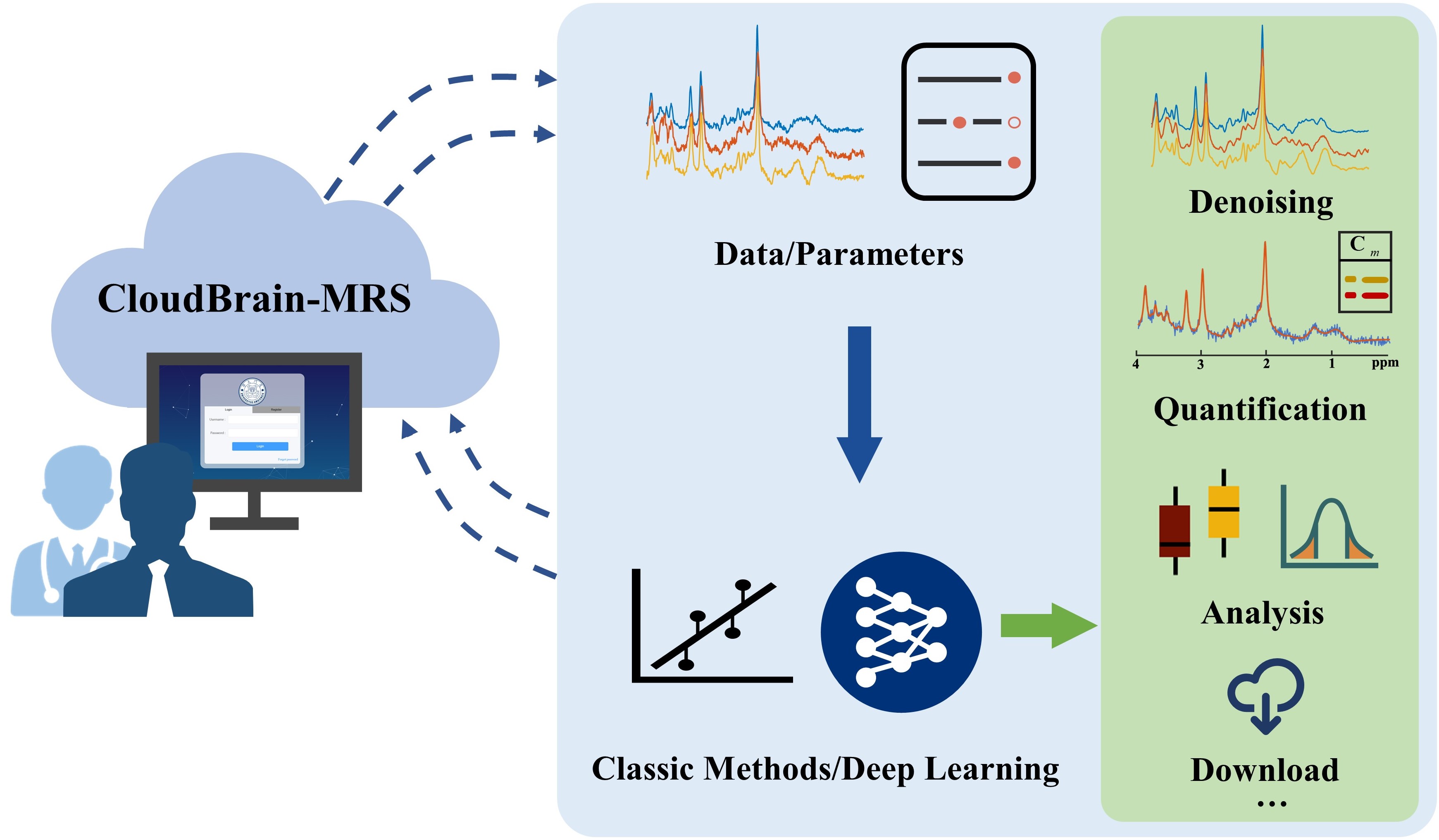
Magnetic Resonance Spectroscopy (MRS) shows remarkable advantages in the field of analysis of human metabolites. MRS spectrum is used to observe the signal intensity of metabolites or further infer their concentrations. Although the magnetic resonance vendors commonly provide basic functions of spectra preprocessing and metabolite quantification, the widespread clinical research of MRS is still limited due to the lack of easy-to-use processing software or platform.Cloud computing provides an easily accessible, flexible and scalable platform. Users need not worry about hardware maintenance and management, and thus, they can focus on innovation and core tasks. In this study, we propose CloudBrain-MRS, a cloud based platform for automated data preprocessing, quantification, and analysis of MRS data, as in Fig. 1. We have shared our cloud platform at MRSHub, providing free access and service for two years. Please visit https://mrshub.org/software_all/#CloudBrain-MRS or https://csrc.xmu.edu.cn/CloudBrain.html. Users can register an account or use our demo account (username: demo_csg, password: csg12345678!).Method
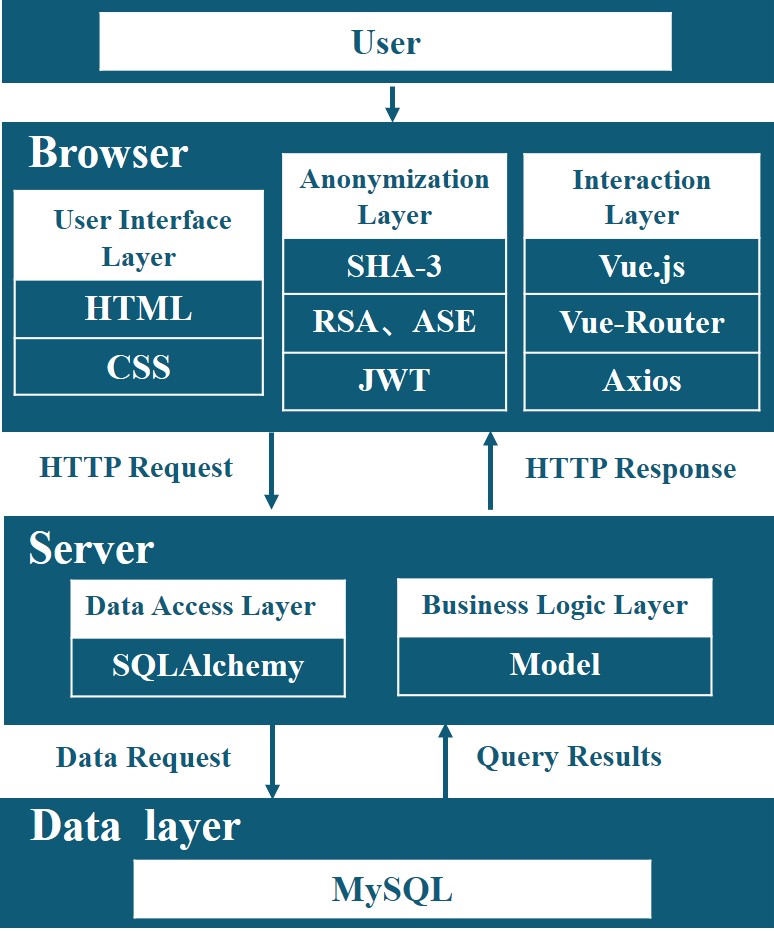
The platform method module is primarily divided into two parts: one is platform construction, which includes platform architecture, security, and privacy aspects; the other is the implementation of the integrated model for MRS data processing, which includes preprocessing, quantification, statistical analysis, and consistency analysis of different methods.Platform construction: CloudBrain-MRS adopts the browser/service (B/S) working model, which stands for a browser-request/server-response model. Fig. 2 displays the interactions between each part and the libraries they depend on. For data secure transmission, the platform uses the 2048-bit Rivest Shamir-Adleman (RSA) algorithm to encrypt sensitive information before transmission. For data storage security, the platform sets up a white list of allowed ports to impose strict access restrictions on the database and adds protection against distributed denial of service (DDOS) attacks.
Integrated processing: This platform includes advanced processing algorithms, including deep learning1 denoising method ReLSTM2 and quantification method QNet3 , and the mainstream quantification tool LCModel4. Users can batch preprocess and quantify MRS data online via a browser. The platform also includes a statistical analysis, consistency analysis and visualization module.
Results
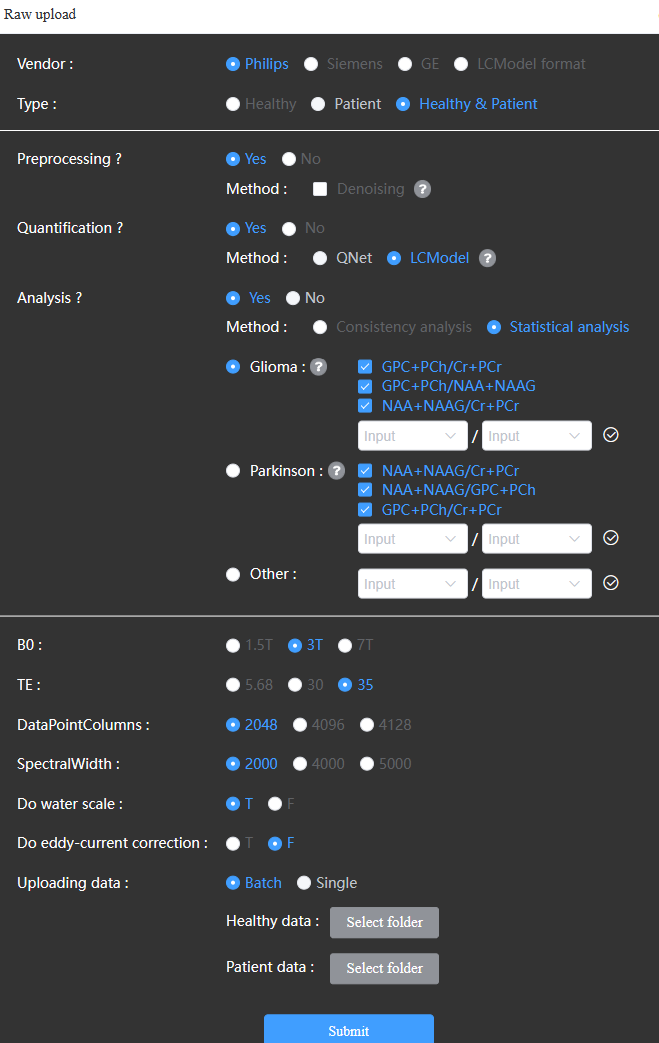
Up to now, the platform currently supports reading RAW data from Philips, Siemens, and GE, DICOM data from United Imaging and Siemens, and also supports LCModel’s data format.1) Statistical analysis: CloudBrain-MRS has developed a statistical analysis module that automatically quantifies and analyzes data uploaded by users, as shown in Fig. 3. The module uses LCModel to quantify data and an independent samples t-test or a Mann-Whitney U-test to analyze whether there is a significant difference between healthy individuals and patients. To analyze the metabolic characteristics of disease, the platform provides several key metabolite concentrations as references. In addition, users can add other indicators according to their research needs for analysis.
2) Consistency analysis: To help users verify the reliability of the traditional quantification method LCModel and artificial intelligence quantification method QNet, CloudBrain-MRS provides a consistency analysis service that is currently limited to healthy individuals, as shown in Fig. 3. This service has two aspects. Firstly, a Bland-Altman analysis is conducted to evaluate the degree of consistency between the two algorithms. Secondly, box plots of metabolite concentrations are generated based on the normal concentration ranges5 in healthy individuals to check the distribution of metabolite concentration values.
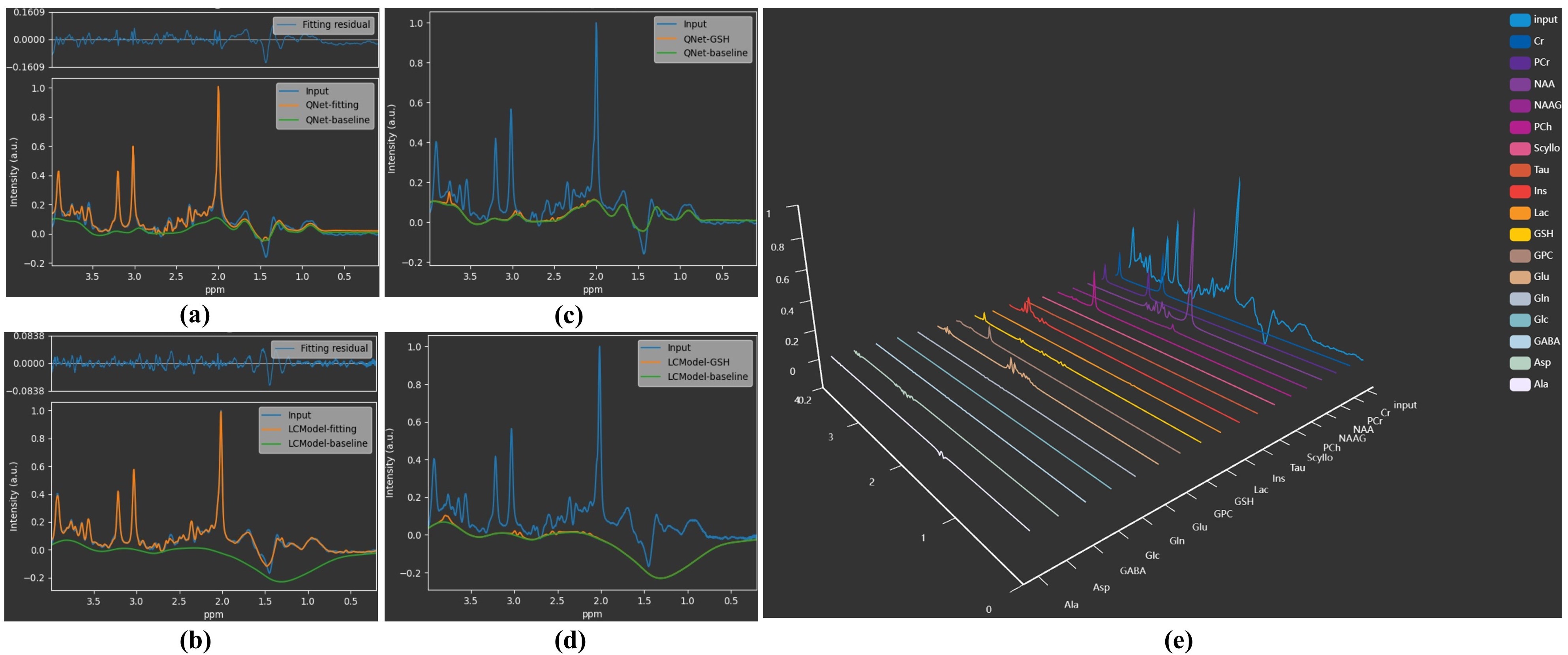
3) Visualization: To help users evaluate quantification results, CloudBrain-MRS has developed a range of visualization tools. Users can view fitted spectra of QNet or LCModel, as shown in Fig. 4a and Fig. 4b. Additionally, the platform extracts the fitted results for each metabolite, as shown in Fig. 4c and Fig. 4d, which aids in evaluating the contribution of each metabolite. Moreover, the platform utilizes echarts technology to provide 3D visualization of every metabolite, enabling users to have a comprehensive view of the fit results, as in Fig. 4e.
Conclusion
We have developed CloudBrain-MRS, a cloud computing platform that leverages artificial intelligence and traditional algorithms to processing MRS signals. Users can perform batch preprocessing, quantification, and analysis of MRS data through a web browser without the need for environment installation or code compilation. In support of clinical research and diagnosis, we will enhance the analysis capabilities to generate examination reports using biomarkers and offer preliminary disease classification for reference by medical professionals. To validate the reliability of CloudBrain-MRS, we encourage more doctors and experts to try it out.Acknowledgements
See more details in the full-length preprint: https://arxiv.org/abs/2306.11021. This work was supported in part by the National Natural Science Foundation of China under grants 62122064, 61971361, and 61871341, Natural Science Foundation of Fujian Province of China under grants 2023J02005 and 2021J011184, President Fund of Xiamen University under grant 20720220063, and Xiamen University Nanqiang Outstanding Talents Program. The authors thank China Mobile for providing cloud computing services support. The authors thank Zhigang Wu, Liangjie Lin, and Jiazheng Wang from Philips and Jiayu Zhu and Xijing Zhang from United Imaging for technical support. The authors also thank Stephen W. Provencher for making LCModel public.
The correspondence should be sent to Prof. Xiaobo Qu (Email: quxiaobo@xmu.edu.cn)
References
- Q. Yang et al., Physics-driven synthetic data learning for biomedical magnetic resonance: The imaging physics-based data synthesis paradigm for artificial intelligence, IEEE Signal Process Mag. 40 (2023) 129–140.
- D. Chen et al., Magnetic resonance spectroscopy deep learning denoising using few in vivo data, IEEE Trans. Comput. Imaging 9 (2023) 448–458.
- D. Chen et al., Magnetic resonance spectroscopy quantification aided by deep estimations of imperfection factors and overall macromolecular signal, arXiv preprint arXiv:2306.09681 (2023).
- S. W. Provencher, Estimation of metabolite concentrations from localized in vivo proton NMR spectra, Magn. Reson. Med. 30 (1993) 672–679.
- H. H. Lee et al., Intact metabolite spectrum mining by deep learning in proton magnetic resonance spectroscopy of the brain, Magn. Reson. Med. 82 (2019) 33–48.
Figures