3802
The Effects of Simulated SAR Data Processing Methods and Network Parameter Tuning on Gridding Artifacts and Network Estimation Accuracy1Cardiff University Brain Research Imaging Centre, Cardiff University, Cardiff, United Kingdom
Synopsis
Keywords: AI/ML Software, Machine Learning/Artificial Intelligence, Specific absorption rate (SAR), artifacts, ultra-high field MRI, deep learning
Motivation: Gridding artifacts in neural network estimated images are common and could inhibit neural network estimation accuracy.
Goal(s): The goal is to discover which parameters are responsible for gridding artifacts, and whether the artifacts inhibit estimation quality.
Approach: We test the effects of simulated body models, neural network parameters, and postprocessing methods on gridding artifacts, and their effect on overall neural network estimation accuracy in the context of local specific energy absorption rate (SAR) matrices, a patient safety concern for MRI scanning.
Results: Altering neural network parameters affects the presentation of gridding artifacts the most. Eliminating gridding artifacts improves network estimation accuracy.
Impact: Researchers working with computer vision whose images experience a gridding artifact can inform their neural network parameter tuning efforts with the results of this exploratory study.
Introduction
A pipeline to use conditional generative adversarial networks (cGANs)1 to predict the consequences of patient head motion on local specific energy absorption rate (SAR) distributions was designed and implemented. During the design process, a gridding artifact (GA) (figure 2) was discovered in the network estimated (NE) images. To mitigate the artifact and discover its effects on NE accuracy, a variety of parameters were tested.The cGAN consists of generator and discriminator convolutional neural networks, where the generator has a U-net architecture. According to2 and3, the gridding or "checkerboard" artifact could occur during the downsampling portion of the U-net which uses transposed convolution. In particular, it could relate to the stride and filter size (FS) used. The combination of these parameters could cause a GA when the FS is not divisible by the stride, leading to uneven overlap, though even overlap also causes artifacts2, 3. No overlap at all (FS = stride), ie. sub-pixel resolution4, was proposed as a solution, though it still causes artifacts2, 3. Enhancing the training by increasing the epochs can capture more effective generator weights (GW) for testing. Though the present network implementation uses the GW from the epoch yielding the lowest loss, more training epochs may give the network a higher chance of securing a GW with lower loss.Methods
The cGANs tested in this study are variations of the one used in 5 , which is a marginally altered version of pix2pix1. The local SAR distribution data was derived from electromagnetic (EM) simulations in Sim4Life (ZMT, Zurich, Switzerland) using finite difference time domain (FDTD) calculations performed on Billie, Duke, Ella, Fats and Glenn from the Virtual Population (IT’IS, Zurich, Switzerland6) at the center of the coil and posterior 5 mm using a generic 8 channel pTx coil at 7 T (295MHz). This investigates two different head positions due to a different padding selection. The composition of each SAR matrix dataset was 256 x 256(image resolution) x 140 (slices) x 64 (self- and mutual-interactions of 8 pTxchannels).1. Body model configurations investigated using the cGAN parameters from5 with a leaky rectified linear unit (LReLu) instead of a ReLu during convolution in the generator:
(a) Train: Fats, Ella, Glenn; validate: Billie; test: Duke
(b) Train: Fats, Billie, Duke; validate: Glenn; test: Ella (configuration FBD-G-E)
(c) Train: Fats, Ella, Glenn; validate: Duke; test: Billie
2. Neural network (NN) parameters evaluated on FBD-G-E:
(a) Changing the leaky rectified linear unit (LReLu) to a ReLu
(b) FS=2
(c) FS=3
(d) FS=3; stride=1
(e) FS=1; stride=1
(f) FS=1; strides=1; change LReLu to a ReLu during convolution in generator
(g) Epochs=160
3. Implemented Hanning filter (HF) in postprocessing to mitigate the GA (FBD-G-E), FSs: 1x1 → 7x7
Results and Discussion
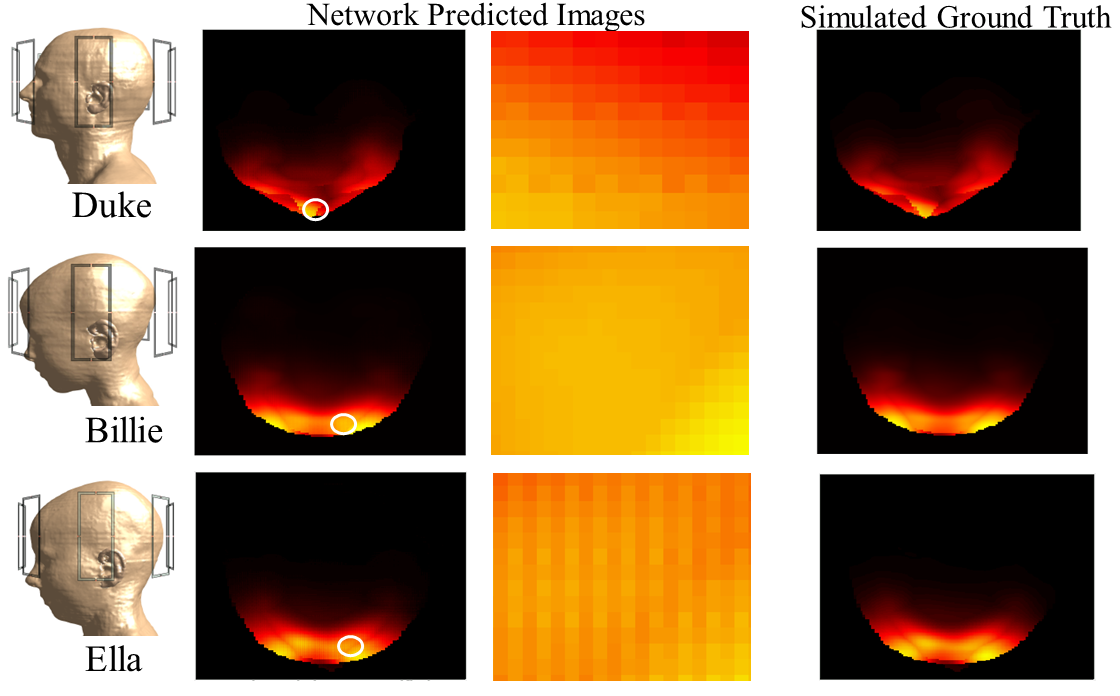
The results were evaluated in terms of the extent of the GA and using L1 error (L1e) calculated using the L1 norm of the difference between the NE images and ground truth (GT).Figure 1 shows that the GA presented when testing on Duke and Ella. The GT images do not contain gridding, therefore the artifact is not learned.
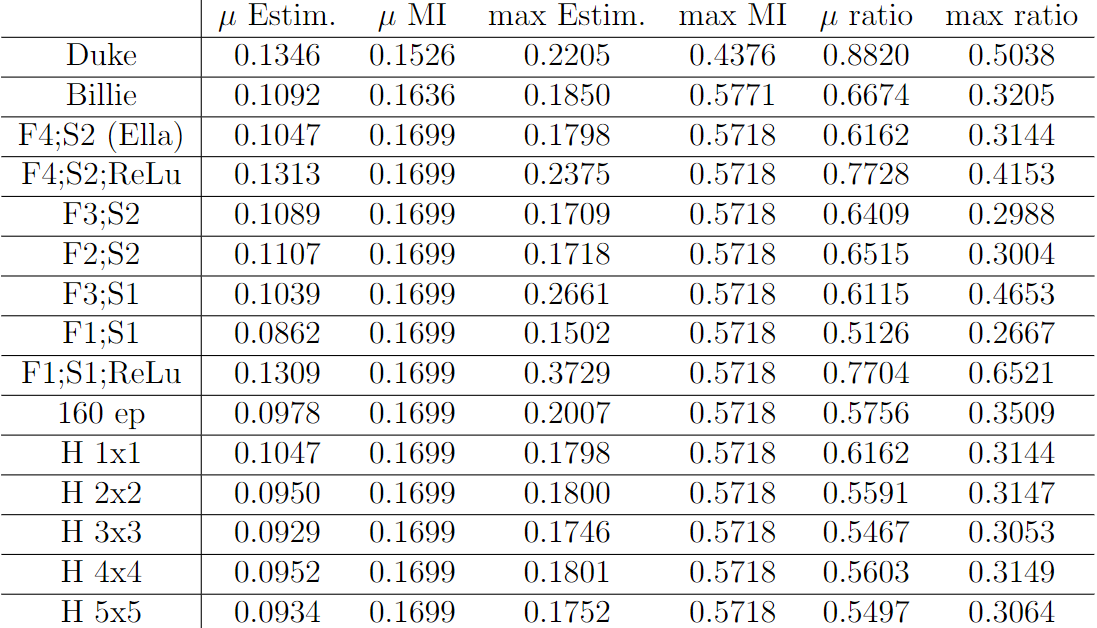
Table 1 indicates that mean and maximum L1e accross slices and channels is lower when testing on Ella. This is likely because Ella’s anatomy fits within the bounds of those of the training body models (BMs) (Fats, Billie, and Duke) in the given BM configuration, suggesting that when arising from BM configuration, the GA does not affect overall NE accuracy. For versatility, more anatomicaly varied BMs should be trained.
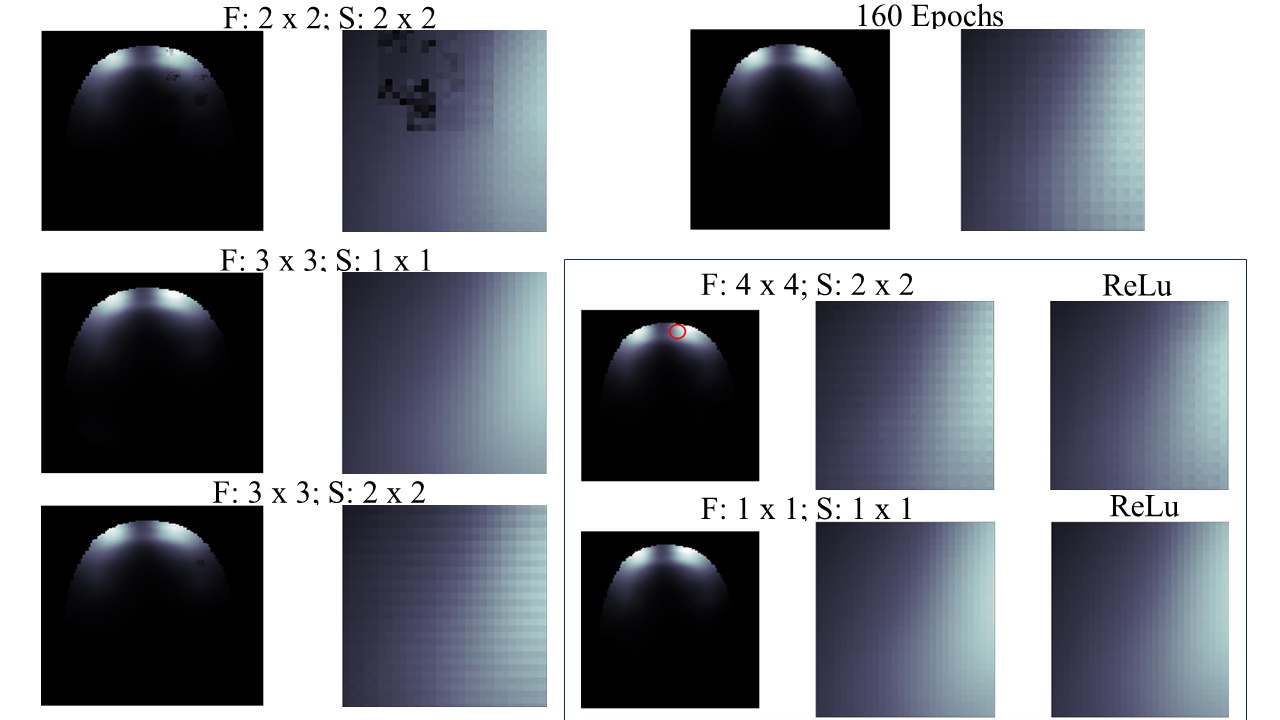
Figure 2 displays the effects of NN parameter changes on the GA, which disappeared when stride=1x1. The GA was affected by the FS. More epochs did not improve quality, indicating that the artifact is not from underfitting, though the mean L1e improved (table 1). The low L1e for FS=1x1 and stride=1x1 suggests that the GA, when arising from parameter tuning, has an effect on NE accuracy.
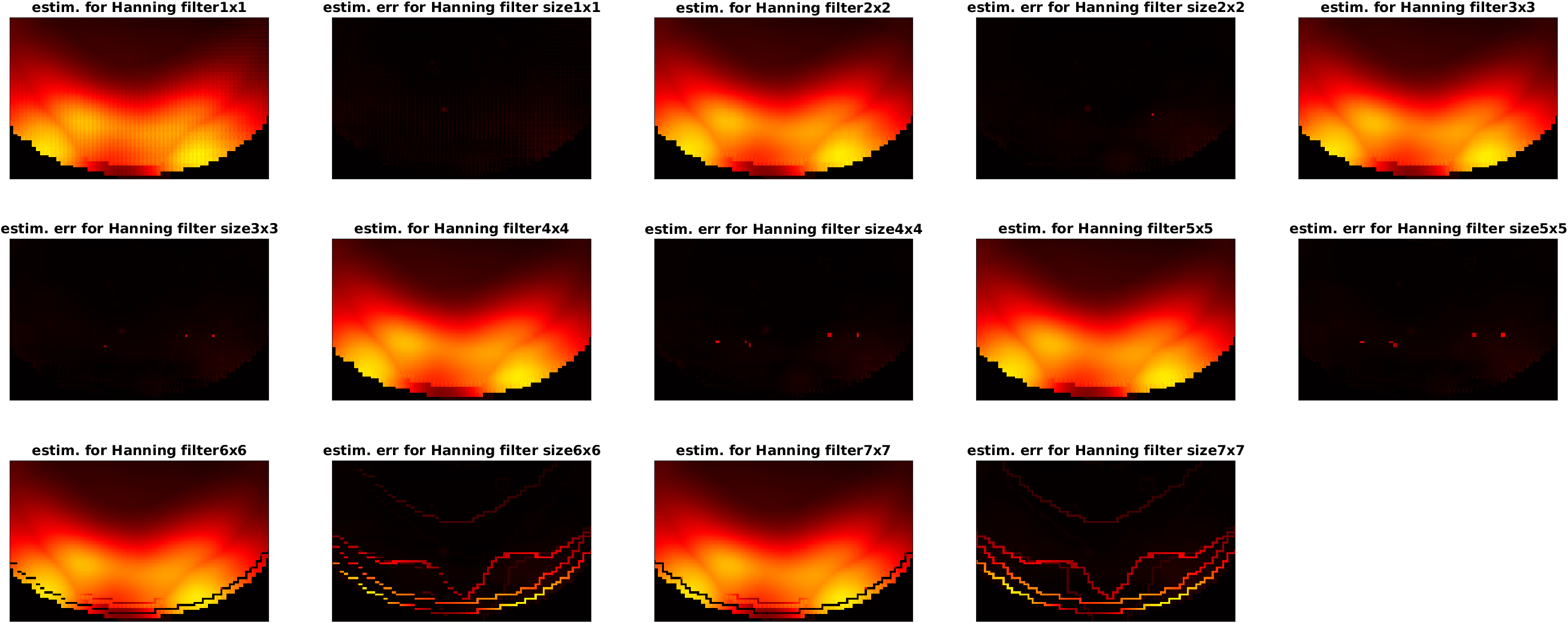
Applying the HF during postprocessing improved NE which contained the GA, but the L1e is higher than when FS and stride=1x1. The HF introduced isolated pixels of large error for filter sizes <6x6 (figure 3), which contributed to higher L1e. FS=3x3 was optimal (table 1). The FS and stride had the most effect on the GA and NE accuracy, with a 1x1 FS and stride with LReLu yielding the best outcome.
Conclusion
We have tested parameters which affect cGAN-caused GAs in local SAR matrices. The results can inform researchers working with computer vision whose results are affected by GAs. This method improves prediction accuracy and reduces computational cost through so-called pointwise convolution7.Acknowledgements
The Wellcome Trust [204824/Z/16/Z], Welsh Government [Wales Data Nation Accelerator project], and EPSRC [Doctoral Training Program].References
1. Phillip Isola, Jun-Yan Zhu, Tinghui Zhou, Alexei A Efros, and Berkeley Ai Research. Image-to-image translation with conditional adversarial networks, 2017.
2. Augustus Odena, Vincent Dumoulin, and Chris Olah. Deconvolution andcheckerboard artifacts. Distill, 1(10):e3, 2016.
3. Yusuke Sugawara, Sayaka Shiota, and Hitoshi Kiya. Checkerboard artifacts free convolutional neural networks. APSIPA Transactions on Signal and Information Processing, 8:e9, 2019.
4. Wenzhe Shi, Jose Caballero, Ferenc Husz ́ar, Johannes Totz, Andrew P Aitken, Rob Bishop, Daniel Rueckert, and Zehan Wang. Real-time single image and video super-resolution using an efficient sub-pixel convolutional neural network. In Proceedings of the IEEE conference on computer vision and pattern recognition, pages 1874–1883, 2016.
5. Alix Plumley, Luke Watkins, Matthias Treder, Patrick Liebig, Kevin Murphy, and Emre Kopanoglu. Rigid motion-resolved prediction using deep learning for real-time parallel-transmission pulse design. Magnetic Resonance in Medicine, 87:2254–2270, 5 2022.
6. Honegger Katharina, Zefferer Marcel, Neufeld Esra, Oberle Michael, Szczerba Dominik, Kuster Niels, Kainz Wolfgang, Guag Joshua, W Hahn Eckhart, G Rascher Wolfgang, Janka Rolf, Bautz Werner, Chen Ji Shen, Jianxiang Kiefer, Berthold Schmitt, Peter Hollenbach, Hans-Peter, Christ Andreas, and Anthony Kam. The virtual family-development of surface-based anatomical models of two adults and two children for dosimetric simulations, Jan 2010.5
7. Binh-Son Hua, Minh-Khoi Tran, and Sai-Kit Yeung. Pointwise convolutional neural networks. In Proceedings of the IEEE conference on computer vision and pattern recognition, pages 984–993, 2018.5
Figures