3787
A CMR-based multi-modality fusion machine learning approach for predicting left ventricular reverse remodeling in dilated cardiomyopathy1The Second Affiliated Hospital of Nanchang University, Nanchang, China, 2GE Healthcare, Beijing, China
Synopsis
Keywords: Diagnosis/Prediction, Machine Learning/Artificial Intelligence, Machine learning; Cardiac magnetic resonance; Multi-modality; Dilated cardiomyopathy; Left ventricular reverse remodeling
Motivation: Few multi-modality machine learning (ML) classifiers combine cardiac magnetic resonance (CMR) imaging with clinical data for predicting LVRR in DCM patients, limiting improvements in patient outcomes and management.
Goal(s): To develop an ML classifier using multi-modality data, including CMR, to predict LVRR in initial DCM patients.
Approach: 129 DCM patients with complete clinical and CMR data were collected. Feature selection identified relevant variables, and an LR-based nomogram was constructed and evaluated.
Results: The nomogram achieved an AUC of 0.857 in the test cohort, incorporating late gadolinium enhancement pattern, global longitudinal peak strain, aldosterone antagonist, and severe mitral regurgitation.
Impact: The CMR-based multi-modality nomogram has a superior ability in the prediction of LVRR in DCM patients.
Synopsis
Motivation: Few multi-modality machine learning (ML) classifiers combine cardiac magnetic resonance (CMR) imaging with clinical data for predicting LVRR in DCM patients, limiting improvements in patient outcomes and management.Goal: To develop an ML classifier using multi-modality data including CMR to predict LVRR in initial DCM patients.
Approach: 129 DCM patients with complete clinical and CMR data were collected. Feature selection identified relevant variables, and an LR-based nomogram was constructed and evaluated.
Results: The nomogram achieved an AUC of 0.857 in the test cohort, incorporating late gadolinium enhancement pattern, global longitudinal peak strain, aldosterone antagonist, and severe mitral regurgitation.
Impact: The CMR-based multi-modality nomogram has a superior ability to predict LVRR in DCM patients.
Introduction
Dilated cardiomyopathy (DCM) is a common disease leading to heart failure and heart transplantation worldwide[1]. Due to the advancement of heart failure treatment, an increasing number of patients are now undergoing left ventricular reverse remodeling (LVRR), which is associated with a favorable long-term prognosis[2]. Cardiac magnetic resonance (CMR) imaging can non-invasively assess cardiac structure, function, and myocardial tissue characteristics. Recent studies have demonstrated that CMR can serve as an indicator of the likelihood of LVRR[3, 4]. Furthermore, there have been reports demonstrating the utility of machine learning (ML) models based on echocardiography and other clinical variables for predicting LVRR[5, 6]. However, to the best of our knowledge, ML classifiers based on the combination of CMR and other clinical data were rarely reported. This study was aim to develop an ML classifier using features derived from baseline clinical characteristics, laboratory data, electrocardiograph (ECG), echocardiography, and CMR to predict LVRR in patients initially diagnosed with DCM.Materials and Methods
This retrospective study received approval from our institutional ethics review committee, and informed consent was waived. LVRR was defined as an absolute increase in LVEF≥10% to a final value of >35% in combination with a decrease in LVEDD≥10% compared to the initial echocardiography[7]. 129 DCM patients were finally included and randomly divided into the training cohort and test cohort with a 7:3 ratio. Baseline clinical characteristics, laboratory data, ECG results, and echocardiography findings were retrospectively collected from medical records for all DCM patients.MR data acquisition
All CMR data were acquired on a 3T MRI system (Discovery MR750W; GE Healthcare). All cine images were acquired by standard breath-held steady-state free precession cine sequence. At 10-15 minutes after contrast administration, an inversion recovery gradient echo sequence was used to acquire late gadolinium enhancement (LGE) imaging.
Feature analysis and model construction
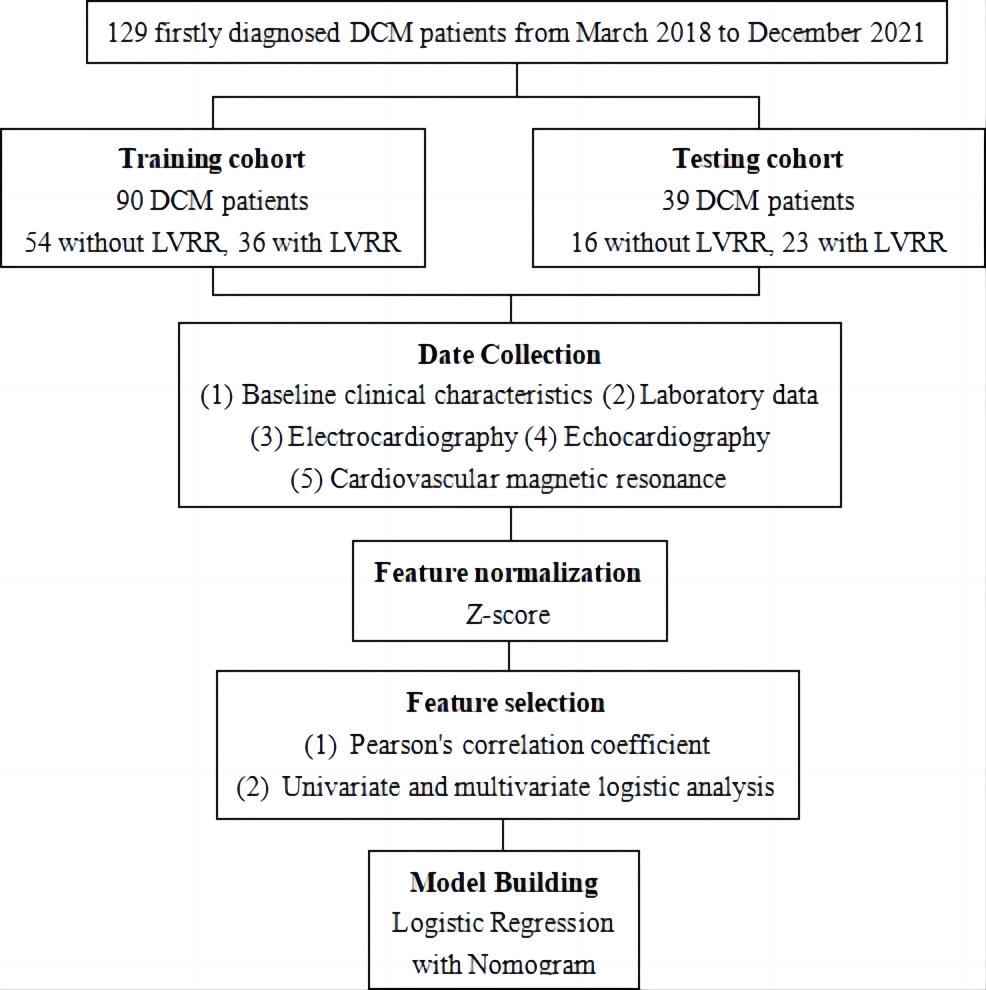
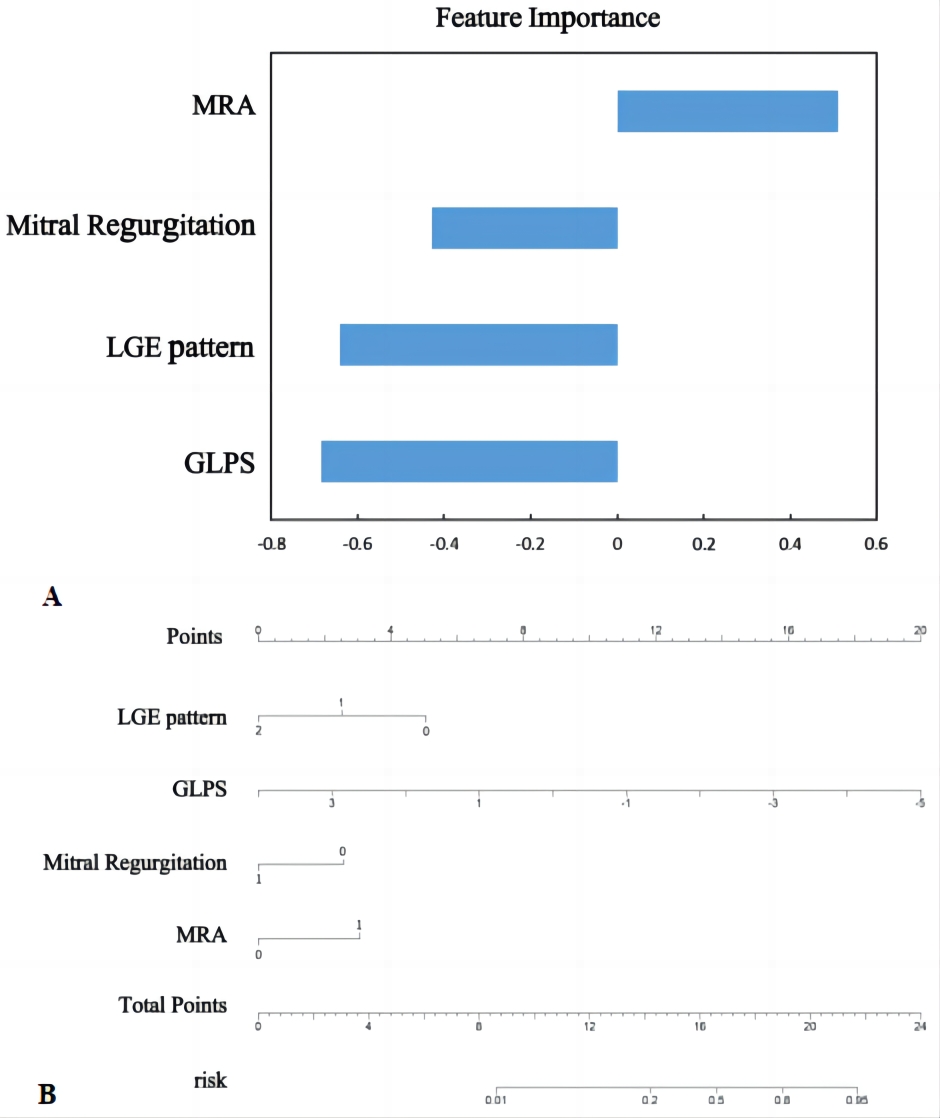
A total of one hundred multi-modality variables were collected and subsequently normalized using the Z-score method. The Pearson correlation coefficient (PCC) was employed to identify relevant features in the initial step. Subsequently, univariate and multivariate logistic analyses were conducted to select the most significant features. These selected features were then utilized to construct a logistic regression model, along with a corresponding nomogram (Figure 1). Five-fold cross-validation was performed in the training set to select the optimal model parameters. The resulting model was then validated using an independent test set.
Statistical Analysis
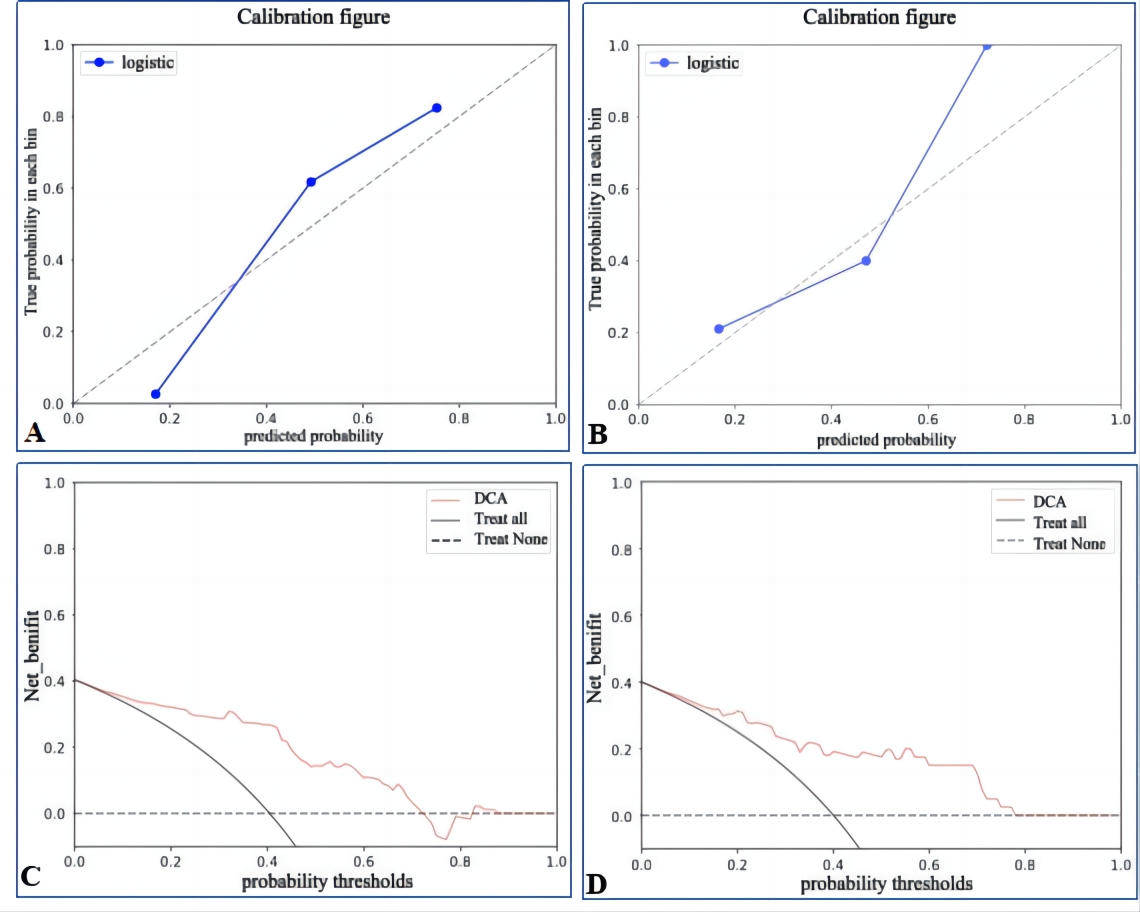
All statistical analyses were performed with Python (version 3.8.8) and R Studio (version 3.6.3). P < 0.05 was considered statistical significance. To test the discrimination capability of the models, the areas under the receiver operating characteristic (ROC) curve (AUCs) were calculated. Decision curve analysis (DCA) was used to better illustrate the clinical utility of the model. The calibration curve was provided to evaluate the agreement between the true and the predicted outcomes of LVRR in DCM with the Hosmer Lemeshow test.
Results
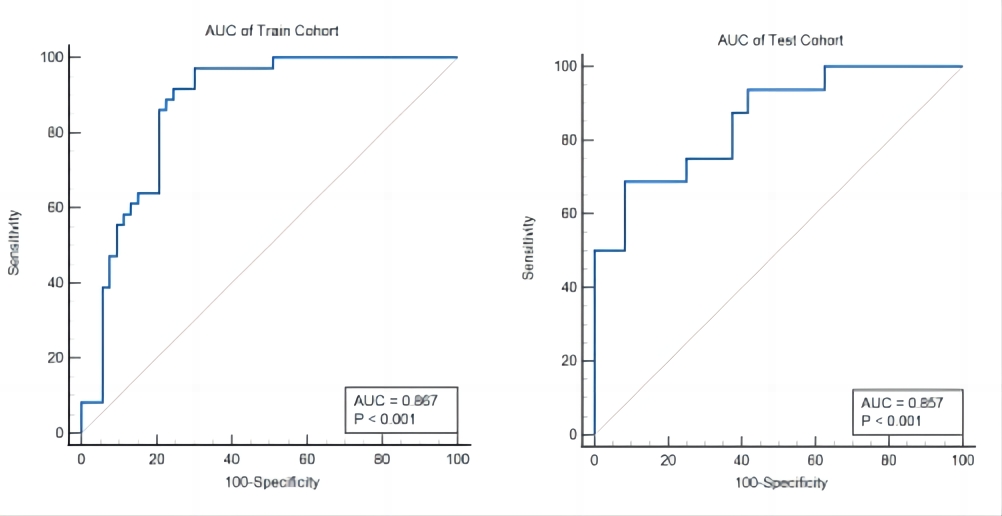
The predictive performance and ROC results of the model are summarized in Table 1 and Figure 2. The nomogram exhibited an AUC of 0.867 (95%CI: 0.802-0.927) in the training cohort and 0.857 (95%CI: 0.747-0.946) in the test cohort. Key variables incorporated into the nomogram included baseline LGE pattern, global longitudinal peak strain (GLPS), aldosterone antagonist, severe mitral regurgitation (Figure 3B), and Figure 3A depicted their importance rank. The nomogram exhibited good calibration, and the Hosmer-Lemeshow (HL) test confirmed the goodness of fit (p > 0.05) as depicted in Figure 4A. The DCA of the nomogram revealed a substantial overall net benefit (Figure 4B).Discussion and conclusion
In this study, we conducted a clinical nomogram by integrating multi-modality data including baseline clinical information and CMR to effectively predict LVRR in DCM patients. This classifier may serve as a valuable tool in guiding clinical therapies and enabling preoperative prognosis prediction. In conclusion, the multi-modality machine learning classifiers based on CMR have the potential to accurately predict LVRR in DCM patients, offering promising clinical implications.Acknowledgements
No acknowledgement found.References
[1] Weintraub R G, Semsarian C, Macdonald P. Dilated cardiomyopathy[J]. Lancet, 2017,390(10092):400-414.
[2] Kubanek M, Sramko M, Maluskova J, et al. Novel predictors of left ventricular reverse remodeling in individuals with recent-onset dilated cardiomyopathy[J]. J Am Coll Cardiol, 2013,61(1):54-63.
[3] Kan A, Fang Q, Li S, et al. The potential predictive value of cardiac mechanics for left ventricular reverse remodelling in dilated cardiomyopathy[J]. ESC Heart Fail, 2023.
[4] Verdonschot J, Hazebroek M R, Wang P, et al. Clinical Phenotype and Genotype Associations With Improvement in Left Ventricular Function in Dilated Cardiomyopathy[J]. Circ Heart Fail, 2018,11(11):e5220.
[5] Xie X, Yang M, Xie S, et al. Early Prediction of Left Ventricular Reverse Remodeling in First-Diagnosed Idiopathic Dilated Cardiomyopathy: A Comparison of Linear Model, Random Forest, and Extreme Gradient Boosting[J]. Front Cardiovasc Med, 2021,8:684004.
[6] Liu L, Qiao C, Zha J R, et al. Early prediction of clinical scores for left ventricular reverse remodeling using extreme gradient random forest, boosting, and logistic regression algorithm representations[J]. Front Cardiovasc Med, 2022,9:864312.
[7] Lang R M, Badano L P, Mor-Avi V, et al. Recommendations for cardiac chamber quantification by echocardiography in adults: an update from the American Society of Echocardiography and the European Association of Cardiovascular Imaging[J]. J Am Soc Echocardiogr, 2015,28(1):1-39.
Figures