3773
A Decision Tree Diagnostic Scheme Based on Multi-label Deep Learning Network for Classification of Adult-type Diffuse Gliomas1The First Affiliated Hospital of Chongqing Medical University, Chongqing, China, 2Southwest University, Chongqing, Chongqing, China, 3Shanxi Provincial People's Hospital, Shanxi, Shanxi, China, 4Chongqing Hospital of Traditional Chinese Medicine, Chongqing, China, 5School of Medical and Life Sciences Chengdu University of Traditional Chinese Medicine, Chengdu, China
Synopsis
Keywords: Diagnosis/Prediction, Brain
Motivation: Genetic biomarkers and WHO grading of gliomas are critical for the classification of glioma subtypes, treatment planning and survival prognosis.
Goal(s): The aim of this study is to apply DL network for non-invasive prediction of multiple genes and classification of subtypes.
Approach: A decision tree diagnostic scheme based on multi-label DL network was constructed to classify adult-type diffuse gliomas into 5 subtypes based on the 2021 WHO classification of tumor of the CNS, combining the WHO grading and 3 genetic biomarkers status.
Results: The model we developed can reclassify adult-type diffuse glioma with a diagnostic accuracy of 94.4%.
Impact: Based on the 2021 WHO CNS tumor classification, this study applies multi-label deep learning to reclassify adult-type diffuse gliomas, which can be helpful for patients to obtain preoperative diagnosis and precise treatment.
Introduction
Gliomas are the most common malignant tumor in the brain, spanning all ages from children to the elderly1. The 2021 WHO CNS tumor classification further demonstrated the importance of genetic biomarkers in the diagnosis and classification of gliomas and emphasized the histological morphology diagnosis in combination with genetic biomarkers for classification2. Increasing evidence has revealed the feasibility of using MRI to predict the status of single or multiple genetic biomarkers and WHO grading of gliomas, via DL method3-5. Previous studies have applied DL to predict only a single genetic biomarker or WHO grading, but have not considered that the prognosis of glioma patients does not depend on a single genetic biomarker or WHO grading. The same gene mutation or WHO grading may show different survival prognosis. So, the purpose of this study is to build a decision tree diagnostic scheme based on the DL network, which is according to the 2021 WHO CNS tumor classification to classify adult-type diffuse gliomas.Methods
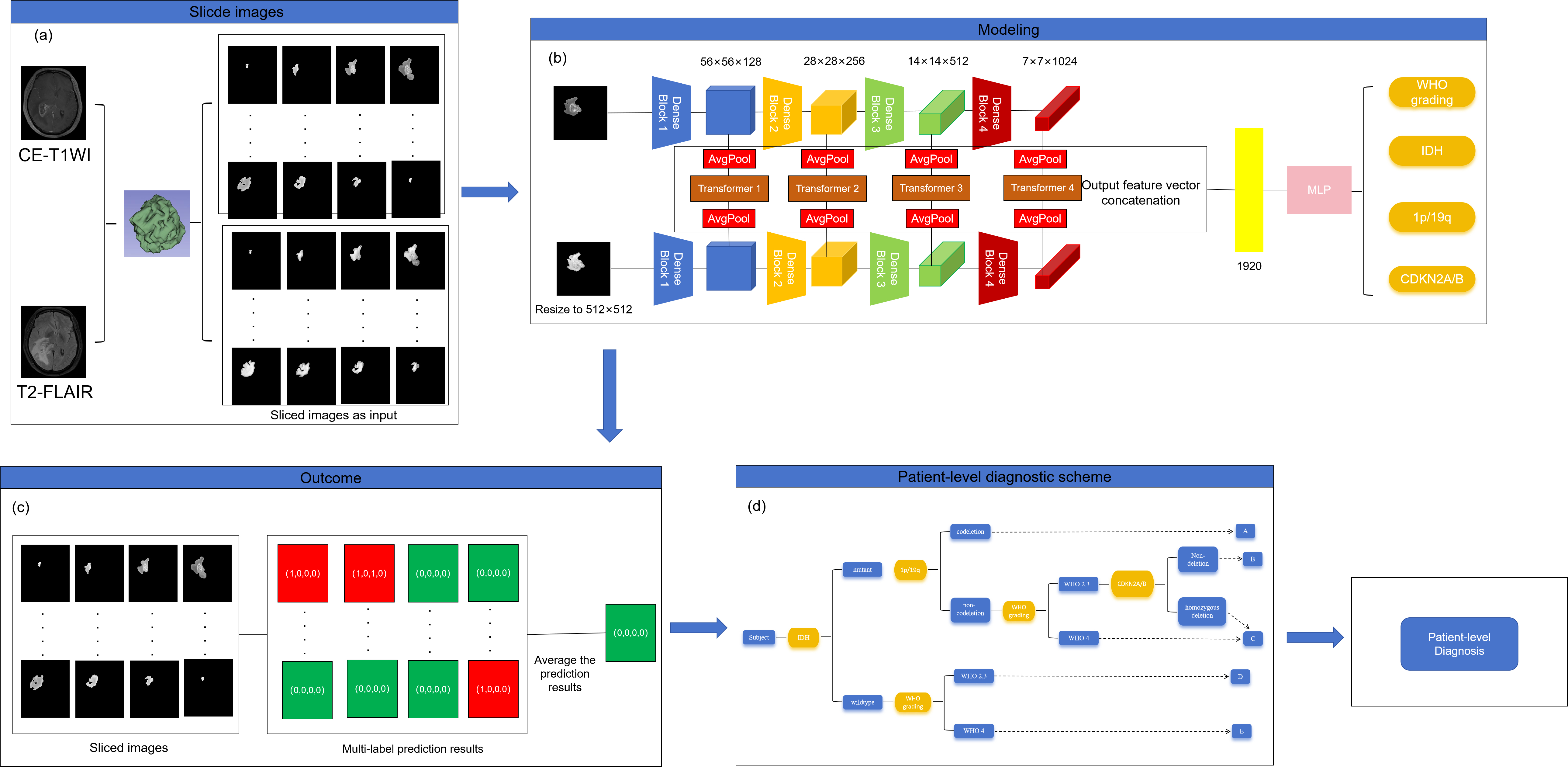
Patients and Image acquisitionThe institutional review board of our institution approved this retrospective cohort study and waived the requirement for informed consent. The imaging data and clinicopathological information were collected from the First Affiliated Hospital of Chongqing Medical University,the Cancer Genome Atlas (TCGA) and the Cancer Imaging Archive (TCIA)(https://www.cancerimagingarchive.net/)6. All collected preoperative MRI were acquired at 3.0T MRI scanner(GE Signa HDxt 3.0T, GE Medical Systems, Chicago, IL, USA) equipped with 8-channel head-neck unite coil. The acquisition sequences were CE-T1WI and T2-FLAIR. 538 patients were enrolled, all patients were randomly divided into training set (n =322) , validation set (n=108)and test set (n =108).Diagnostic ModelThe experiments were conducted using PyTorch on an NVIDIA 2060 12G graphics processing unit (GPU). The strategy involved developing a diagnostic model based on patient slice images and then combining the prediction results from each slice image to form the final integrated diagnosis.The process of the whole experiment is shown in Fig 1.The multi-label classification network we designed is illustrated in Fig 1(b). We employed a pre-trained DenseNet-121 architecture from the ImageNet dataset as the backbone. It was used to extract features separately from CE-T1WI and T2-FLAIR images, generating feature maps through convolutional layers. To harness the image features from each sequence and simultaneously exploit the relationships between sequence images, leveraging the complementary characteristics of features from different sequence images, we introduced multiple Transformers to integrate features obtained from different sequence convolutions. Fig 1(b) illustrates the multi-gene classification and WHO grading pipeline based on DL models. Finally, as shown in Fig 1(d), we use a decision tree to determine the type of tumor based on the predicted results of multiple genes and WHO grading in the patients, namely: (A) Oligodendroglioma, IDH-mutant, and 1p/19q-codeleted, (B) Astrocytoma, IDH-mutant, WHO 2-3, (C) Astrocytoma, IDH-mutant, WHO 4, (D) Astrocytoma, IDH-wildtype, WHO 2-3, (E) Glioblastoma, IDH-wildtype.Results
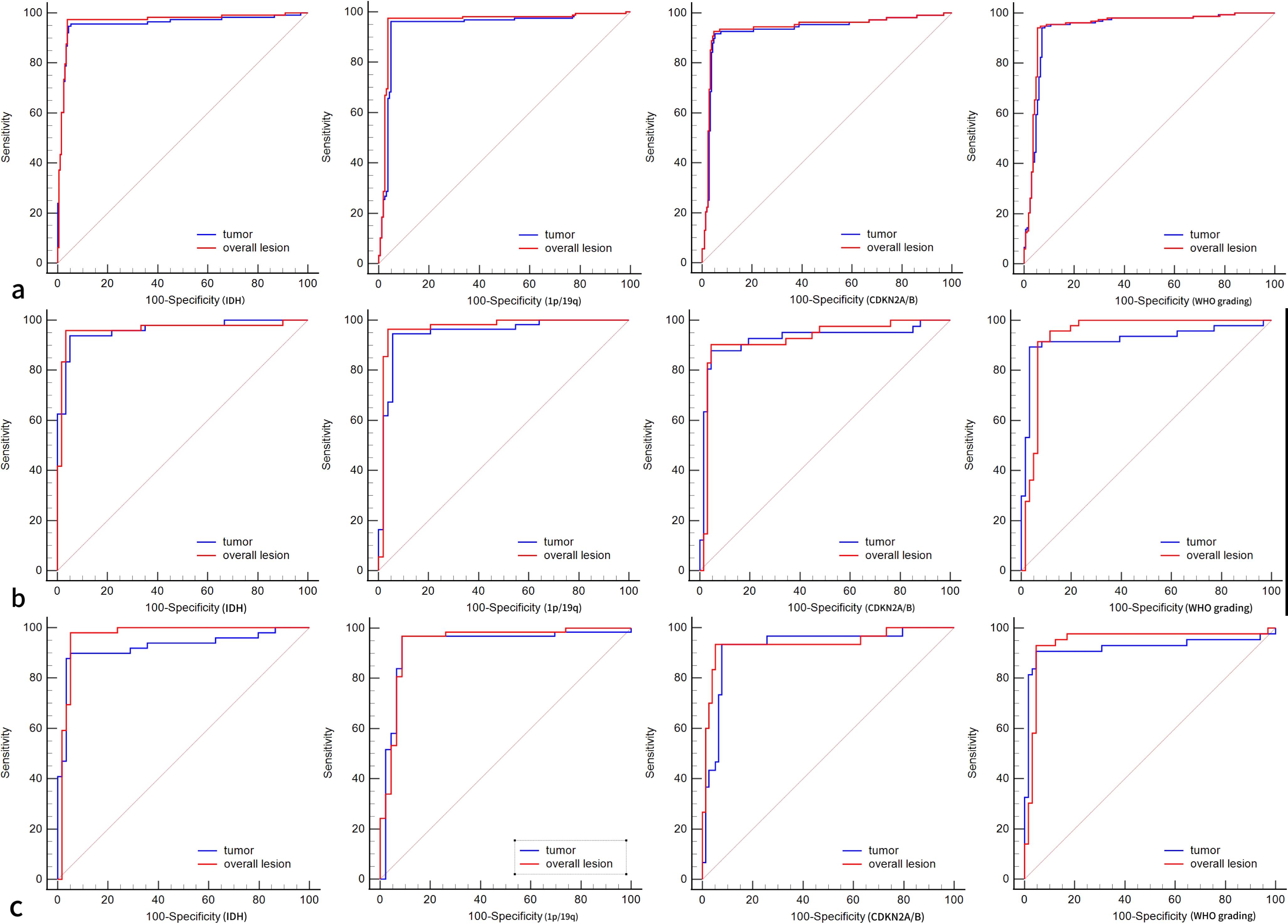
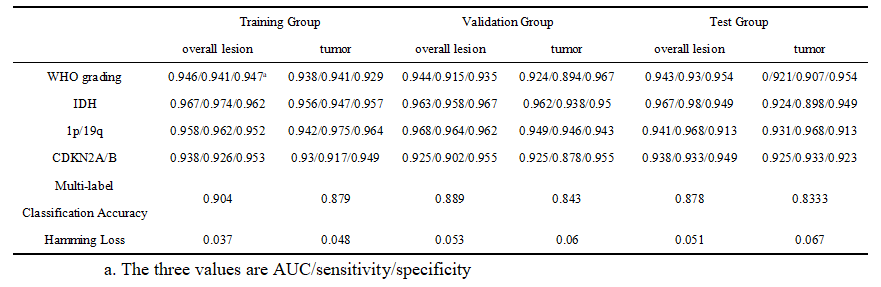
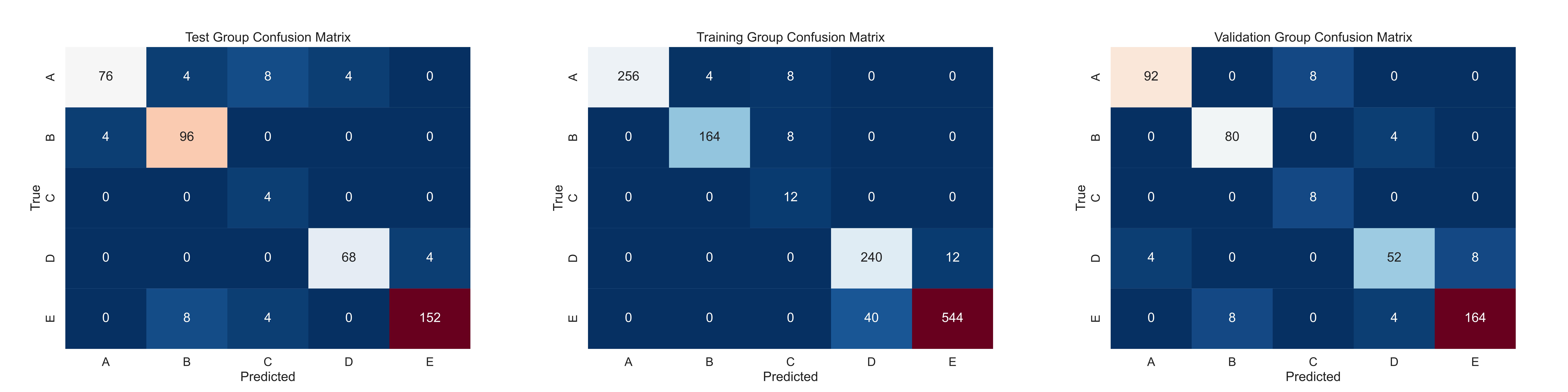
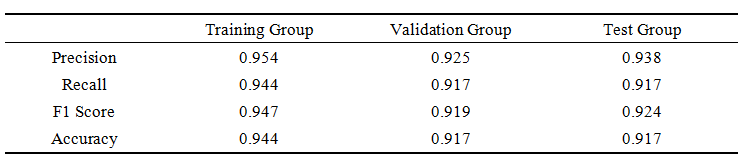
In this study, the DL model was constructed to predict IDH, 1p/19q, CDKN2A/B status and WHO grading were shown in Fig 2 and Fig 3, the AUC values of the training set were 0.967, 0.958, 0.938 and 0.946; the AUC values of the validation set were 0.963, 0.968, 0.925 and 0.944; the AUC values of the test set were 0.967, 0.941, 0.938 and 0.943, respectively. Subsequently, the decision tree diagnostic scheme was constructed to classify adult-type diffuse gliomas according to WHO grading and 3 genetic biomarkers status, Fig 4 displays the confusion matrix of the proposed classification network. Additionally, we used Precision, Recall, F1 Score, and Accuracy to evaluate the tumor subtype classification performance of the network, as shown in Fig 5. In independent testing, the network achieved Precision, Recall, F1 Score, and Accuracy values of 0.938, 0.917, 0.924, and 0.917, respectively.Discussion
We used the multi-label DL network DenseNet-121 architecture as the backbone to predict 3 genetic biomarkers status(IDH, 1p/19q, CDKN2A/B) and WHO grading, and then used a decision tree approach to derive 5 subtypes according to the 2021 WHO CNS tumor classification criteria. The results show good reclassification of gliomas using decision tree diagnostic scheme, with precision is 0.938, and accuracy is 0.917. It can be seen that the flexible application of the imaging field in machine learning marks a significant progress of glioma in machine learning research, which has great potential and is promising.Conclusion
In summary, a decision tree diagnostic scheme based on multi-label DL network can help to classify adult-type diffuse gliomas according to the latest criteria of 2021 WHO CNS tumor classification, combined with WHO grading and genetic biomarkers.Acknowledgements
We wish to thank the help given by Mr. Shanxiong Chen in Statistics analysis and we thank Mr. Ming Wen for his advice on experimental design.References
1. Ostrom QT, Price M, Neff C, et al. CBTRUS Statistical Report: Primary Brain and Other Central Nervous System Tumors Diagnosed in the United States in 2015-2019. Neuro Oncol. 2022 Oct 5;24(Suppl 5):v1-v95.
2. Louis DN, Perry A, Wesseling P, et al. The 2021 WHO Classification of Tumors of the Central Nervous System: a summary. Neuro Oncol. 2021 Aug 2;23(8):1231-1251.
3. Zhang H, Zhang H, Zhang Y, et al. Deep Learning Radiomics for the Assessment of Telomerase Reverse Transcriptase Promoter Mutation Status in Patients With Glioblastoma Using Multiparametric MRI. J Magn Reson Imaging. 2023 Nov;58(5):1441-1451.
4. Calabrese E, Rudie JD, Rauschecker AM, et al. Combining radiomics and deep convolutional neural network features from preoperative MRI for predicting clinically relevant genetic biomarkers in glioblastoma. Neurooncol Adv. 2022 Apr 22;4(1):vdac060.
5. van der Voort SR, Incekara F, Wijnenga MMJ, et al. Combined molecular subtyping, grading, and segmentation of glioma using multi-task deep learning. Neuro Oncol. 2023 Feb 14;25(2):279-289.
6. Clark K, Vendt B, Smith K, et al. The Cancer Imaging Archive (TCIA): maintaining and operating a public information repository. J Digit Imaging. 2013 Dec;26(6):1045-57.
Figures