3749
A faster VOP post-processing algorithm and its impact on supervision complexity1Medical Physics in Radiology, German Cancer Research Center (DKFZ), Heidelberg, Germany, 2Faculty of Physics and Astronomy, University of Heidelberg, Heidelberg, Germany, 3Faculty of Medicine, University of Heidelberg, Heidelberg, Germany
Synopsis
Keywords: Safety, Safety, VOP, SAR
Motivation: The complexity of SAR calculation increases dramatically with the number of channels in a parallel transmit system.
Goal(s): The goal of this work is to improve VOP post processing and investigate the impact of post processing on the complexity of SAR calculation with increasing number of channels.
Approach: An existing post-processing algorithm was improved by introducing a new criterion for upper boundedness from the literature. The new algorithm was used to investigate the increase in the number of VOPs with the channel count when median relative overestimation was kept constant.
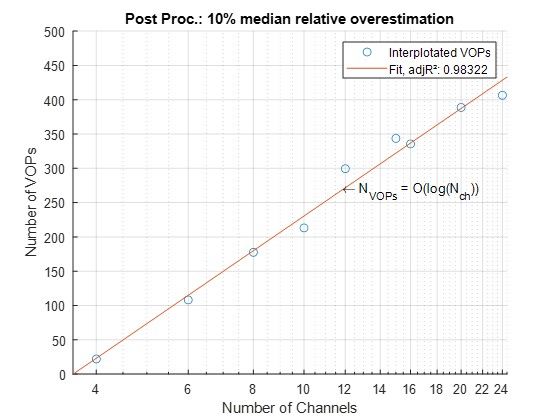
Results: The number of VOPs increases logarithmically with the number of channels.
Impact: VOP compression is important for SAR supervision and constraint RF-pulse calculation. Using an improved post-processing algorithm, we show that the increase in the number of VOPs when going to higher channel count Nch can be reduced from Nch2.3 to log(Nch).
Introduction
Specific absorption rate (SAR) calculation is a necessity for safety in MRI. In parallel transmission (pTx), virtual observation points (VOPs) are used to quickly calculate the maximum local SAR in online safety supervision as well as in SAR constraint RF pulse design. VOP models always introduce a certain overestimation as a tradeoff for complexity. As the number of channels becomes larger, the overestimation increases rapidly for a fixed number of VOPs, so additional VOPs are needed to maintain the same overestimation. Orzada et al.1 showed that for a constant median relative overestimation, the number of VOPs increases by the number of channels to the power of 3.7 or 2.3 depending on whether a clustering2 or non-clustering3 algorithm was used.The overestimation of a VOP set can be reduced by using a post-processing algorithm4, but this is computationally very intensive, especially for high VOP counts. Recently, Gras et al. presented a new criterion5 that can be used for VOP compression that is much faster at high numbers of VOPs. In this work we implement this criterion into the post-processing algorithm by Orzada et al.4 and use the enhanced speed to investigate the impact of channel count on supervision complexity when using post processing.
Methods
The proposed algorithm shares most steps with the algorithm proposed by Orzada et al.4. While the check for upper boundedness is now performed with the criterion introduced by Gras et al. to increase the overall calculation speed, the calculation of the overestimation is still done with the criterion of Lee et al.6. SAR matrices for head coils with 4-24 channels from Orzada et al.1 were compressed with an iterative non-clustering VOP algorithm starting at 40% of worst-case local SAR for the overestimation. With each iteration step, the overestimation was reduced by division by the third root of 2. A total of 12 iteration steps were calculated for each array. Afterwards, each VOP set was post processed.The median relative overestimation of 1e6 random excitation vectors was calculated for all VOP sets with and without post processing. To calculate the number of VOPs for identical median overestimation, a linear interpolation was used on the logarithmized data for number of VOPs and median relative overestimation.
Results
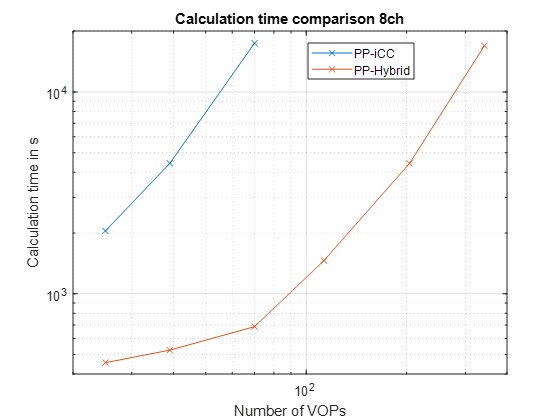
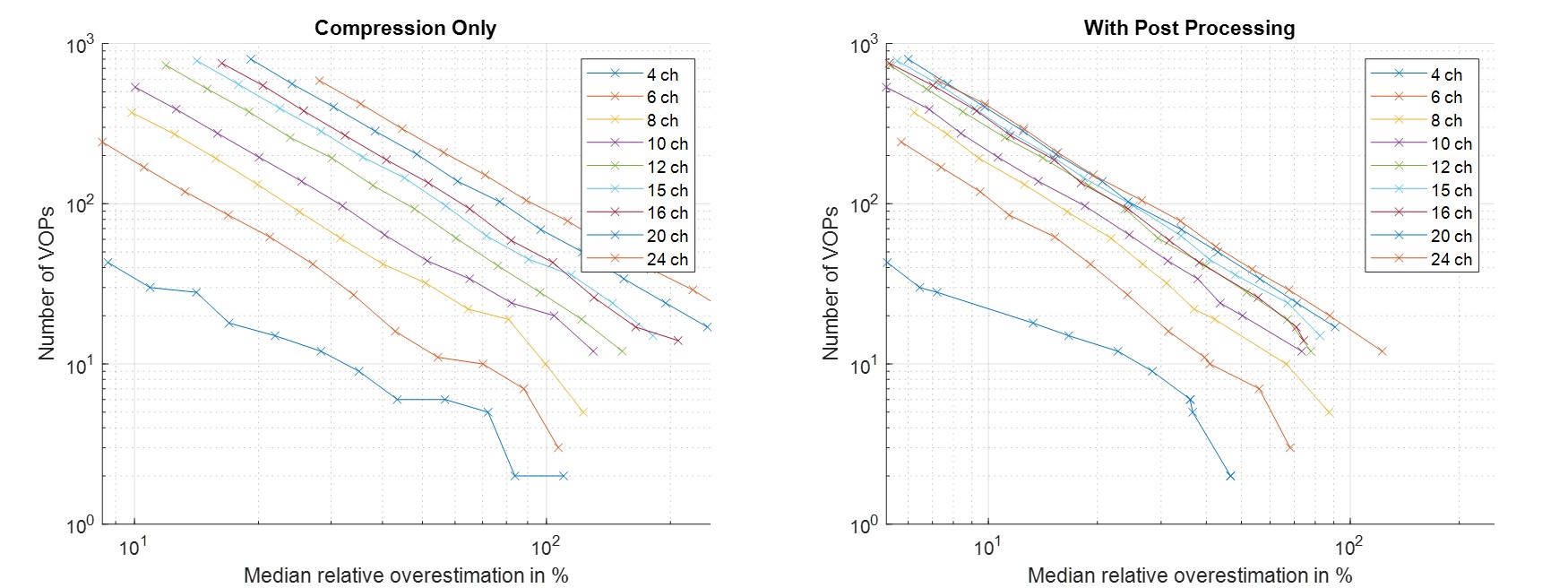
Figure 1 shows the calculation times for the original algorithm and the proposed algorithm for an 8-channel array. At 70 VOPs the new hybrid algorithm is faster by more than an order of magnitude.Figure 2 shows the number of VOPs versus the median relative overestimation in a double logarithmic plot for all channel counts. The left plot uses non-clustering compression only, the right plot shows the results when post processing is applied to the non-clustering compression results. Above approximately 50 VOPs, the relationship between the logarithm of the median relative overestimation and the logarithm of the number of VOPs appears linear. Furthermore, all line plots for different channel counts seem to run parallel to one another. With post processing, the lines for higher channel counts move closer together.
Figure 3 shows the number of VOPs from the interpolation for 10% median relative overestimation versus the number of channels in a semi-logarithmic plot. A function a+b*log(Nch) was fitted to the data with an adjusted R² of 0.98.
Discussion
The new algorithm is much faster than the original algorithm, which was based solely on the criterion introduced by Lee et al. The new algorithm allowed for the investigation of the impact on complexity shown in this work, as the calculations would have taken many months using the old algorithm.The results imply that the increase in the number of VOPs when increasing the number of channels follows a logarithmic law when keeping the median relative overestimation constant. This is a much slower increase than the increase in the number of channels to the power of 2.3 that was found for compression alone1. Thus, post processing of VOPs can be an important factor for time critical use cases such as online SAR supervision when going to high channel counts.
Conclusion
The new algorithm is much faster than the previous algorithm. Post processing of VOPs greatly reduces the problem of rapidly increasing complexity when going to higher channel counts.Acknowledgements
This work has received funding from the European Union’s Horizon Europe Programme under project 101078393 / MRItwins.References
- Orzada, S., et al., An investigation into the dependence of virtual observation point-based specific absorption rate calculation complexity on number of channels. Magn Reson Med, 2023. 89(1): p. 469-476.
- Eichfelder, G. and M. Gebhardt, Local specific absorption rate control for parallel transmission by virtual observation points. Magn Reson Med, 2011. 66(5): p. 1468-76.
- Orzada, S., et al., Local SAR compression algorithm with improved compression, speed, and flexibility. Magn Reson Med, 2021. 86(1): p. 561-568.
- Orzada, S., et al., Post-processing algorithms for specific absorption rate compression. Magn Reson Med, 2021. 86(5): p. 2853-2861.
- Gras, V., et al., A mathematical analysis of clustering-free local SAR compression algorithms for MRI safety in parallel transmission. IEEE Trans Med Imaging, 2023. PP.
- Lee, J., et al., Local SAR in parallel transmission pulse design. Magn Reson Med, 2012. 67(6): p. 1566-78.
Figures