3748
A Hybrid FDTD-FEM Simulation Approach For Safety Assessment of Geometrically Complex Birdcage Coils.1Biomedical Engineering, Eindhoven University of Technology, Eindhoven, Netherlands, 2Electrical Engineering, Eindhoven University of Technology, Eindhoven, Netherlands, 3Philips Healthcare, Best, Netherlands, 4Imaging and oncology division, University Medical Center Utrecht, Utrecht, Netherlands
Synopsis
Keywords: Safety, Simulations
Motivation: RF safety assessment requires accurate simulation results. FEM simulations offer superior performance for delicate structures while FDTD simulations are more efficient for realistic body models.
Goal(s): Improve the accuracy of FDTD simulations for four-layered body coil models using a simplified, three layered, model combined with network co-simulation.
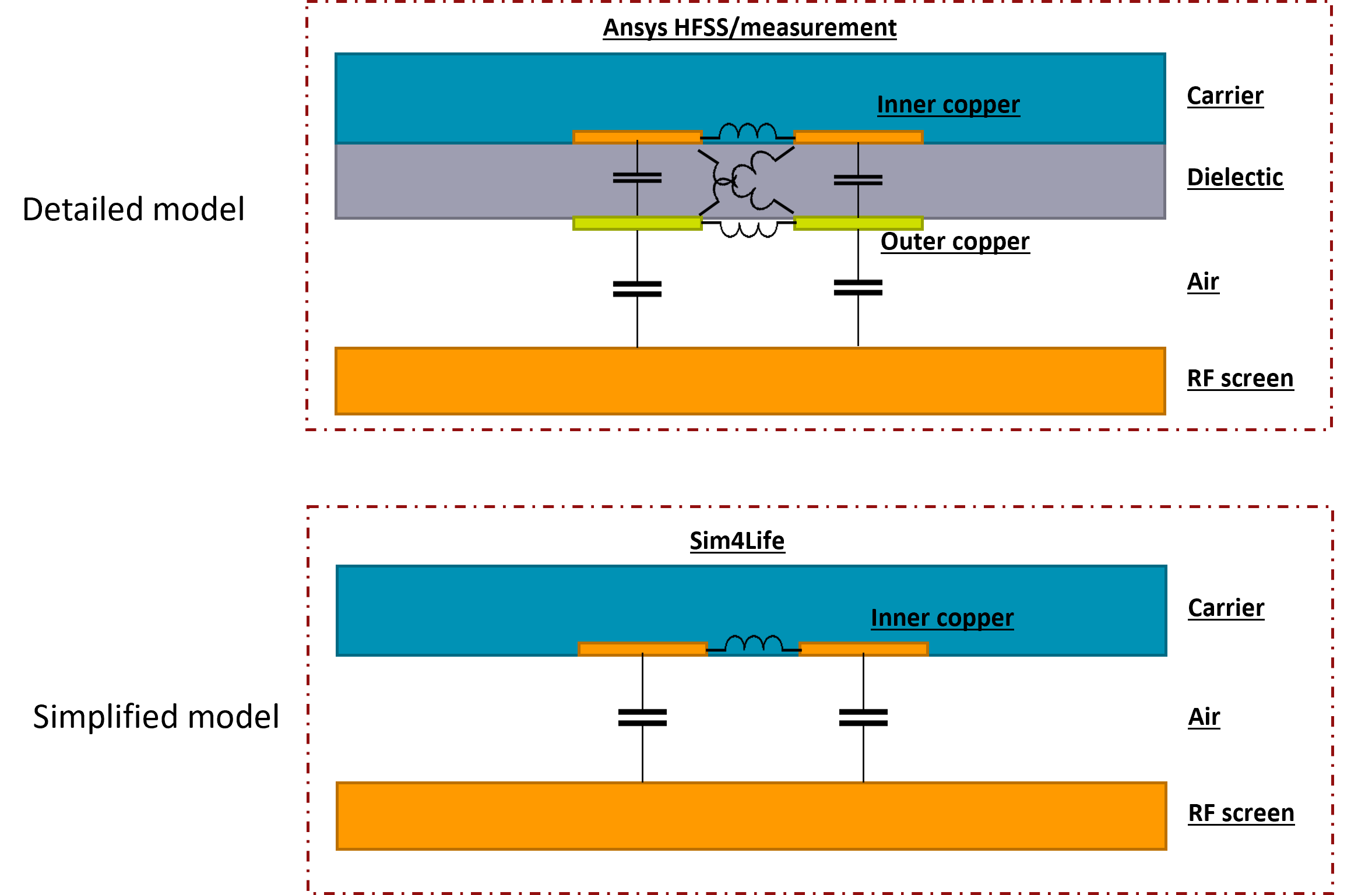
Approach: In Sim4Life, a body coil is simulated using lumped element capacitors instead of layered capacitor structures. Capacitor values are optimized by network co-simulation to minimize differences in the resulting E-field distribution and that of HFSS.
Results: Improved E-field and B1+ field distributions are observed in common phantoms for whole-body SAR and implant local SAR assessment.
Impact: The proposed method can accurately simulate complex birdcage body coils with layered capacitor structures while also being able to include realistic body models. As such, the method combines the features of FDTD and FEM simulations.
Introduction
The radiofrequency (RF) fields applied by MRI scanners to implants can pose safety risks which require careful characterization. Therefore, accurate simulation studies using tools that closely mimic real MRI conditions are essential. Two commonly used simulation methods are finite element (FEM) and finite difference time domain (FDTD). FEM’s tetrahedral grid offers flexibility in geometry but resolving tissue transitions is memory intensive, making it a challenge for realistic engineering models of body coils in combination with accurate human body models. FDTD is less affected by tissue transitions, but its cubical grid must be very fine for resolving complex geometries, making simulation of delicate structures difficult. This study presents a hybrid simulation method that combines FEM and FDTD to exploit their strengths, while circumventing their weaknesses.Method
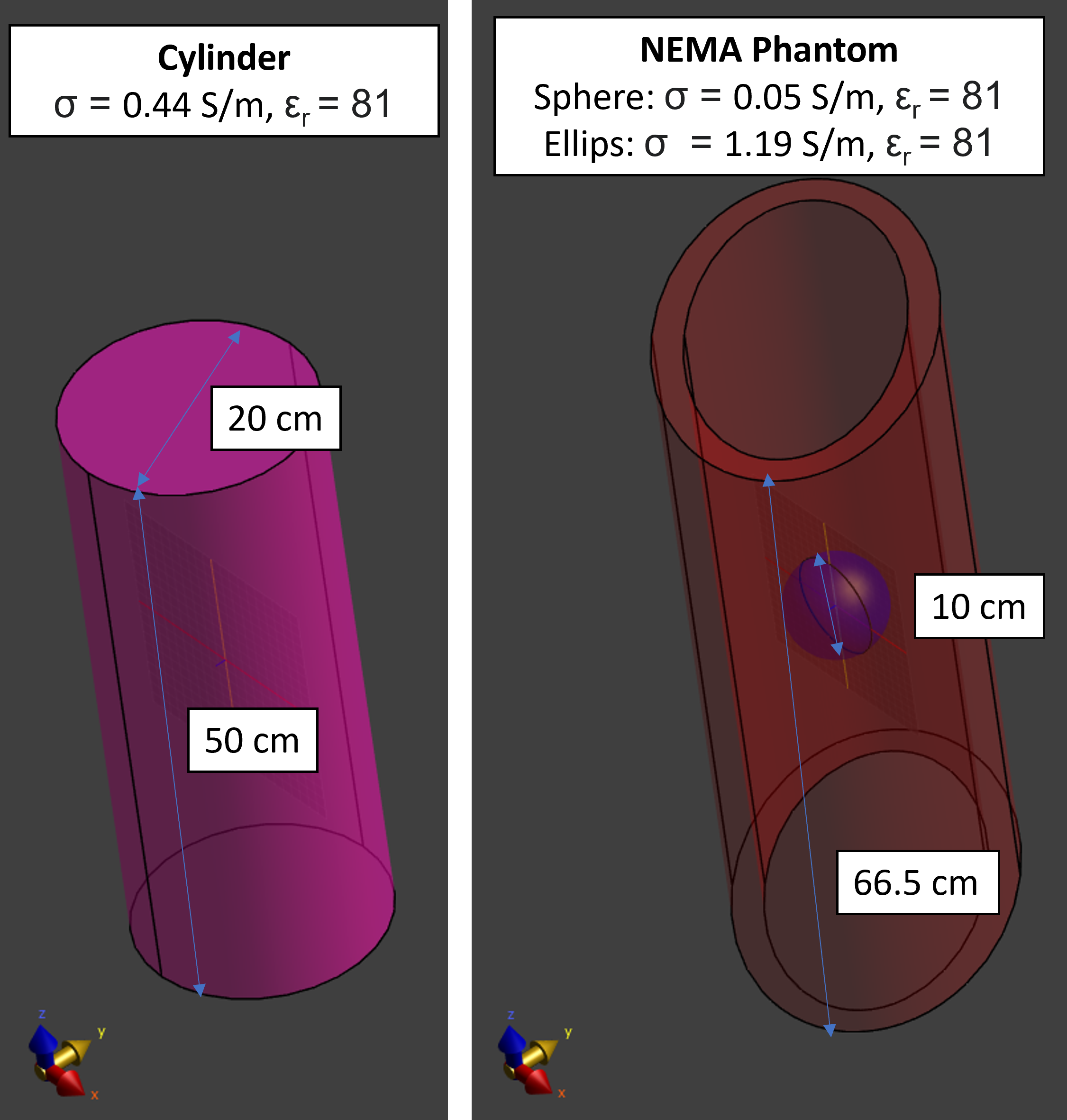
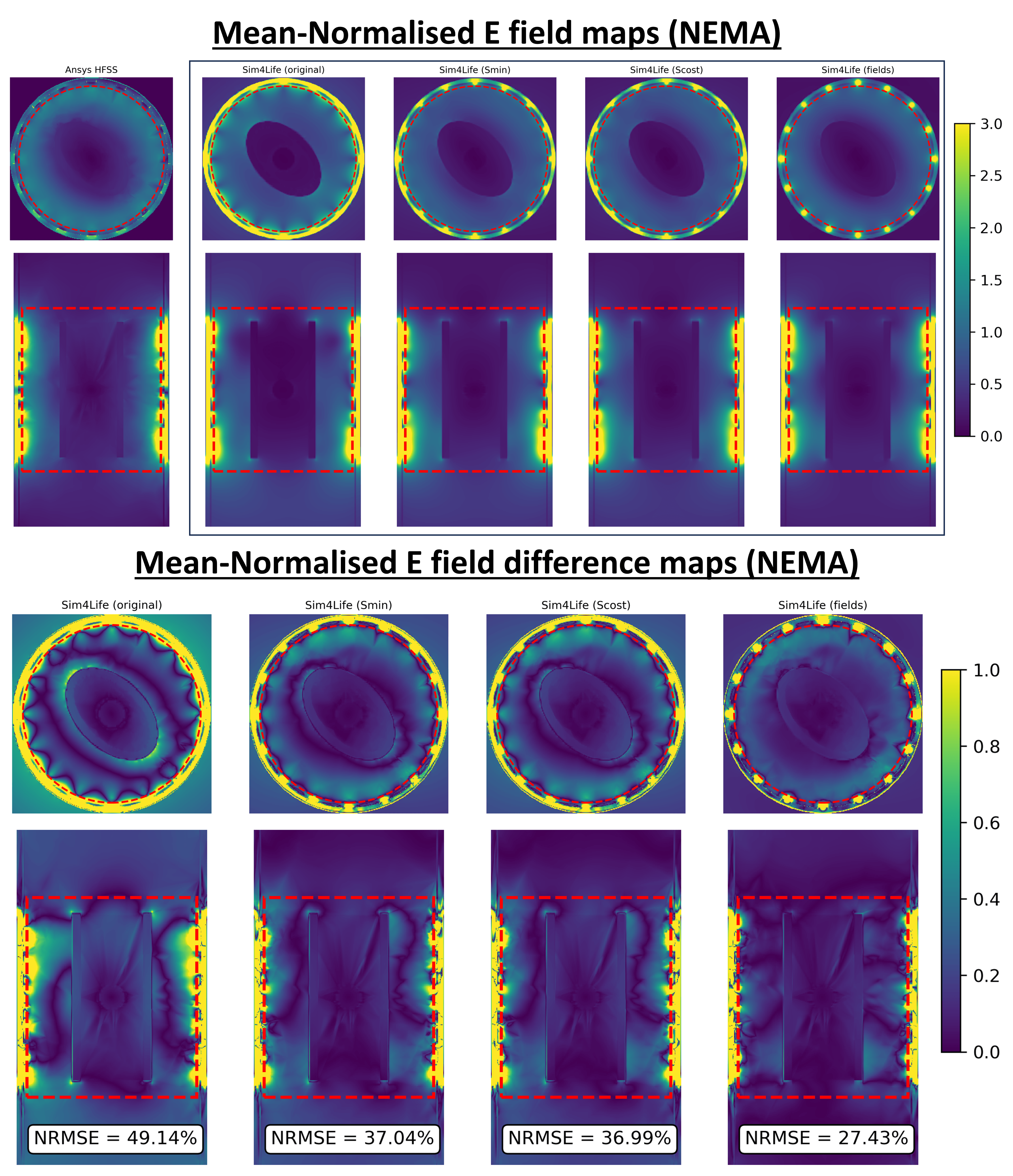
The hybrid simulation method combines Ansys HFSS (FEM) and Sim4Life (FDTD) to accurately model realistic patient models, with the accuracy of a complex birdcage model. HFSS is known for accurately handling complex layers and mutual couplings, making it suitable for detailed birdcage simulations as can be seen in Figure 1. However, it cannot simulate human models due to its more extensive memory consumption. In contrast, Sim4Life’s cubical simulation grid does not handle the curved and thin geometries of the birdcage coil as effectively, but it can easily deal with the tissue transitions of realistic human body models. In addition, the availability of the patient models is limited in HFSS, while Sim4Life uses the so-called Virtual Family1 (VF), which is a set of four highly detailed, anatomically correct whole-body models. In order to model layered capacitor structures in Sim4Life, we have implemented lumped element capacitors (Figure 1). As a result, the multi-layer structure is replaced by a single layer with lumped elements (112 capacitors and 2 ports) between the copper structures. Network co-simulation is used to improve the agreement between Sim4Life and HFSS2. Network co-simulation enables retrospective adaptation of the capacitor values by minimizing a cost-function. The standard cost function minimizes the S-parameter2 (Smin), but an alternative is a previously proposed method that minimizes all S-parameter differences3: here between Sim4Life and HFSS (Scost). In our case, the S-parameters of HFSS were used as ground truth. In addition, an alternative network co-simulation cost function was used to minimize the difference between the Sim4Life E-field magnitude distributions and the HFSS-generated field distributions (fields). The cylindrical phantom model used for the optimization is shown in Figure 2. To quantify the agreement between FEM and FDTD simulations, the Normalised Root Mean Square Error (NRMSE) was used per voxel, after normalizing the mean field magnitude in a region of interest. To verify generalisability, the method is then tested on another phantom, the NEMA phantom, also shown in Figure 2. The field distribution for this phantom is also analysed.Results
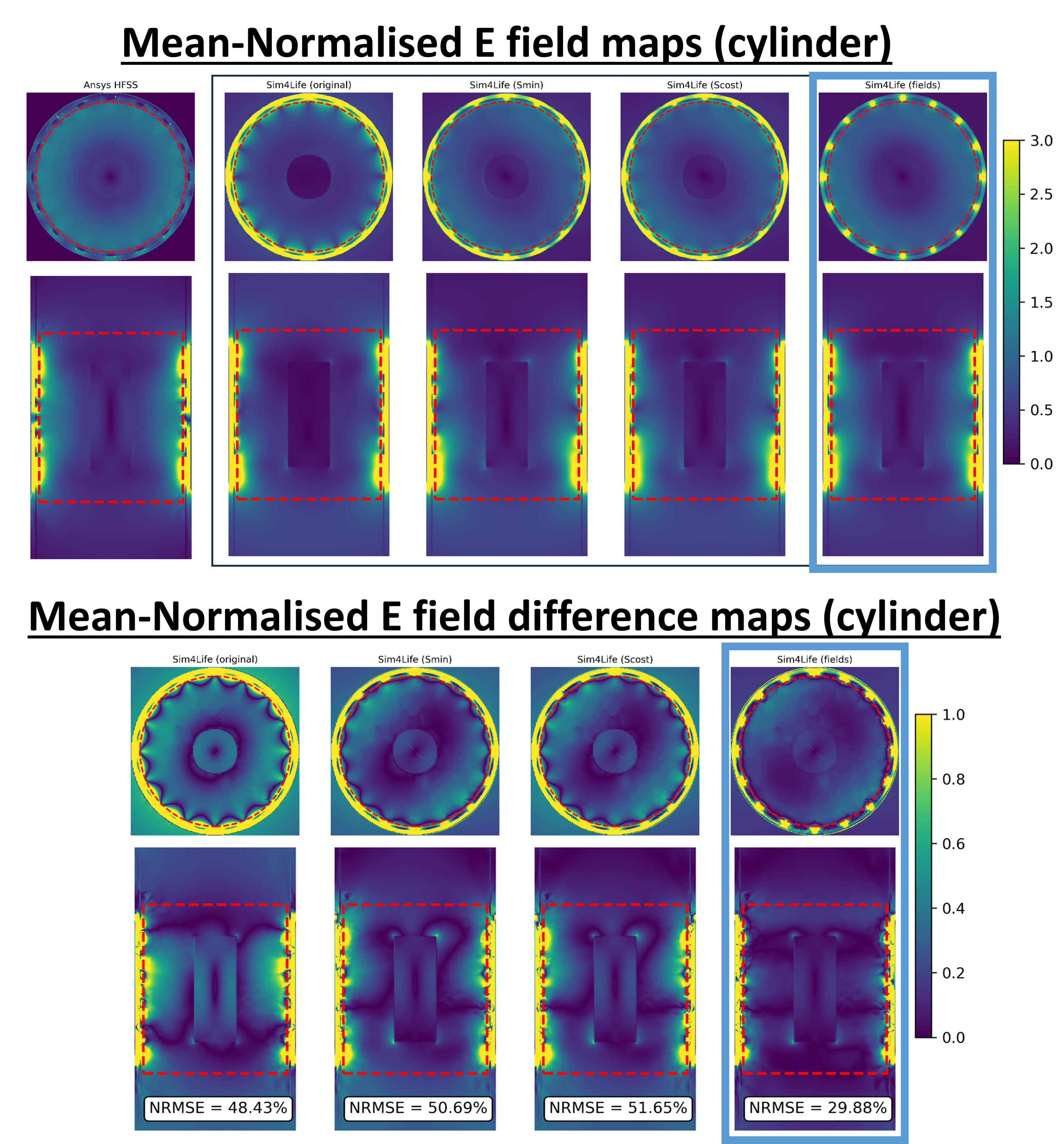
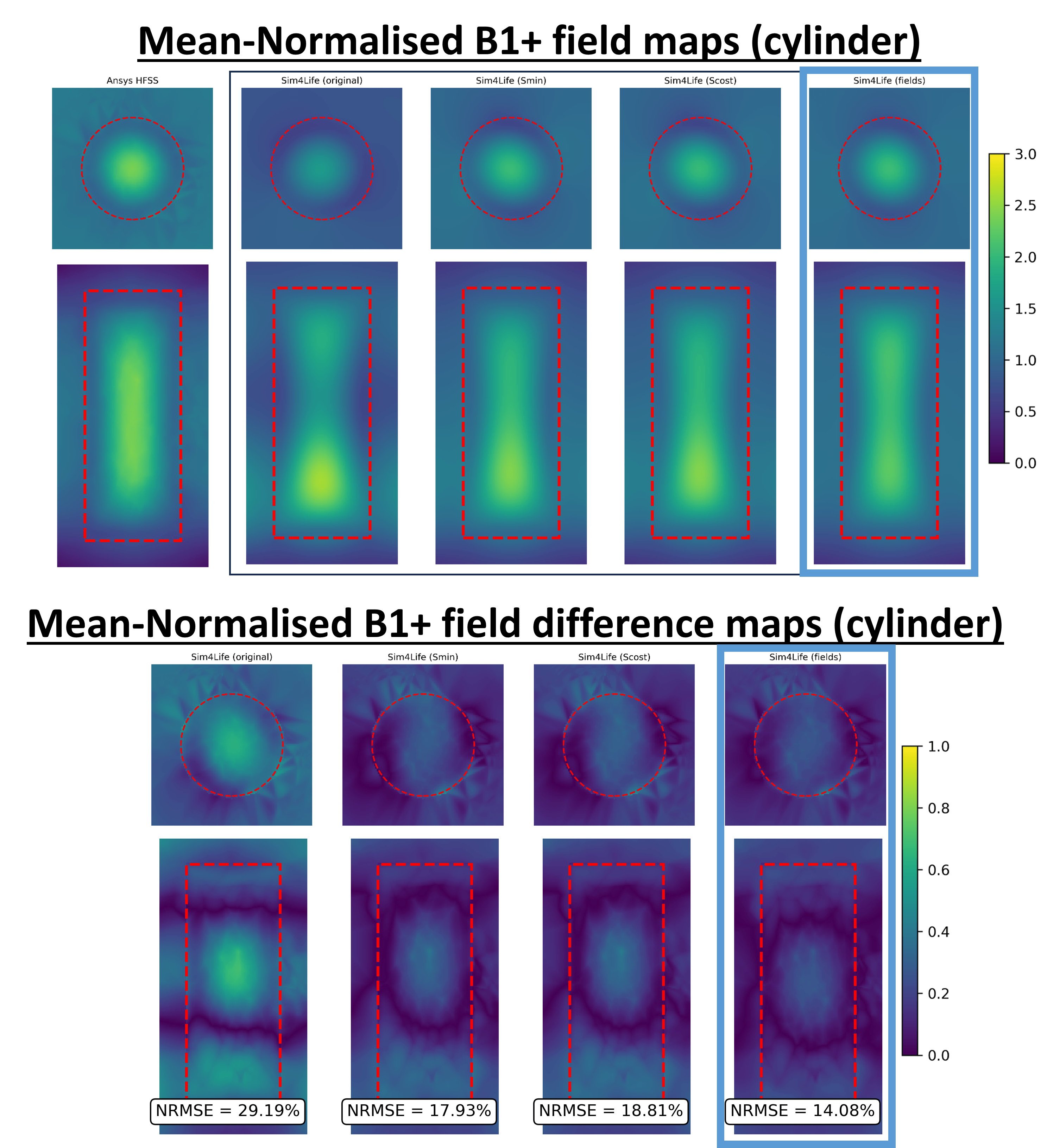
Figure 3 depicts the E-field distributions for the various cost function optimizations. Qualitatively, the agreement between Sim4Life and HFSS is greatly improved using the proposed field-based cost-function. Figure 4 shows that the B1+ field prediction is also improved. The dedicated matching method achieved a significant improvement over the original Sim4Life simulation, reducing the NRMSE for the E-field from 48.43% to 29.88% and for the B1+ field from 29.19% to 14.08%. Using the same optimized capacitor values, field distributions for the NEMA phantom are shown in Figure 5. The NRMSE for the E-field was reduced from 49.14% to 27.43%, and from 9.00% to 0.75% for the B1+ field (B1+ data not shown).Discussion
This study introduces a novel method to adapt lumped capacitor values to improve the agreement between three-layer implementations with those of four-layer body coil simulations. NRMSE could be improved to 27.43%. Network co-simulation not only improved simulation matching, but could also be applied to improve the resulting field distributions. Our hybrid co-simulation method is able to accurately simulate birdcage body coils with layered capacitor structures, while also enabling efficient SAR assessment in complex body models. Although actual performance of the simulators is dependent on the source implementation, the method appears capable of homogenizing also slightly inhomogeneous distributions.Conclusion
Two different methods were combined into a hybrid method using FEM (HFSS) and FDTD (Sim4Life) through network co-simulation. A field-matching optimization procedure was proposed and tested on different sets of phantoms. The results improve the normalised field distribution, with the new method significantly outperforming conventional methods.Acknowledgements
No acknowledgement found.References
[1] Gosselin, M. C., Neufeld, E., Moser, H., Huber, E., Farcito, S., Gerber, L., Jedensjo, M., Hilber, I., Gennaro, F. di, Lloyd, B., Cherubini, E., Szczerba, D., Kainz, W., & Kuster, N. (2014). Development of a new generation of high-resolution anatomical models for medical device evaluation: the Virtual Population 3.0. Physics in Medicine & Biology, 59(18), 5287. https://doi.org/10.1088/0031-9155/59/18/5287
[2] A. Beqiri, J. W. Hand, J. V. Hajnal, and S. J. Malik,“Comparison between simulated decoupling regimes forspecific absorption rate prediction in parallel transmitMRI,” Magnetic Resonance in Medicine, vol. 74, no. 5,pp. 1423–1434, 11 2015.
[3] M. Restivo, A. Raaijmakers, C. van den Berg, P. Luijten,and H. Hoogduin, “Improving peak local SAR predictionin parallel transmit using in situ S-matrix measurements,”Magnetic Resonance in Medicine, vol. 77, no. 5, pp. 2040–2047, 5 2017.
[4] National Electrical Manufacturers Association. " NEMA Standards Publication MS 8-2016: Characterization of the Specific Absorption Rate (SAR) for Magnetic Resonance Imaging Systems" NEMA Publication MS 8-2016.
Figures