3747
Real-time SAR Supervision for a 32-channel RF Transmit System with Virtual Observation Points1Medical Physics in Radiology, German Cancer Research Center (DKFZ), Heidelberg, Germany, 2Faculty of Physics and Astronomy, University of Heidelberg, Heidelberg, Germany, 3Erwin L. Hahn Institute for MRI, University Duisburg-Essen, Essen, Germany, 4Faculty of Medicine, University of Heidelberg, Heidelberg, Germany
Synopsis
Keywords: Safety, Safety
Motivation: Real-time local SAR supervision is a major obstacle in pTx system especially since the computational demand scales proportionally with the number of RF channels.
Goal(s): To develop a safety supervision that monitors 32 transmit channels phase sensitive and perform local SAR calculation with a higher number of VOPs.
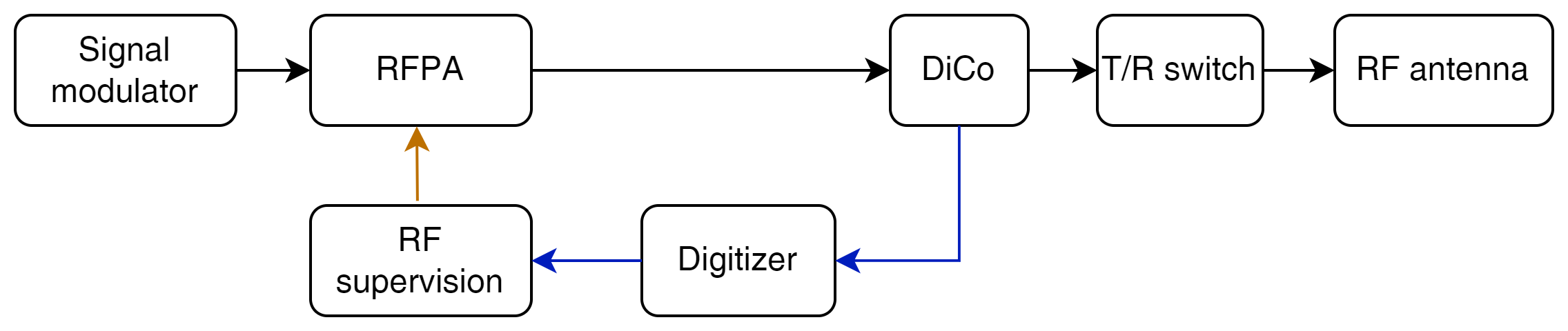
Approach: Directional couplers are placed in the transmit path, digitizers sample the RF signal, and a GPU performs the local SAR calculation.
Results: This study demonstrates real-time RF supervision for a 32-channel pTx transmit system with local SAR calculation using 600 VOPs on a single GPU.
Impact: This study demonstrates real-time RF supervision for a 32-channel pTx transmit system with single-GPU-based local SAR calculation using 600 virtual observation points.
Introduction
Previously, we presented a 32-channel RF transmit (Tx) add-on system including an integrated antenna array for body imaging at 7T MRI.1,2 To supervise safety of the subjects, the transmitted RF power must be supervised by an independent supervision system that stops the transmission of the RF signal if one of the limits defined in the IEC standard,3 including local and whole-body SAR, is exceeded.Local SAR supervision is a major obstacle in pTx systems, as simulations with anatomical body models results in several million Q-matrices.2 To reduce the number of matrices, the concept of virtual observation points (VOPs) was introduced, where a compressed set of Q-matrices is computed, reducing the number of matrices to supervise to a few hundred. The compression algorithms incorporate an overestimation factor, which is defined as a percentage of the worst-case SAR. A high overestimation factor results in a low number of VOPs but high SAR overestimation, which reduces the imaging performance of the RF array, as the supervision estimates a higher SAR compared to the actual SAR due to the VOP overestimation. As shown previously,4 the relative overestimation for a specific RF shim can easily reach several hundred percent, as the worst-case SAR is the global value achievable by any shim. Thus, a low overestimation factor is preferable, which in turn leads to a high number of VOPs.
The computational demand for SAR calculation in the safety supervision also scales with the number of channels. A 32-channel Tx-system requires 16x more floating-point operations per matrix compared to an 8-channel Tx-system.
In this work, we present a safety supervision system designed to address two challenges: 1) to monitor 32 RF transmit channels including their relative phases, resulting in a total of 64 data channels; 2) to perform the local SAR calculation within the data acquisition time to ensure real-time supervision, using a high number of VOPs to reduce the SAR overestimation.
Methods
Data acquisition8 digitizer cards (Teledyne ADQ14-4C, 1 GSPS sampling rate, 14-bit vertical resolution, max. 1.8 Vpp input range, four digital down converters (DDC) per card) are connected to a workstation (Intel Core i7-10700K, 32 GB DDR4, Ubuntu 22.04) via PCIe connection (Adlink PCIe-PXIe-8638). The sampling rate was reduced to 3.91 MHz, resulting in a data stream of 0.5 Gbyte/s. Directional couplers are placed in the transmit path close to the scanner and the output was adjusted to the input range of the digitizers.
The data stream of 64 data channels from the DDCs is combined to 32 complex signals, and the recorded data are split into data blocks of 8192 16-bit data samples (record time per block: 2.1 ms).
SAR calculation and time-averaging
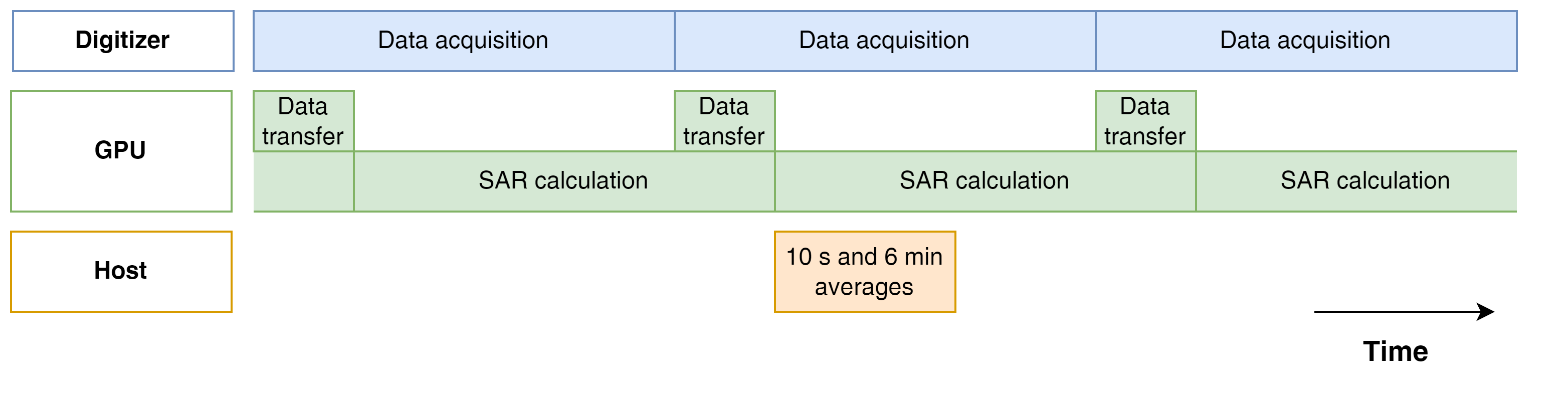
A complete data block record is sent to a GPU (Nvidia RTX 3080Ti, 34.2 TFLOPS FP32) for SAR calculation, which is performed using the quadratic form5 for each data sample.
The calculation is performed within the 2.1 ms acquisition time for the subsequent data block, Fig. 2. Nvidia Nsight Systems was used for GPU profiling.
SAR of 48 data blocks (100.66 ms) is time-averaged per VOP and added to ring buffers for 10s and 6min averaging. The ring buffers are evaluated regarding the IEC limits after every 100.66 ms.
System supervision
The supervision software running on the Ubuntu workstation sends an alternating signal every 0.1 s to the RF power amplifiers (RFPAs). If this signal is interrupted, the RFPAs will switch off.
Results
The number of VOPs was increased until the system lost its real-time capability. With the selected GPU, up to 600 VOPs can be supervised in real-time, while a simple non-accelerated CPU-based implementation was able to supervise 20 VOPs.Discussion and Conclusions
Real-time supervision is a crucial element of an RF parallel transmit system to supervise safety of the subject and utilize the full potential of the RF array. However, the computational demand scales proportionally with the number of RF channels.6 As arrays with a large number of channel tend to have higher worst-case SAR,4 it is preferable to use a high number of VOPs for supervision to reduce SAR overestimation, which in turn increases the computational demand further.In this work, we present a real-time RF supervision system designed to monitor a 32-channel pTx system phase sensitive and perform the local SAR calculation with 600 VOPs. SAR calculation was performed on a GPU due to the parallel calculation capabilities. As an independent supervision system, this system can monitor any antenna array with up to 32-channels using the corresponding VOP-file obtained from numerical simulations.
Acknowledgements
The research leading to these results has received funding from the European Research Council under the European Union's Seventh Framework Programme (FP/2007-2013) / ERC Grant Agreement n. 291903 MRexcite.References
1. Orzada S et al. A 32-channel parallel transmit system add-on for 7T MRI. In: PLoS ONE. 2019;14(9):e0222452.
2. Fiedler T et al. Performance and safety assessment of an integrated transmit array for body imaging at 7 T under consideration of specific absorption rate, tissue temperature, and thermal dose. In: NMR in Biomedicine. 2021;e4656; DOI: 10.1002/nbm.4656
3. International Electrotechnical Commission (IEC). IEC 60601–2-33:2022 Medical electrical equipment - Part 2–33: Particular requirements for the basic safety and essential performance, Ed. 4.0.
4. Fiedler T et al. Performance analysis of integrated RF microstrip transmit antenna arrays with high channel count for body imaging at 7 T. In: NMR in Biomedicine. 2021;e4515 DOI: 10.1002/nbm.4515
5. Zhu Y. Parallel excitation with an array of transmit coils. In: Magn Reson Med. 2004;51(4):775-784.
6. Orzada S et al. A new hybrid non-clustering VOP compression algorithm. Submitted to Proc. ISMRM 2024.
Figures