3744
An Efficient Method to Mitigate RF-induced Heating in DBS patient at 7T Using Geometrically Adjustable RF Head Array.1Electronic Engineering, Hanyang University, Seoul, Korea, Republic of, 2Biomedical Engineering, Hanyang University, Seoul, Korea, Republic of
Synopsis
Keywords: Safety, Safety, RF-induced heating, Implantable Devices
Motivation: Patients with deep brain stimulation (DBS) devices are strictly prohibited from undergoing 7 Tesla magnetic resonance imaging (MRI) scans.
Goal(s): Mitigating radiofrequency (RF)-induced heating in DBS for 7 T MRI using a convenient approach.
Approach: By utilizing the electromagnetic characteristics arising from the near-field region of the RF coil, a novel method of rearranging the positions of the RF channels adjacent to the DBS lead using a geometrically adjustable RF array was proposed.
Results: Adjusting the position of channels adjacent to lead reduces the specific absorption rate and the extent of temperature increase around the electrode up to 34% and 23.8 %, respectively.
Impact: Our method involves strategically adjusting the position of RF coil near the lead, providing a practical solution to mitigate RF-induced heating in DBS. It eliminates the necessity for a new lead design or complex numerical optimization for incident electromagnetic field.
Introduction
Due to the risk of radiofrequency (RF)-induced heating associated with metallic implants, individuals with deep brain stimulation (DBS) devices are strictly prohibited from undergoing ultrahigh-field 7 T magnetic resonance imaging (MRI) scans. Despite various approaches suggested to mitigate RF-induced heating, their implementation within the current MRI system has proven to be challenging, often necessitating structural modifications to the leads [1, 2] or the customization of RF coil input parameters through complex mathematical calculations [3]. In this context, we introduce a method for conveniently and effectively reducing RF-induced heating from DBS by adjusting the geometry of the RF array, leveraging the electromagnetic field characteristics in the near-field region.Preliminary Study to Evaluate Effect of Near-Field Region
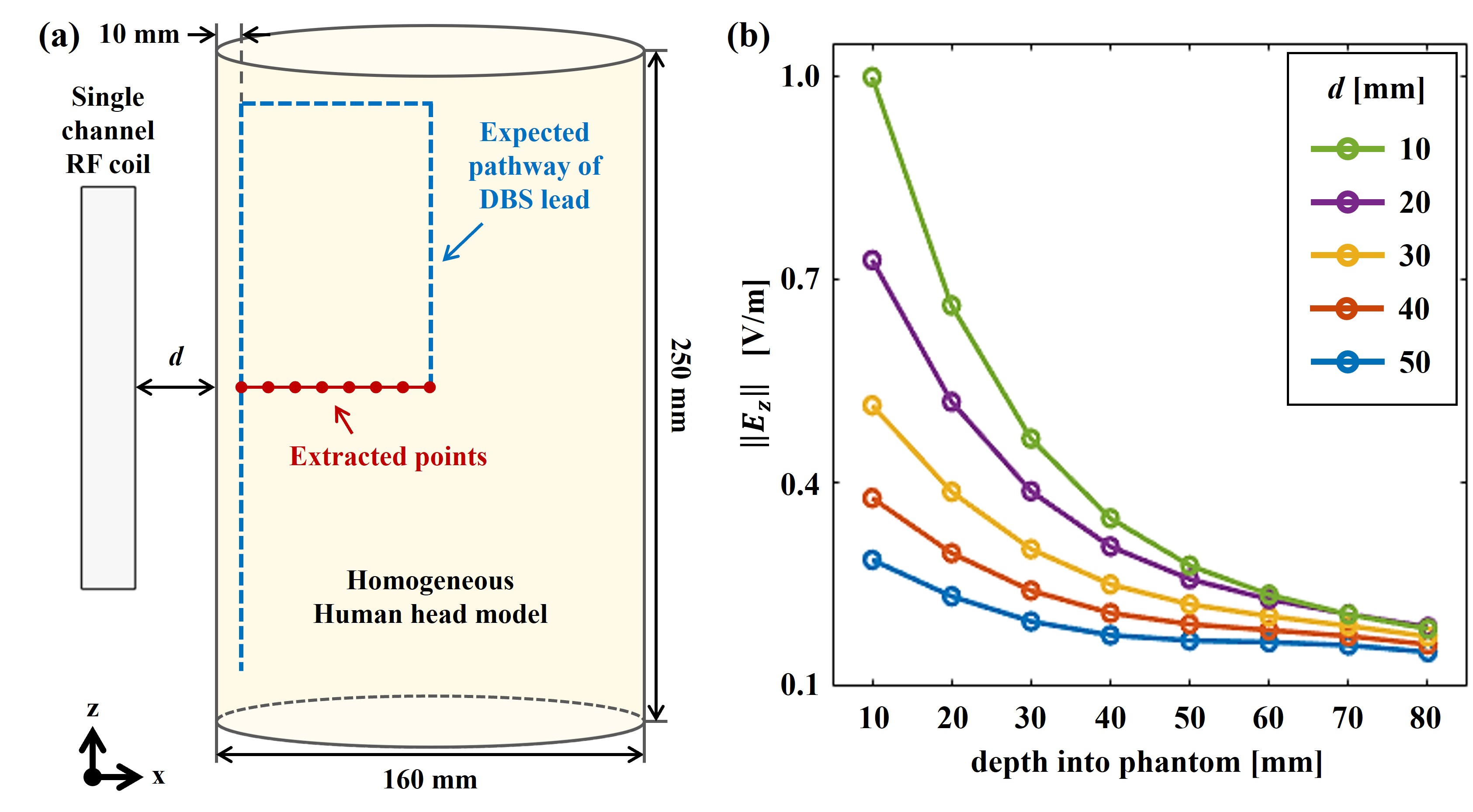
In order to quickly and intuitively evaluate the impact of a DBS lead situated in the near-field region, where even slight positional adjustments can lead to significant changes in EM field intensity, we conducted an initial investigation using the commercial finite-difference time-domain (FDTD) simulation software, Sim4Life [4]. This study specifically involved employing a cylindrical head model consisting of a uniform head-mimicking medium (with εr = 58.1 and σ = 0.539 S/m) and a single RF coil, as illustrated in Figure 1(a). In Figure 1(b), the relative magnitude of the z-directional electric field (Ez) is depicted at eight specified points, as shown in Figure 1(a). This magnitude is represented as a function of the distance d between the RF coil and the human head. It's important to note that the input power of the single RF coil remained constant for all distances d. As the distance d increased, the magnitude of Ez decreased at all points within the head model. Notably, at points situated closer to the source, particularly those near the surface of the model, the characteristics originating from the near-field region became more pronounced, resulting in a significant variation in Ez magnitude with respect to changes in distance d. This suggests that by properly repositioning the channels of RF array in close proximity to the lead, effective reduction of RF-induced heating in DBS can be accomplished.Simulation Modeling of RF Array and Human Head with DBS Lead
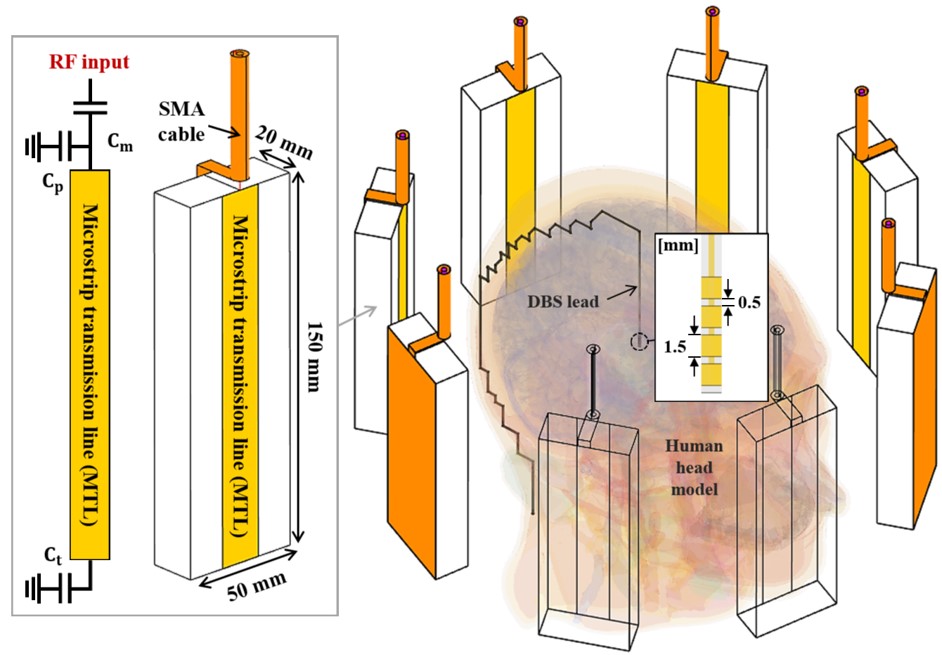
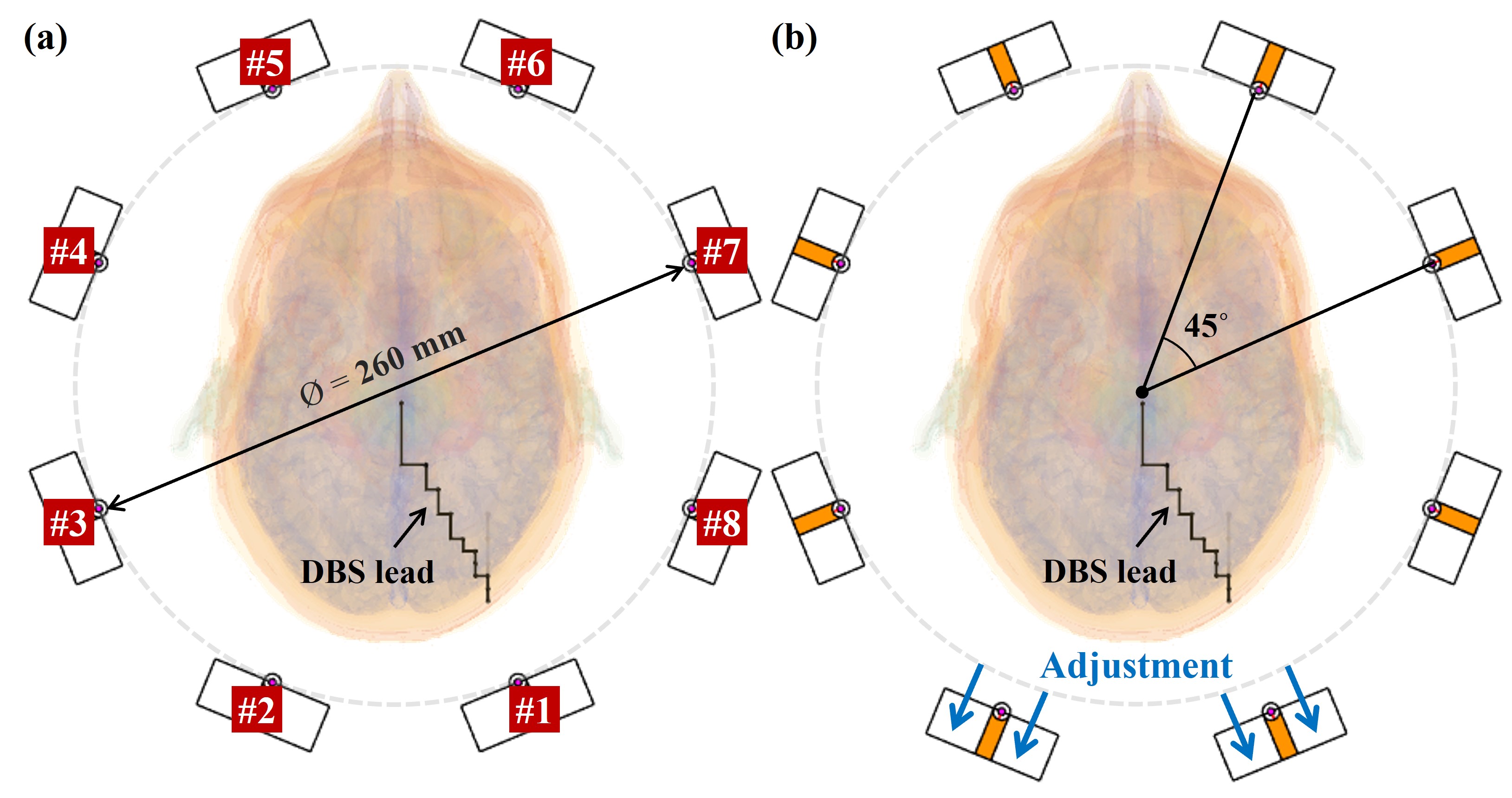
Figure 2 depicts the setup used for the simulation, encompassing an RF array for MR head imaging and a realistic heterogeneous model of an adult male's head (DUKE model: male, 32 years old). The RF array consisted of eight RF resonators and was configured to encircle the human head cylindrically. To evaluate the practicality and effectiveness of adjusting the geometry of the RF array to mitigate RF-induced heating caused by the DBS lead, we conducted simulations for four different scenarios based on a geometrically adjustable RF array, as previously designed in our group [5]. These four simulated scenarios comprised one initial case with no geometric adjustments (seen in Figure 3(a)), where eight channels were arranged in a circular shape with a diameter of 260 mm. Additionally, there were three adjusted cases, as depicted in Figure 3(b). In these adjusted scenarios, the positions of two channels (#1 and #2) located near the lead were selectively shifted by 3, 8, and 13 mm away from the human head.Results and Discussion
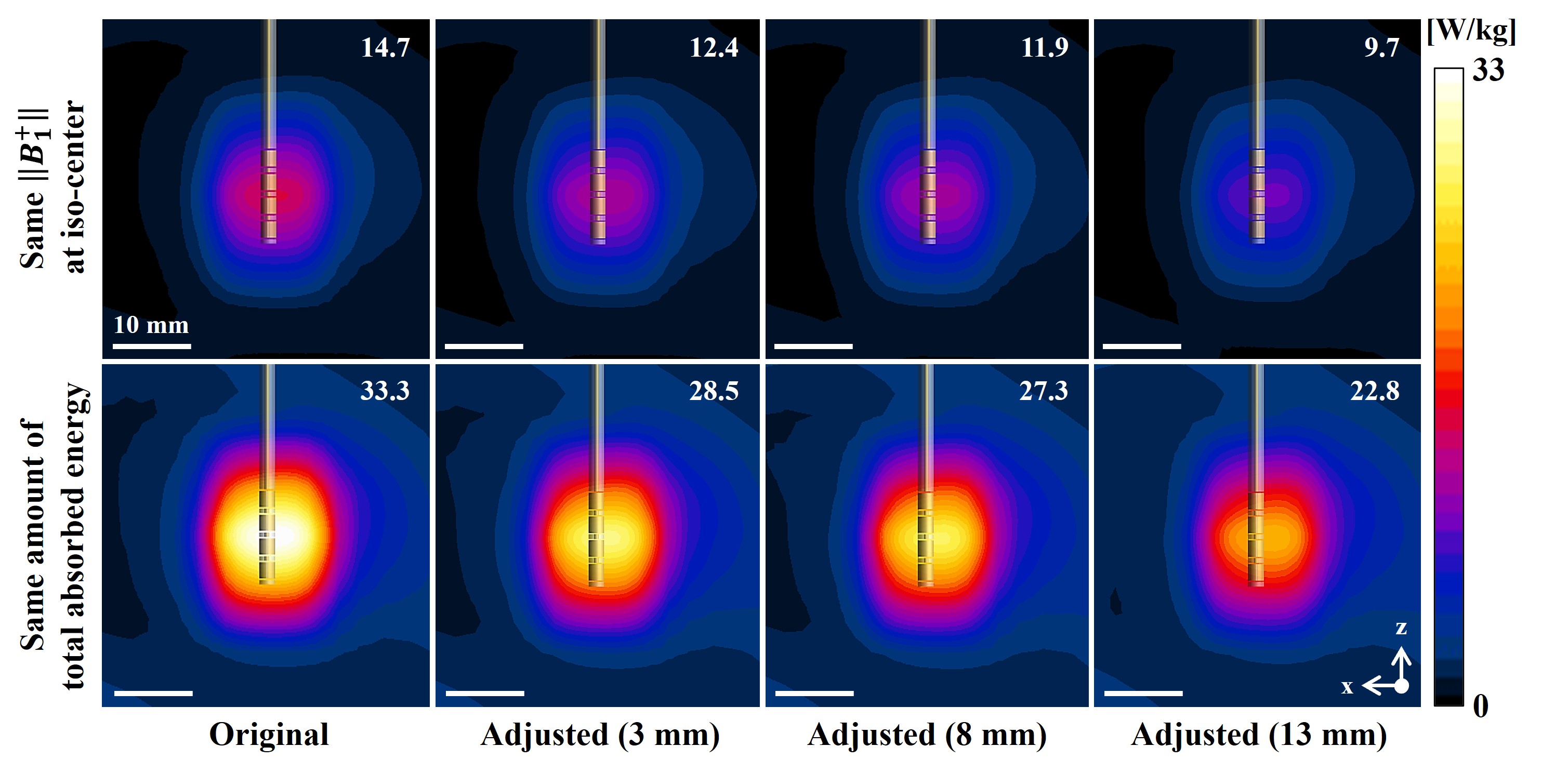
Figure 4 shows the 1-gram specific absorption rate (SAR), known as SAR1g, in the vicinity of the electrode when the lead is inserted into the head, as shown in Figure 2. The input power supplied to the RF arrays was scaled based on following two conditions: 1) to ensure uniform B1+ intensity at the center of the head, and 2) to uphold equal power absorption across the entire head. The numbers in the top right corner of each figure indicate the highest SAR1g values observed for each case. As deduced from the outcomes presented in the preliminary study in Section I, the strength of the Ez field impacting the head diminished as the RF channels near the lead were shifted further away. Consequently, the induced current decreased, resulting in a gradual reduction in SAR1g around the electrode. The ratio of the reduced peak SAR1g due to the geometric adjustment of the RF array reached a maximum of 34%. This outcome verifies that altering the RF channel positions effectively mitigates the risk of RF-induced heating.Acknowledgements
This work was supported by the National Research Foundation of Korea (NRF) Grant by the Korean Government through the Ministry of Science and ICT (MSIT) under Grant 2022R1A2C2003726.References
[1] D. Rupam and H. Yoo, "RF Heating Study of a New Medical Implant Lead for 1.5 T, 3 T, and 7 T MRI Systems," IEEE Trans. Electromagn. Compat., vol. 59, no. 2, pp. 360-366, Apr. 2017.
[2] L. Golestanirad, L. M. Angelone, J. Kirsch, S. Downs, B. Keil, G. Bonmassar, and L. L. Wald, "Reducing RF-induced Heating near Implanted Leads through High-Dielectric Capacitive Bleeding of Current (CBLOC)," IEEE Trans. Microw. Theory Tech., vol. 67, no. 3, pp. 1265- 1273, Mar. 2019.
[3] E. Kazemivalipour, B. Keil, A. Vali, S. Rajan, B. Elahi, E. Atalar, L. L. Wald, J. Rosenow, J. Pilitsis, and L. Golestanirad, "Reconfigurable MRI technology for low-SAR imaging of deep brain stimulation at 3T: Application in bilateral leads, fully-implanted systems, and surgically modified lead trajectories," Neuroimage, vol. 199, pp. 18—29, Oct. 2019.
[4] Sim4Life by ZMT. [Online]. Available: http://www.zmt.swiss.
[5] Y. Cho, A. Basir, and H. Yoo, "Adjustable RF Transmitter Head Coil: Improving Transmit Efficiency With SAR Management for 7-T Magnetic Resonance Imaging," IEEE Trans. Microw. Theory and Techn., vol. 69, no. 5, pp. 2686-2696, May 2021.
Figures