3740
Investigation of RF-Induced Heating of Active implantable Medical Devices with Shorted Leads Under 1.5T MRI1University of Houston, Houston, TX, United States, 2Abbott Medical, Plano, TX, United States
Synopsis
Keywords: Safety, Safety
Motivation: In active implantable medical devices (AIMDs), electrical shorts may occur either between electrodes of two leads in multi-lead systems (inter-lead shorts), or within the AIMD header due to incomplete lead insertion (intra-lead shorts).
Goal(s): Whether these shorts invalidate the originally-established MR safety condition for RF-induced heating?
Approach: The RF-induced heating for three shorted-lead cases were investigated. Device heating models (transfer functions) and RF-induced heating were measured for 1.5T MR systems.
Results: Though the intra-lead short case exhibited a similar transfer function (TF) and RF-induced heating to non-shorted leads, inter-lead shorts had significant impact on the RF-induced heating.
Impact: This research improves MRI safety for patients with active implantable medical devices (AIMDs) by studying the effects of electrical shorts.
Introduction
When a patient with an implantable device undergoes an MRI scan, one of the major safety concerns is RF-induced heating. The transfer function (TF) method is a convenient way to estimate the RF-induced heating under MRI, which decouples the device model development from the RF field within the MRI environment1. Since the AIMD is designed to remain in the body for years, slight position shifts of the device over time could cause electrical shorts between electrodes of multi-lead systems, which might result in unexpected RF-induced heating. Additionally, even for single-lead systems, shorts may occur within the device header due to improper insertion of the lead. Both short types are typically detected within the device, preventing the device from entering MRI-mode and contra-indicating the device/patient for MR scanning. In this work, the impacts of these shorts on RF-induced heating under MRI were studied. Transfer function and RF-induced heating measurements were conducted at 1.5 T for four short scenarios.Method
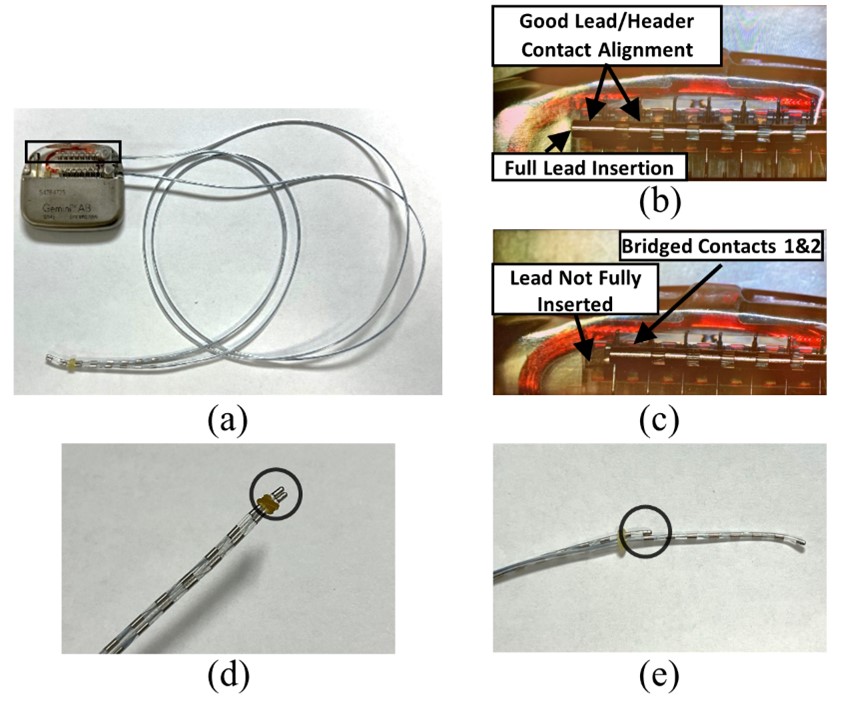
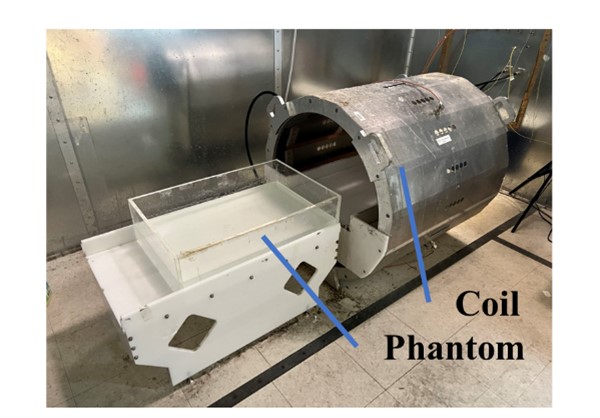
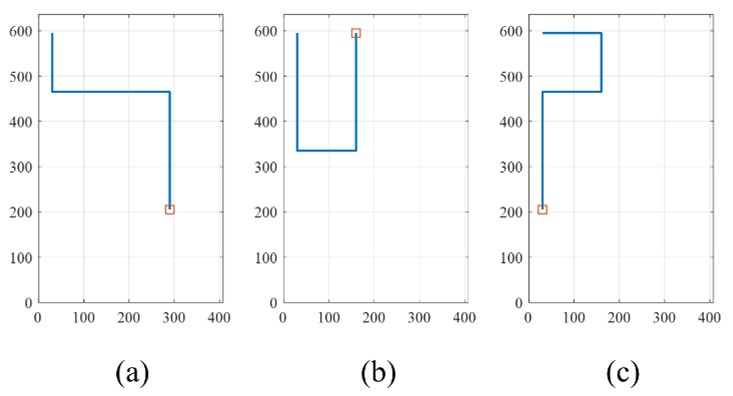
A commercially available spinal cord stimulator with two 64 cm leads was used in this study (Figure 1). Four cases were studied, including single lead full insertion, single lead incomplete insertion (intra-lead short), and shorts between either the two distal electrodes or distal/proximal electrodes of two leads (inter-lead shorts 1-1 and 1-8 respectively). These two inter-lead cases were chosen as edge cases representing the range of combinations of all possible inter-lead shorts. For each case, the transfer function and RF-induced heating were measured at 1.5T. To measure the RF-induced heating, the device was placed inside the ASTM phantom (636 × 408 × 90 mm3) filled with gel (σ = 0.47 S/m, εr = 81) at a height 45mm beneath the gel surface and excited using a 1.5T birdcage coil (Figure 2). RF-induced heating was measured for 1 minute for each case with the lead routed along three different pathways (Figure 3), which were chosen to provide variation across a range of expected heating levels. The E-field at 2 cm from the phantom edge was set at ~143 V/m (RMS). Before the transfer function and RF-induced heating measurements, the hotspot was determined using a thermal camera with the lead routed along pathway 3. Tangential E-field values were extracted for each pathway, which were used to calculate expected temperature rise for TF scaling and validation of each configuration.Results
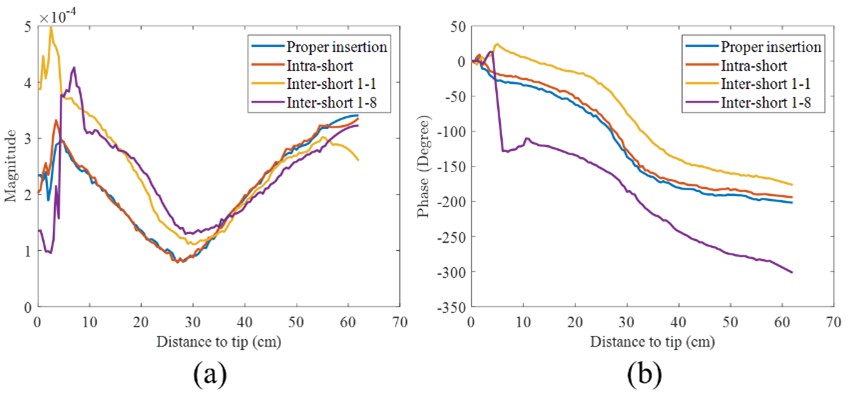
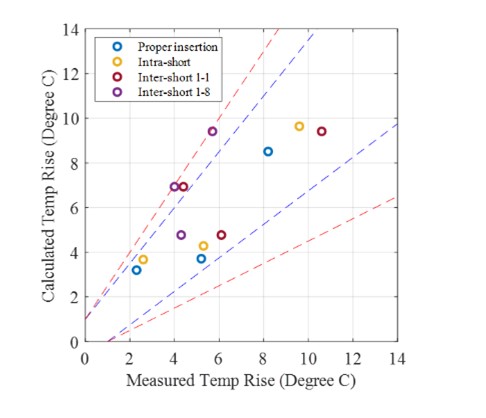
For single lead full insertion and intra-lead short case, the hotspots are near the distal electrode, while for inter-lead short cases, the hot spots are near the contacted electrodes. The magnitude and phase of the four TFs are shown in Figure 4. Figure 5 presents the 1-min temperature rise measurements and TF-based calculated temperature rise. The average measured temperature rises for single lead full insertion, intra-lead short case, inter-lead short 1-1 case, and inter-lead short 1-8 case are 5.23, 5.83, 7.03 and 4.67 ℃, respectively.Discussion
The TFs of the intra-short case and single lead full insertion are very similar to each other (Figure 4) suggesting that shorts due to incomplete lead insertion may have little effect on electrode heating. Although the average temperature rises for the two inter-short cases differ from each other, their TFs are closely aligned, both appearing higher magnitude than the full insertion control. This indicates that lead-to-lead contact has the potential for increased RF heating. Considering that parallel dual lead configurations typically generate lower heating than a single lead2, the increased heating from the inter-lead contact may be significant.Conclusion
This study investigated three distinct scenarios involving lead shorts against a full insertion control lead. The transfer functions for the intra-short case and single lead full insertion were found to be very similar, and the RF-induced heating in both cases was closely matched. However, inter-lead shorts were found to potentially lead to higher temperature rises compared to the properly inserted single lead case. Overall, these results suggest that labeling for MR-conditionality of certain lead short cases may be feasible for device manufacturers in the future but that there may be distinct differences in patient safety dependent on the exact conditions of the short. These differences would require thorough evaluation.Acknowledgements
No acknowledgement found.References
1. Feng S, Qiang R, Kainz W, Chen J. A Technique to Evaluate MRI-Induced Electric Fields at the Ends of Practical Implanted Lead. IEEE Transactions on Microwave Theory and Techniques. 2015;63(1):305-313.
2. Hu W, Guo R, Wang Q, et al. RF‐induced heating for active implantable medical devices in dual parallel leads configurations at 1.5 T MRI. Magnetic Resonance in Medicine. 2023;90(2):686-698.
Figures