3737
Evaluating Specific Absorption Rate Effects of a Flexible Receive-Only Coil With Various Blocking Configurations via Simulation1General Electric HealthCare, Aurora, OH, United States, 2Weill Cornell Medicine, New York, NY, United States
Synopsis
Keywords: Safety, Safety
Motivation: The effects of flexible receive-only coils on Specific Absorption Rate (SAR) are understudied and poorly understood.
Goal(s): The goal was to examine, in the pediatric case, SAR effects in the presence of a receive coil with various blocking impedance characteristics.
Approach: Finite Difference Time Domain analysis was applied to evaluate SAR for pediatric human models wrapped in a flexible 16-channel coil with three blocking impedance configurations.
Results: Results demonstrated that local and whole-body SAR decreased upon inclusion of a wrapped surface coil when blocking impedance was resistive or inductive and increased when capacitive.
Impact: The demonstration of SAR effects in the presence of flexible receive-only coils and the indication of SAR configurability via blocking impedance control informs coil design to lower SAR and facilitate safety in high thermal-risk applications such as pediatric imaging.
Introduction
Specific Absorption Rate (SAR), the rate of radiofrequency power absorbed per unit mass (W/kg)1, is an important factor in magnetic resonance (MR) safety due to body heating from energy absorption, which can result in tissue damage and injury2. An object’s SAR depends on its conductivity, density, and the electric field it experiences. MR applications must remain within International Electrotechnical Commission (IEC)-defined SAR limits, which is particularly important in pediatric imaging3 due to risk of overheating with poor thermoregulation4. Numerical models for verifying SAR in high-risk cases such as pediatric and ultra-high-field5,6 imaging, have been developed7,5,6, all with the need for accurate B1+ and E fields.Receive-only surface coils are typically ignored when describing transmit fields since they are designed to decouple from transmit fields to protect preamplifiers. However, due to the presence of conductive elements, receive-only coils will still have an impact on local B1+ and E fields during transmission. With the development of flexible surface coils, elements and their local fields are closer to the patient than ever. There have been few SAR studies to evaluate the impact of local elements inside a transmit field8,9,10, all of which found SAR to be affected by the presence of receive-only coils, but with no consensus on typical SAR behaviour. Each study represented blocking impedance differently, with only one group incorporating a complex impedance model. This work aims to explore the impact on SAR of different receive coil blocking impedance characteristics in a pediatric imaging case.
Methods
3D electromagnetic simulations were performed using a Finite Difference Time Domain (FDTD) solver (Sim4Life, ZMT Zurich MedTech AG, Switzerland). Simulations were performed at 3T (127.72 MHz) with a 16-rung, 60 cm diameter, high-pass, RF birdcage. The idealized transmit system had 16 equal-amplitude sources applied at the rungs with phases offset to create a circularly polarized transmit field, scaled to 3.6 μT B1+ RMS at patient center.Three pediatric human body models were utilized, including a 29-month-old male (Martin: 13 kg)11, a 5-year-old female (Roberta: 17.6 kg)12, and a scaled-down 2.5-month-old male (Mini Martin: 5.7 kg). All models have anatomical tissue segmentations with appropriate electromagnetic tissue characteristics.
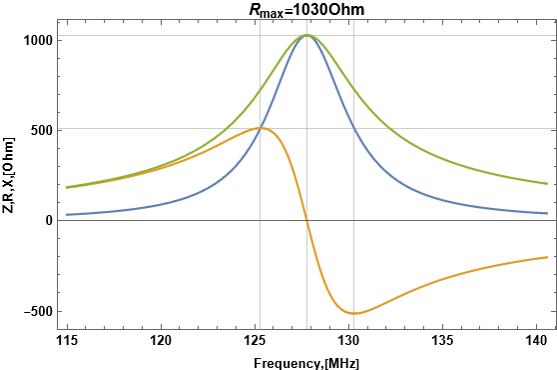
The receive array was modeled after a 16 channel flexible array. The three blocking impedance configurations applied at element ports were resistive (1030Ω), capacitive (515Ω + 2.42pF), or inductive (515Ω + 0.64 μH) via the series combination of two lumped element resistors, a resistor and a capacitor, or a resistor and an inductor, respectively. These represented the impedance of a single parallel resonant blocking network whose tuning was held constant or shifted to maximize positive or negative reactance. Blender was used to wrap the coil model around each pediatric body model, emulating the wrapping of a flexible surface coil.
Results & Discussion
In all three pediatric models, local and whole-body SAR were lowest when a surface coil with inductive blocking impedance was present, which could be due to the reduction of large circulating currents resulting from stray capacitance at coil overlaps. Figure 1 illustrates consistent SAR reductions for both inductive and purely resistive blocking configurations. Capacitive blocking impedance resulted in slightly higher whole-body and local SAR compared to no surface coil, indicating that capacitive blocking may be a sub-optimal configuration. Furthermore, SAR decreased as the size of the body model decreased.SAR effects in the conditions of capacitive, resistive, and inductive blocking are demonstrated for comparison in Figure 4, indicating a consistent trend of best SAR performance in the inductive blocking case and worst SAR performance in the capacitive blocking case for every body size. Local E-field distortion around elements is observed clearly in Figure 2, which also demonstrates local SAR reduction in the presence of the coil compared to no-coil. Reduction in the fields at a distance around these local hot spots is also observed, which may contribute to reduced electric fields at the patient surface. Distortion of B1 upon introduction of both the patient and the surface coil is clearly demonstrated in Figure 3.
Future work includes incorporating additional circuitry and cabling in the simulation which present in typical receive coils, which may impact local E-fields in a similar fashion to elements.
Conclusion
In this model, local and whole-body SAR decreased upon inclusion of a wrapped receive-only coil when blocking impedance was resistive or inductive and increased when blocking was capacitive. While this model is limited, early results indicate that the intentional design of blocking networks for receive-only coils may enable purposeful reduction of SAR, providing engineers and scientists with a tool for expanding applications and ensuring safety, particularly in pediatric scanning.Acknowledgements
No acknowledgement found.References
1. International Electrotechnical Commission. International Standard IEC 60601-2-33. 3.1.; 2013.
2. Shellock FG. Radiofrequency Energy-Induced Heating During MR Procedures: A Review. J Magn Reson Imaging. 2000;12:30-36. doi:10.1002/1522-2586
3. Chavhan GB, Babyn PS, Singh M, Vidarsson L, Shroff M. MR Imaging at 3.0 T in Children: Technical Differences, Safety Issues, and Initial Experience1. https://doi.org/101148/rg295095041. 2009;29(5):1451-1466. doi:10.1148/RG.295095041
4. Falk B. Effects of thermal stress during rest and exercise in the paediatric population. Sport Med. 1998;25(4):221-240. doi:10.2165/00007256-199825040-00002/METRICS
5. Fiedler TM, Ladd ME, Bitz AK. SAR Simulations & Safety. Neuroimage. 2018;168:33-58. doi:10.1016/J.NEUROIMAGE.2017.03.035
6. Zhang X, Schmitter S, Van De Moortele PF, Liu J, He B. From Complex B1 Mapping to Local SAR Estimation for Human Brain MR Imaging Using Multi-channel Transceiver Coil at 7T. IEEE Trans Med Imaging. 2013;32(6):1058. doi:10.1109/TMI.2013.2251653
7. Graesslin I, Homann H, Biederer S, et al. A specific absorption rate prediction concept for parallel transmission MR. Magn Reson Med. 2012;68(5):1664-1674. doi:10.1002/MRM.24138
8. Krishnamurthy N, Zhao T, Ibrahim TS. Effects of receive-only inserts on specific absorption rate, B1+ field, and Tx coil performance. J Magn Reson Imaging. 2014;39(2):475-484. doi:10.1002/JMRI.24152
9. Malzacher M, Davids M, Schad LR, Chacon-Caldera J. Evaluating the effects of receive-only arrays in specific absorption rate simulations at 3 and 7 T. Magn Reson Imaging. 2018;53:7-13. doi:10.1016/J.MRI.2018.06.011
10. Golestanirad L, Keil B, Angelone LM, Bonmassar G, Mareyam A, Wald LL. Feasibility of using linearly polarized rotating birdcage transmitters and close-fitting receive arrays in MRI to reduce SAR in the vicinity of deep brain simulation implants. Magn Reson Med. 2017;77(4):1701-1712. doi:10.1002/MRM.26220/ASSET/SUPINFO/MRM26220-SUP-0001-SUPPINFO.DOCX
11. Jeong H, Ntolkeras G, Alhilani M, et al. Development, validation, and pilot MRI safety study of a high-resolution, open source, whole body pediatric numerical simulation model. PLoS One. 2021;16(1):e0241682. doi:10.1371/JOURNAL.PONE.0241682
12. Gosselin MC, Neufeld E, Moser H, et al. Development of a new generation of high-resolution anatomical models for medical device evaluation: the Virtual Population 3.0. Phys Med Biol. 2014;59(18):5287. doi:10.1088/0031-9155/59/18/5287
Figures
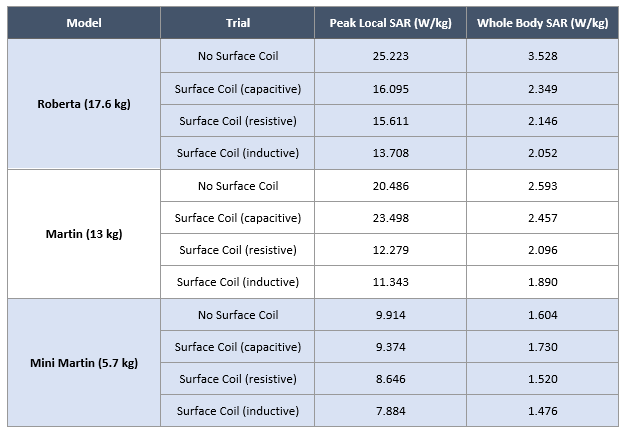
Figure 1: Whole-body and local SAR (averaged over 10 g) in every simulation case for all three pediatric body models. A clear trend of SAR reduction in the presence of a surface coil with inductive blocking is noted. We hypothesize that stray capacitance from coil overlaps may result in large circulating currents across the array. The inductive blocking case may be beneficial due to the effect of lowering this induced current, which has direct implications for local SAR.
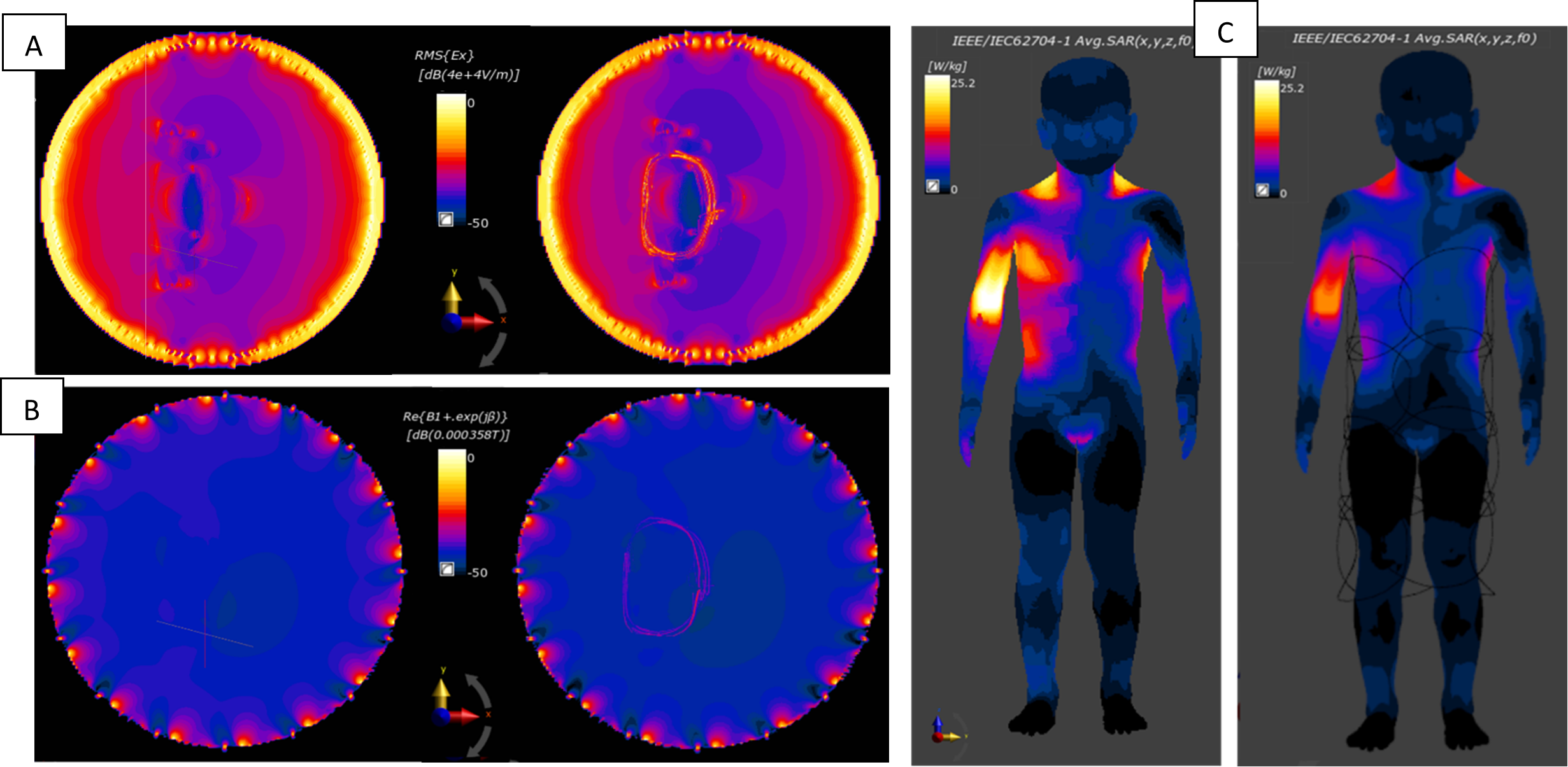
Figure 2. Simulation results comparing no-surface-coil to a wrapped flexible surface coil with resistive blocking impedance. E-fields [A] for the case without the coil [left] and with the coil [right]. B-fields [B] for the case without the coil [left] and with the coil [right]. Local SAR [C] for the case without the coil [left] and with the coil [right].
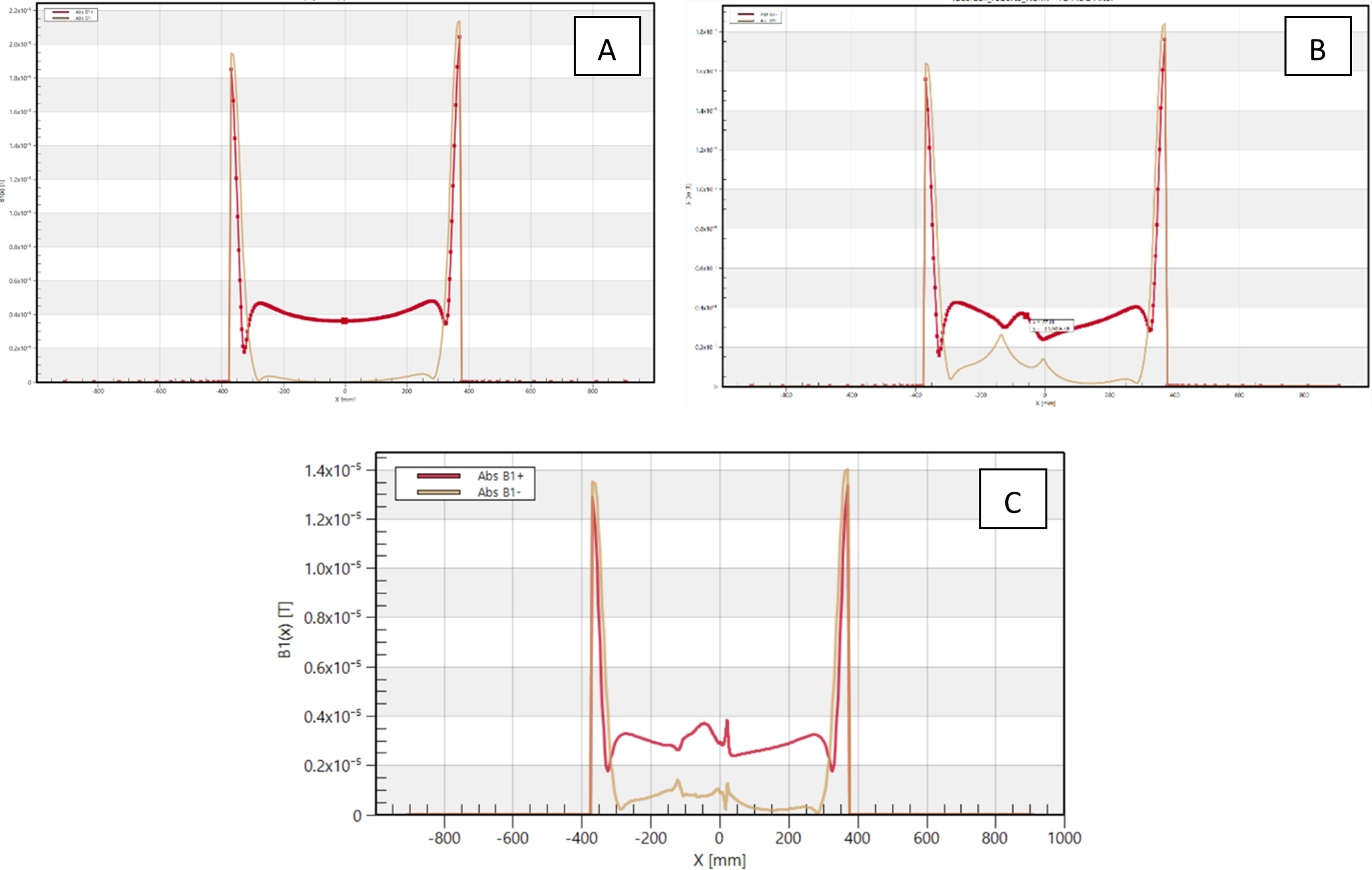
Figure 3. 1-D plots of B+ (red) and B-(yellow) field distributions along the x-axis for the empty transmit coil [A], the transmit coil containing only Roberta [B], and the transmit coil containing Roberta wrapped in a flexible surface coil with purely resistive blocking impedance [C].
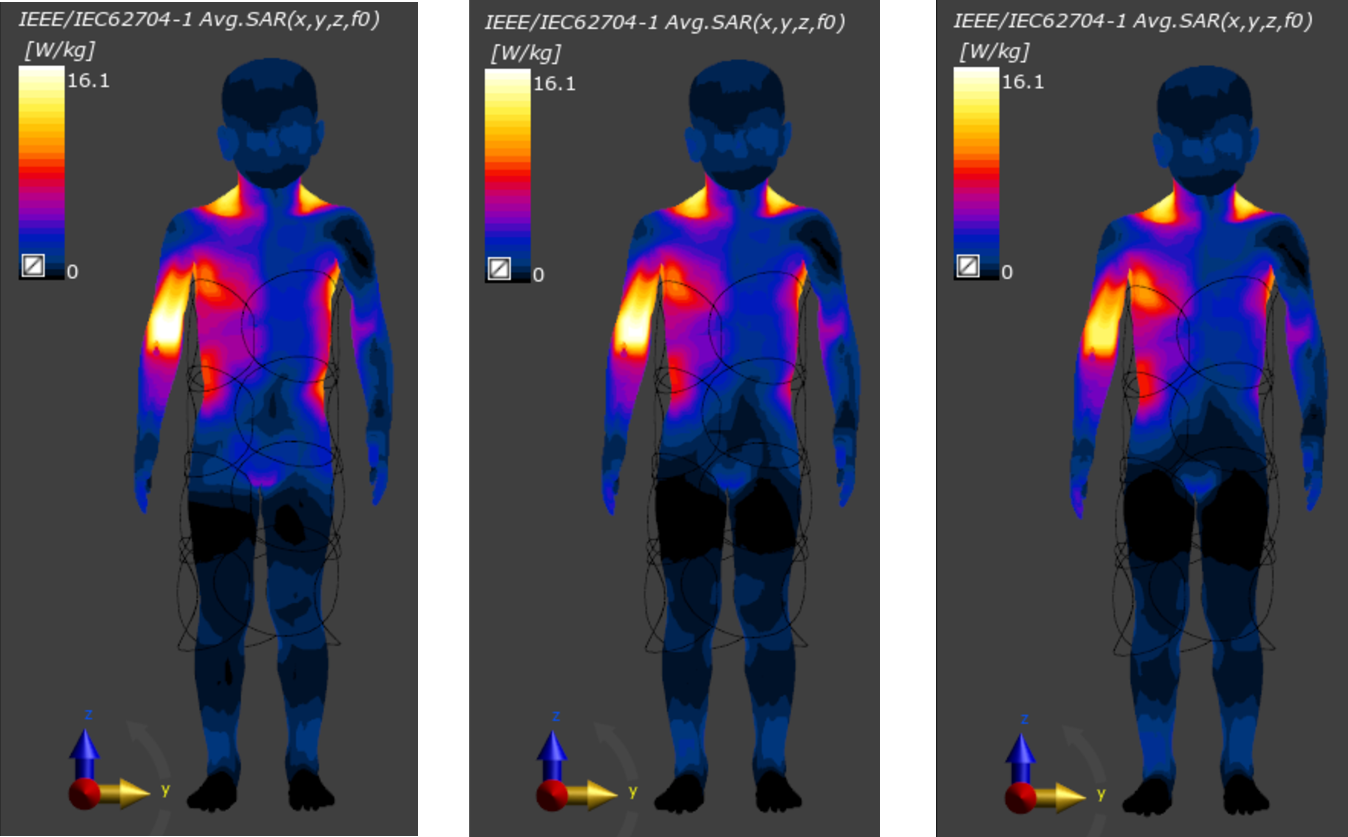
Figure 4. local SAR (averaged over 10g) for Roberta wrapped in a flexible surface coil with capacitive [left], purely resistive [center], and inductive [right] blocking impedance representation.