3735
Heat and torque minimization for designing brain shim coil translated from Stream Function1Advance Imaging Research Center, University of Texas Southwestern Medical Center, Dallas, TX, United States
Synopsis
Keywords: Shims, Shims, High-Field MRI, Simulations, Safety, New Devices
Motivation: The safety concerns of heating and torque in ultra-high field MRI easily become a problem in implementing local devices. As our designed brain shim coil with dense wire pattern can improve the B0 homogeneity significantly, it is important to ensure safety before utilization.
Goal(s): The study aims to minimize the power dissipation and torque in the designed shim coil.
Approach: The study introduced regularization for power dissipation and torque, employs the wire interpolation method to enhance power efficiency, and simulates the impact of varying the number of turns in shim coils.
Results: We found the optimal design parameters balancing safety and performance.
Impact: We introduced a series of methods to design a safe and efficient shim coil for the brain in ultra-high field. The torque and heat results provide insight into the performance of the local shim coil.
Introduction
The application of B0 shimming is essential for enhancing the B0 field homogeneity at 7 T. In previous work, we described a human brain B0 shim coil with a high-density wire pattern translated from Stream Function1. However, heating and torque are important safety concerns to consider during the design phase for B0 shim coils at ultra-high field MRI2. The primary aim of this research is to minimize power dissipation and torque during the B0 shim coil design and application phases.Methods
We utilized Stream Function theory3 to design B0 shim coil wire pattern. The power dissipation is expressed as $$$P(\varphi)=\frac{1}{\sigma d}\int \|J(\varphi)\|_2^2 \,dS$$$, and torque is expressed as $$$\tau(\varphi)=B_0\int r\times (J\times e_z)\,dS$$$. $$$\varphi$$$ is the Stream Function and $$$J$$$ is the current density.Firstly, we added regularization terms for power dissipation and torque to the Stream Function optimization problem. $$\min_{\varphi} \sum_{i=1}^{N_{target}} \|B_z(\varphi,r)+B_z^i (r)\|_2^2,\ s.t.\ P(\varphi)\leq P_{max},\ \tau(\varphi)\leq\tau_{max}$$
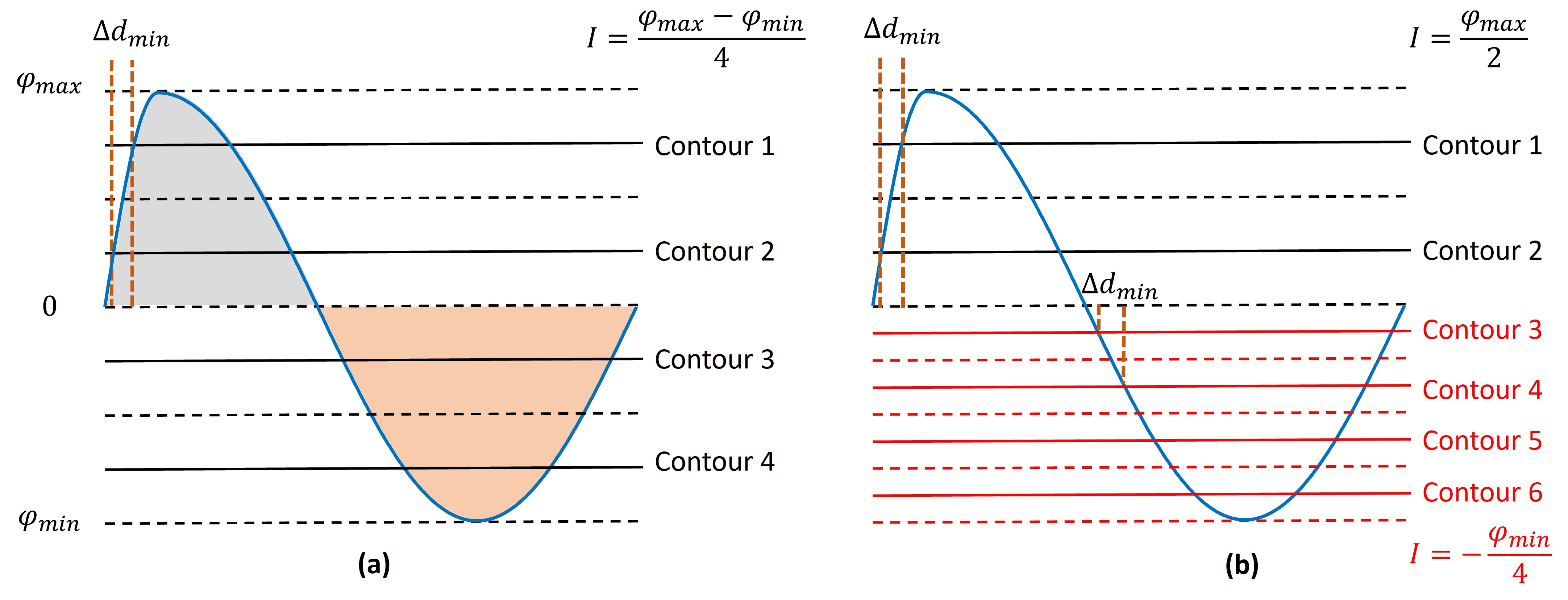
Secondly, we introduced the wire interpolation method to improve shim coil power efficiency. Previously, the wire pattern was discretized from the whole Stream Function, and the contour levels and hence distance between adjacent wires were chosen based on the steepest region in Stream Function to satisfy the minimum coil distance requirement (Fig 1(a)). However, the insufficient wire density in gentle slope regions caused high current input and low power efficiency. Here, we discretized the Stream Function separately to generate a dense wire pattern in gentle slope regions (Fig 1(b)). This method can reduce current input for the same magnetic field strength, thus minimizing power dissipation.
The third method involves increasing the number of turns $$$N_{turn}$$$ of the shim coil. Based on the Biot-Savart law, this reduces the required current input for a given magnetic field strength. Theoretically, the power dissipation decreases proportionally, and the torque slightly increases as the force radius increases. However, because the inductance and manufacturing complexity increase with $$$N_{turn}$$$, we aimed to find the optimal number of turns regarding power, heat, and practical implementation.
We also added regularization over torque and power dissipation when calculating the current input for the given B0 map $$$B_z^i$$$.
$$\min_{I_m} \|B_z^i+\sum_{m=1}^M I_m B_m\|_2^2+\lambda_p \sum_{m=1}^M I_m^2 R_m + \lambda_{\tau} \sum_{m=1}^M \tau_m I_m,\ s.t.\ \max|I_m|\leq I_{max}$$
Result and Discussion
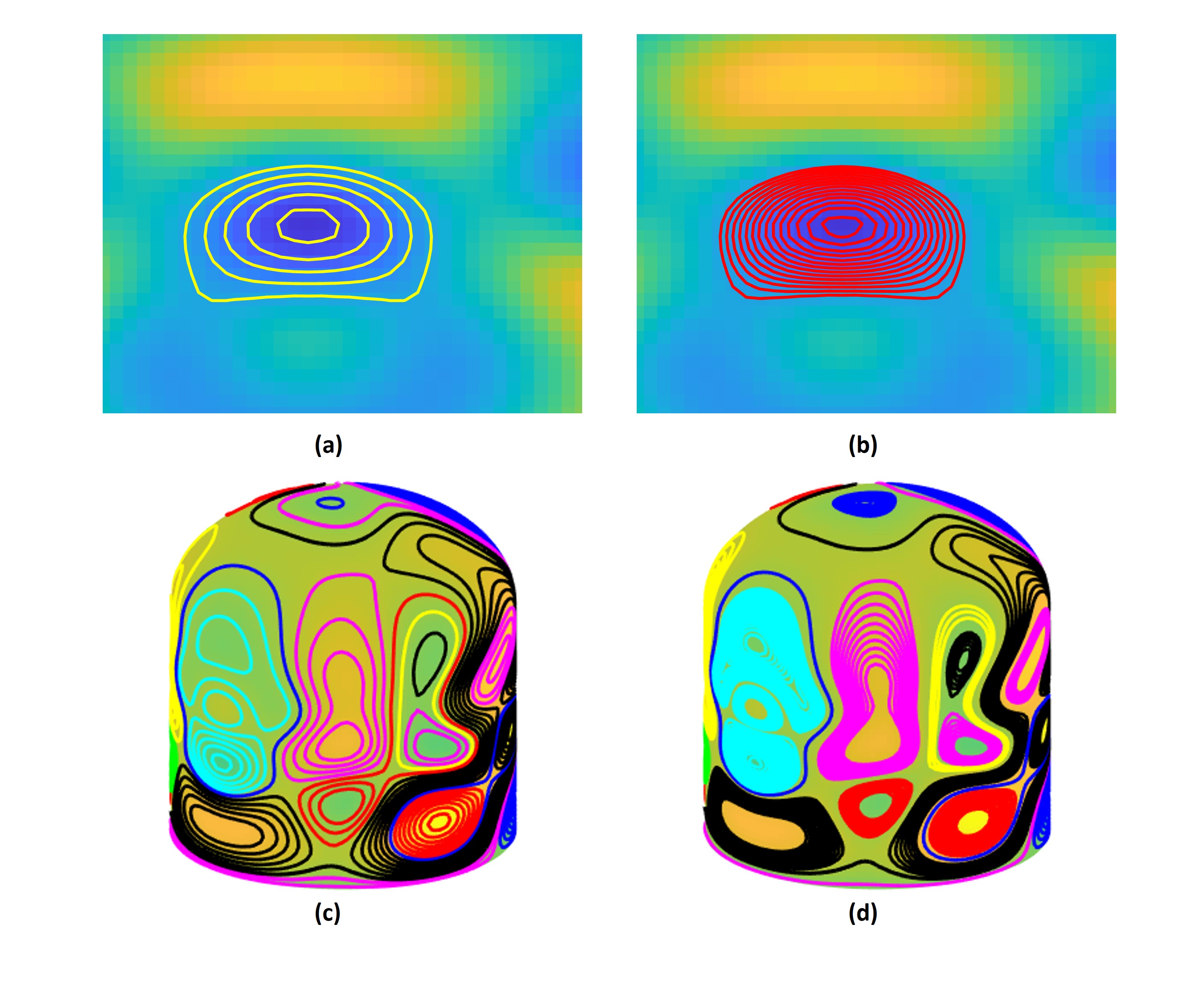
After applying torque minimization to Stream Function optimization, we decreased the total net torque from 34.60 Nm to 11.25 Nm, with the shim effect compromised only by 3.3%. One thing that should be noted here is that achieving a torque-balanced coil in gradient coil design4 is easier as it has only one physical channel. In contrast, for B0 shim coil design, the Stream Function is translated to over 20 channels with different current inputs making zero net torque challenging.After wire interpolation method (Figure 2), with the same input, the power dissipation decreased by 33.47% and the shim effect even increases by 4.46%. These data suggest that wire interpolation can increase power efficiency while preserving or even enhancing the shim effect.
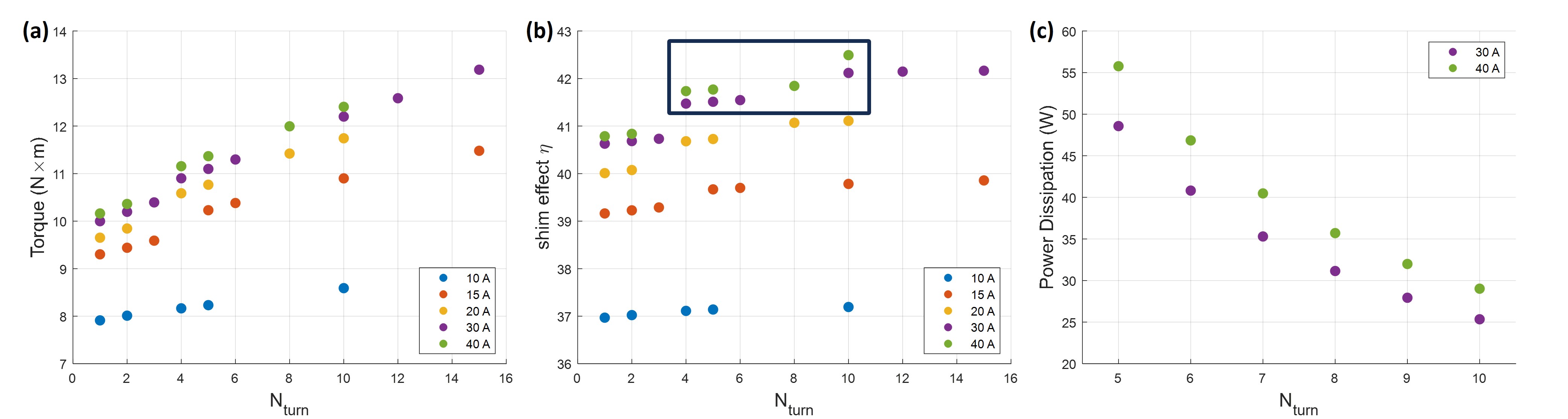
We simulated the shim performance with different numbers of turns (1-15 turns), with equivalent current input $$$I_e = 10 - 40 A$$$ per channel, and the actual input per channel $$$I=\frac{I_e}{N_{turn}}$$$. The total net torque increases linearly with $$$N_{turns}$$$ (Fig.3(a)). The calculated shim effects increase with $$$I_e$$$, but $$$N_{turn}$$$ doesn't affect the shim effect, and when $$$I_e\geq 30 A$$$, the shim effect becomes stable (Fig.3(b)). We found that $$$N_{turn} = 5- 10$$$ can achieve a low torque without compromising shim effect. The power dissipation decreases by half from 5 to 10 turns, while the torque only increases by 9% (Fig 3(c)). Therefore, we select $$$N_{turn} = 10$$$, with 3-4 A input per channel for future coil manufacturing.
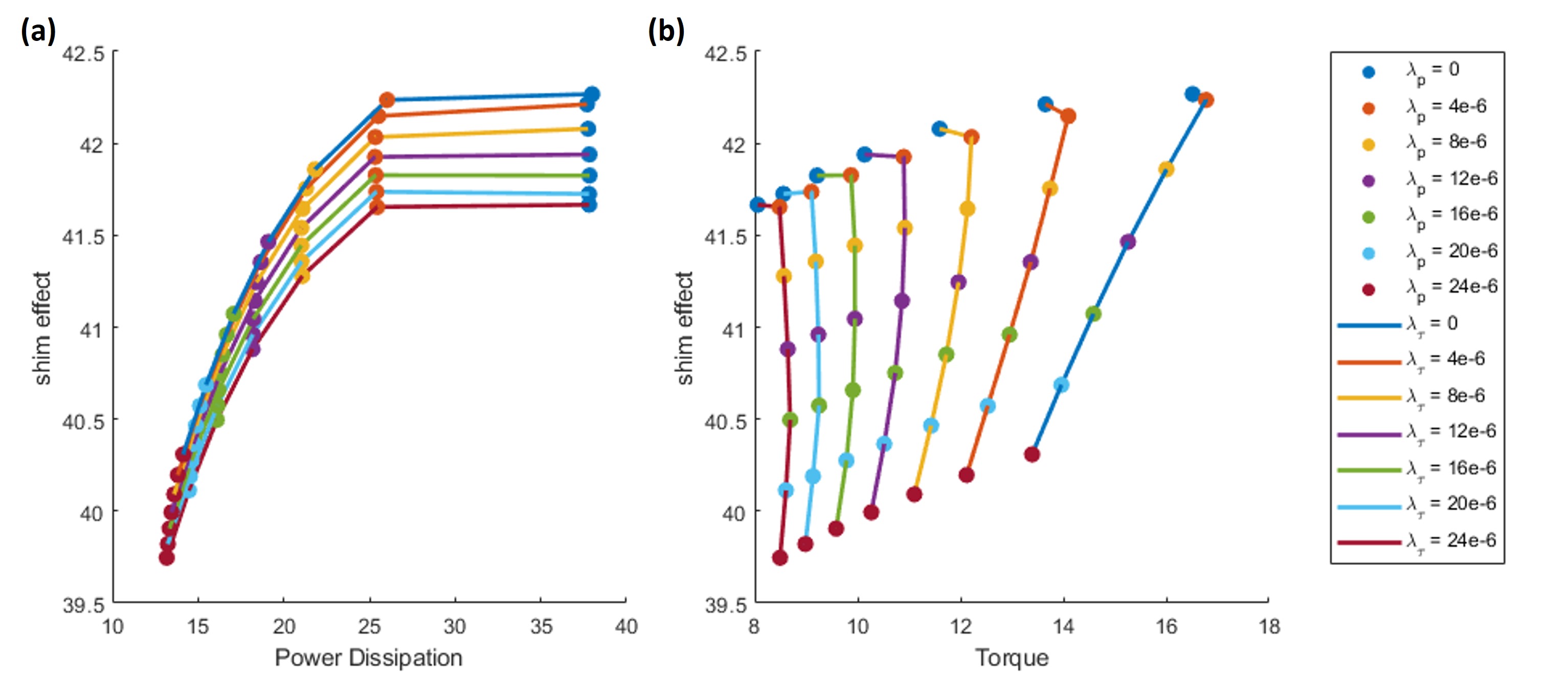
We simulated different regularization parameters on power dissipation $$$\lambda_p$$$ and torque $$$\lambda_\tau$$$. With $$$\lambda_p,\ \lambda_\tau$$$ increase, both power dissipation and torque decrease. The power dissipation decreases by 34% with a minor impact on shim effect when $$$\lambda_p = 4e^{-6}$$$ (Fig.4(a)). The torque regularization shows a less significant penalty on shim effect (Fig.4(b)), therefore $$$\lambda_\tau$$$ can be selected based on future practical experience.
With all methods above, we can achieve an average power dissipation of 25.32 W (SD: 11.87 W-37.88 W), and average torque of 10.90 Nm (SD: 4.86 Nm-16.89 Nm) in simulation.
Conclusion
This research addresses safety concerns related to heat dissipation and torque in ultra-high field MRI B0 shim coil design. The utilization of wire interpolation, optimization of the number of turns, and application of regularization for power dissipation and torque collectively contribute to an efficient B0 shim coil design. They provide a basis for further research in the field of MRI shim coil design.Acknowledgements
This work was performed in the Advance Imaging Research Center at University of Texas Southwestern Medical center Dallas. This work was supported by Cancer Prevention and Research Institute of Texas (CPRIT) grant / RR180056.References
1. Su S, Henning A. Design of human brain shim coil with high-density wire pattern translated from Stream Function. Paper presented at: Proc. Intl. Soc. Mag. Reson. Med. 312023.
2. Dula AN, Virostko J, Shellock FG. Assessment of MRI issues at 7 T for 28 implants and other objects. American Journal of Roentgenology. 2014;202(2):401-405.
3. Peeren GN. Stream function approach for determining optimal surface currents. Journal of Computational Physics. 2003;191(1):305-321.
4. Alsop DC, Connick TJ. Optimization of torque‐balanced asymmetric head gradient coils. Magnetic resonance in medicine. 1996;35(6):875-886.
Figures