3733
A new hybrid non-clustering VOP compression algorithm1Medical Physics in Radiology, German Cancer Research Center (DKFZ), Heidelberg, Germany, 2Faculty of Physics and Astronomy, University of Heidelberg, Heidelberg, Germany, 3Faculty of Medicine, University of Heidelberg, Heidelberg, Germany
Synopsis
Keywords: Safety, Safety, VOP, SAR
Motivation: Compression of SAR matrices can take very long for large data sets and large channel counts when using non-clustering algorithms that show the highest compression efficiency.
Goal(s): The goal of this study was to develop an algorithm that performs the compression faster while maintaining the compression efficiency.
Approach: We use a hybrid method that combines different algorithms to form a hybrid algorithm with greatly increased calculation speed.
Results: The new compression algorithm outperforms the older non-clustering compression algorithms at all VOP counts while maintaining the compression efficiency.
Impact: VOP compression is important for local SAR supervision and constraint pulse calculation in parallel transmission. We propose a new algorithm for non-clustered compression that greatly increases calculation speed, which is important especially at large channel counts.
Introduction
Parallel transmission (pTx) is a powerful tool in MRI. At ultra-high field, pTx even is a necessity to achieve homogenous excitation. To stay within the specific absorption rate (SAR) limits set by the guidelines1, it is necessary to calculate the maximum local SAR at any time point during an MRI experiment, which is a function of the complex excitation vector b(t), containing the amplitudes and phases for all channels. Multiplying this vector with SAR matrices yields the SAR value for the averaging volumes for which these matrices are specified. Since these matrices, which are derived from simulations, can number in the millions, compression algorithms are necessary to reduce their number and allow for fast SAR calculations in pulse calculation and online supervision. For this purpose, the virtual observation point (VOP) formalism was presented by Eichfelder and Gebhardt2, where the number of SAR matrices is traded for overestimation by a clustering algorithm. A new criterion for jointly upper bounding the SAR matrices for compression was introduced by Lee et al.3 (CC), and the corresponding non clustering algorithm was improved in terms of speed and compression through an iterative approach (iCC) by Orzada et al.4. Recently, Gras et al. introduced a new criterion (CO) that is much faster than CC for large numbers of VOPs and, when used iteratively (iCO), is faster than iCC, while achieving the same compression5. In this work we present a hybrid approach combining the two criteria to make VOP compression even faster.Methods
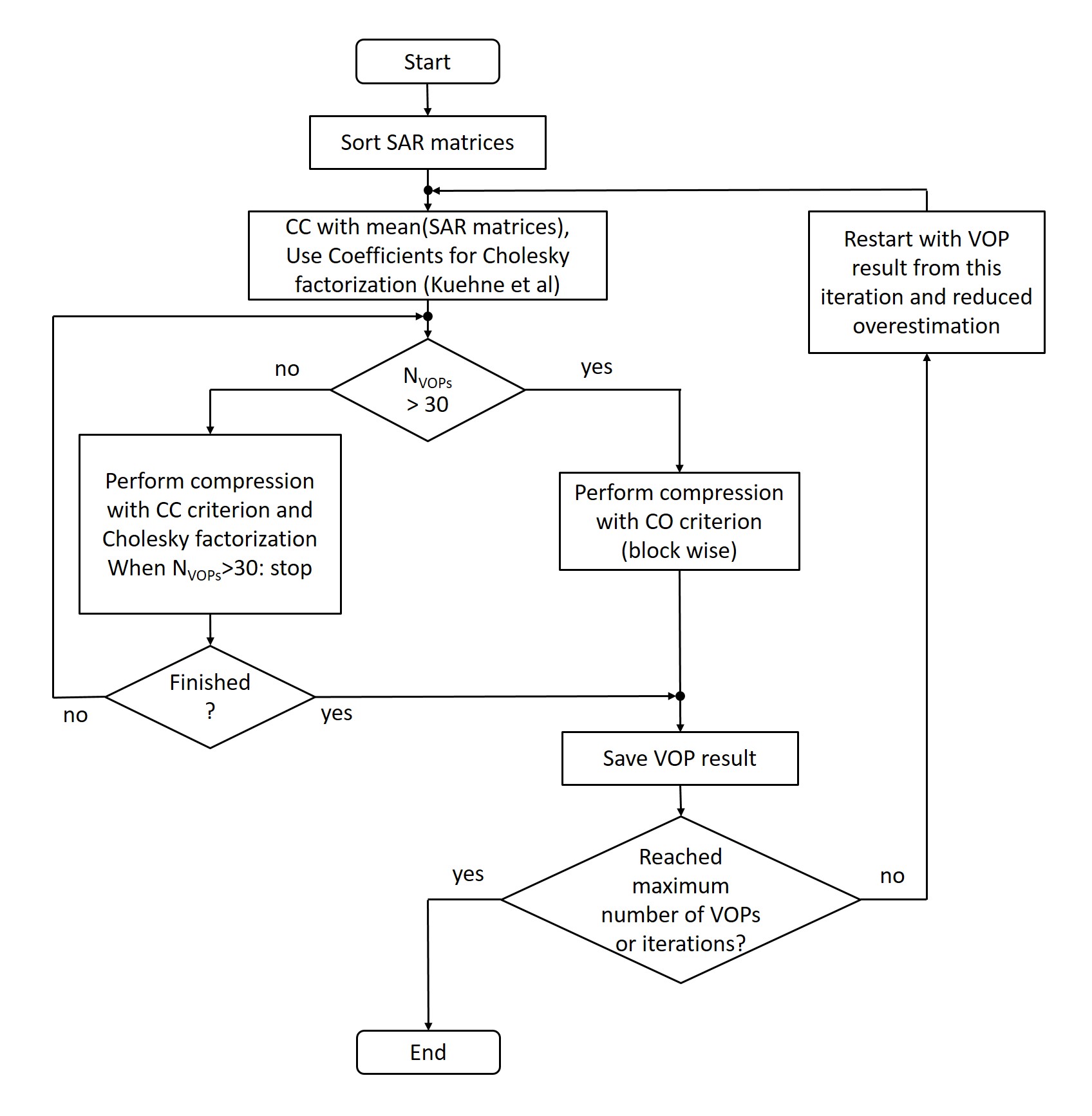
The proposed compression algorithm (Figure 1) uses the iterative approach as proposed by Orzada et al. As long as the number of VOPs stays below 30, the iCC approach is used. As soon as 30 VOPs are reached, the CO criterion is used to check for upper boundedness, except for the first step in each iteration, where the CC criterion is used with the goal of upper bounding the mean of all SAR matrices. The resulting coefficients are then used for Kuehne et al.’s speed enhancement6 to upper bound a large proportion of the SAR matrices. Furthermore, in difference to the code published by Gras et al., the CO criterion is checked in small blocks of a few matrices and a new VOP is added as soon as it is found, thereby reducing multiple checks of the same matrices.The algorithm was implemented in Matlab and run on a virtual workstation with 40 CPU cores and one half of an Nvidia A100 GPU. iCC and iCO implementations were taken from the respective open-source repositories as provided by the respective papers4,5.
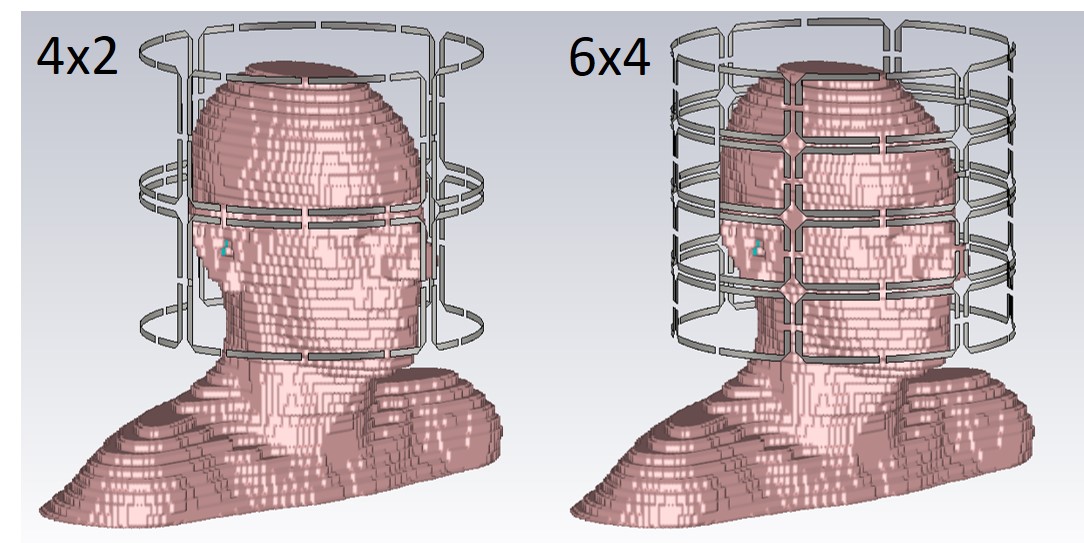
To compare the three algorithms (iCC, iCO and Hybrid), SAR matrices of two simulated head coils with 8 (4 by 2) and 24 (6 by 4) loops were used (Figure 2). The sets contained about 1.78 and 1.87 million SAR matrices, respectively. The reduction factor of the overestimation for the iterative compression was set to the square root of 2, and the starting point for the overestimation was 40% of the worst-case SAR 4.
Results
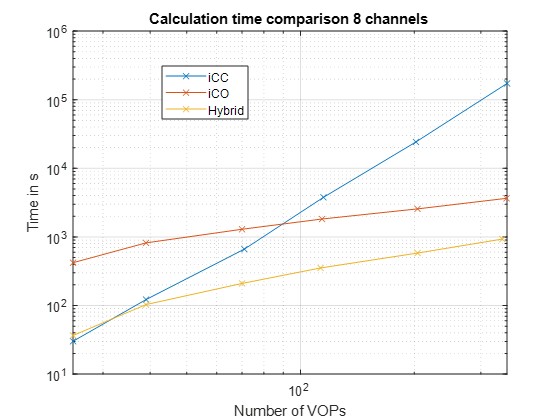
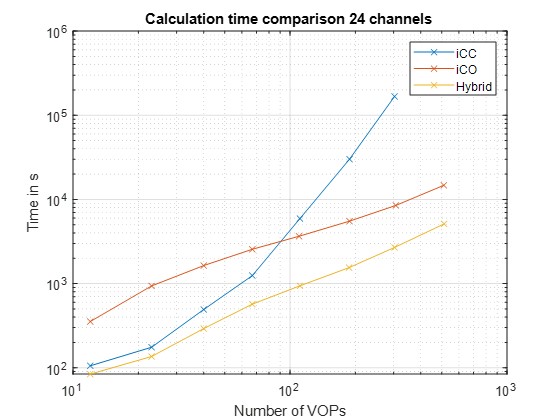
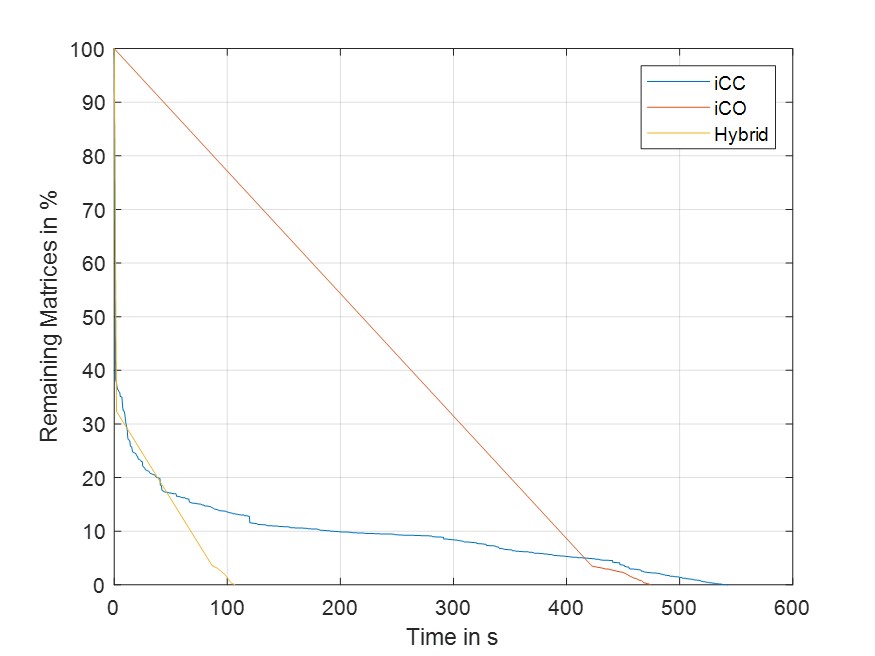
Figures 3 and 4 show the results in computation time for all three algorithms for the two respective arrays. As shown by Gras et al., the iCO algorithm outperforms the iCC algorithm for large numbers of VOPs. For low VOP counts, the iCC algorithm outperforms the iCO algorithm. The Hybrid algorithm outperforms both algorithms as soon as the number of VOPs exceeds 30.Figure 5 shows the number of remaining matrices in the iteration step finishing with ~70 VOPs for the 8-channel array. It is visible that the first calculations in the Hybrid and CC algorithms quickly find upper boundedness of a large portion of the matrices, but then, the CC criterion is slow to check all the other matrices. Furthermore, it is visible that the block-wise checks of the CO criterion are faster than checking all remaining matrices as proposed by Gras et al.
Discussion
VOP compression is important for efficient safety supervision and pulse calculation with SAR constraints. Compared to the other non-clustering algorithms in the literature, the presented algorithm performs identically in terms of compression efficiency, while outperforming both algorithms in terms of computation speed. Although compression usually is not time critical, compression of large data sets (several high resolution body models) with very high channel count (>16) can take several days, and reduced calculation time is appreciated.Conclusion
We present an algorithm that outperforms the non-clustering SAR compression algorithms by at least a factor of 2.5 in calculation speed while retaining compression efficiency.Acknowledgements
This work has received funding from the European Union’s Horizon Europe Programme under project 101078393 / MRItwins.References
- IEC, International Electrotechnical Commission (IEC). IEC 60601-2-33 Medical Electrical Equipment - Part 2-33: Particular Requirements for the Basic Safety and Essential Performance. Edition 3.2. 2015.
- Eichfelder, G. and M. Gebhardt, Local specific absorption rate control for parallel transmission by virtual observation points. Magn Reson Med, 2011. 66(5): p. 1468-76.
- Lee, J., et al., Local SAR in parallel transmission pulse design. Magn Reson Med, 2012. 67(6): p. 1566-78.
- Orzada, S., et al., Local SAR compression algorithm with improved compression, speed, and flexibility. Magn Reson Med, 2021. 86(1): p. 561-568.
- Gras, V., et al., A mathematical analysis of clustering-free local SAR compression algorithms for MRI safety in parallel transmission. IEEE Trans Med Imaging, 2023. PP.
- Kuehne, A., H. Waiczies, and T. Niendorf, Massively accelerated VOP compression for population-scale RF safety models. Proc. Intl. Soc. Mag. Reson. Med. 26, 2017: p. 478.
Figures