3730
Investigation of Radiofrequency-induced Heating of Abandoned Cardiac Lead Wire with Conductive Caps of Different Electrical Conductivities1Human and Information Science, Tokai University, Kanagawa, Japan, 2BioView, Inc., Tokyo, Japan
Synopsis
Keywords: Safety, Safety
Motivation: To reduce radiofrequency (RF)-induced heating of abandoned implantable cardiac leads equipped with plastic caps, which remarkably increase heat generation around the lead tip.
Goal(s): RF-induced heating with various electrical property of the cap was investigated to find optimal condition.
Approach: Tissue heating around the lead wire with caps of electrical conductivity ranging over 10-6 to 10+6 S/m were compared in the ASTM phantom model by FDTD simulation, and validated by experiments.
Results: Tissue heating around the lead tip clearly decreased and became similar to the uncapped case, when the conductivity was higher than 10-1 S/m, which was approximately the same as the media.
Impact: Simulations and experiments on abandoned cardiac leads revealed that the "electrically conductive cap" dramatically reduces RF-induced heating around the lead tip. Such cap may protect the lead from body fluid infiltration into the insulation material while also contribute to MR-safety.
Introduction
Application cases of magnetic resonance imaging (MRI) for patient with implantable medical device (IMD) are recently increasing1. It is important for understanding of electromagnetic interference between MRI and IMD, in particular that induces tissue heating by radiofrequency (RF) electromagnetic (EM) wave of MRI, called as RF-induced heating. It has reported that the capped cardiac abandoned lead generates heat more than the uncapped lead2,3; however, the plastic cap is needed to prevent the infiltration of body fluid into the connector of the lead. Because the high heating around the tip of the capped lead is caused by the concentration of the electrical current to the one-sided bare part of the lead, it is expected to reduce the heating by scattering the current on the both sides of the lead tip. In this study, to reduce the heat generation by the capped abandoned cardiac lead, the RF-induced tissue heating around the lead in the absence/presence of the cap with different electrical conductivity immersed in the ASTM phantom has been investigated using EM field simulation.Methods
EM simulation was performed using finite elements time domain (FDTD) method on commercial software (Sim4Life, Zurich Med Tech AG, Zurich, Switzerland). Figure 1 shows the simulation model of RF system. The RF magnetic field at 64 MHz of 1.5-T MRI was generated by lowpass-typed 8-elements birdcage coil. The B1+ at the isocenter was scaled to 1 µT. Figure 2 presents models of the lead and cap including the dimensions. The cap was equipped on the one-sided bare part of the lead. The electrical conductivity and relative permittivity of the models are shown in Fig. 2. The cap conductivity was set to 0 S/m, assuming a typical plastic, and ranging over 10-6 to 10+6 S/m. The lead was immersed in polyacrylic acid gel of ASTM phantom denoted in ASTM F21824. Local specific absorption rate (SAR) was defined as SAR averaged in 1 mm3 cubic region.Results
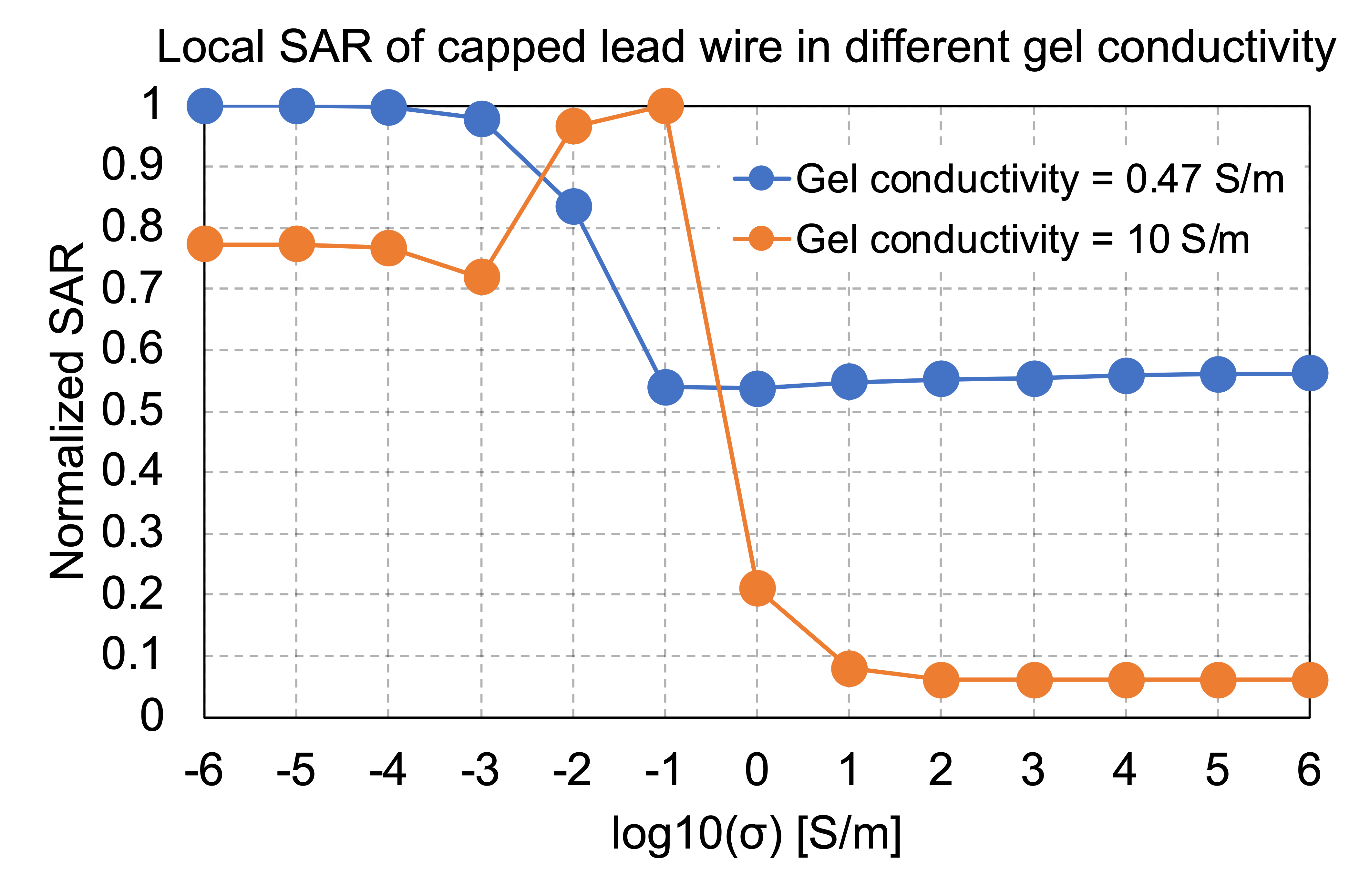
Figure 3 exhibited the SAR distributions around the lead wire without the cap, with the plastic cap, and with the electrically conductive cap. The local SAR around the lead with the conductive cap was lower than that with the plastic cap, which the SAR was similar to the uncapped case. The local SAR around the tip of the lead wire with and without the cap was summarized in Fig. 4. The local SAR in the conductive cap was dramatically dropped around the electrical conductivity of 10-1 S/m, which was almost the same as the conductivity of the phantom gel. The additional analysis to compare the heat generation by the conductivities between the gel and the conductive cap was performed that the local SAR around the capped lead in the gel with different electrical conductivities was calculated as shown Fig. 5. The local SAR in the gel conductivity of 10 S/m was dropped at the relatively high conductivity of the cap compared with in the gel conductivity of 0.47 S/m.Discussion
The EM simulations demonstrated the MRI RF-induced heating around the abandoned cardiac lead without and with the cap which has different electrical conductivity. The results may provide a means to avoid the risk of the RF-induced tissue heating around the cardiac lead with the cap.The SAR around the lead without and with the cap of the different electrical conductivities was calculated in this study. The local SAR with the plastic cap was higher than that without the cap, which was the similar observation in previous reports2-3. Meanwhile, the local SAR in the electrically conductive capped case was clearly decreased since the electrical current was scattered on the both ends of the lead. It indicates that the RF-induced tissue heating around the lead tip is reduced by using the electrically conductive cap. In addition, the local SAR in the gel of the different electrical conductivities was analyzed, which exhibited that the trend of the SAR decrease changed. These results suggest that the decrease of the local SAR with the electrically conductive cap may be caused according to the impedance between the gel and the cap. This indicates that the RF-induced heating around the lead wire can be reduced by considering the electrical properties of the cap and tissue around the IMD.
Conclusion
The MRI RF-induced tissue heating around the lead wire in absence/presence of the cap as well as with the different electrical conductivity was investigated. The heating by the plastic cap may be reduced by rising the electrical conductivity of the cap, in particular to be almost the same as that of tissue around IMD.Acknowledgements
No acknowledgement found.References
1. Kanal E. Pacemakers in MRI for the Neuroradiologist: Revisited. Am J Neuroradiol. 2018 May;39(5):54-55.
2. Mattei E, Gentili G, Censi F, Triventi M, Calcagnini G. Impact of capped and uncapped abandoned leads on the heating of an MR-conditional pacemaker implant. Magn Reson Med. 2015 Jan;73(1):390-400
3. ASTM Standard F2182-19e2, 2020, " Standard Test Method for Measurement of Radio Frequency Induced Heating On or Near Passive Implants During Magnetic Resonance Imaging," ASTM International, West Conshohocken, PA, 2020, DOI: 10.1520/F2182-19E02, www.astm.org
Figures
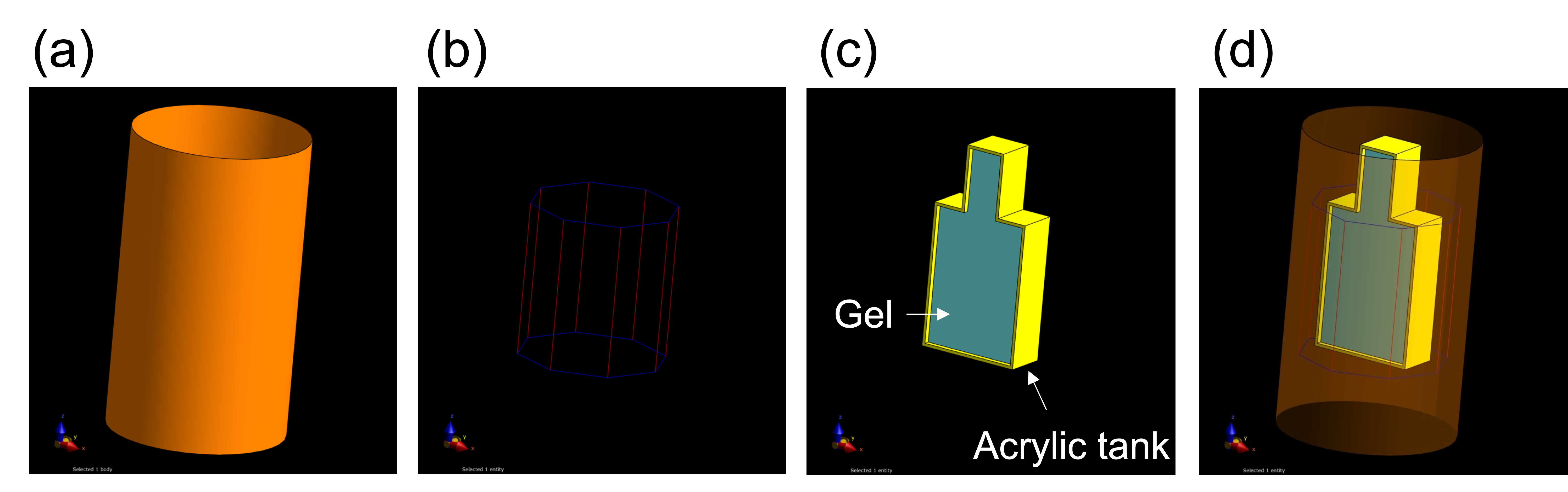
Figure 1: Simulation model of RF system. (a) MRI RF shield set to a perfect electric conductor. (b) Lowpass-typed 8-elements birdcage coil created by line elements to irradiate circular electromagnetic wave. Amplitude of B1+ was scaled to 1 µT. (c) Phantom designed in ASTM F2182 consisted of polyacrylic acid gel and acrylic tank which mimics human trunk and head. (d) The models (a-c) are combined and simulated RF field in the phantom.
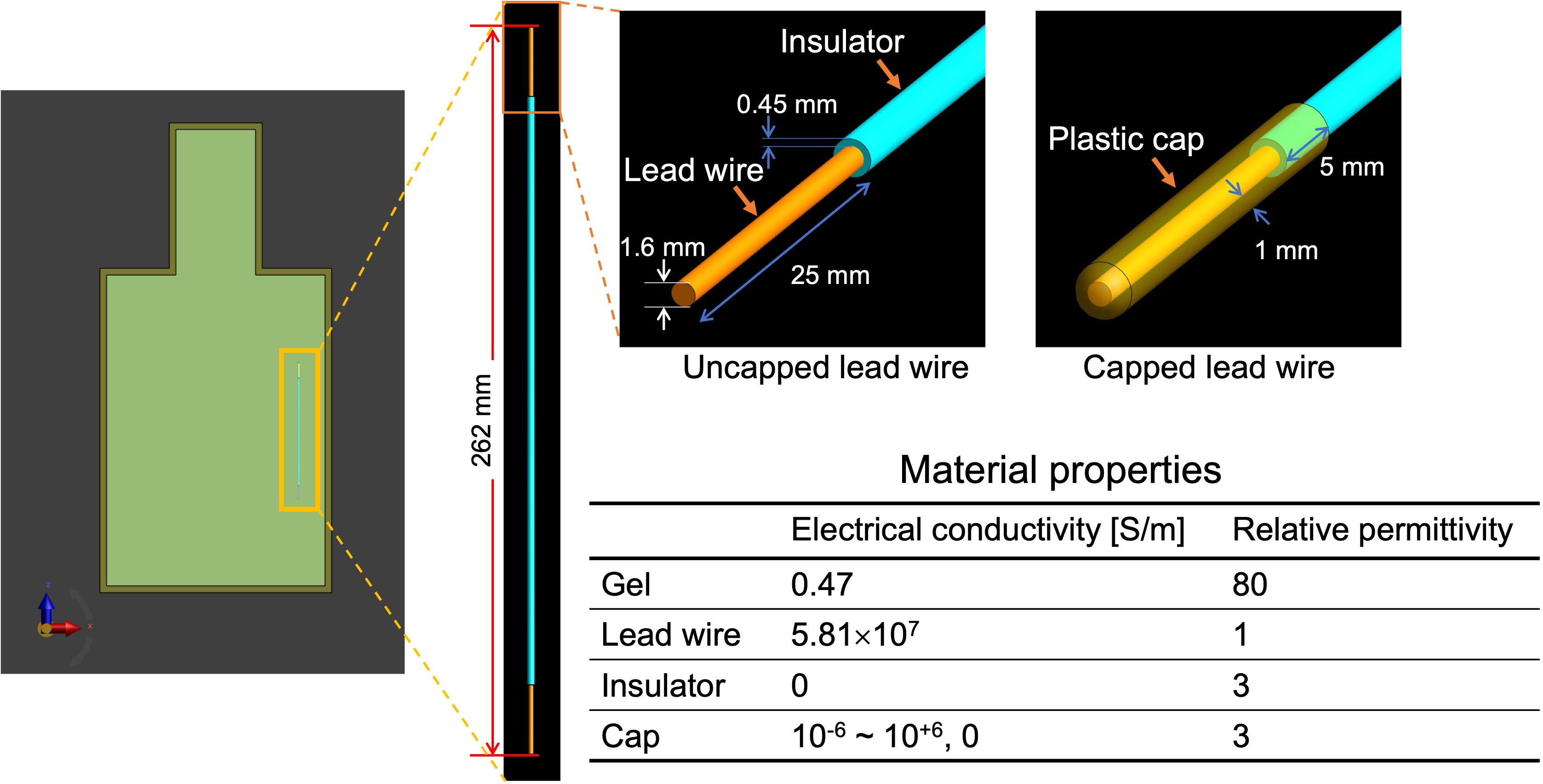
Figure 2: Lead wire model including the dimensions and its material properties. The lead wire model was placed in the side part of the body. The plastic cap was equipped on the one-sided bare part of the lead wire, while it was overlapped on the insulator for 5 mm. Table in the bottom right in this figure indicates electrical conductivity and relative permittivity of the models. The electrical conductivity of the cap was set to 0 and between 10-6 and 10+6 S/m.
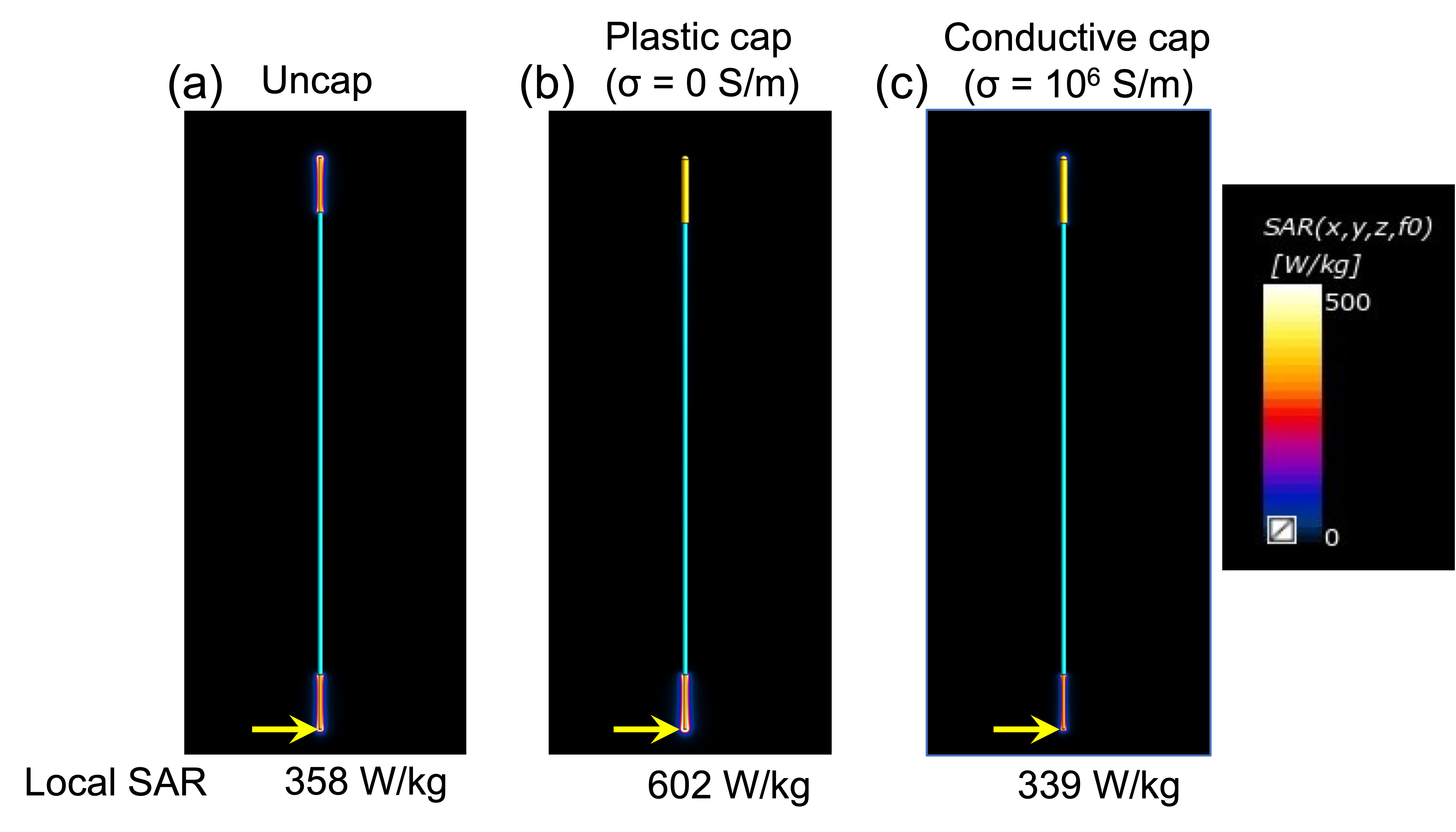
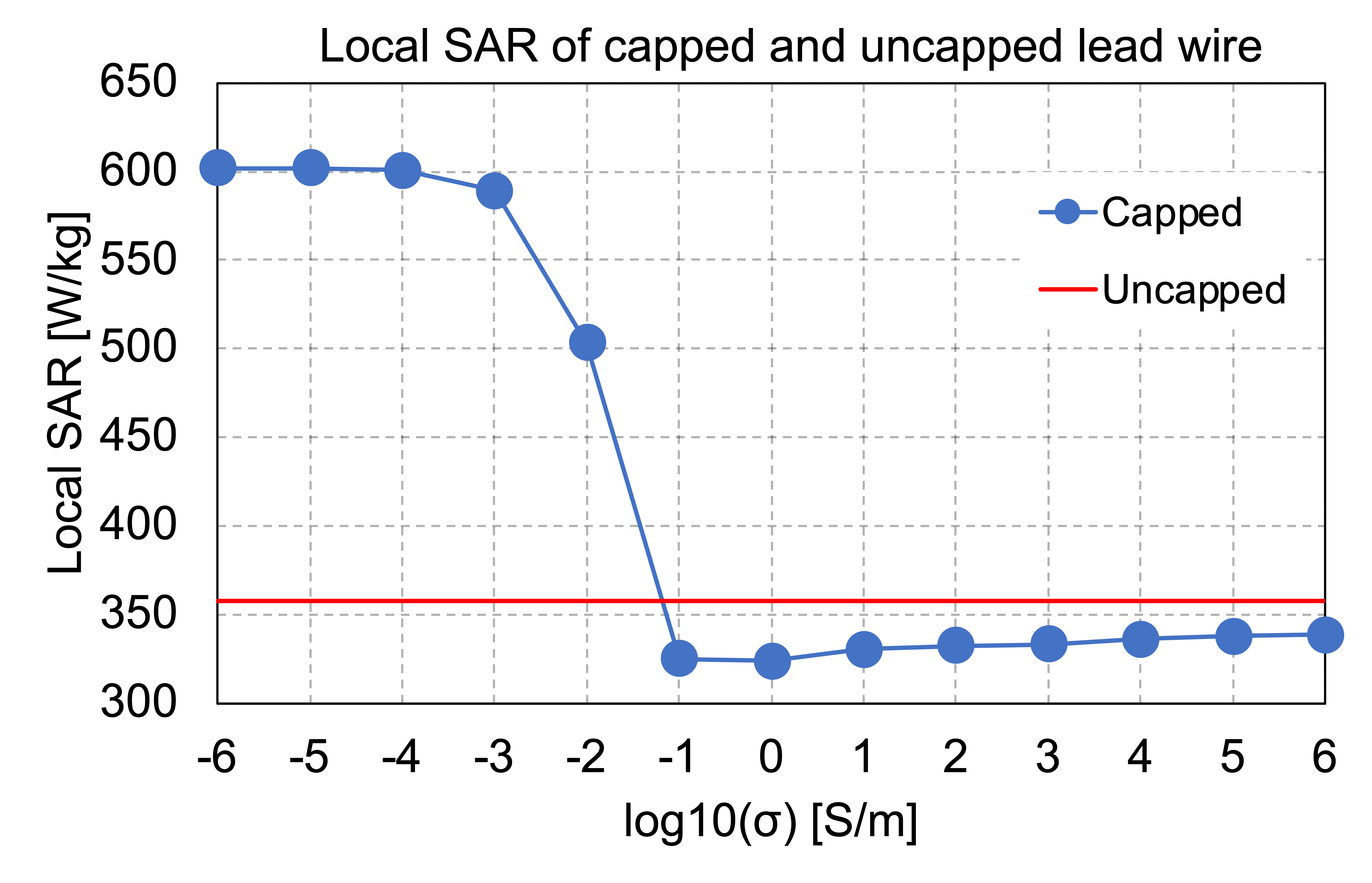
Figure 4: Local SAR of the tip of the lead wire without and with the electrically conductive cap. The horizontal axis is electrical conductivity scaled logarithmically. The horizontal red line is the local SAR of the uncapped lead wire. The local SAR was dropped at the electrical conductivity more than 10-1 S/m.